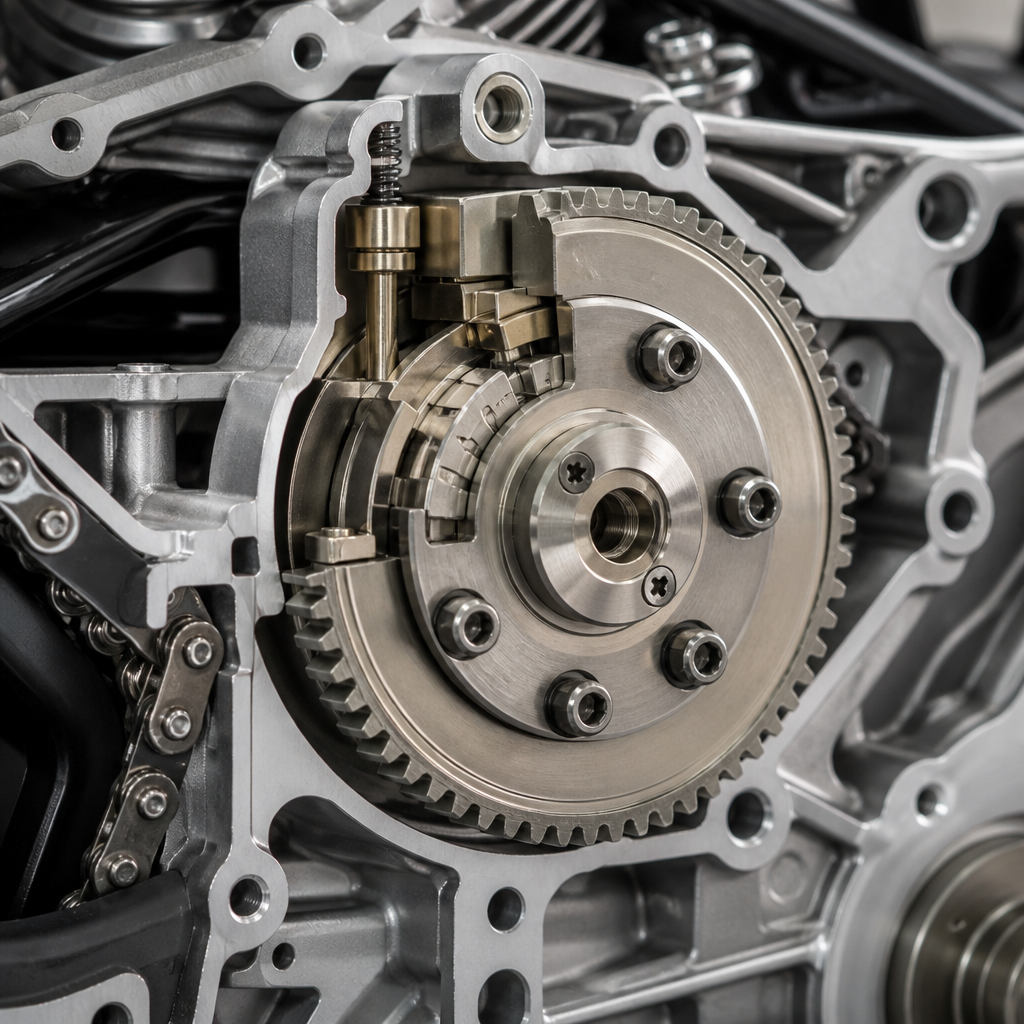
Variable valve timing changes when the intake and exhaust valves open and close, and on a large-displacement V-twin it can reshape torque, heat, idle quality, and emissions without changing the engine’s basic character. In the 2026 Harley-Davidson 117 VVT platform, the cam phaser is the key mechanical device that makes that timing change possible, rotating the cam relative to its drive so the engine can favor low-speed cylinder filling, midrange response, or high-load breathing as conditions change.
This matters because modern V-twin performance is no longer defined by displacement alone. Riders still want the heavy flywheel feel, broad torque curve, and distinct pulse of a 117 cubic-inch Harley-Davidson engine, but regulators demand cleaner exhaust, customers expect less heat at idle, and touring riders want stronger roll-on power across a wider rpm range. A well-executed VVT system addresses all three. I have worked with cam-timed V-twin builds where a fixed cam delivered either excellent bottom end or strong top-end pull, but not both; cam phasing is one of the few production-ready ways to widen that window without making the motorcycle harder to ride.
To understand the 2026 H-D 117 VVT cam phaser, start with the terms. “Cam phasing” means advancing or retarding the camshaft angle relative to the crankshaft. “Advance” generally opens and closes the valves earlier; “retard” does the opposite. “Variable valve timing” in this context does not usually change valve lift or duration at the lobe itself. Instead, it alters the whole valve event schedule by rotating the cam. The mechanism is mechanical-hydraulic in operation and electronically commanded, using engine oil pressure, a controlled actuator path, and position feedback to place the cam where the calibration wants it.
As a hub for V-Twin Performance and Mechanics, this article explains the phaser itself, how it works inside the 2026 117 VVT engine, what changes it makes to combustion behavior, how it affects torque and rideability, what can fail, and how this topic connects to camshaft design, oil control, tuning strategy, and thermal management across the Harley-Davidson lineup.
What the 2026 H-D 117 VVT cam phaser is mechanically
The cam phaser on the 2026 Harley-Davidson 117 VVT engine is a rotational indexing device mounted at the cam drive interface. Its job is simple in concept: hold the cam in a default angular relationship during some operating conditions, then rotate it a controlled number of crank-angle degrees when commanded. In practice, it is a compact assembly made of a housing, rotor, vane chambers or equivalent hydraulic cavities, locking features, oil passages, sealing surfaces, and a controlled feed system. The camshaft is connected to the rotor. The timing drive sprocket or gear is connected to the housing. By using oil pressure on one side or the other of the internal vanes, the system rotates the rotor relative to the housing.
That mechanical movement is small but significant. A few camshaft degrees can transform effective intake valve closing, overlap behavior, and trapped cylinder pressure. On a long-stroke V-twin, those changes are especially noticeable because the engine spends much of its life in low to moderate rpm, where volumetric efficiency is highly sensitive to valve timing. Earlier intake closing typically supports low-speed dynamic compression and torque; later intake closing can reduce pumping losses at light load and improve high-rpm breathing. The phaser gives the engine calibration team both options.
The design also has to survive Harley-Davidson realities: large combustion pulses, high oil temperatures, low-rpm lugging, and customers who expect durability over high mileage. That is why production phasers use positive mechanical stops, robust locking pins for start-up positioning, and oil-control strategies that prevent uncontrolled movement during cranking or low-pressure conditions. The phaser is not an abstract emissions part. It is a structural timing component that must hold position accurately while attached to a big-inch V-twin experiencing repeated torsional disturbances.
How oil pressure, control valves, and rotor motion change cam timing
In operation, the engine control module requests a target cam angle based on rpm, throttle, load, temperature, and emissions strategy. An oil control valve meters pressurized oil into advance or retard chambers within the phaser. When oil fills one chamber and evacuates the opposite chamber, hydraulic force acts on the rotor vanes, rotating the camshaft relative to the drive sprocket. A cam position sensor confirms the achieved angle, allowing closed-loop correction. This is the same control logic used in many automotive systems from suppliers such as BorgWarner, Schaeffler, and Aisin, adapted to motorcycle packaging and duty cycle constraints.
At cold start, many systems lock the cam in a parked position. That position is chosen for stable combustion, predictable cranking, and catalyst light-off. Once oil pressure rises and the control strategy permits movement, the locking pin releases and the phaser becomes active. At idle, the target may reduce overlap to improve combustion stability and lower reversion. During cruise, the target may shift to cut pumping losses and improve fuel economy. Under strong acceleration, the calibration can move the cam toward a torque-optimized point that improves cylinder filling without requiring a radical fixed cam profile.
The exact implementation on the 2026 117 VVT is important because Harley-Davidson engines package timing components differently than many overhead-cam automotive engines. Packaging space is tighter, the audible character of valvetrain components matters more to riders, and oil aeration control is critical in an engine that may see long highway operation in high ambient heat. For that reason, phaser response is typically tuned for repeatable, damped movement rather than extremely aggressive angle swings. Smooth, measured actuation is better for rider feel and timing stability.
| Operating condition | Typical cam phaser goal | Mechanical effect | Rider result |
|---|---|---|---|
| Cold start | Hold default locked position | Stable fixed cam angle during cranking | Easier starting and cleaner initial combustion |
| Idle | Limit overlap | Valve events shifted for steadier trapped charge | Smoother idle and less heat sensation |
| Low rpm roll-on | Advance toward torque target | Earlier intake event timing | Stronger response without downshifting |
| Midrange cruising | Optimize efficiency | Reduced pumping loss and better charge motion balance | Improved drivability and fuel economy |
| High load/high rpm | Retard as airflow needs rise | Later valve events support breathing | Broader pull near the top of the usable range |
Why cam phasing works so well on a large Harley-Davidson V-twin
The 117 cubic-inch Milwaukee-Eight architecture gives cam phasing a particularly useful job because the engine must satisfy conflicting requirements. A touring or performance-cruiser rider wants immediate torque at 2,000 to 3,500 rpm, where the bike spends most street miles. Emissions compliance, however, often pushes cam timing toward cleaner combustion and lower residual gases in some zones, while top-end horsepower wants airflow-biased timing at higher speed. With a fixed cam, engineers compromise. With VVT phasing, they can move the compromise point as the operating state changes.
On a V-twin, intake valve closing is one of the most influential events for how the engine feels. Close the intake too late at low rpm and some of the charge is pushed back as the piston rises, softening effective compression and torque. Close it too early at higher rpm and the cylinder cannot capitalize on inertia-driven filling. Cam phasing shifts that closing point. Because the 117 has substantial displacement per cylinder, even modest improvements in trapped mass produce obvious gains in roll-on acceleration and throttle connection.
There is also a thermal benefit. Engines that idle hot in traffic often suffer from combustion instability, residual dilution, and strategies that must protect exhaust aftertreatment. By controlling overlap and valve timing more precisely, VVT can reduce the conditions that make big air-cooled or partially oil-cooled twins unpleasant in stop-and-go use. Riders experience this not as an engineering diagram but as a bike that feels less ragged and less punishing when the weather is hot and the road is slow.
Connection to camshaft design, torque curve shaping, and tuning decisions
Cam phasing does not replace camshaft design; it changes how much one cam can accomplish. Lobe separation angle, duration at 0.050 inch, opening ramps, valve lift, and intake port velocity still define the engine’s character. What the phaser adds is the ability to shift those lobe events across part of the operating range. In practical terms, that means Harley-Davidson can use a cam profile that supports strong peak output yet retain street manners that would be difficult with a fixed relationship.
For tuners, this changes the old question of “Which cam do I pick?” into a wider systems question involving exhaust, intake tract, compression ratio, spark mapping, knock control, and oil behavior. A calibration that commands too much advance too early may improve dyno torque but create knock sensitivity on poor fuel. Too much retard at the wrong load point can raise exhaust gas temperature. That is why competent VVT tuning relies on logged cam angle, manifold pressure, cylinder head temperature, lambda behavior, and spark correction, not seat-of-the-pants impressions alone.
This hub article connects naturally to deeper articles on Harley-Davidson cam profiles, intake tuning, header scavenging, and ECU strategy. The phaser sits in the middle of all those topics. Change the exhaust backpressure curve and the best overlap target changes. Change compression and the preferred intake closing angle moves. Upgrade the oil pump or alter viscosity beyond specification and phaser response can change subtly. On modern V-twin performance work, the mechanical hardware and the calibration are inseparable.
Failure modes, diagnostics, and maintenance realities
Most cam phaser problems come from oil control, wear, contamination, or position tracking faults. Dirty oil can restrict the control valve or clog fine passages. Aerated oil can make phaser movement inconsistent. Worn internal seals can slow response or cause angle error. A sticking locking pin may create start-up noise or unstable cold operation. If commanded and actual cam positions diverge beyond a threshold, the control system can set a fault, reduce authority, or fall back to a default position. In rider terms, symptoms include rough idle, lazy throttle response, unusual mechanical noise, reduced fuel economy, or a check-engine light.
Good diagnostics start with basics. Verify oil level, viscosity, service interval history, and pressure behavior before blaming the phaser itself. Then inspect cam position data, actuator command, and correlation between crank and cam signals. On engines with variable timing, using the correct oil specification matters even more than riders often assume. Hydraulic timing devices are calibrated around known viscosity behavior across temperature. An oil that is too thick cold can delay response; one that shears excessively hot can reduce control stability.
For owners and technicians, the practical lesson is simple: VVT adds capability, but it also raises the importance of disciplined maintenance. If this Harley-Davidson subtopic is your focus, continue into related articles on lubrication strategy, sensor diagnostics, and performance tuning, because understanding the 2026 H-D 117 VVT cam phaser gives you a clear map of how modern V-twin mechanics now create stronger torque, cleaner operation, and a broader, more usable powerband. Use that knowledge when choosing upgrades, evaluating service issues, or deciding which Harley-Davidson V-twin technical article to read next.
Frequently Asked Questions
What does the cam phaser actually do on the 2026 Harley-Davidson 117 VVT engine?
The cam phaser is the mechanical device that lets the 2026 Harley-Davidson 117 VVT engine change valve timing without changing the camshaft itself. In simple terms, it rotates the cam relative to its drive position so the intake and exhaust events happen slightly earlier or later depending on engine speed, load, throttle input, and operating conditions. That small rotational change has a big effect on how the engine behaves, because valve timing strongly influences cylinder filling, combustion stability, exhaust scavenging, and how much residual heat stays in the chamber.
On a large-displacement V-twin, that matters a great deal. At low rpm, the engine benefits from timing that supports strong torque, clean idle behavior, and predictable combustion. In the midrange, slightly different timing can improve response and smoothness. Under heavier load or at higher rpm, another timing position can help the engine breathe more efficiently and maintain power. The cam phaser is what makes those transitions possible while preserving the core character riders expect from a Harley-Davidson big twin.
Rather than being a separate “power adder,” the phaser works as a precise timing tool. It does not increase displacement, compression, or boost pressure. Instead, it optimizes when the valves open and close so the engine can operate closer to ideal across a wider range of conditions. That is why VVT can improve torque spread, reduce unnecessary heat, support emissions goals, and sharpen rideability all at once.
How does the mechanical cam phaser rotate the camshaft relative to its drive?
Mechanically, a cam phaser is built as a rotational coupling between the camshaft and the component driving it. One side is connected to the timing drive, and the other side is connected to the cam. Inside the unit, controlled movement allows one side to shift angularly relative to the other by a limited amount. That shift is measured in degrees of cam timing, and it is what advances or retards the valve events.
In most modern phasing systems, that movement is managed by oil pressure acting on internal chambers, vanes, or similar torque-transmitting features inside the phaser body. When the engine management system commands a timing change, it directs oil flow so pressure is applied in a way that rotates the cam toward an advanced or retarded position. Because the movement happens within a controlled range, the system can continuously position the cam where it wants it rather than simply switching between two fixed settings.
What makes this especially useful on the 117 VVT platform is that the phaser can respond to real operating demands instead of forcing the engine to live with one timing compromise. Earlier valve timing may be favored when the goal is stronger low-speed cylinder filling and a stable, cooler-feeling idle. Later timing may be more useful when engine speed and load increase and breathing priorities change. The phaser allows that transition to happen smoothly, with the camshaft timing being altered while the engine is running, rather than requiring any mechanical reconfiguration by the rider.
Although the details of internal architecture can vary by manufacturer, the principle remains the same: the phaser is a compact mechanical adjuster that uses hydraulic force, physical stops, and precise control logic to reposition the camshaft relative to its drive, delivering variable valve timing in a durable and repeatable way.
Why is variable valve timing especially valuable on a large-displacement V-twin like the H-D 117?
A large-displacement V-twin operates across a very broad range of real-world demands. It may spend time idling in traffic, pulling strongly from low rpm, cruising under light load, and then accelerating hard with significant cylinder pressure and heat. A fixed cam profile and fixed cam timing can be tuned to do one or two of those things very well, but it is always a compromise everywhere else. Variable valve timing helps reduce that compromise.
On the 2026 Harley-Davidson 117 VVT engine, changing cam timing gives engineers a way to shape the torque curve and improve combustion quality without changing the engine’s fundamental layout or personality. At lower rpm, valve timing can be positioned to promote better trapped charge, stronger off-idle response, and smoother combustion. That can improve how willingly the engine pulls from the bottom of the rev range. In the midrange, timing can be adjusted to support broad, useful torque where street riders spend much of their time. At higher loads, timing can shift again to help the engine breathe and manage airflow more effectively.
There are also thermal and emissions benefits. Big air-cooled or partially liquid-cooled twins are especially sensitive to combustion heat management, idle quality, and residual exhaust gas behavior. By optimizing valve timing for conditions rather than locking the engine into one static setting, VVT can help reduce unwanted heat buildup, improve idle consistency, and support cleaner exhaust behavior. That is a major reason why modern VVT systems matter: they let a traditional engine architecture meet modern performance and regulatory expectations more gracefully.
The important point is that VVT does not erase the engine’s character. It refines it. Riders still get the feel, pulse, and torque-rich delivery associated with a big Harley twin, but with a wider operating sweet spot and fewer of the usual fixed-cam tradeoffs.
Does the cam phaser change valve lift or duration, or only the timing of valve events?
The cam phaser primarily changes cam timing, meaning it advances or retards when the valve events occur relative to crankshaft position. It does not typically change the physical shape of the cam lobe, so by itself it does not alter maximum valve lift or the inherent lobe duration ground into the camshaft. The lobes still open the valves the same amount and with the same basic ramp profile; the difference is that those events happen earlier or later in the engine cycle.
That distinction is important because many people hear “variable valve timing” and assume everything about the cam is changing at once. In this case, the phaser’s job is to shift phase angle, not rewrite the cam profile. Even so, changing phase angle can meaningfully influence effective engine behavior. Advancing the cam can close the intake valve earlier in the cycle, which may improve low-speed cylinder filling and torque characteristics. Retarding the cam can move those events later, which may better suit higher-rpm airflow demands or other operating targets. So while lift and nominal duration stay the same, the engine can still feel very different depending on where the phaser positions the cam.
From a tuning perspective, that makes phasing a powerful tool. Engineers can keep the base cam profile aligned with the engine’s character and intended performance envelope, then use the phaser to broaden usefulness around that profile. It is a more elegant approach than forcing one fixed timing setup to satisfy idle, torque, emissions, fuel efficiency, and high-load breathing all at the same time.
What are the practical rider benefits of the 117 VVT cam phaser in everyday use?
For riders, the benefits show up less as a dramatic “on-off” change and more as a better engine almost everywhere. The 2026 Harley-Davidson 117 VVT cam phaser helps the engine deliver stronger and more flexible torque across the rev range, especially in the transitions that matter on the street: pulling away from a stop, rolling on the throttle in the midrange, and carrying load without feeling strained. The motorcycle can feel more responsive because valve timing is no longer stuck in one compromise position.
Idle quality is another practical advantage. Big twins have a distinctive character, but maintaining that character while also keeping combustion stable, temperatures controlled, and emissions in check is challenging with fixed timing. A phaser gives the engine management system more authority to place valve events where they support a cleaner, steadier idle when needed. That can improve consistency in stop-and-go traffic and reduce some of the roughness that would otherwise come from a less adaptable cam setup.
Heat management and rideability also benefit. Because valve timing affects trapped charge, residual exhaust, and combustion efficiency, the engine can be tuned to avoid unnecessary thermal stress in certain operating zones. Riders may experience that as less harshness in hot conditions, smoother low-speed manners, and more cooperative throttle behavior. None of that changes the motorcycle into something unrecognizable; it simply makes the engine feel more refined and more optimized for real-world use.
In short, the cam phaser’s value is that it helps the 117 VVT platform act like a broader, smarter engine. It can preserve the torque-rich identity of a Harley-Davidson V-twin while improving flexibility, comfort, and efficiency in the places riders notice most.