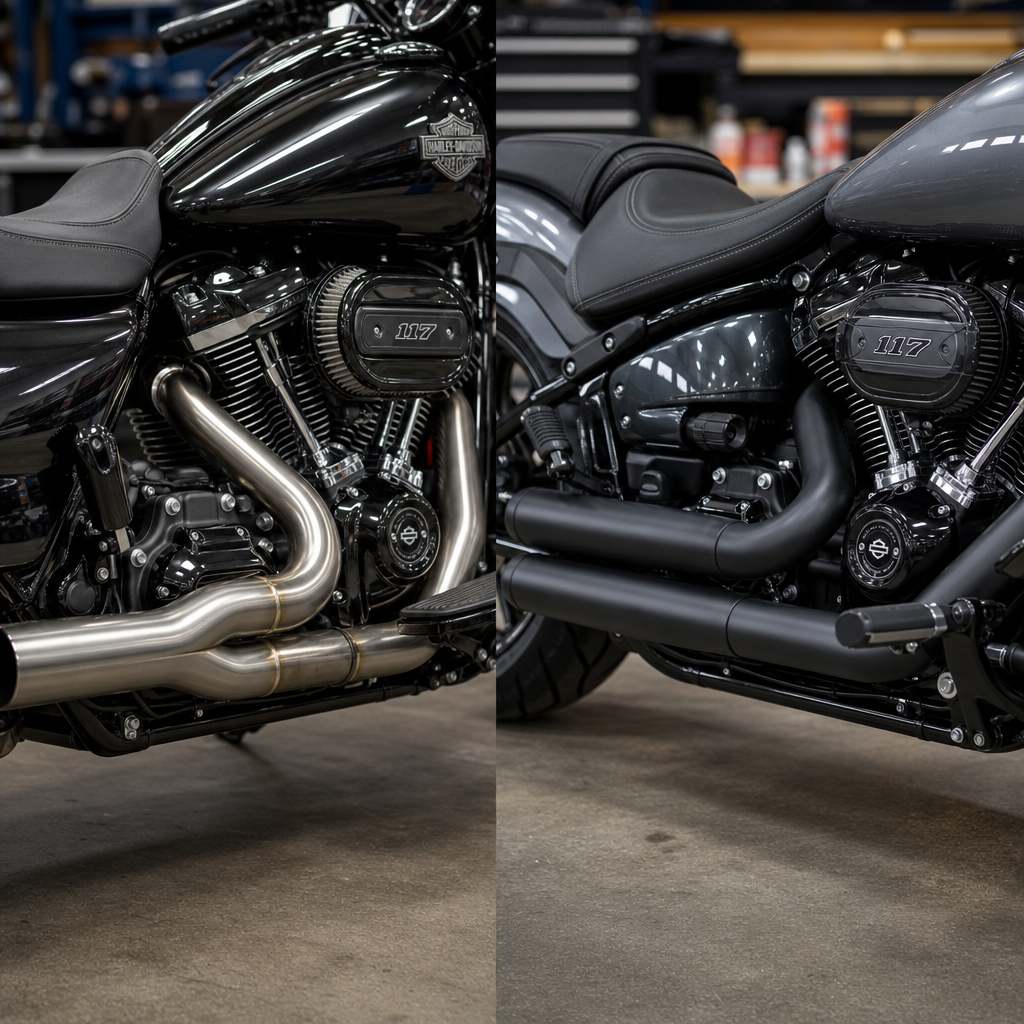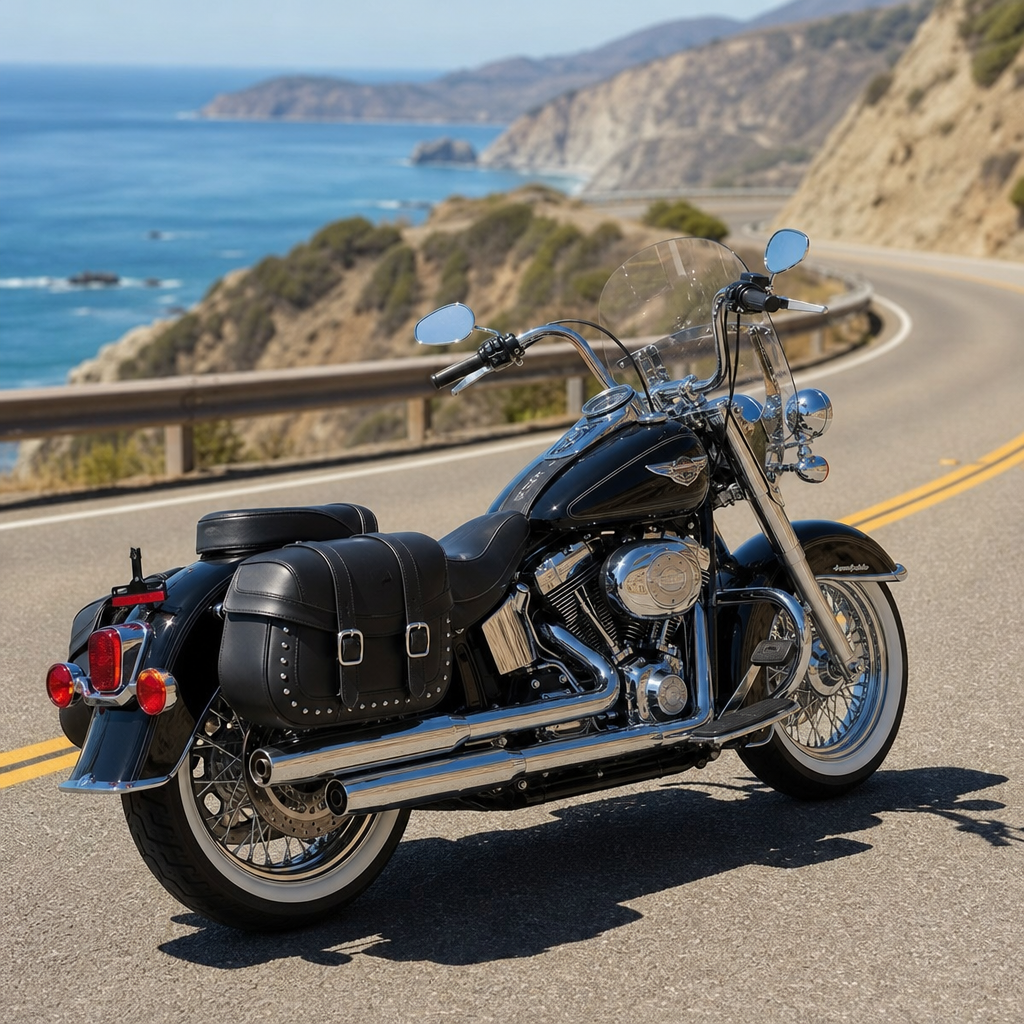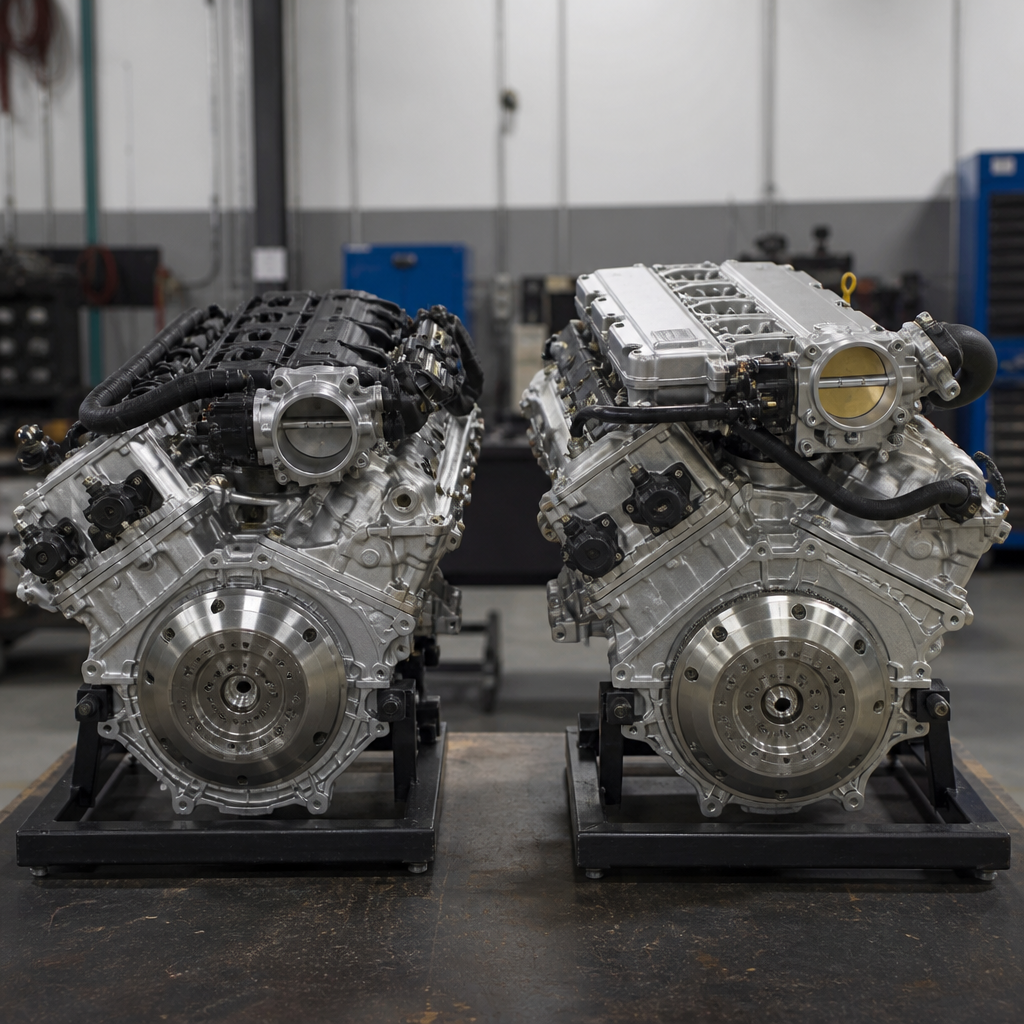
Within Harley-Davidson tuning circles, few comparisons come up more often than 117 VVT vs. 121 HO, because both engines promise stronger V-Twin performance and mechanics while arriving there through different engineering priorities. The 117 VVT is the Milwaukee-Eight 117 with variable valve timing, designed to broaden usable power, improve combustion control, and sharpen response across changing loads. The 121 HO, short for High Output, is a larger-displacement performance version aimed at maximizing airflow, cylinder filling, and top-end urgency. Volumetric efficiency, the percentage of air an engine actually draws compared with its theoretical displacement, sits at the center of this debate. Torque curve describes how twisting force builds and falls through the rev range, and on a heavy touring or performance bagger platform, that shape matters more than peak horsepower alone.
I have spent enough time around dyno sheets, cam selections, intake changes, and rider feedback to know that engine comparisons become misleading when they focus on one headline number. A 121 cubic inch engine can produce more peak output simply because it moves more air, but that fact alone does not mean it will always feel better on the road. The 117 VVT uses cam phasing to improve low-speed cylinder pressure and maintain breathing as rpm rises, which can make the bike more flexible in real use. The 121 HO typically relies on displacement, cam profile, head flow, compression, and calibration to achieve a more aggressive result. Riders choosing between them are really choosing between breadth and intensity.
This article serves as a hub for V-Twin performance and mechanics within the Harley-Davidson world. That means looking beyond spec-sheet tribalism and examining what creates torque, what limits volumetric efficiency, how intake and exhaust dynamics affect cylinder filling, and why gearing, cooling, fuel quality, and tuning strategy change the ownership experience. If you want to understand why one engine pulls harder from 2,500 rpm while another surges above 4,000, this comparison gives the framework. It also points toward the connected topics enthusiasts usually explore next, including cam timing, throttle body sizing, head work, exhaust scavenging, octane requirements, and dyno interpretation.
What 117 VVT and 121 HO actually represent
The 117 VVT and 121 HO are not just two displacement labels; they reflect two performance philosophies within the modern Milwaukee-Eight family. The 117 VVT uses variable valve timing to alter intake cam phasing based on operating conditions. In plain terms, the engine can advance or retard valve events to strengthen low-rpm torque, stabilize combustion, improve part-throttle manners, and still support better breathing higher in the range. That flexibility matters on touring motorcycles where riders ask the engine to idle in traffic, accelerate with luggage and passenger weight, and cruise for hours under heat soak.
The 121 HO increases displacement and targets higher overall output. More cubic inches usually translate into more torque everywhere, provided the heads, intake tract, exhaust, and fuel map can support the added airflow. Harley-Davidson’s high-output approach also implies more aggressive breathing hardware and calibration. In practice, the 121 HO tends to feel more immediate and forceful when the throttle is opened decisively, especially in the midrange and upper revs where airflow demand climbs quickly. The tradeoff is that larger, more performance-focused combinations can become less forgiving if the tune, fuel, or thermal environment is not ideal.
For riders researching Harley-Davidson engine performance, this distinction is essential. The 117 VVT is often the smarter daily-use package because it aims for broad efficiency over a wide operating window. The 121 HO is often the stronger statement piece because it raises the ceiling. Neither concept is inherently better; the right choice depends on how torque is delivered, how the motorcycle is used, and how much a rider values flexibility over maximum output.
Volumetric efficiency: why airflow wins or loses the comparison
Volumetric efficiency is the clearest technical lens for comparing these engines. A four-stroke engine only makes torque when it fills the cylinder effectively, burns the mixture efficiently, and converts pressure into crankshaft force. Even large displacement does not guarantee exceptional cylinder filling. Port shape, valve size, valve timing, intake runner behavior, exhaust scavenging, piston speed, and temperature all influence how much air mass enters the chamber. In dyno work, I repeatedly see engines with impressive cubic inches underperform because the airflow package is mismatched.
The 117 VVT has a major advantage in how it manages changing airflow needs. By adjusting valve timing, it can reduce reversion at lower engine speeds, increase dynamic compression where useful, and keep airflow velocity high enough for good mixture quality. That usually translates into flatter torque, better roll-on response, and less of the soggy transition that some fixed-cam setups display. Variable valve timing does not create magic airflow, but it helps the same hardware behave more intelligently across the rev range.
The 121 HO attacks volumetric efficiency from another angle: it increases demand and capacity. Bigger displacement creates a stronger pull on the intake tract, and if the heads, throttle body, manifold, and camshaft are matched well, the engine can achieve excellent cylinder filling at higher loads. This is where larger engines often shine on a dyno chart. Their breathing system is tuned to move more mass, and that extra air supports higher torque and horsepower. However, if velocity drops too much at low rpm or overlap is excessive for the application, some drivability can be traded away for peak performance.
Torque curves in the real world: broad pull versus high-output surge
Torque curve shape determines how a Harley feels in traffic, on mountain roads, and during highway passing. The 117 VVT generally aims for a broad, plateau-like curve. Instead of chasing one dramatic spike, it builds usable torque early and sustains it through the middle of the range. On a heavy touring chassis, that means fewer downshifts, smoother two-up acceleration, and easier control when corner exits or passing maneuvers happen from imperfect rpm. Riders often describe this as an engine that is always in the right part of the powerband.
The 121 HO tends to deliver a more forceful curve with greater absolute numbers, especially once airflow demand rises. If the combination is tuned aggressively, the engine may hit harder in the midrange and continue pulling more strongly toward the upper end than the 117 VVT. For performance bagger builds or riders who enjoy decisive throttle inputs, that character is compelling. The bike feels less restrained and more urgent. On the other hand, a stronger peakier surge can expose traction limits, amplify heat, and make small throttle changes feel sharper.
| Engine | Primary strength | Typical torque feel | Best fit |
|---|---|---|---|
| 117 VVT | Adaptive valve timing and broad efficiency | Early, smooth, flat pull through the midrange | Touring, daily riding, mixed conditions |
| 121 HO | Greater displacement and higher airflow potential | Stronger surge with higher peak output | Performance-focused street and bagger builds |
When riders ask which engine is faster, the answer depends on context. From a low-rpm roll with passenger and cargo, the 117 VVT may feel more composed and instantly useful. In a harder acceleration run where rpm climbs and traction is managed well, the 121 HO will usually show its extra breathing and displacement. Torque curves are not abstract lines; they are a map of how the motorcycle behaves under your right hand.
The mechanical reasons the engines feel different
Several mechanical factors explain the personality gap. Cam timing is the obvious one. Intake valve closing strongly affects dynamic compression and low-speed torque, while overlap influences scavenging and upper-rpm breathing. The 117 VVT can optimize valve events across multiple conditions instead of being locked into one compromise. That is a significant engineering benefit in a street engine. It helps a relatively large air-cooled or oil-assisted V-Twin behave civilly at low rpm without giving up as much efficiency higher up.
The 121 HO leans harder on displacement and fixed hardware choices. Larger cylinders increase the amount of air-fuel mixture burned each cycle. If paired with higher-flow heads, a larger throttle body, freer exhaust, and an assertive cam, the result is a meaningful increase in brake mean effective pressure and airflow at speed. But those parts must be matched carefully. Oversized components can slow port velocity, blunt throttle response, or create tuning gaps. Good 121 builds feel brutal and clean; mediocre ones feel loud, hot, and inconsistent.
Thermal management also matters. As cylinder pressure and output rise, heat rejection becomes more important, especially on heavy Harleys ridden slowly in warm climates. Higher output combinations can require more attention to oil temperature, spark control, knock resistance, and fuel quality. This is one reason riders should not evaluate the 121 HO by displacement alone. An engine that makes excellent dyno numbers but pulls timing because of heat or poor fuel is not delivering its theoretical advantage consistently. Calibration quality is inseparable from mechanical performance.
Tuning, supporting parts, and the wider V-Twin performance ecosystem
As a hub for V-Twin performance and mechanics, this comparison naturally leads to the supporting systems that decide whether either engine meets its potential. Intake design is first. Air cleaner flow, runner length, throttle body diameter, and manifold shape all influence velocity and cylinder filling. Exhaust is second. Header diameter, collector behavior, catalyst restriction, and muffler design change scavenging and torque shape dramatically. I have seen simple exhaust swaps move a torque dip enough for a rider to think the cam changed.
Cylinder head work is another critical subtopic. Port velocity, short-side radius quality, valve job precision, and chamber shape often matter more than raw port size. A well-developed head can raise airflow while preserving mixture motion, which helps both power and combustion stability. Fueling and ignition then tie everything together. Tools such as dyno tuning software, wideband oxygen sensors, and data logging are indispensable because modern Harley engines respond strongly to air-fuel ratio, spark advance, knock control strategy, and throttle mapping. A strong tune improves not just power, but starting, heat behavior, and longevity.
Riders comparing 117 VVT and 121 HO should also think about gearing, clutch capacity, and intended load. A touring rider crossing states with luggage values a broad torque shelf, stable oil temperatures, and low-maintenance behavior. A performance-oriented rider may accept more heat, sharper manners, and tighter tuning tolerances in exchange for harder acceleration. The benefit of understanding V-Twin performance and mechanics is that you stop buying parts based on forum mythology and start building an engine package around airflow, combustion, and actual use. If you are planning your next Harley-Davidson upgrade, use this comparison as the starting point, then dive deeper into cam selection, head flow, exhaust tuning, and dyno analysis with the rest of this subtopic in mind.
The clearest takeaway from 117 VVT vs. 121 HO is that engine size and engine strategy are different things. The 117 VVT uses variable valve timing to widen the sweet spot, strengthen part-throttle and midrange behavior, and keep torque accessible in the conditions most street and touring riders actually encounter. The 121 HO raises the performance ceiling through greater displacement and airflow potential, rewarding riders who want stronger acceleration and are prepared to support that output with the right hardware and calibration.
Volumetric efficiency explains why the comparison cannot be reduced to cubic inches alone. An engine wins by filling its cylinders well, controlling combustion, and sustaining that performance under real heat and load. Torque curves explain why the answer changes from rider to rider. Broad, flat torque often feels better and works better on the road, while a more forceful high-output curve can deliver the drama and speed some owners want from a premium build. Both engines can be excellent when matched to the motorcycle’s mission.
For anyone exploring Harley-Davidson V-Twin performance and mechanics, this hub should frame the next questions to ask: How do cam events alter cylinder pressure? What intake and exhaust combination supports the target rpm range? How does head flow affect velocity and mixture quality? What tuning strategy keeps power repeatable in real weather and traffic? Start with those questions before choosing parts, and you will make smarter decisions, spend money more effectively, and end up with a Harley that feels right every time you twist the throttle.
Frequently Asked Questions
What is the core difference between the 117 VVT and the 121 HO in how they make power?
The biggest difference is not just displacement, but the strategy each engine uses to create usable power. The 117 VVT relies on variable valve timing to widen the effective powerband, improve cylinder filling across more of the rpm range, and maintain better combustion behavior under changing throttle and load conditions. In practical terms, that means it is engineered to feel flexible, responsive, and easy to ride in a broad range of real-world situations. It is less about chasing one dramatic peak number and more about shaping a flatter, more accessible torque curve.
The 121 HO approaches performance from the other direction. Its larger displacement and high-output calibration are aimed at maximizing airflow demand and producing stronger peak torque and horsepower potential. With more cubic inches available, the engine can generate greater force with less reliance on advanced valve event adjustment. That usually translates into a more aggressive character, especially as rpm rises and the engine is allowed to breathe through supporting intake, exhaust, and tuning changes.
So when riders compare the two, they are really comparing breadth versus intensity. The 117 VVT is designed to optimize volumetric efficiency over a wider operating window, while the 121 HO is built to push more air and fuel overall and convert that into stronger outright performance. Neither concept is automatically better in every case. The better choice depends on whether the rider values broad, refined torque delivery or maximum displacement-driven output.
How does volumetric efficiency differ between the 117 VVT and the 121 HO?
Volumetric efficiency refers to how effectively an engine fills its cylinders with fresh air during the intake process compared with its theoretical capacity. In a V-Twin performance discussion, this matters because better cylinder filling usually leads to stronger combustion, more torque, and more efficient use of the engine’s mechanical package. The 117 VVT has an important advantage here because variable valve timing allows the engine to alter valve events to better match airflow demands at different rpm and load points. That flexibility can improve cylinder filling in conditions where a fixed-valve-timing setup would be forced to compromise.
At lower and midrange engine speeds, the 117 VVT can be calibrated to favor intake velocity, combustion stability, and smoother torque development. At higher engine speeds, valve timing can shift to support better breathing and reduce some of the tradeoffs normally associated with camshaft design. This does not mean it will always produce the highest absolute airflow number, but it often means the engine can maintain stronger volumetric efficiency across a larger portion of the operating range. That is why many riders describe VVT-equipped engines as feeling fuller and more linear from roll-on to higher-rpm acceleration.
The 121 HO can still achieve excellent volumetric efficiency, but it often depends more heavily on the overall combination: cylinder head flow, camshaft selection, intake tract design, exhaust scavenging, and tune quality. Because it starts with more displacement, it does not need to be more efficient everywhere to produce more torque in absolute terms. It simply moves more air because the cylinders are larger. In a well-developed package, the 121 HO can deliver extremely strong airflow and impressive peak numbers, but its efficiency curve may be more shaped around performance priorities rather than broad adaptability. That distinction is central to the comparison: the 117 VVT often optimizes efficiency across more conditions, while the 121 HO often leverages displacement to create bigger output where performance riders want it most.
Which engine typically has the better torque curve for street riding?
For pure street manners, many riders will find the 117 VVT especially appealing because its torque delivery is usually broader and more predictable. A wide, smooth torque curve matters on the street more than a single headline number because most real-world riding happens in the lower and middle sections of the rpm range. That includes pulling away from stops, rolling through traffic, passing without downshifting, climbing grades, carrying a passenger, or transitioning in and out of corners. In those situations, an engine that produces strong, stable torque over a wide range often feels faster and easier to use than one that is tuned to hit harder in a narrower window.
The 117 VVT’s variable timing helps shape that kind of delivery. It can support low-rpm tractability without giving away as much top-end breathing as a conventional fixed-timing compromise might require. The result is often a torque curve that rises early, stays present through the middle, and avoids abrupt dips or soft spots. That makes throttle response feel more connected and reduces the need to constantly manage gear selection to stay in the strongest part of the powerband.
The 121 HO, however, should not be dismissed for street use. Because of its displacement, it can produce abundant torque almost everywhere, and in many builds it will simply make more of it. The difference is in the feel and emphasis. The 121 HO can come across as more forceful, more muscular, and more performance-oriented, especially when paired with supporting hardware and a tune that favors stronger upper-range output. Riders who enjoy an aggressive surge and want the sensation of big-inch authority may prefer that character. Riders who prioritize balance, flexibility, and smooth roll-on power often lean toward the 117 VVT. For typical mixed street riding, the 117 VVT frequently wins on curve shape and usability, while the 121 HO often wins on outright thrust.
Does the 121 HO always outperform the 117 VVT because it has more displacement?
Not always, and this is where the comparison gets more nuanced than spec-sheet discussions suggest. More displacement gives the 121 HO a major built-in advantage in absolute torque and horsepower potential, but actual performance depends on how and where that performance is measured. If the goal is peak dyno output, hard acceleration under ideal conditions, or extracting the strongest possible numbers from a performance-focused build, the 121 HO will usually have the upper hand simply because larger cylinders can process more air-fuel mixture and create more force.
But outperform is not a one-dimensional term. If the criteria include part-throttle smoothness, adaptability to changing loads, broad efficiency, or the quality of torque delivery across a wider operating range, the 117 VVT can be extremely competitive and in some cases preferable. Variable valve timing gives it an ability to optimize valve events in ways a fixed setup cannot, which can make the engine feel more refined and responsive in everyday use. A rider may find that the 117 VVT delivers power more cleanly and predictably in the exact riding conditions they experience most often, even if the 121 HO produces higher maximum numbers.
It is also important to remember that tune quality, fuel calibration, exhaust design, intake flow, and thermal management can dramatically affect the end result. A well-tuned 117 VVT may feel sharper and more complete than a poorly sorted 121 HO. So while the 121 HO generally holds the advantage in raw output potential, the real-world winner depends on whether the rider prioritizes peak performance, torque curve shape, or all-around rideability.
Which is the better choice for riders deciding between modern flexibility and traditional big-inch performance?
If a rider values modern engine behavior, the 117 VVT is often the smarter choice. Its appeal lies in how intelligently it manages airflow and combustion across different riding situations. That can mean stronger drivability, smoother transitions, broader torque access, and a more polished response when conditions change. Riders who spend a lot of time on public roads, encounter mixed speeds, carry passengers, or simply want an engine that feels consistently strong without demanding aggressive riding technique may find the 117 VVT to be the more satisfying long-term package.
If the rider’s priority is classic big-inch performance with a more direct path to higher output, the 121 HO often stands out. It speaks to the traditional performance mindset: add displacement, improve breathing, tune aggressively, and enjoy the stronger mechanical punch that follows. That formula has enduring appeal in Harley-Davidson tuning circles because it delivers a visceral payoff. The engine tends to feel bolder, heavier-hitting, and more assertive, particularly when the build is centered on acceleration and top-end gains rather than broad operational refinement.
In simple terms, the 117 VVT represents a more advanced efficiency-based approach to making a V-Twin quicker and more versatile, while the 121 HO represents a displacement-led approach to achieving bigger torque and horsepower. Riders who want broad usefulness and a refined torque curve often gravitate toward the 117 VVT. Riders who want maximum shove and stronger headline performance usually favor the 121 HO. The better choice comes down to whether the rider wants the widest effective powerband or the biggest performance ceiling.