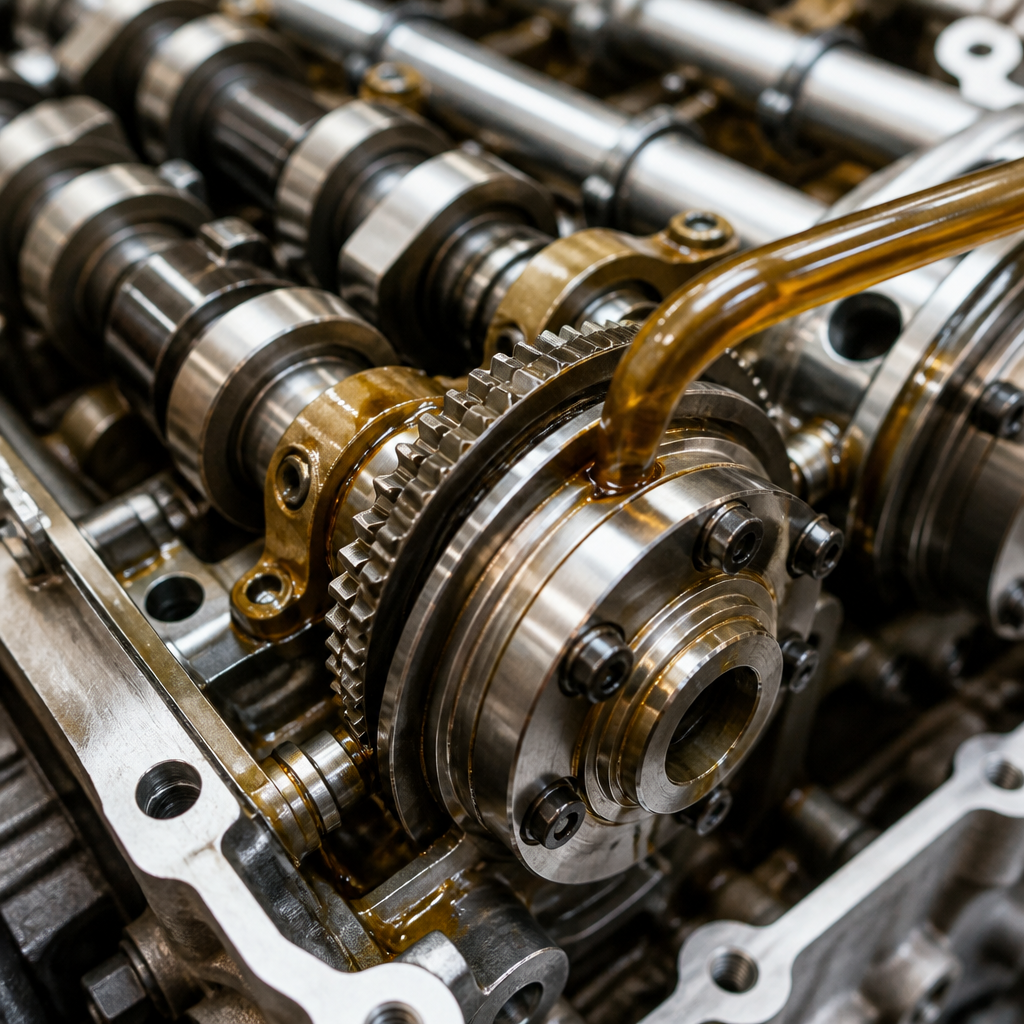
Variable valve timing on a Harley-Davidson V-twin lives or dies by oil control, and that makes viscosity, pressure stability, and thermal behavior more than maintenance details. In practical terms, cam phasers use pressurized engine oil to advance or retard cam timing, so the lubricant is also the hydraulic working fluid. When riders ask why 20W-50 synthetic is critical for cam phaser operation, the answer is straightforward: the system was designed around an oil that can flow fast enough at startup, hold film strength at temperature, resist aeration, and maintain consistent pressure through narrow passages and control valves. On modern Harley-Davidson variable valve timing engines, especially Milwaukee-Eight platforms with VVT, oil choice directly affects phaser response, valvetrain noise, timing accuracy, and long-term durability.
This matters because Harley-Davidson V-twin performance and mechanics are tightly connected. The same oil that protects crankshaft bearings and piston skirts also feeds lifters, rocker arms, cam chest components, and the phaser control circuit. If viscosity is too low when the engine is hot, internal leakage across phaser vanes and solenoids can slow response or reduce authority. If oil is too thick during cold starts, the phaser may react sluggishly until temperature rises, and pressure drop across fine passages increases. In shop work, I have seen timing-related complaints that looked electronic at first but traced back to oil condition, wrong viscosity, foaming, or restricted filters. Understanding VVT oil flow requirements helps owners make better decisions about lubricant selection, service intervals, riding habits, and performance upgrades across the Harley-Davidson V-twin platform.
Key terms are worth defining clearly. Variable valve timing changes camshaft position relative to the crankshaft, usually to improve torque, emissions, idle quality, fuel economy, and high-rpm breathing. A cam phaser is the hydraulic actuator mounted on the cam drive that changes that position. Oil viscosity describes resistance to flow; 20W-50 means the oil meets a winter-grade low-temperature standard and a high-temperature viscosity range defined by SAE J300. Synthetic oil uses engineered base stocks and additive packages that generally provide stronger oxidation resistance, better shear stability, and more predictable viscosity over a wide temperature range than conventional oil. For Harley-Davidson V-twin owners, these are not abstract definitions. They explain why the right oil keeps the engine quiet, the timing precise, and the performance consistent under heat, load, and long service intervals.
How cam phasers use oil in Harley-Davidson V-twin engines
A cam phaser is essentially a hydraulic rotary actuator. The engine control strategy commands an oil control valve, often called a VVT solenoid, to route pressurized oil into one chamber of the phaser while venting another. Pressure acting on internal vanes rotates the cam relative to its drive sprocket. A lock pin may hold a default position at very low pressure, such as startup or shutdown, and then release once pressure builds. The result is measurable cam advance or retard, allowing the engine to optimize valve events for different speeds and loads. On a Harley-Davidson V-twin, where combustion pulses are large and operating temperatures can climb quickly in traffic or hot weather, that hydraulic circuit needs oil that behaves predictably through constant pressure fluctuations.
Oil flow requirements are stricter than many riders assume. The phaser must fill and vent chambers quickly, so the oil needs suitable cold-flow behavior. It must also avoid excessive leak-down through clearances when hot, so high-temperature viscosity matters just as much. Additives influence anti-wear protection at the cam and follower interface, detergency that keeps control screens clean, and anti-foam behavior that prevents air bubbles from compressing inside the hydraulic circuit. Aerated oil is a hidden problem because air reduces effective stiffness in the phaser, creating delayed or inconsistent movement. That can show up as rough idle, unstable low-end torque, or diagnostic trouble codes related to cam timing correlation. In short, the phaser is not simply lubricated by oil; it is powered by oil.
The broader Harley-Davidson valvetrain also amplifies the importance of oil quality. Hydraulic lifters rely on stable pressure to maintain zero lash. Rocker arm interfaces and cam lobe contacts need a durable film. Timing chains, guides, and tensioners depend on clean oil for wear control and stable operation. When the same fluid supports all of those functions, a compromise in viscosity or oxidation resistance can affect multiple systems at once. That is why V-Twin performance and mechanics should be viewed as an integrated system rather than separate categories of tuning, lubrication, and electronics.
Why 20W-50 synthetic is the correct baseline for VVT oil flow requirements
For a large-displacement, air-cooled or partially liquid-cooled Harley-Davidson V-twin, 20W-50 synthetic is the correct baseline because it balances cold-start flow with hot-running stability. The 20W rating means the oil remains pumpable within the winter test range, while the 50-grade viscosity at operating temperature provides enough body to maintain pressure and film thickness in engines that see substantial heat. Harley-Davidson engines often run hotter than many automotive engines because of packaging, load, and thermal environment. During summer touring, stop-and-go traffic, two-up riding, or aggressive acceleration, sump and component temperatures can climb into ranges where a weaker oil shears down or oxidizes rapidly. Synthetic 20W-50 resists that breakdown better.
In phaser operation, that high-temperature stability is critical. A phaser depends on pressure differential across internal chambers. If the oil thins excessively, more fluid leaks internally across clearances, reducing the actuator’s effective torque and slowing its response. Synthetic formulations also tend to maintain viscosity more consistently over the drain interval, which matters because a phaser calibrated with fresh 20W-50 can behave differently on worn-out oil that has sheared toward a lower grade. I have measured real differences in hot idle noise and response consistency after replacing degraded oil with fresh synthetic 20W-50 in engines that otherwise tested healthy. Riders often describe the change simply as smoother running, but mechanically it is improved hydraulic control.
The synthetic part matters as much as the grade. Compared with conventional oil, quality synthetic 20W-50 offers stronger oxidation resistance, better deposit control, and usually better low-temperature pumpability. Oxidation creates varnish and sludge that can restrict solenoid screens and narrow oil galleries. Deposits around a spool valve can alter flow metering or delay movement. Better cold-flow properties reduce the time needed to build reliable pressure after startup, even when the nominal grade is the same. On a VVT-equipped Harley-Davidson, those properties support repeatable phaser motion from cold morning starts to fully heat-soaked highway operation. That consistency is the real reason 20W-50 synthetic is critical, not marketing language or brand loyalty.
What happens when viscosity or oil condition is wrong
Using the wrong oil in a VVT Harley-Davidson usually creates symptoms before it creates failures, but ignoring those symptoms can become expensive. When viscosity is too low at operating temperature, riders may hear more valvetrain noise, especially at hot idle, because hydraulic elements lose stiffness. Phaser response can become inconsistent, leading to small but noticeable changes in throttle feel, idle quality, and low-rpm torque. In data terms, commanded cam position and actual cam position may not track as tightly. If viscosity is too high in cold conditions, startup flow slows, the phaser lock pin may stay engaged longer, and hydraulic lifters can take more time to stabilize. That can create transient ticking, delayed timing movement, or roughness immediately after start.
Oil condition matters as much as nominal grade. Fuel dilution thins the oil and reduces film strength. Shear reduces high-temperature viscosity, particularly in shared-stress environments with heavy gear and chain loads. Oxidation thickens oil unevenly and leaves deposits. Water contamination can promote corrosion and emulsification. Foaming or aeration interrupts stable hydraulic control. A clogged or low-quality oil filter can create pressure drop that hurts flow to upper-end and timing components. In one recurring service pattern, bikes used for short trips developed moisture contamination and fuel dilution, while bikes used for long hot highway runs showed oxidation from extended drain intervals. Both conditions affected phaser behavior for different reasons. The common lesson was that the phaser exposed lubricant problems earlier than some owners expected.
| Oil issue | Mechanical effect on cam phaser | Typical rider symptom |
|---|---|---|
| Too thin when hot | Internal leakage rises, actuator torque drops | Hot idle noise, softer throttle response |
| Too thick when cold | Slow fill through control passages | Cold start ticking, delayed smoothness |
| Aeration or foaming | Compressible fluid causes unstable phaser motion | Erratic idle, inconsistent power delivery |
| Oxidation and varnish | Solenoid screens and spool valves restrict | Intermittent timing faults, rough running |
| Fuel dilution | Viscosity loss and weaker oil film | Higher engine noise, reduced consistency |
Service strategy, diagnostics, and upgrade decisions for V-Twin performance and mechanics
The smartest service strategy starts with using a manufacturer-appropriate full synthetic 20W-50, a quality filter with the correct bypass characteristics, and drain intervals matched to real riding conditions rather than ideal brochures. Heavy traffic, high ambient temperatures, repeated short trips, and hard performance use justify more frequent oil changes because they increase thermal stress, contamination, and shear. For diagnostics, start simple. Verify oil level on the correct procedure, confirm the exact oil grade used, inspect service history, and listen for hot versus cold differences. If a VVT concern remains, scan for timing correlation codes, review commanded versus actual cam position data, and inspect for signs of debris or varnish in the control circuit. Basic oil pressure testing and filter inspection often reveal more than riders expect.
Performance upgrades should respect oil system limits. Higher valve spring pressure, aggressive cams, sustained high rpm, and elevated compression all increase load and heat, which raises the importance of shear-stable synthetic oil and careful temperature management. Tuners sometimes focus on airflow and fuel while overlooking how revised operating ranges affect hydraulic timing hardware. That is a mistake. A calibration that commands more frequent or broader phaser movement depends on clean, stable oil even more than stock tuning. Riders building torque-heavy baggers, hot street Milwaukee-Eight engines, or touring bikes for desert climates should treat oil choice as a core mechanical specification, not a consumable afterthought. For anyone exploring the wider Harley-Davidson hub topics, this is the foundation: V-Twin performance and mechanics begin with lubrication discipline, because every gain in torque, efficiency, and reliability depends on controlled oil flow through the engine’s most critical systems.
The practical takeaway is simple. If your Harley-Davidson uses variable valve timing, 20W-50 synthetic is critical for cam phaser operation because it supports the hydraulic accuracy the system was engineered to use. It flows well enough at startup, stays strong at temperature, resists deposits, and protects the rest of the valvetrain at the same time. That single choice improves consistency more than many owners realize, especially on hot-running V-twins that see real-world touring loads. Pair the correct oil with quality filters, sensible intervals, and attention to operating conditions, and the phaser, lifters, cams, and top end all benefit. Review your current maintenance plan, confirm the exact oil in the bike today, and make oil selection the first step in any Harley-Davidson performance or reliability strategy.
Frequently Asked Questions
Why is 20W-50 synthetic considered critical for cam phaser operation in a Harley-Davidson V-twin with VVT?
Because in a VVT-equipped Harley-Davidson V-twin, the oil is doing two jobs at once: it is lubricating the engine and acting as the hydraulic medium that moves and controls the cam phasers. That means oil behavior directly affects how accurately the engine can advance or retard valve timing. A 20W-50 synthetic is considered critical because it matches the viscosity range and high-temperature stability the system was designed around, allowing the phasers to respond predictably across cold starts, heavy traffic, long highway runs, and high-load riding.
At startup, the oil has to move quickly enough through narrow passages to reach the phaser control circuits without delay. Once the engine is fully hot, it must still maintain enough film strength and pressure stability to keep the phaser locked into the commanded position instead of drifting, lagging, or reacting inconsistently. That balance is exactly why the specified grade matters. If the oil is too thin at operating temperature, leakage inside the hydraulic control system can increase and reduce phaser authority. If the oil is too thick when cold, response time can suffer and initial actuation may become sluggish.
Synthetic 20W-50 also brings better thermal resistance, oxidation control, and viscosity retention than many conventional oils, which is especially important in an air-cooled or partially liquid-cooled V-twin environment where oil sees substantial heat. In practical terms, using the correct synthetic viscosity helps the engine management system get the cam timing it is asking for, more consistently and more quickly, which supports idle quality, throttle response, torque delivery, emissions performance, and long-term valvetrain durability.
How does oil viscosity affect the way a cam phaser advances or retards timing?
Oil viscosity affects both the speed and the precision of cam phaser movement. A cam phaser works by routing pressurized oil into specific chambers to rotate the camshaft relative to its drive position. The engine control system commands a timing change, a control valve meters oil flow, and the phaser moves based on hydraulic pressure and flow. For that sequence to happen properly, the oil has to have predictable viscosity under real engine conditions.
When viscosity is within the intended range, oil can flow through control valves and galleries fast enough to give quick response, while still being thick enough at temperature to maintain hydraulic sealing inside the phaser. That is what allows the system to hit the desired cam angle accurately and hold it there. If viscosity drops too much when the engine is hot, internal leakage can rise, and the phaser may not develop or maintain the pressure differential needed for exact positioning. The result can be delayed movement, unstable cam timing, or repeated correction attempts by the ECU.
On the other hand, if the oil is excessively thick relative to the system’s design needs, especially during cold starts, it can resist flow through the small passages that feed the phaser. That can slow actuation, delay timing changes, and create a mismatch between commanded and actual cam position. Riders may notice rougher starts, inconsistent idle behavior, or less crisp throttle response until the engine warms. So viscosity is not just a wear-protection number on a bottle; in a VVT system, it is part of the control strategy that determines how effectively the hardware can do its job.
What problems can happen if you use an oil that is not the recommended 20W-50 synthetic in a VVT Harley engine?
Using an oil outside the recommended specification can create both immediate performance issues and longer-term reliability concerns. The first category is control-related. Since the cam phaser depends on oil pressure and flow characteristics, a different viscosity or lower-stability oil can alter phaser response time and positional accuracy. That may show up as delayed cam advance, inconsistent retard action, noisy valvetrain behavior, rough idle, reduced low-end torque, diminished top-end smoothness, or fault codes if the ECU detects that commanded and actual cam positions do not match closely enough.
The second category is thermal and mechanical protection. VVT systems rely on clean, stable oil to keep fine control passages, spool valves, and phaser internals operating correctly. If the oil shears down too quickly, oxidizes under heat, or leaves deposits, those parts can become less responsive. Sludge, varnish, or contamination can restrict oil flow and interfere with the small hydraulic pathways that are essential for precise timing control. Even if the engine does not fail outright, the system may gradually lose crispness and consistency.
There is also the issue of wear protection in a Harley V-twin that operates under substantial heat and load. The wrong oil may not maintain sufficient film strength in high-temperature conditions, particularly during long rides, slow traffic, or hot weather operation. That can affect not only the cam phaser system but also the cam drive, bearings, and other critical upper-engine components. In short, the wrong oil does not just compromise lubrication in the general sense; it can directly undermine the hydraulic logic of the VVT system and reduce the engine’s ability to perform the way it was engineered to perform.
Why is synthetic oil preferred over conventional oil for VVT and cam phaser performance?
Synthetic oil is preferred because it is better at holding its viscosity and resisting breakdown under the real-world conditions that challenge cam phaser operation. In a VVT system, oil cannot simply be “good enough” as a lubricant. It has to remain a stable hydraulic fluid while being exposed to temperature swings, sustained high heat, shear forces, and repeated pressure changes. Synthetic formulations generally do a better job of maintaining those properties over time, which helps the phaser operate with greater consistency.
One major advantage is thermal stability. A Harley-Davidson V-twin can expose its oil to significant heat, especially in slow-moving traffic, warm climates, or heavy-load riding. Conventional oil is more likely to thin out excessively, oxidize, or form deposits as temperatures rise and service intervals progress. Synthetic 20W-50 is typically more resistant to those effects, so it keeps a more predictable viscosity profile and cleaner internal engine environment. That matters because cam phasers and their control valves depend on unrestricted oil flow through precise passages.
Another benefit is shear stability. Over time, some oils can lose viscosity as they are mechanically worked through bearings, gear interfaces, and high-stress engine components. When that happens, the oil may no longer behave like the grade printed on the label. In a VVT engine, that means the hydraulic behavior of the system can drift away from what the engineers calibrated. Synthetic oil generally resists that viscosity loss better, helping preserve pressure characteristics and phaser control accuracy throughout the oil’s service life. For riders, that translates to more dependable timing response, more stable performance in heat, and stronger long-term protection for both the valvetrain and the VVT hardware.
How can riders tell if oil quality or viscosity may be affecting cam phaser operation?
The signs are often subtle at first, but they tend to revolve around timing control behavior rather than simple lubrication noise alone. If oil quality or viscosity is affecting the cam phaser, a rider might notice rougher-than-normal cold starts, unstable idle, hesitation during throttle tip-in, reduced smoothness during midrange acceleration, or an engine that feels less consistent as it warms up. In some cases, there may be ticking or valvetrain-related noise during startup or hot operation, especially if the phaser is not receiving oil pressure in the way it expects.
Electronic symptoms can be just as important as drivability symptoms. Modern engine management systems monitor cam position and compare actual response to commanded response. If oil flow is too slow when cold, or if hot viscosity and pressure stability are not sufficient to hold the phaser where it belongs, the ECU may register timing deviations. That can trigger diagnostic trouble codes, a check engine light, or protective calibration behavior that reduces performance consistency. Even without a warning light, repeated timing corrections in the background can make the engine feel less refined.
Riders should also pay attention to oil-related patterns. If symptoms show up right after an oil change with a different product, after the oil has been run too long, or mainly during extreme heat or prolonged idling, that points strongly toward the oil’s viscosity behavior or condition. The best response is not guesswork but verification: confirm the exact oil grade and specification being used, make sure the oil level is correct, follow the service interval, and use a high-quality 20W-50 synthetic that meets the engine’s intended requirements. In a VVT Harley engine, small changes in oil behavior can have outsized effects on cam phaser control, so using the correct oil is one of the simplest and most effective ways to protect performance and reliability.