RevMax 1250 quickshifter maintenance on the 2026 Pan Am 14 is not a niche service item; it sits at the intersection of engine torque management, shift-rod sensor accuracy, clutch adaptation, ride-by-wire calibration, and chassis stability, making it a central topic for any serious Harley-Davidson technical deep-dive. In workshop practice, I treat the quickshifter as a system rather than a standalone accessory, because smoother shifts depend on how the RevMax 1250 powertrain, transmission dogs, ECU logic, IMU-informed intervention, and rider-controls hardware work together under load. The term quickshifter refers to an electronic shift-assist feature that allows clutchless upshifts and, in many calibrations, rev-matched downshifts by briefly interrupting ignition, fuel, or torque delivery when the rider applies pressure to the shift lever. On the 2026 Pan Am 14, that process is especially sensitive because the Revolution Max engine is a stressed member, the chassis communicates road shock directly, and the bike’s adventure-touring mission exposes the linkage and electronics to mud, water, heat cycling, and vibration.
This article serves as a hub for Harley-Davidson technical deep-dives spanning Milwaukee-Eight, Twin Cam, Evolution, and RevMax platforms, with the RevMax 1250 quickshifter as the anchor topic. That broader scope matters because experienced owners often cross-shop symptoms and maintenance philosophy across engine families. A Twin Cam rider understands drivetrain lash, an Evo owner knows the value of mechanical inspection, an M8 technician recognizes adaptive electronic control, and a RevMax specialist must blend all three mindsets. The Pan America’s quickshifter will not feel consistently smooth if the shift shaft pivot is dry, if chain tension is off, if software is outdated, or if engine braking settings conflict with rider technique. Maintenance therefore means inspection, validation, cleaning, calibration, and symptom-led forensic analysis. Done correctly, it reduces false neutrals, harsh cut events, missed downshifts, and premature wear on shift dogs or linkage joints. Just as importantly, it gives the rider confidence when standing on the pegs, cornering on pavement, or loading the gearbox during two-up travel.
Why RevMax 1250 quickshifter maintenance matters on the 2026 Pan Am 14
The RevMax 1250 differs from older Harley-Davidson engines because it was designed around high specific output, integrated electronics, and structural packaging. That means quickshifter behavior is tied more tightly to torque modeling than on simpler motorcycles. In practical terms, the ECU must predict engine load, throttle angle, gear position, and shaft speed, then command a cut window short enough to protect acceleration but long enough to unload the transmission. When this coordination is correct, the shift feels crisp and almost seamless. When it is not, riders describe a head toss, driveline thud, or a lever that feels like it hits a wall.
On the 2026 Pan Am 14, maintenance matters because adventure use magnifies small faults. Dust can increase friction at the lever pivot. Repeated water crossings can degrade connectors if seals are pinched. A minor tip-over can bend the shift rod just enough to alter sensor preload. Chain tension that is too tight can make suspension compression feed shock into the countershaft during a shift event. I have seen bikes brought in for “bad software” that were actually suffering from dry rose joints, a boot pressing against the lever, or aftermarket pegs changing foot angle. Quickshifter complaints are often system complaints in disguise.
Harley-Davidson owners exploring Technical Deep-Dives: M8, Twin Cam, Evo, and RevMax should also note how maintenance philosophy evolves across these platforms. Evo and Twin Cam diagnosis leans heavily on mechanical baseline checks. Milwaukee-Eight adds more electronic adaptation and sensor validation. RevMax requires both, plus an understanding of torque intervention strategy and CAN-based module communication. That is why this hub article emphasizes first-principles analysis instead of one-size-fits-all fixes.
Core components and failure points in the quickshifter system
A modern quickshifter system includes the shift lever, pivot, shift rod, strain or load sensor, harness, connectors, ECU strategy, ride-by-wire throttle coordination, gear-position input, and the transmission’s own selector mechanism and engagement dogs. Any one of these can degrade shift quality. The shift sensor is often blamed first, but in service bays it is just as common to find linkage friction, poor lever ergonomics, contaminated joints, or an ECU calibration mismatch after battery replacement or accessory installation.
On the RevMax 1250, the sensor must detect a deliberate rider input, not random vibration. That requires proper rod alignment and stable mounting torque. If the rod is clocked incorrectly, the sensor can see partial preload, delaying recognition in one direction and making the opposite direction oversensitive. If a rider reports clean upshifts but abrupt downshifts, I inspect not only software settings but also lever free movement and whether the toe piece position encourages a sideways input instead of a straight axial load. Transmission internals matter too. Worn dogs, bent forks, or abnormal drum indexing can mimic electronic faults, though these are less common than setup issues on low-mileage machines.
| Component | What to inspect | Typical symptom | Likely remedy |
|---|---|---|---|
| Shift lever and pivot | Free movement, side play, contamination | Notchy or delayed shifts | Clean, lubricate, replace bushing if worn |
| Shift rod and joints | Straightness, jam nuts, joint stiffness | Inconsistent cut timing | Realign, tighten, replace worn joints |
| Sensor and harness | Connector seal, chafing, fault codes | Intermittent assist loss | Repair wiring, validate sensor output |
| ECU calibration | Software version, adaptations, battery history | Harsh or lazy shifts across gears | Update software, reset adaptations if specified |
| Chain and drivetrain | Slack, sprocket wear, cush behavior | Clunk on load transition | Set slack to spec, inspect related parts |
Forensic analysis: separating electronic faults from mechanical faults
Technical forensic analysis starts with the complaint pattern. Does the problem happen only on aggressive upshifts above 6,000 rpm, or also during relaxed commuting? Is it worse between first and second, where ratio change and driveline lash are greater, or only on downshifts entering corners? A repeatable pattern usually points to a calibration, setup, or technique issue. A random pattern that appears after rain, a battery disconnect, or a tip-over suggests harness, connector, or sensor integrity.
My workflow is simple but disciplined. First, scan for diagnostic trouble codes using a factory-compatible tool or a professional platform that can read Harley-Davidson modules accurately. Second, inspect live data if available: gear position, throttle angle, sensor status, and any logged quickshifter inhibit conditions. Third, verify mechanical baseline: chain slack, rear wheel alignment, lever movement, rod geometry, and fastener torque. Fourth, road test under controlled conditions in multiple ride modes. This process matters because replacing the sensor without checking the linkage can hide the root cause for a few weeks, then the harshness returns.
Internal engine and transmission analysis enters the picture when all external checks pass but symptoms persist. On the RevMax platform, repeated missed clutchless shifts under power can round engagement dogs over time. Oil analysis can reveal abnormal metallic content, though it is not a standalone verdict. Borescope access is limited for this complaint, so technicians rely more on shift feel, debris inspection, and teardown evidence when necessary. Compared with an M8 touring bike, the Pan Am’s package and intended use mean chassis input plays a larger role in what the rider perceives as a gearbox issue.
Electronics, calibration, and rider-mode interactions
Quickshifter smoothness is shaped by software more than many owners realize. The ECU must choose a torque cut duration that fits rpm, throttle opening, gear pair, and requested direction. On a ride-by-wire motorcycle, that may involve ignition retard, fuel interruption, and throttle plate adjustment in tightly managed sequence. If software revisions alter these tables, the difference can be obvious. Manufacturers routinely refine low-speed behavior, false-trigger rejection, and transition smoothness after field data comes in.
Rider modes also matter. A mode with sharper throttle response can make the reapplication of torque feel more abrupt after the cut, even if the shift event itself is normal. Engine braking settings influence downshift feel because the ECU has to reconcile wheel speed, target rpm, and chassis pitch. Add luggage, a passenger, or off-road tires, and the same calibration may feel different due to driveline loading and tire compliance. That is why I always test the bike in the owner’s usual configuration, not just in a stripped shop setup.
Battery health and grounding are easy to overlook. Low voltage during startup or a marginal ground can produce adaptation irregularities, communication faults, or transient sensor anomalies. While modern control systems are robust, they are not indifferent to weak electrical baselines. On any RevMax service visit involving shift complaints, I check battery condition, charging output, and harness routing near heat sources and steering movement points.
Chassis dynamics, rider input, and maintenance practices that improve shift quality
The Pan Am’s chassis dynamics directly affect shift quality because suspension movement changes chain geometry and because body position affects how force enters the shift lever. If rear preload is too soft for load, the bike can squat under acceleration, tightening the chain and amplifying driveline reaction during upshifts. If damping is poorly set, the chassis may pitch during downshifts, making the rider feel a mechanical jolt that is partly suspension behavior. This is not theory; on test rides, correcting sag and chain slack often improves “gearbox feel” without touching the gearbox.
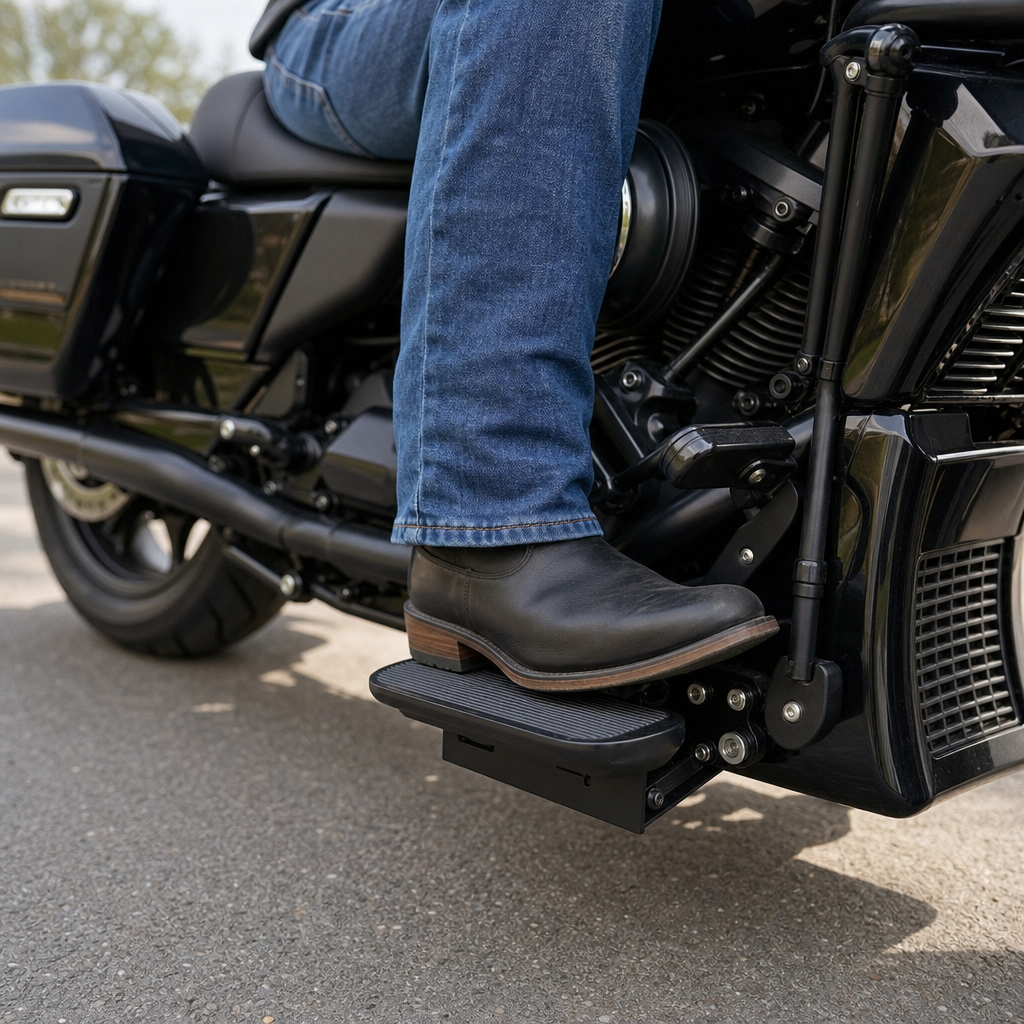
Rider technique remains part of maintenance because the quickshifter expects a clear, committed input. Resting weight on the lever, preloading too early, or making a half-hearted toe movement can produce roughness. Adventure boots add another variable by changing ankle articulation and lever contact. For some riders, a small lever position adjustment does more than any software update. The goal is a natural foot angle that allows a straight, positive motion.
Routine maintenance should include cleaning the lever pivot, inspecting rod ends, confirming jam nuts are secure, checking for crash damage, and verifying chain slack at the specified measurement point. Use the correct lubricant sparingly on pivots and avoid contaminating the sensor area. After any control adjustment, perform a careful road test across gears and engine speeds. For owners following Harley-Davidson technical deep-dives across M8, Twin Cam, Evo, and RevMax, this is the big lesson: sophisticated electronics do not replace mechanical housekeeping; they amplify the benefits of doing it well.
How this hub connects M8, Twin Cam, Evo, and RevMax technical deep-dives
This sub-pillar hub is broader than one service topic. It organizes Harley-Davidson technical deep-dives by platform logic. Milwaukee-Eight content should explore combustion efficiency, oil control, hydraulic lifter behavior, counterbalancer strategy in select models, throttle mapping, and touring chassis load paths. Twin Cam articles should cover cam chest wear patterns, tensioner evolution, crank runout implications, intake sealing, charging-system reliability, and six-speed driveline behavior. Evolution pieces belong around valve-train simplicity, oiling fundamentals, charging diagnostics, carburetion or early EFI tuning, and vibration-related fastener management. RevMax coverage should include variable valve timing strategy, liquid-cooling thermal control, integrated powertrain structure, advanced rider aids, clutch adaptation, and shift-assist diagnostics.
What ties these families together is method. Establish a baseline, confirm the complaint, inspect mechanically, validate electronically, and only then interpret deeper forensic evidence. That method prevents parts-swapping and gives owners better answers. If you are building out the Harley-Davidson knowledge base, use this article as the entry point for related pages on RevMax clutch adaptation, Pan Am chain and suspension setup, M8 throttle-body diagnostics, Twin Cam cam chest inspection, and Evo charging-system troubleshooting. The benefit is practical: riders get smoother shifts, cleaner drivability, and more reliable diagnosis across every major modern Harley-Davidson engine family.
The 2026 Pan Am 14 rewards disciplined quickshifter maintenance because its RevMax 1250 powertrain is precise, fast-reacting, and highly sensitive to setup quality. Smooth clutchless shifting is not just about one sensor. It depends on a clean and aligned linkage, stable electrical fundamentals, current calibration, correct chain slack, healthy transmission engagement, and chassis settings that keep driveline loads predictable. When owners understand that relationship, they stop chasing single-cause myths and start maintaining the bike as the integrated system it is.
As the hub for Harley-Davidson Technical Deep-Dives: M8, Twin Cam, Evo, and RevMax, this page sets the standard for how to approach diagnosis: use evidence, compare symptoms carefully, and respect both mechanical and electronic causes. The immediate payoff is smoother shifts on the 2026 Pan Am 14. The longer-term payoff is better decision-making across every Harley platform, from an Evo commuter to a Twin Cam bagger, an M8 tourer, or a RevMax adventure bike. If your Pan Am quickshifter feels abrupt, inconsistent, or hesitant, start with a full baseline inspection, document the exact conditions, and use this hub to map your next technical deep-dive.
Frequently Asked Questions
1. Why is quickshifter maintenance on the 2026 Pan Am 14’s RevMax 1250 treated as a full-system diagnostic job instead of a simple sensor check?
Because the quickshifter does not create a smooth shift by itself; it only triggers a very brief torque-management event that has to be supported by the engine, transmission, electronics, and chassis at the exact same moment. On the 2026 Pan Am 14, the RevMax 1250 platform relies on coordinated communication between the shift-rod sensor, ride-by-wire throttle control, ignition and fuel intervention strategies, clutch adaptation values, gear-position logic, and the mechanical condition of the shift linkage and gearbox. If any one of those elements is even slightly out of spec, the rider may feel a harsh cut, an incomplete shift, a false neutral, a delayed reapplication of power, or a general sense that the bike shifts better in one gear range than another.
In real workshop terms, that means a proper maintenance approach starts with the rider complaint but does not stop there. I want to know whether the issue happens on upshifts only, under heavy throttle only, at specific rpm ranges, after the bike is fully warm, or when the suspension is loaded over rough pavement. Those details matter because the quickshifter’s behavior is heavily influenced by engine torque, driveline lash, throttle angle, and chassis movement. A bike that feels fine on a stand or in a calm road test can still show quickshifter irregularities when acceleration squat, rider boot input, and load transfer alter the geometry of the shift lever and the force signal delivered to the sensor.
From a technical forensic standpoint, maintenance also means distinguishing between an electronic command issue and a mechanical acceptance issue inside the transmission. The quickshifter can request a cut perfectly, but if the shift drum indexing, shift fork tracking, or dog engagement faces are showing wear patterns, the result at the lever may still feel abrupt or indecisive. That is why serious service on this system is never just “replace the sensor and retest.” It is a structured review of data, calibration, linkage alignment, clutch baseline behavior, and the mechanical condition of the transmission’s shift path. Treating it as a system is the only reliable way to restore the smooth, quick, confidence-inspiring shifts riders expect from the RevMax 1250 platform.
2. What are the most common signs that the quickshifter needs maintenance or recalibration on the RevMax 1250?
The most common signs are not always dramatic failures. In many cases, the first clue is simply inconsistency. The bike may shift beautifully from second to third under firm acceleration, then feel slightly hesitant from fourth to fifth, or it may produce a clean shift when cold but become more abrupt once fully heat-soaked. Riders often describe this as “notchy,” “jerky,” or “like the cut happens too long or too short.” Those descriptions are useful because they point toward either a timing issue in torque reduction, a sensor-signal problem, or growing friction and play in the mechanical linkage.
Another common symptom is an upshift that requires more boot pressure than normal. When that happens, I look closely at shift-rod sensor accuracy, lever pivot friction, rod-end wear, and the basic alignment of the linkage. If the signal is not being generated cleanly, the control system may not initiate the ideal torque interruption at the exact moment the rider applies force. The result is a shift that feels resistant or partly loaded. In other cases, riders report a momentary surge or head toss after the shift, which can indicate that torque is being restored abruptly or that chassis dynamics are exaggerating the sensation during weight transfer.
False neutrals, missed shifts under hard acceleration, or a tendency for the gearbox to feel better with the clutch than without it are also important warning signs. Those symptoms can suggest that the quickshifter is compensating for an underlying issue it cannot fully overcome, such as worn linkage joints, adaptation values that have drifted, gear-position reading irregularities, or developing wear at the transmission dog interfaces. On a motorcycle as integrated as the 2026 Pan Am 14, even software updates and calibration states can influence how refined the shift event feels. That is why “it still shifts, but not as nicely as before” should be taken seriously. Early maintenance often prevents a minor calibration or linkage problem from being misread as a major gearbox fault later.
3. What does a proper quickshifter maintenance procedure typically include on the 2026 Pan Am 14?
A proper procedure begins with verification, not assumptions. I start with a controlled road test and scan-tool review so I can compare rider feedback against actual operating conditions. I want to see whether the quickshifter function is active when expected, whether there are any stored or pending faults related to throttle control, gear position, clutch logic, or sensor plausibility, and whether there is any evidence that the engine management system is not executing torque reduction consistently. This initial stage matters because many shift-quality complaints originate in systems that the rider does not associate directly with the quickshifter.
Next comes the mechanical side. The shift lever, pivot, shift rod, and associated joints should be inspected for free play, binding, contamination, and alignment errors. Even small amounts of wear can distort the force profile the sensor sees. On a bike used for mixed touring, off-pavement riding, or high-mileage commuting, dust, water exposure, and repeated impacts through the boot can gradually change the precision of the shift input. Fastener security, rod straightness, pedal position, and sensor mounting integrity all need to be verified. If the rider’s ergonomics were recently changed, that also deserves attention, because lever angle and boot contact can affect how consistently force is applied through the sensor axis.
After that, I evaluate the electronic and adaptive side of the system. That can include checking for software updates, validating sensor output behavior, confirming ride-by-wire responsiveness, and reviewing any clutch or transmission-related adaptation routines specified by the manufacturer. If the bike’s baseline clutch behavior is off, the quickshifter may still function, but the overall shift quality can degrade because the system is working around an unstable reference point. Finally, I confirm results with another test under realistic load. A maintenance procedure is only complete when the bike delivers repeatable shift quality across the rpm and throttle ranges where the customer actually rides. The goal is not just “working”; it is smooth, predictable, mechanically sympathetic operation that protects the transmission while improving rider control.
4. Can poor quickshifter performance indicate internal transmission or engine issues, and how do you tell the difference?
Yes, it absolutely can. One of the biggest mistakes in diagnosis is assuming every rough quickshifter event is an electronics problem. The quickshifter is only the trigger for unloading the gearbox momentarily; it cannot fix worn engagement dogs, bent or heavily worn shift forks, marginal shift drum indexing, or abnormal driveline shock coming from elsewhere in the powertrain. On the RevMax 1250, where torque delivery is strong and rider expectations are high, internal wear often reveals itself first as inconsistent shift feel under load rather than as an obvious catastrophic failure.
The way I separate the possibilities is by comparing patterns. If the issue is highly gear-specific, repeatable under the same load, and persists even when shifting conventionally with the clutch, then I become much more suspicious of internal mechanical causes. For example, if one particular upshift routinely feels reluctant, half-engaged, or noisy despite good sensor readings and proper calibration, that points away from a simple quickshifter input problem. On the other hand, if the behavior changes dramatically with throttle position, ride mode, software state, or sensor plausibility data, then the problem is more likely rooted in the control side of the system.
Engine behavior also matters. Uneven torque delivery, throttle-body calibration issues, ignition irregularities, or fueling inconsistencies can make a quickshifter feel harsh because the torque reduction and reapplication phases no longer occur against a stable combustion baseline. In forensic analysis, I pay attention to whether the bike is producing smooth, predictable power before and after the shift event. If it is not, the quickshifter may simply be exposing a deeper issue rather than causing it. The key is disciplined diagnosis: correlate rider feel with scan data, road-test findings, linkage condition, and if needed, deeper mechanical inspection. That is how you avoid replacing external components while the real problem continues to develop inside the transmission or powertrain.
5. How do riding style, chassis dynamics, and setup changes affect quickshifter smoothness on the Pan Am 14?
They affect it more than many riders realize. The quickshifter does not operate in isolation from the motorcycle’s motion. During an aggressive upshift, the bike is pitching, squatting, transferring weight rearward, and changing chain or driveline load while the rider’s foot is moving through the lever. On the 2026 Pan Am 14, chassis stability and rider positioning can strongly influence how cleanly that lever input reaches the sensor and how refined the shift feels once torque returns. A motorcycle with excessive suspension movement, awkward lever ergonomics, or unusual luggage and load distribution can make a properly functioning quickshifter feel less polished than it really is.
Suspension setup is an underrated factor. If the rear end squats excessively