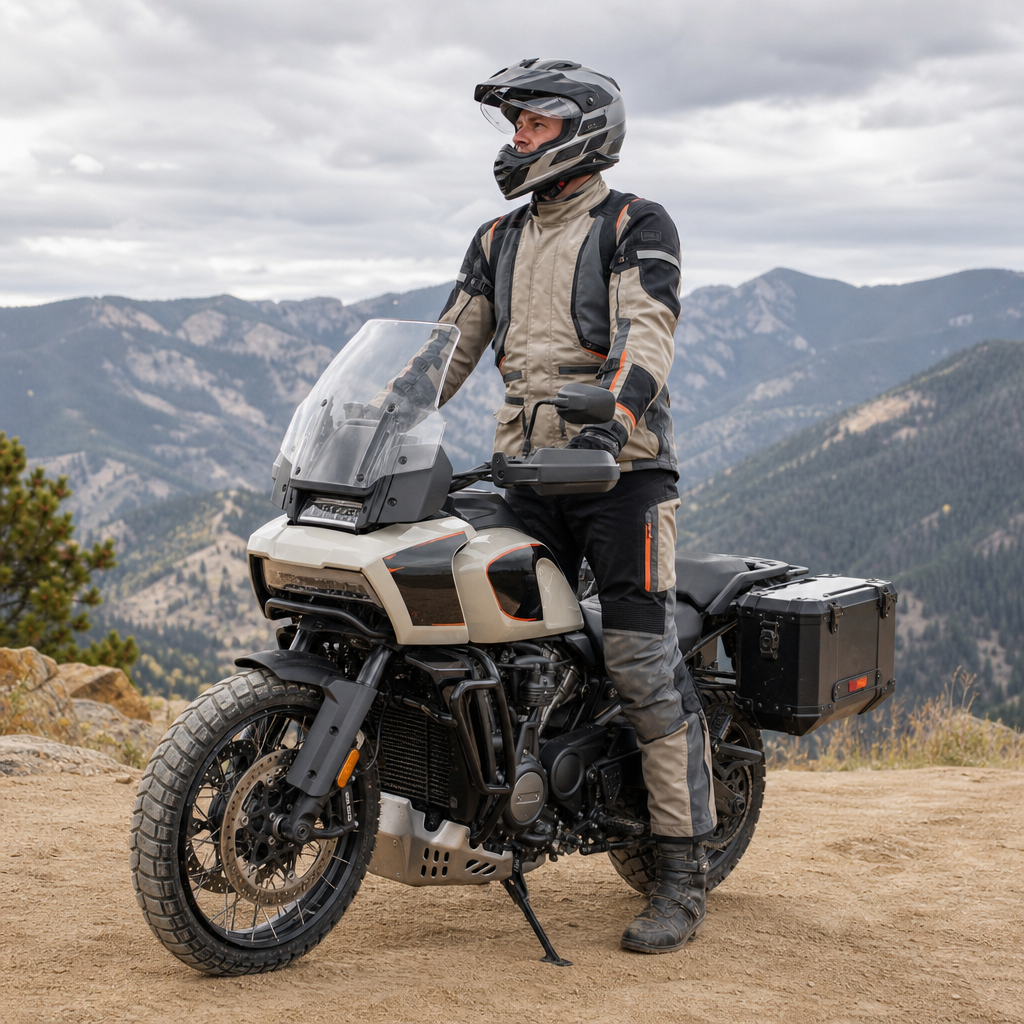
The Pan America 1250 center stand recipe is a practical blueprint for making the 2026 Harley-Davidson Pan America 1250 easier to service, easier to load, and less frustrating to live with in a real garage. In this context, a recipe means a repeatable combination of parts choice, fitment checks, setup steps, and riding-use compromises that improve one outcome without creating bigger problems elsewhere. For owners focused on maintenance ease, the center stand sits near the top of the list because it changes how quickly you can clean and lubricate the chain, inspect tires, remove wheels, pack luggage, and stabilize the motorcycle on uneven surfaces.
I have worked through enough adventure-bike workshop routines to know that a center stand is rarely just an accessory. On a 2026 Pan America 1250, it affects lifting effort, ground clearance, suspension behavior when parked, and how confidently a rider can perform roadside tasks. It also ties directly into the broader world of model-specific ergonomics and performance recipes: practical tuning decisions that adapt a motorcycle to a rider’s height, strength, terrain, and maintenance habits. As the hub for that subtopic under Harley-Davidson, this article explains how the center stand fits into a wider system that includes seat height strategy, foot control position, luggage balance, tire selection, suspension sag, and service workflow.
Why does this matter? Because convenience changes behavior. Riders who can get the rear wheel off the ground in seconds are more likely to maintain chain slack within specification, spot punctures early, and keep the bike cleaner around sensitive moving parts. That leads to less wear, fewer surprises on long trips, and lower ownership friction. The Pan America 1250 already offers strong engineering, including its Revolution Max platform and adaptive ride height availability on some trims, but maintenance ease depends on what happens after purchase. A good center stand recipe closes the gap between factory capability and everyday ownership, especially for riders who tour, commute, or mix pavement with gravel and mud.
What the Pan America 1250 Center Stand Actually Solves
A center stand solves three core problems. First, it lifts the rear wheel so chain care becomes controlled rather than awkward. On chain-driven adventure motorcycles, routine lubrication every few hundred miles in wet or dusty conditions is normal, and a stand turns that from a two-person task into a one-person job. Second, it stabilizes the motorcycle for loading and storage. Hard luggage, top cases, and camping gear can make a side-stand-leaning bike feel unsettled, especially on hot asphalt or dirt. Third, it supports deeper maintenance, including wheel removal, brake inspection, and better access during cleaning.
On the Pan America 1250, those benefits are especially relevant because this is a tall, relatively heavy adventure bike built to carry equipment and cover distance. Depending on trim and accessories, curb weight and luggage mass can push the parked bike into situations where side-stand management becomes tedious. I have seen owners improvise with paddock stands, trail jacks, and blocks under the side stand, but a properly designed center stand remains the most efficient answer for routine service. It is not a cure-all, though. It adds weight, introduces another low-mounted component, and can reduce clearance if poorly designed. The best recipe balances those tradeoffs deliberately.
How to Choose the Right Center Stand Recipe for 2026 Use
The right recipe starts with intended use, not with a catalog page. A rider who spends 80 percent of the time touring on pavement needs a different solution than someone crossing rutted fire roads every weekend. In my experience, the selection process should evaluate four variables in order: stand geometry, deployment effort, compatibility with skid plates and exhaust routing, and retained cornering or off-road clearance.
Stand geometry determines whether the bike rolls up smoothly or feels like dead weight. Good geometry uses lever length and foot tang position to give mechanical advantage without creating an obtrusive appendage. Deployment effort matters even more on a loaded Pan America. If a rider of average strength cannot place one foot on the tang, hold the left grip and rear frame point, and rock the bike onto the stand with controlled body weight, the design is wrong for that rider. Compatibility is non-negotiable. Many adventure setups use aftermarket skid plates, lower crash bars, or modified foot controls, and those parts can interfere with stand arc, spring tension, or retracted position.
Ground clearance is the hidden factor. Some owners buy the first stand available, then discover it contacts terrain transitions or drags sooner than expected in aggressive cornering. That is why the recipe must include spring preload retention, stop design, and retracted angle. On a machine expected to handle both road and trail, those details matter more than marketing claims.
Fitment Factors: Suspension, Tires, and Adaptive Ride Height
Fitment on the 2026 Pan America 1250 is not only about bolt holes. It is about the bike’s parked attitude and lift path. Tire diameter changes, suspension sag, preload settings, and adaptive ride height can all affect how easily the rear wheel comes clear of the ground. Even a small change in rolling radius from a more aggressive adventure tire can alter the practical usefulness of a stand.
If the stand lifts the rear wheel too high, deployment effort rises sharply, especially with luggage. If it lifts too low, chain service may still be awkward because the tire drags. Riders using adaptive ride height need to confirm whether the system’s lowered state at stop affects center stand engagement or whether the bike returns to a predictable height before the lift motion begins. That interaction is exactly why model-specific recipes matter. A part that works on a standard suspension bike may feel completely different on a machine whose seat height behavior changes dynamically.
| Recipe Variable | What to Check | Why It Matters for Maintenance Ease |
|---|---|---|
| Stand geometry | Lift arc, tang length, stop position | Determines whether one person can raise the bike consistently |
| Suspension setup | Sag, preload, adaptive ride height behavior | Changes how high the bike sits before and after deployment |
| Tire choice | Overall diameter and tread block height | Affects wheel clearance for chain cleaning and rotation |
| Accessory compatibility | Skid plate, crash bars, exhaust, foot controls | Prevents interference during installation and use |
| Weight distribution | Luggage, tool kits, fuel load | Influences lifting effort and parking stability |
Installation Standards and Workshop Best Practices
A proper center stand installation should follow Harley-Davidson service guidance, torque specifications supplied with the kit, and thread treatment requirements for pivot fasteners. This is not the place for guesswork. Pivot bolts, bushings, return springs, and stop surfaces all work under repeated load cycles, dirt exposure, and vibration. If the stand develops lateral play, binds, or retracts weakly, maintenance ease disappears and safety risk grows.
In the workshop, I treat center stand installation like chassis work, not like bolt-on decoration. That means supporting the motorcycle securely, confirming fastener alignment without cross-threading, checking full stand travel before spring installation, and verifying that springs seat correctly in both deployed and retracted positions. After installation, I compress suspension, inspect skid plate and exhaust clearance, and confirm there is no contact with the chain run or swingarm through the expected range of motion. A short road test should include slow-speed left and right transitions, speed bump clearance, and a post-ride fastener recheck after heat cycling.
Owners doing their own work should use a calibrated torque wrench, suitable spring-installation method, and the official service manual. If anything feels forced, misaligned, or under tension before hardware is seated, stop and reassess. Center stands are simple in concept but unforgiving when installed incorrectly.
Ergonomics: Why Rider Size and Technique Matter
Center stand usability is part ergonomics, part mechanics. Two riders can own identical Pan America 1250s and report opposite experiences because one uses leverage correctly and the other tries to muscle the bike upward with arms alone. The correct technique is to hold the left handlebar, grip a strong rear lifting point, place firm downward force on the stand tang, and let body weight roll the bike onto the stand rather than deadlifting it.
Rider inseam, ankle mobility, and upper-body confidence matter here. A shorter rider may need a stand with a better-positioned tang or a luggage rack point that is easier to grasp. A taller rider may care more about retracted clearance than deployment leverage. This is why a model-specific ergonomics recipe should never be reduced to seat height alone. The whole parking-and-maintenance interaction matters, especially on an adventure motorcycle that may be handled when tired, muddy, or fully loaded at the end of a long day.
For some riders, the best recipe includes small supporting changes: lower-profile luggage on service days, strategic tool storage moved forward, or suspension preload reduced before lifting the bike in the garage. Those are not hacks; they are sensible workflow adjustments.
Performance Tradeoffs: Weight, Clearance, and Off-Road Reality
No honest center stand article should ignore performance costs. A stand adds mass low on the chassis, usually several pounds once hardware is counted. Low-mounted mass is less harmful than high-mounted luggage, but it is still there. More importantly, the stand occupies space that off-road riders may want for obstacle clearance and unimpeded underbody protection. In rocky terrain, a stand can become a contact point or collect mud and debris.
That does not make it a bad choice. It means the recipe must match the mission. For long-distance touring, commuting, and mixed-surface travel with regular maintenance stops, the benefits usually outweigh the costs. For riders building a Pan America primarily for harder trail work, the better recipe may be a lighter underbody setup plus a compact trail stand carried in luggage for occasional wheel service. The key is to be explicit about priorities rather than assuming every accessory belongs on every build.
On-road riders should also check lean-angle implications. A well-engineered stand retracts tightly and uses solid return spring force. A mediocre one can touch down early, especially if suspension is soft or the bike is heavily loaded. That is why post-installation testing matters as much as installation itself.
Building the Full Maintenance-Ease Hub Around the Center Stand
As a hub within Harley-Davidson model-specific ergonomics and performance recipes, the Pan America 1250 center stand topic connects naturally to several adjacent articles. The most useful next topics include chain maintenance routines, luggage loading balance, skid plate compatibility, tire choice effects on handling, suspension sag setup for touring, seat and peg ergonomics for standing control, and garage storage strategies for tall adventure motorcycles. Internal topic relationships matter because owners rarely solve one usability issue in isolation.
For example, a rider may search for a center stand because chain cleaning is annoying, then discover the real friction point is overloaded rear luggage making deployment difficult. Another may blame the stand when the actual issue is a tall tire and excessive preload reducing wheel clearance. Hub content should help readers diagnose the whole system. That is the value of the recipe approach: it treats comfort, control, and serviceability as connected decisions rather than separate accessory purchases.
In practical ownership terms, the best Pan America 1250 maintenance-ease setup is usually a package. It includes a quality center stand, verified accessory fitment, correct suspension baseline, a chain-care kit stored accessibly, and rider technique practiced at home before a trip. When those pieces are aligned, the bike becomes easier to maintain not just once in the garage, but repeatedly over thousands of miles.
How to Decide if This Recipe Fits Your Bike
The simplest test is to ask three questions. Do you perform your own chain service and inspection regularly? Do you travel with luggage or park on variable surfaces often? Do you value fast, stable access for cleaning, wheel work, and loading more than absolute minimum underbody complexity? If the answer is yes to most of those, a center stand recipe is probably a strong fit for your 2026 Pan America 1250.
If your riding is heavily off-road, your maintenance is done mostly in a fully equipped shop, or you prioritize every bit of clearance, the answer may be different. There is no universal best setup, only a setup that supports how the motorcycle is actually used. The strongest Harley-Davidson ownership decisions come from that kind of honest fit analysis.
The main takeaway is clear: the Pan America 1250 center stand recipe improves 2026 maintenance ease when it is chosen as part of a broader ergonomics and performance system. Pick a stand with sound geometry, verify compatibility with suspension and accessories, install it to proper standards, and test it under realistic load conditions. Do that well, and routine service becomes simpler, faster, and more reliable. Use this hub as your starting point, then map the related setup decisions that turn your Pan America into a bike that works better both on the road and in the garage.
Frequently Asked Questions
What does “center stand recipe” mean for a 2026 Harley-Davidson Pan America 1250?
In this article, a center stand recipe is not just a single accessory recommendation. It is a practical, repeatable setup strategy that combines the right stand, the right hardware, the right fitment checks, and the right expectations for day-to-day use. The goal is to improve maintenance ease without creating new annoyances such as reduced cornering clearance, awkward deployment, unstable parking, or interference with other accessories. For the 2026 Pan America 1250, that matters because a center stand affects more than tire changes or chain lubrication routines on other motorcycles. It changes how easily you can inspect the underside, clean the bike, rotate wheels for detailed checks, stabilize the motorcycle during garage work, and reduce the effort involved in loading luggage or working around the bike in a tight space.
A good recipe starts by identifying how the motorcycle is actually used. A rider who mainly tours on pavement may prioritize easy lifting and solid parking stability. A rider who mixes in rough backroads may care more about ground clearance, spring retention, and how tucked-up the stand sits when retracted. A rider who performs most maintenance at home may value stand geometry and leverage above all else. That is why the recipe concept is useful: it treats the center stand as part of a system rather than a bolt-on afterthought. You are balancing maintenance convenience, riding clearance, installation complexity, long-term durability, and compatibility with skid plates, exhaust routing, suspension height, and luggage habits.
In practical terms, the recipe usually includes four pieces: choosing a stand designed specifically for the Pan America platform, confirming compatibility with model-year-specific hardware and any existing aftermarket parts, installing and torquing it correctly with proper spring alignment, and testing how the bike behaves both on and off the stand with realistic fuel load and luggage weight. That repeatable process is what turns a center stand from “nice to have” into a meaningful improvement in garage usability for 2026 ownership.
Why is a center stand such a high-value upgrade for maintenance ease on the Pan America 1250?
The biggest reason is simple: a center stand makes routine service less awkward. On a large adventure motorcycle like the Pan America 1250, anything that helps you hold the bike upright, stable, and predictable saves time and reduces frustration. Tasks that are annoying on the side stand become much easier when the bike is upright. That includes cleaning wheels, inspecting tires for damage, checking brake components from both sides, accessing the lower engine area, removing skid-adjacent debris, and organizing garage work without constantly worrying about the bike leaning or shifting. Even basic jobs like washing, drying, and storing the motorcycle are more controlled when the machine is planted on a center stand.
It also improves how the bike fits into real garage life. A center stand often reduces the amount of floor space the bike occupies compared with the side stand, which can matter if the motorcycle shares room with shelves, tools, a car, or another bike. It keeps the Pan America more vertical for storage, makes it easier to cover, and can simplify loading soft luggage or top luggage because the bike is less likely to lean and sway while you are working. For riders who do their own service, that stable upright position is especially useful when checking fasteners, removing bodywork, or doing detailed inspections after travel.
Another often-overlooked benefit is repeatability. Maintenance gets easier not because every task becomes effortless, but because the setup becomes predictable every time. You know where the bike will sit, how it will balance, and how much working room you will have beneath and around it. That repeatability matters more than many owners realize. It lowers the barrier to doing small maintenance tasks promptly instead of postponing them. Over time, that means cleaner inspections, faster pre-ride checks, and a better overall ownership experience. On a capable but physically substantial motorcycle like the 2026 Pan America 1250, the center stand earns its value by reducing friction in everyday ownership.
What should owners check before choosing and installing a center stand on the 2026 Pan America 1250?
The first thing to verify is true model compatibility. Even if a stand is advertised for the Pan America 1250 family, owners should confirm it specifically supports the 2026 fitment and any trim differences that affect mounting points, suspension ride height, underbody protection, or exhaust clearance. A stand that fits one year or one variant can still require revised hardware, different stop geometry, or extra attention on a later bike. It is also important to check whether the motorcycle has a stock or modified skid plate, crash bars, lowered suspension components, aftermarket exhaust pieces, or other accessories that occupy the same physical space as the stand or its retracted arc.
Next, pay attention to leverage and parking geometry rather than only looking at price. A center stand should not be judged only by whether it physically bolts on. It should lift the bike with reasonable effort, hold it securely, and retract cleanly without rattling or hanging low. Review the shape of the foot tang, the spring arrangement, and the deployed footprint. If a stand requires excessive effort to use, owners may stop using it regularly. If it retracts too low, it may become an annoyance off pavement or in aggressive cornering. If it sits too close to an aftermarket skid plate or center section of the exhaust, heat and vibration can become long-term problems.
Before installation, inspect all supplied components carefully. Confirm that bushings, pivot bolts, spacers, stops, washers, and springs match the instructions and are free of obvious defects. During installation, the mounting points should be clean, hardware should be torqued to specification, and any thread treatment should match the manufacturer’s instructions rather than guesswork. Once installed, cycle the stand multiple times before riding. Check for smooth movement, spring retention, full retraction, even leg contact, and adequate clearance with the bike unloaded and loaded. Then test real-world conditions: full fuel, luggage if used, suspension compressed by rider weight, and steering moved side to side if there is any possibility of indirect interference. That careful pre-check and post-check process is what separates a successful center stand recipe from a frustrating one.
Are there any trade-offs to adding a center stand to the Pan America 1250 for easier maintenance?
Yes, and acknowledging them honestly is part of building a good recipe. The most common trade-offs are added weight, reduced underbody clearance, possible cornering or obstacle contact depending on design, and one more mechanical assembly that needs occasional inspection. On a large adventure motorcycle, even a well-designed center stand adds mass low on the bike. That is usually acceptable for riders prioritizing maintenance ease, but it is still real. If the bike is used aggressively off road, crossing ledges, deep ruts, or uneven terrain, the physical presence of the stand matters more than it does for a mostly pavement-based touring setup.
There can also be compromises in use feel. Some stands are easier to deploy but tuck up less tightly. Others preserve better clearance but take more effort to lift. A stand that works beautifully in a clean garage on level concrete may feel less convenient on uneven pavement, gravel, or a fully loaded travel stop. That is why “best” depends on the owner’s routine. If your priority is home maintenance, detailing, and loading, the trade-off is usually worth it. If your priority is maximum off-road clearance and the lowest possible vulnerability under the bike, the trade-off becomes more significant.
Compatibility trade-offs are also important. A center stand can conflict with certain skid plates, exhaust systems, or lowering kits. In some cases the conflict is obvious and physical; in others it shows up only under suspension compression or vibration. There is also the question of long-term noise and wear. Poorly fitted stands can develop rattles, uneven stop wear, or spring fatigue if they are not installed and checked correctly. None of that means a center stand is a bad idea. It means the right approach is to choose a design that matches how the Pan America is actually ridden and maintained. The smartest recipe is the one that improves service access and garage usability while keeping the bike’s real-world riding strengths intact.
How can owners get the most maintenance benefit from a center stand after it is installed?
The biggest gain comes from using it as part of a consistent maintenance routine rather than only as an emergency convenience. Once installed, the center stand should become your default position for garage inspections, cleaning, storage, and service preparation whenever the surface is solid and level. That allows you to standardize how you check tire condition, brake wear, wheel cleanliness, under-engine grime, loose hardware, fluid seepage, and road damage after longer rides. Because the bike sits upright, visual checks are more accurate and less physically awkward. Over time, that reduces the tendency to skip smaller tasks that later become larger issues.
It also helps to learn the bike’s ideal lifting technique with your exact setup. The Pan America 1250 may behave differently depending on tire choice, luggage, fuel load, and suspension setup. Practice deploying the stand with the bike unloaded first, then with your normal travel kit. Use smooth pressure on the stand tang while guiding the bike up rather than trying to muscle it awkwardly. Owners who understand the stand’s leverage point and balance behavior tend to use it more often, which is