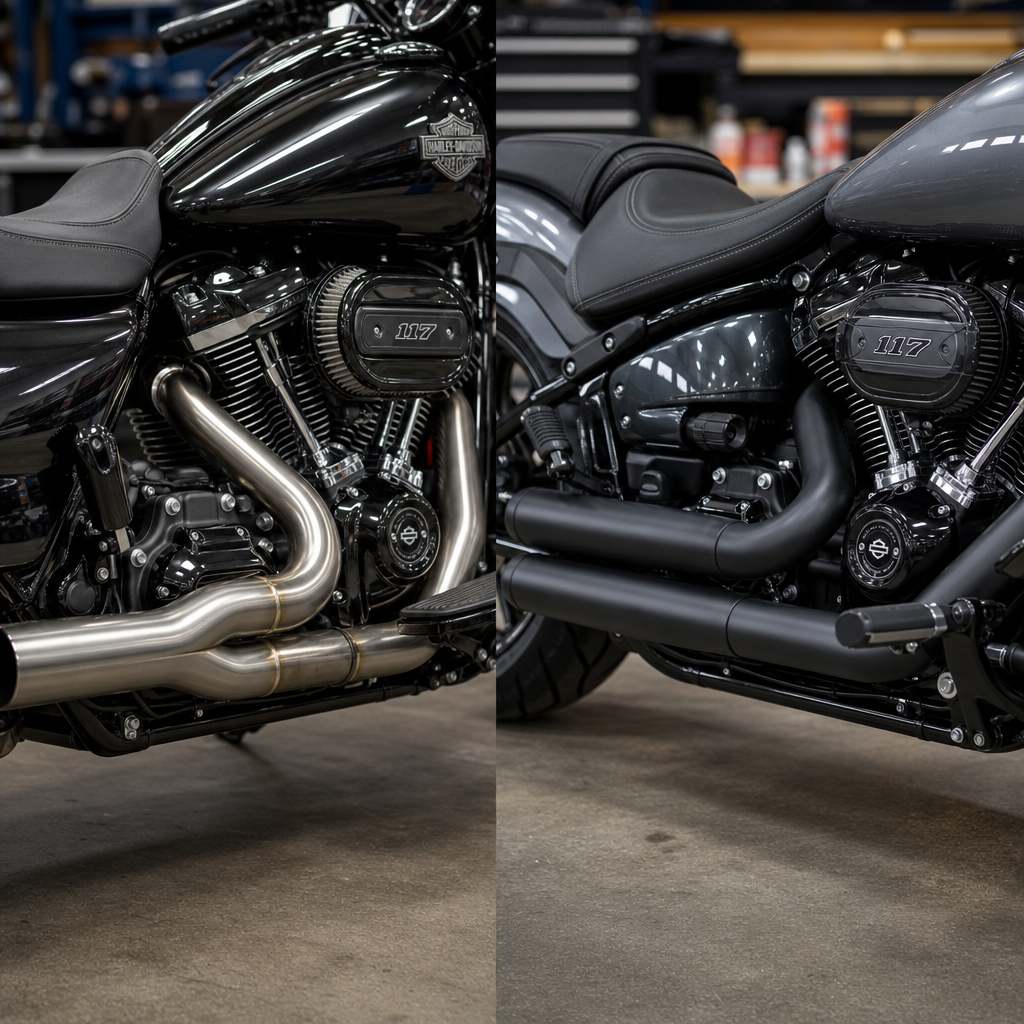
The 2020 Low Rider S has become one of the smartest used Harley-Davidson buys in 2026 because it combines the Milwaukee-Eight 114 engine, aggressive West Coast styling, proven Softail chassis hardware, and a parts ecosystem that makes ownership easier than many newer models. For riders shopping the used market, it also sits at an unusually useful intersection: modern enough to deliver strong brakes, decent electronics, and broad dealer support, yet old enough to avoid the steepest depreciation curve.
Within Harley-Davidson used buyer guides, terms matter. The “114 motor” refers to the air-and-oil-cooled Milwaukee-Eight 114 V-twin, displacing 114 cubic inches, or 1,868 cc. “Bronze wheels” refers to the cast Radiate design finished in matte dark bronze, one of the visual signatures that separates the 2020 Low Rider S from standard cruisers. A “sub-pillar hub” for used buyer guides means this article does more than review one bike: it helps buyers understand how the 2020 Low Rider S fits into the broader Harley-Davidson buying timeline from 1990 through 2035, including what to compare, what to inspect, and what ownership trends are shaping values.
I have worked through enough used Harley evaluations to know that popular models rarely stay popular by accident. They become favorites because they solve real buyer problems. The 2020 Low Rider S solves several. It offers a big-inch engine without moving into full touring-bike bulk. It looks custom from the factory without demanding immediate cosmetic spending. And it delivers a familiar mechanical package that independent shops already understand. That combination is exactly why riders returning to Harley-Davidson in 2026, as well as first-time V-twin buyers, keep shortlisting it.
This matters because the used Harley-Davidson market from 1990 to 2035 is crowded, and buyers need context. Evo-era bikes from the 1990s have charm but can require catch-up maintenance. Twin Cam models from the 2000s opened the door to bigger displacement and broad customization, but some years require careful attention to cam chain tensioners, compensators, and heat management. Milwaukee-Eight bikes, especially post-2018 examples, brought smoother running, stronger stock torque, and better day-to-day manners. The 2020 Low Rider S lands in that later, more refined window while keeping the stripped, performance-cruiser personality that many riders actually want.
What makes the 2020 Low Rider S stand out in the Harley-Davidson used buyer guide timeline
The 2020 Low Rider S matters in the 1990–2035 used buyer guide timeline because it represents a clear endpoint in Harley-Davidson’s shift from nostalgia-first cruisers to factory-built performance-oriented V-twins. Earlier Dyna Low Rider S models built a following, but the 2020 Softail-based version widened the audience. It used the stiffer Softail frame, inverted front suspension, dual front discs, and a riding position that encouraged brisk back-road use rather than only boulevard cruising.
In practical buying terms, that gives the 2020 model unusual reach. A rider cross-shopping a 1998 FXD, a 2006 Dyna Street Bob, a 2016 Low Rider S, and a 2022 Low Rider ST will notice that the 2020 Low Rider S sits in the middle of several trends. It has more stock performance than older cruisers, fewer touring parts than baggers, and less electronic complexity than the latest infotainment-heavy models. For used buyers, fewer layers can mean fewer expensive surprises.
Its relevance as a hub topic is even broader. If you are researching Harley-Davidson used buyer guides from 1990 to 2035, this model serves as a benchmark for what many shoppers now expect: real torque, modern brakes, stable chassis behavior, and styling that still feels current six years later. That benchmark helps you judge both older and newer Harleys more accurately. Once you know why the Low Rider S works, it becomes easier to evaluate whether a Heritage Softail, Road King Special, Street Bob 114, Fat Bob 114, or Low Rider ST better matches your budget and riding style.
Why the Milwaukee-Eight 114 remains a favorite engine in 2026
The main reason buyers continue to prioritize the 114 motor is simple: it feels strong everywhere riders actually use it. The Milwaukee-Eight 114 makes abundant low- and midrange torque, which means easy launches, relaxed highway passing, and less constant shifting than smaller-displacement cruisers. Harley-Davidson rated the 114 at roughly 119 lb-ft of torque in this period, and in real riding that translates to a bike that pulls with authority from low rpm without needing aggressive clutch work.
I have found that this engine’s appeal grows when riders move directly from Twin Cam bikes. The Milwaukee-Eight runs smoother at speed, idles with less busy mechanical feel, and generally responds better to stock fueling. It also benefits from four valves per cylinder, improved combustion efficiency, and dual spark plugs, all of which contribute to stronger throttle response and cleaner cold starts compared with older generations.
That does not mean it is perfect. The 114 still produces heat in traffic, especially in hot climates, and some owners prefer upgraded seats or reduced-reach bars to make longer rides easier. But as a used-engine platform, it has a strong reputation. Independent tuners know it well, Screamin’ Eagle parts are plentiful, and support from companies such as S&S, Bassani, Fuel Moto, and Dynojet remains extensive. A Stage 1 setup with intake, exhaust, and tune is common and usually transforms the bike without hurting its street manners when done correctly.
For shoppers asking whether the 114 is enough in 2026, the answer is yes. Larger-displacement crate builds and 117-powered models exist, but the 114 hits the sweet spot between stock reliability, easy serviceability, and satisfying real-world performance. On used market terms, that sweet spot supports resale and helps explain why demand remains strong.
Bronze wheels, blacked-out finishes, and why factory style affects resale
The bronze wheels are not a trivial styling note; they are a major reason the 2020 Low Rider S remains visually distinctive in a crowded Harley-Davidson field. Used-bike shoppers often claim cosmetics do not matter, then consistently pay more for the bike that already looks right. Harley understood that with this model. The matte dark bronze cast wheels break up the bike’s black mass, add contrast without looking flashy, and instantly identify the model from a distance.
Factory style matters because it changes ownership cost. A standard cruiser may need bars, wheels, exhaust, lighting, and paint accents before the owner feels satisfied. The Low Rider S arrives with a compact cowl, moto-style handlebar, blacked-out finishes, and premium stance already in place. Buyers save money by avoiding the first wave of cosmetic modifications, and that lowers the true cost of ownership.
This also affects resale behavior. Tasteful factory styling ages better than heavily personalized builds. In the used Harley market, many modified bikes are worth less than their parts bill because buyers worry about tuning quality, wiring shortcuts, and hard riding. The 2020 Low Rider S avoids that trap when left close to stock. Even when upgraded, it tends to carry changes that buyers understand, such as a 2-into-1 exhaust, taller risers, or improved suspension.
| Feature | 2020 Low Rider S benefit | Used-buyer effect in 2026 |
|---|---|---|
| Milwaukee-Eight 114 | Strong torque and broad aftermarket support | High demand, easier service planning |
| Bronze cast wheels | Distinctive factory appearance | Better curb appeal and resale confidence |
| Softail chassis | Improved stiffness and predictable handling | Appeals to riders upgrading from older Dynas |
| Dual front discs | Stronger braking than many traditional cruisers | Adds value for commuters and back-road riders |
| Blacked-out trim | Custom look without heavy modification | Reduces immediate personalization cost |
How the 2020 Low Rider S compares with older and newer Harley-Davidson options
In a comprehensive Harley-Davidson used buyer guide covering 1990 through 2035, comparison is essential. Against 1990s Evolution models, the 2020 Low Rider S wins on braking, frame rigidity, and stock power. Evo bikes still attract riders who want mechanical simplicity and classic character, but most will feel older in every dynamic category. Against 2000s Twin Cam Dynas, the 2020 bike adds stronger stock performance, modern chassis behavior, and better all-around refinement, though some riders still prefer the feel and tuning culture of the rubber-mounted Dyna platform.
Compared with newer motorcycles, the 2020 Low Rider S remains competitive because the formula has not gone stale. A 2022 or 2023 Low Rider ST adds fairing, bags, and touring utility, but also adds complexity, weight, and usually a higher buy-in. A Street Bob 114 offers a simpler entry point, yet it lacks some of the Low Rider S hardware that enthusiasts specifically want. The Fat Bob 114 delivers more radical styling and dual-disc confidence, but it remains a more polarizing design in the resale market.
That is why the 2020 Low Rider S works so well as a hub reference point. It helps buyers sort Harley-Davidson used purchases by intended use. Want pure nostalgia? Compare against Evo Softails. Want the strongest value among big-inch modern cruisers? Compare against Street Bob 114 and Fat Bob 114. Want distance capability with similar engine character? Compare against the Low Rider ST and Road King Special. The Low Rider S anchors the conversation because it sits at the performance-cruiser center of the lineup.
What to inspect before buying a used 2020 Low Rider S
A good used Harley-Davidson buyer guide must answer the practical question: what should you inspect before handing over money? Start with service records. Confirm the initial break-in service was completed and look for regular fluid changes, especially engine oil, transmission fluid, and primary fluid. Ask whether the bike has been tuned after intake or exhaust changes. A proper flash tune or dyno tune matters; a poorly mapped bike can run hotter and less smoothly.
Inspect tires for age as well as tread. Many used cruisers have decent-looking rubber that is simply old and hardened. Check brake pad life and rotor condition, especially if the bike was ridden hard in urban traffic. On the 2020 Low Rider S, examine the fork for seal leakage, the rear shock for preload adjustment condition, and the wheels for curb rash or impact damage. Bronze finishes can hide neglect from a distance but tell the truth up close.
Look at common modification zones carefully: exhaust mounting, wiring around bars and signals, aftermarket seats, and relocated gauges. I routinely advise buyers to be cautious with heavily customized examples unless documentation is excellent. Accessories are not automatically bad, but every extra electrical component increases the need for tidy routing and competent installation. During a test ride, verify smooth clutch take-up, stable straight-line tracking, no pulsing through the front brake lever, and clean fueling off idle.
Finally, check VIN history, title status, recall completion, and whether any original take-off parts are included. A seller who kept stock components usually maintained the bike thoughtfully. That detail often predicts an easier ownership experience better than shiny paint does.
Ownership costs, reliability, and who should buy this bike in 2026
The 2020 Low Rider S is not the cheapest Harley-Davidson to insure or buy, but it often represents better value than cheaper older bikes that need immediate sorting. Reliability is generally solid when maintenance is current. Consumables are straightforward, dealer and independent shop knowledge is deep, and parts availability remains strong. Fuel economy varies with riding style, but many owners see mileage in the low-to-mid 40 mpg range, which is acceptable for a big-inch performance cruiser.
This bike best suits riders who want one Harley to cover commuting, weekend back roads, and occasional light touring. Add a windshield and compact luggage and it broadens easily. It is less ideal for riders who prioritize passenger comfort, very long interstate days, or feet-forward relaxed ergonomics above all else. In those cases, a Heritage Softail, Road King, or Low Rider ST may be the better used-buy answer.
As a sub-pillar hub for used buyer guides from 1990 to 2035, the key lesson is this: buy by platform, not just by badge. The 2020 Low Rider S succeeds because its engine, chassis, appearance, and aftermarket all align with how people actually ride. That alignment is rare. It explains why the 114 motor and bronze wheels still attract attention in 2026, and why clean examples continue to move quickly when priced fairly.
If you are building a Harley-Davidson shortlist, start with the 2020 Low Rider S as your measuring stick. Compare it honestly against older Evo and Twin Cam models, against newer bagger-influenced performance bikes, and against your own riding needs. When a used motorcycle still feels current, needs little to look right, and delivers torque you can use every day, it earns its reputation. The 2020 Low Rider S has earned it. Use this hub as your foundation, then move deeper into year-by-year Harley-Davidson used buyer guides to find the exact bike that fits your budget, maintenance tolerance, and riding goals.
Frequently Asked Questions
Why is the 2020 Low Rider S such a strong used Harley-Davidson buy in 2026?
The 2020 Low Rider S hits a rare sweet spot in the used market. It feels modern where it matters most, but it is old enough to have moved beyond the heaviest early depreciation. For 2026 buyers, that matters because you are getting a motorcycle with strong real-world performance, solid braking, useful electronic rider aids, and widespread dealer familiarity without paying the premium often attached to newer models. It is not an old-school compromise bike; it is a genuinely capable performance cruiser built around Harley-Davidson’s proven Softail platform.
Another major reason it stands out is balance. The bike combines the Milwaukee-Eight 114 engine, an aggressive factory stance, and a very usable riding position that appeals to a broad range of riders. It looks custom without demanding that you immediately spend thousands modifying it just to achieve the right attitude. At the same time, it has enough aftermarket support that owners who do want to personalize it can do so easily. That mix of factory performance, long-term parts availability, and easy customization is a big reason the 2020 model continues to attract attention in 2026.
There is also a practical ownership argument. Because the 2020 Low Rider S sold well and shares key components with other Softail models, service knowledge, replacement parts, tuning options, luggage solutions, and comfort upgrades are all widely available. In a used-bike environment where some machines are hard to source parts for or expensive to insure and repair, the Low Rider S remains accessible. That makes it a smart choice not only for enthusiasts who appreciate the styling and engine, but also for buyers who are thinking carefully about long-term cost, support, and resale.
What makes the Milwaukee-Eight 114 engine one of the biggest reasons buyers still want the 2020 Low Rider S in 2026?
The Milwaukee-Eight 114 is a major part of the 2020 Low Rider S appeal because it delivers exactly what many cruiser riders want in the real world: strong torque, quick roll-on acceleration, and a broad powerband that works well on city streets, back roads, and highways. It is not just about peak numbers. The engine gives the bike an easy, muscular character that makes passing, merging, and casual two-lane riding feel effortless. In everyday use, that kind of accessible power matters far more than spec-sheet bragging rights.
In 2026, buyers also appreciate that the 114 has a well-established reputation. By now, the market has had years to understand how these engines hold up, what common service items look like, and which upgrades produce worthwhile results. That reduces uncertainty for used-bike shoppers. Instead of buying into an unfamiliar platform, owners are stepping into a mature ecosystem with known maintenance patterns, broad technician familiarity, and countless proven aftermarket tuning paths. If you want to keep it stock, that is easy. If you want intake, exhaust, cam, or tuning upgrades, that path is also well mapped out.
Perhaps most importantly, the 114 helps the Low Rider S feel special without making it difficult to live with. It gives the bike performance credibility, but it does not turn ownership into a niche project. Riders who want a Harley that feels fast, sounds right, responds well to modifications, and still benefits from mainstream parts and service support continue to see the Milwaukee-Eight 114 as a core reason the 2020 Low Rider S remains a favorite.
Why are the bronze wheels and overall styling of the 2020 Low Rider S still so popular in 2026?
The bronze wheels are a perfect example of why the 2020 Low Rider S continues to connect with buyers years after launch. They give the bike a factory-custom look that stands apart from more traditional chrome-heavy cruisers and from fully blacked-out models that can sometimes look generic. On the Low Rider S, the bronze finish adds contrast, highlights the bike’s performance-oriented identity, and ties together the West Coast-inspired visual theme in a way that still feels distinctive in 2026.
Styling matters in this segment, and Harley-Davidson got the proportions right. The compact fairing, moto-style handlebar setup, dark finishes, and muscular stance make the bike look aggressive without appearing overdone. It has an athletic silhouette that hints at performance rather than pure showmanship. That is important because the Low Rider S attracts riders who want a bike that looks ready to move, not just one designed to sit outside a coffee shop. Even years later, it still looks intentional and contemporary.
There is also a practical side to the design’s popularity. Because the stock appearance is so strong, many buyers feel less pressure to spend immediately on cosmetic changes. The bike already has identity. For used shoppers, that makes value easier to see because the visual appeal comes from the factory package rather than from expensive aftermarket parts that may or may not suit the next owner’s taste. In short, the bronze wheels are not just a color choice; they are part of a design package that helped make the 2020 Low Rider S memorable, and that memorability continues to drive demand in 2026.
How does the 2020 Low Rider S compare with newer Harley models for everyday ownership and value?
Compared with many newer Harley-Davidson models, the 2020 Low Rider S often wins on value because it offers a lot of the experience riders actually want without the highest purchase price. Buyers get modern performance hardware, a respected engine, strong visual character, and proven chassis engineering in a package that has already absorbed a meaningful portion of depreciation. That means the ownership equation can be more favorable: lower buy-in, broad support, and less fear of taking a major financial hit compared with buying brand new.
For everyday ownership, the 2020 model is also attractive because it is recent enough to avoid feeling outdated. It benefits from the modern Softail chassis, capable brakes, and the kind of baseline refinement many riders expect in a contemporary Harley. Yet it avoids some of the complexity, scarcity, or early-adopter pricing that can surround newer platforms and newly introduced trim variations. In practical terms, that can mean easier shopping, more examples on the market, more owner feedback to learn from, and a larger supply of compatible accessories and replacement parts.
There is an emotional component as well. Some newer models may offer incremental refinements, but the 2020 Low Rider S has already established itself as a standout in Harley’s recent lineup. It is viewed by many riders as one of the cleaner, more focused expressions of the performance-cruiser idea. That gives it a certain staying power. In 2026, a buyer is not just purchasing an older used bike; they are buying a model with a reputation, a clear identity, and a strong chance of remaining desirable for years to come.
What should buyers check when shopping for a used 2020 Low Rider S in 2026?
Start with the basics, but be thorough. Confirm service history, look for evidence of regular fluid changes, and ask whether the bike has had any tuning work, intake or exhaust modifications, suspension changes, or electrical accessory additions. None of those upgrades are automatically bad; in fact, many Low Rider S models are tastefully improved. The key is documentation and quality. A professionally installed, well-tuned setup is very different from a bike with unknown mapping, homemade wiring, or parts chosen for appearance rather than reliability. On a used performance-oriented Harley, modification quality matters almost as much as mileage.
Inspect wear items carefully. Check tires for age as well as tread, examine brake pad life and rotor condition, and look for signs of neglect around the belt, pulleys, controls, and switchgear. Make sure the bike starts cleanly, idles properly, and pulls smoothly through the rev range. During a test ride, pay attention to clutch feel, transmission engagement, brake response, and any unusual vibration, rattles, or headshake. The Softail chassis is proven, so odd behavior should be taken seriously rather than dismissed as “just Harley character.”
Also evaluate how the bike was used. A lower-mile example is not always the better buy if it sat for long periods, while a properly maintained bike with reasonable mileage can be an excellent choice. Look at cosmetic details too, especially the bronze wheels, finishes, and bodywork, because these bikes are often purchased by owners who care about presentation. If a Low Rider S has complete records, quality upgrades, clean cosmetics, and evidence of attentive maintenance, it can be one of the smartest and most satisfying used Harley-Davidson purchases in 2026.