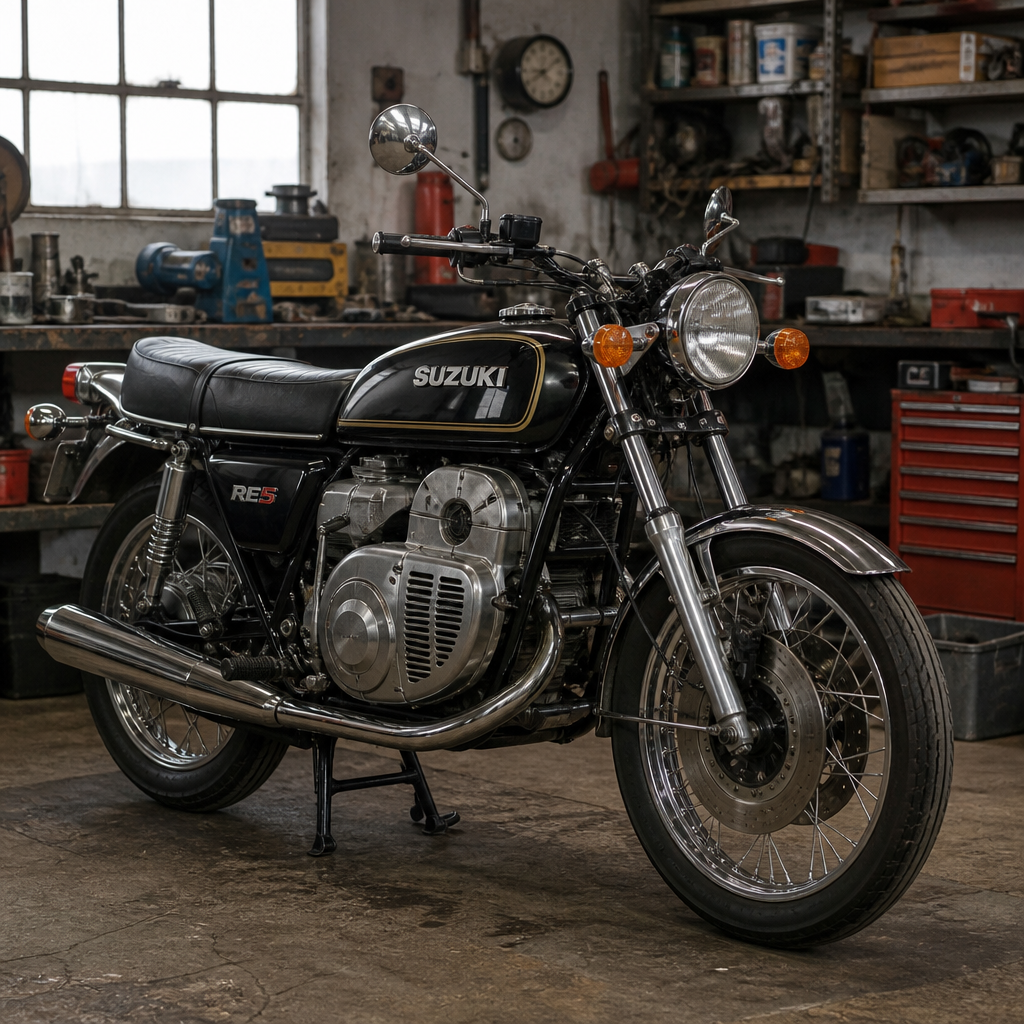
The Suzuki RE5 Rotary occupies a strange and fascinating corner of motorcycle history, and restoring one is both a technical nightmare and a deeply satisfying reward. Built for only a brief period in the mid-1970s, the RE5 was Suzuki’s bold attempt to commercialize a Wankel-powered motorcycle at scale, blending advanced engineering with styling that was years ahead of many rivals. In today’s metric-classic world, especially within the broader field of restoration guides for 1970–1995 Japanese motorcycles, the RE5 stands apart because ordinary vintage-bike habits do not fully apply. A restorer dealing with a CB, XS, Z, or GS can rely on familiar four-stroke patterns; the RE5 demands rotary-specific knowledge, careful diagnostics, and unusually disciplined parts planning.
For clarity, a metric classic generally refers to a motorcycle built in Japan or continental Europe using metric fasteners and engineering conventions, most often from the 1970–1995 period now favored by restorers. A hub article on restoration guides for metric classics must cover more than paint and polishing. It should explain model selection, parts support, documentation, authenticity, mechanical risk, and the restoration strategy that separates a safe rider from an expensive garage ornament. The RE5 is the ideal case study because it compresses every major restoration challenge into one machine: rare parts, misunderstood engineering, heat management, fragile seals, difficult carburetion, and a market that rewards correct work while punishing shortcuts. I have seen projects bought cheaply become far more expensive than a fully sorted example simply because the owner underestimated rotary-specific failures.
That is why this page matters as a sub-pillar hub. If you are researching restoration guides for metric classics from 1970–1995, you need a framework that helps you judge any project before spending money, and you need one flagship example that teaches hard lessons clearly. The RE5 provides both. Its restoration process touches every discipline in the encyclopedia: engine rebuilding, fuel-system rehabilitation, electrical troubleshooting, chassis recommissioning, sourcing obsolete components, evaluating originality, and deciding when preservation is wiser than a cosmetic teardown. Understanding the RE5 also improves your approach to other complex Japanese classics, from six-cylinder Hondas to turbo-era machines, because it trains you to respect documentation, verify assumptions, and budget realistically before the first bolt is removed.
Why the Suzuki RE5 matters within metric-classic restoration
The RE5 matters because it represents a high-water mark of Japanese engineering ambition during the 1970–1995 metric-classic era. Suzuki invested heavily in rotary development after licensing Wankel technology and believed the smoothness, compactness, and novelty of the concept could create a premium sport-touring motorcycle. The production result used a liquid-cooled, single-rotor engine displacing roughly 497 cc in chamber volume, with output commonly cited around 62 horsepower. On paper, that gave the RE5 competitive touring performance and a uniquely turbine-like power delivery. In practice, the bike was heavy, thirsty, hot-running, and expensive to build, but technically it was extraordinary.
For restorers, that significance translates into two realities. First, the RE5 has historical weight. A correct restoration preserves one of the few serious rotary motorcycles ever sold by a major manufacturer, and collectors recognize that importance. Second, the bike is unforgiving of generic methods. You cannot treat it like a GS750 with unusual bodywork. Suzuki engineered dedicated lubrication paths, cooling provisions, and induction controls specifically to manage combustion-chamber heat and rotor-seal survival. Miss one system interaction and the whole machine suffers. That makes the RE5 a central reference point for serious restoration guides covering metric classics, especially when discussing rare or technically atypical models.
It also functions as a practical hub model because the same restoration decision tree applies across the category. Before tackling an RE5, you assess title status, engine completeness, corrosion, fuel contamination, electrical damage, and parts availability. Those same checks guide work on an early Gold Wing, a Kawasaki Z1R, a Yamaha V-Max, or a first-generation GSX-R. The difference is that the RE5 magnifies consequences. A missing side cover on a common four-cylinder may be inconvenient; a missing RE5 airbox component or intake control part can stall a project for months. That pressure forces good habits that every metric-classic restorer should learn.
Engine and rotary-system challenges that make restoration difficult
The engine is the reason people buy an RE5 and the reason many projects are abandoned. The Wankel design replaces reciprocating pistons with a triangular rotor spinning inside an epitrochoid housing. Combustion occurs in moving chambers, and sealing depends on apex seals, side seals, corner seals, and properly finished housing surfaces. In restoration terms, that means compression testing is not as straightforward as on a piston engine, wear patterns are different, and damage from storage can be severe if moisture reached the housing or if stale oil compromised internals.
The most common technical nightmares begin with heat and sealing. RE5s run hot by modern expectations, and Suzuki addressed that with liquid cooling, oil metering, and a substantial exhaust layout. If the cooling system is neglected, hoses harden, water-pump seals degrade, and internal corrosion can attack passages. If the oil-injection system is tampered with or lines are brittle, seal and housing wear accelerate. I have found that many long-stored bikes carry evidence of amateur “simplifications,” such as disconnected emission or intake-control hardware, blanked vacuum lines, or improvised premix assumptions that ignore the original lubrication strategy. Those shortcuts often create difficult hot-starting, unstable idle, and poor rotor longevity.
Carburetion is another trap. The RE5’s induction system was tuned to support emissions compliance, rideability, and thermal control, not just peak power. Owners unfamiliar with the factory logic frequently misadjust the carburetor while trying to solve unrelated ignition or vacuum problems. The result is a bike that starts poorly, fouls plugs, overheats, or bogs under load. Correct restoration requires the factory service manual, the owner’s manual, and ideally period technical bulletins because Suzuki revised details during production. This is true across metric classics, but on the RE5 documentation is not optional; it is part of the tool kit.
| System | Common RE5 Failure | What a Restorer Should Check First |
|---|---|---|
| Rotary engine | Poor compression, housing wear, seal damage | Specialist compression evaluation, housing inspection, service-history review |
| Cooling system | Leaks, corrosion, overheating | Radiator condition, hoses, pump seals, coolant passage cleanliness |
| Oil metering | Blocked lines or incorrect modifications | Pump operation, feed lines, correct routing, evidence of tampering |
| Fuel and intake | Gummed carburetor, vacuum leaks, missing airbox parts | Original intake completeness, carb settings, diaphragm integrity |
| Ignition and charging | Weak spark, aged connectors, charging faults | Coils, stator output, grounds, connector heat damage |
The takeaway is direct: never buy an RE5 project on cosmetic impressions alone. Confirm the engine turns correctly, verify the rotary-specific systems are complete, and assume that a non-running example needs a full systems inspection before any attempt to start it. That disciplined approach belongs at the center of every restoration guide for metric classics, because exotic engineering magnifies the cost of wishful thinking.
Parts sourcing, documentation, and authenticity standards
Parts availability determines whether an RE5 restoration is merely difficult or genuinely impossible within your budget. Consumables such as bearings, seals, hoses, brake components, chains, tires, and many electrical supplies can often be matched through industrial suppliers or specialist vintage vendors. Model-specific items are another matter. Exhaust sections, body panels, intake components, instrumentation pieces, trim, rotary internals, and certain cooling or oiling parts can be painfully scarce. That is why experienced restorers buy completeness before they buy price. A rough but complete RE5 is usually a better starting point than a cleaner machine missing unique hardware.
Documentation is equally important. The factory service manual should be your primary reference, supported by the parts book and period sales literature. The parts book matters because it reveals supersessions, market-specific differences, and missing assemblies that a seller may not notice. On many metric classics from 1970–1995, especially Japanese models, owners have swapped wheels, forks, tanks, indicators, and exhausts over decades of use. The RE5’s rarity makes those substitutions more consequential because originality affects both function and value. For example, nonstandard intake or exhaust changes can alter running temperatures and mixture behavior, while missing cosmetic details can sharply reduce collector appeal.
Authenticity should not become dogma, but it must be deliberate. If you are building a rider, modern hoses, upgraded brake lines, improved tires, and discreet electrical improvements are sensible. If you are restoring for concours or serious collection, correct finishes, decals, fastener types, and year-specific equipment matter. The hub principle for all metric-classic restoration guides is simple: define the end state before spending money. A preservation-grade rider, a factory-correct show bike, and a mechanically renewed tourer require different choices, and the RE5 makes those choices visible early because correct parts are too expensive to buy twice.
How to plan an RE5 restoration from triage to first road test
The best RE5 restorations begin with triage, not disassembly. First document the machine thoroughly with photos, casting numbers, frame and engine identifiers, and routing details. Second, test completeness: airbox parts, exhaust shields, side covers, gauges, cooling pieces, oil lines, and emissions or control hardware. Third, inspect structural condition, including frame corrosion, crash damage, fork pitting, wheel integrity, and fuel-tank contamination. Only then should you build a budget and work sequence.
My preferred workflow mirrors what I use on other high-risk metric classics. Stabilize the electrical system, rebuild the fuel system, service the cooling system, verify lubrication integrity, assess compression and spark, then attempt first fire-up under controlled conditions. Once the engine proves viable, move to brakes, tires, steering-head bearings, swingarm bearings, suspension, and cables. Cosmetics come last. This order prevents a common and expensive mistake: spending heavily on paint, plating, and upholstery before learning that the engine or rotary housings are beyond practical repair.
The first road test should be short and data-driven. Monitor charging voltage, coolant behavior, oil consumption, idle stability, throttle response, and hot restarting. Check for fuel percolation, fan or airflow adequacy, and brake drag after heat cycles. Then retorque, recheck fluids, inspect plugs, and review every fastener you touched. These habits are not glamorous, but they are exactly how difficult machines become dependable riders. In the wider 1970–1995 metric-classic landscape, this process works just as well on turbo bikes, early EFI systems, and shaft-drive tourers with known weak points.
The reward: what a correctly restored RE5 gives back
A correctly restored Suzuki RE5 delivers something few classic motorcycles can match: genuine engineering novelty that still feels special on the road. The power delivery is smooth and linear, the sound is unlike a piston twin or four, and the bike carries the charisma of a manufacturer taking a real technical gamble. At shows, knowledgeable people stop because they know how few survived intact. On the road, the RE5 feels substantial and unmistakably seventies, yet the rotary character remains modern enough to surprise riders expecting agricultural behavior.
That reward is why the RE5 deserves its place at the center of restoration guides for metric classics from 1970–1995. It teaches that successful restoration is not about optimism; it is about method, documentation, and respect for original engineering. Buy the most complete example you can afford, verify rotary health before cosmetic spending, and use factory references for every system. If you apply those principles here, you can apply them to the rest of the metric-classic field with better results and fewer expensive mistakes.
For anyone building a serious maintenance and technical encyclopedia, the RE5 is both warning and inspiration. It warns that rarity and complexity punish casual work. It inspires because careful restoration can return a misunderstood machine to reliable, fascinating life. Start with research, build a realistic parts and labor plan, and follow the evidence instead of assumptions. Do that, and the Suzuki RE5 Rotary will reward you with one of the most memorable restorations in the entire metric-classic world.
Frequently Asked Questions
Why is the Suzuki RE5 considered such a difficult motorcycle to restore?
The Suzuki RE5 is difficult to restore because it combines several layers of complexity that restorers do not usually face all at once. First, it uses a Wankel rotary engine rather than a conventional piston engine, which means many mechanics familiar with 1970s Japanese motorcycles are immediately outside their comfort zone. The rotary’s operating principles, sealing requirements, cooling demands, and oiling strategy are fundamentally different from those of a four-stroke twin or four-cylinder machine. That alone raises the technical bar. On top of that, the RE5 was produced in limited numbers for a short period, so parts availability is dramatically narrower than for more common Suzuki models of the same era.
Another challenge is that the bike was ambitious everywhere, not just in the engine. The RE5 included unusual instrumentation, model-specific bodywork, distinctive intake and exhaust systems, and a number of one-year or low-volume components that are now hard to source in usable condition. Even seemingly ordinary restoration jobs, such as refurbishing electrics, rebuilding cooling components, or replacing rubber parts, can become drawn-out because originality matters and substitutes are not always straightforward. Many surviving bikes have also spent decades off the road, which means the usual storage-related issues are compounded by rotary-specific concerns such as internal corrosion, hardened seals, carbon buildup, and uncertainty about whether previous owners understood proper maintenance.
What makes it a “technical nightmare” is not that the RE5 is badly engineered. In fact, it was impressively engineered. The difficulty comes from the fact that it was advanced, unconventional, and never supported by a large long-term aftermarket. Restoring one properly requires patience, research, parts-hunting, and a willingness to solve problems that do not exist on mainstream vintage Japanese motorcycles. That is also exactly why finishing an RE5 restoration feels so rewarding: you are not simply reviving an old bike, you are preserving one of the boldest engineering experiments of the 1970s.
What are the most important mechanical areas to inspect before buying a Suzuki RE5 project?
Before buying an RE5 project, the first priority is to assess engine health as carefully as possible, because the rotary power unit is the heart of both the bike’s value and its restoration risk. You want to know whether the engine turns freely, whether it has acceptable compression characteristics for a rotary, whether there are signs of damaged apex or side seals, and whether the cooling and lubrication systems are complete and intact. A machine that has been stored improperly may have internal corrosion or seal deterioration, and unlike a conventional engine, the consequences can be expensive and technically intimidating. If there is any opportunity to inspect service history, prior rebuild documentation, or evidence of specialist work, that information can be more valuable than cosmetic appearance.
The second major area is completeness. Because so many RE5 parts are unique, an incomplete motorcycle can quickly become a restoration trap. Pay close attention to the original carburetion, airbox, exhaust system, radiator and cooling hardware, ignition components, gauges, warning-light assemblies, side covers, and trim pieces. Bodywork and instrumentation are especially important because cosmetic restoration on an RE5 is often limited by what can actually be found. Missing or damaged rotary-specific engine ancillaries can be more serious than worn paint or torn seat covers. A rough but complete machine is usually a better candidate than a cleaner-looking example assembled from mismatched parts.
You should also evaluate the wiring loom, fuel tank interior, brake system, forks, and final drive components just as you would on any 1970s motorcycle, but with added caution. Long dormancy can ruin hydraulic systems, contaminate the fuel system, and compromise every rubber component on the bike. Check for modifications by previous owners, especially crude electrical repairs, emissions-system removals, nonstandard intake changes, or improvised engine work. The best RE5 project is not necessarily the cheapest one; it is the one with the strongest combination of engine viability, parts completeness, and documented originality.
Are parts for the Suzuki RE5 still available, and what is hardest to find?
Yes, parts are still available, but availability exists on a spectrum, and understanding that is essential before starting a restoration. Basic service items can sometimes be sourced through specialist suppliers, owner networks, rotary enthusiasts, or cross-referencing with period Suzuki components where applicable. Consumables such as bearings, seals, hoses, brake rebuild items, and general hardware are often manageable if you have measurements, parts books, and patience. However, the RE5 quickly becomes difficult when you move beyond general service parts into model-specific engine pieces, emissions and intake hardware, original exhaust components, instruments, trim, and cosmetic details.
The hardest parts to find are usually the items that were unique to the RE5 and either wore out, were discarded long ago, or are difficult to reproduce economically. Complete and correct exhaust systems are highly prized. Airbox components, carburetor-specific fittings, original gauges, side covers, and rotary-engine-related parts can also be challenging. Depending on the model year and market, some styling details are scarcer than others, and condition matters enormously. A cracked, corroded, or modified original part may still be worth saving simply because there is no easy replacement. That is why many experienced restorers will buy spares whenever they appear, even if they do not need them immediately.
The best approach is to treat parts sourcing as a parallel restoration process rather than a later step. Join RE5 clubs and specialist forums, build relationships with marque experts, and obtain factory parts books and workshop literature early. In the RE5 world, knowledge often matters as much as inventory. A restorer who knows which parts can be restored, which can be adapted, and which absolutely must be original will save time, money, and frustration. With these bikes, the difference between a stalled project and a successful one often comes down to parts strategy rather than workshop skill alone.
Does the rotary engine require special restoration techniques compared with conventional 1970s Japanese motorcycles?
Absolutely. The RE5’s rotary engine changes the restoration process in ways that are both technical and procedural. A Wankel engine does not rely on pistons, valves, and camshafts, so the usual benchmarks of vintage motorcycle engine restoration do not fully apply. Instead, attention centers on rotor housing condition, internal sealing surfaces, apex and side seal integrity, proper lubrication, coolant passage health, and carbon management. Tolerances, wear patterns, and failure points differ from those of a piston engine, which means a restorer must either develop rotary-specific understanding or work closely with someone who already has it.
Cooling and oiling are particularly important on the RE5. Rotary engines generate heat differently, and sustained reliability depends on the cooling system being complete, clean, and functioning exactly as intended. A neglected radiator, compromised hoses, blocked passages, or incorrect coolant setup can create serious problems. Likewise, the lubrication arrangement must be understood and preserved correctly. Using the wrong oil practices or making assumptions based on conventional motorcycles can shorten engine life. Carburetion and intake setup also matter because drivability, temperature behavior, and starting characteristics can all suffer if the system is out of specification.
The practical takeaway is that restoration should begin with research, not dismantling. Factory manuals, period service bulletins, and specialist advice are indispensable. Compression testing, leak assessment, and careful inspection should guide the rebuild plan before major money is spent. In many cases, a conservative, informed recommissioning is better than an aggressive teardown performed by someone unfamiliar with rotary engines. The RE5 rewards methodical work and punishes guesswork. When restored correctly, however, the engine delivers the smooth, unusual character that made the bike so fascinating in the first place.
Is restoring a Suzuki RE5 worth it from a collector and riding perspective?
For the right enthusiast, yes, restoring a Suzuki RE5 is absolutely worth it, but it is important to define “worth” realistically. If the goal is a simple, inexpensive vintage Japanese motorcycle project, the RE5 is not the ideal choice. It is more demanding, more specialized, and generally more expensive to restore correctly than many conventional 1970s alternatives. But if the goal is to own and preserve one of the most unusual production motorcycles ever built by a major Japanese manufacturer, the RE5 offers something genuinely special. It occupies a unique place in motorcycle history as a large-scale attempt to bring rotary power into the showroom, and that historical significance gives the bike lasting collector interest.
From a riding perspective, the RE5 offers an experience that feels distinct even today. The power delivery, engine character, sound, and overall sense of engineering novelty set it apart from period twins and fours. It is not simply a curiosity to park at shows; when sorted properly, it delivers a smoothness and personality that make it memorable on the road. Riders who appreciate rare machinery often find the RE5 deeply satisfying because every mile reinforces that they are operating something different from the mainstream evolution of motorcycle design. That emotional return is a major part of the bike’s appeal.
As a collector’s machine, the RE5 also benefits from rarity and from the growing appreciation for technically ambitious dead ends in motorcycle history. Well-restored, complete, and correct examples attract attention precisely because they are uncommon and because many people know how difficult they are to bring back properly. The reward, then, is not purely financial. It