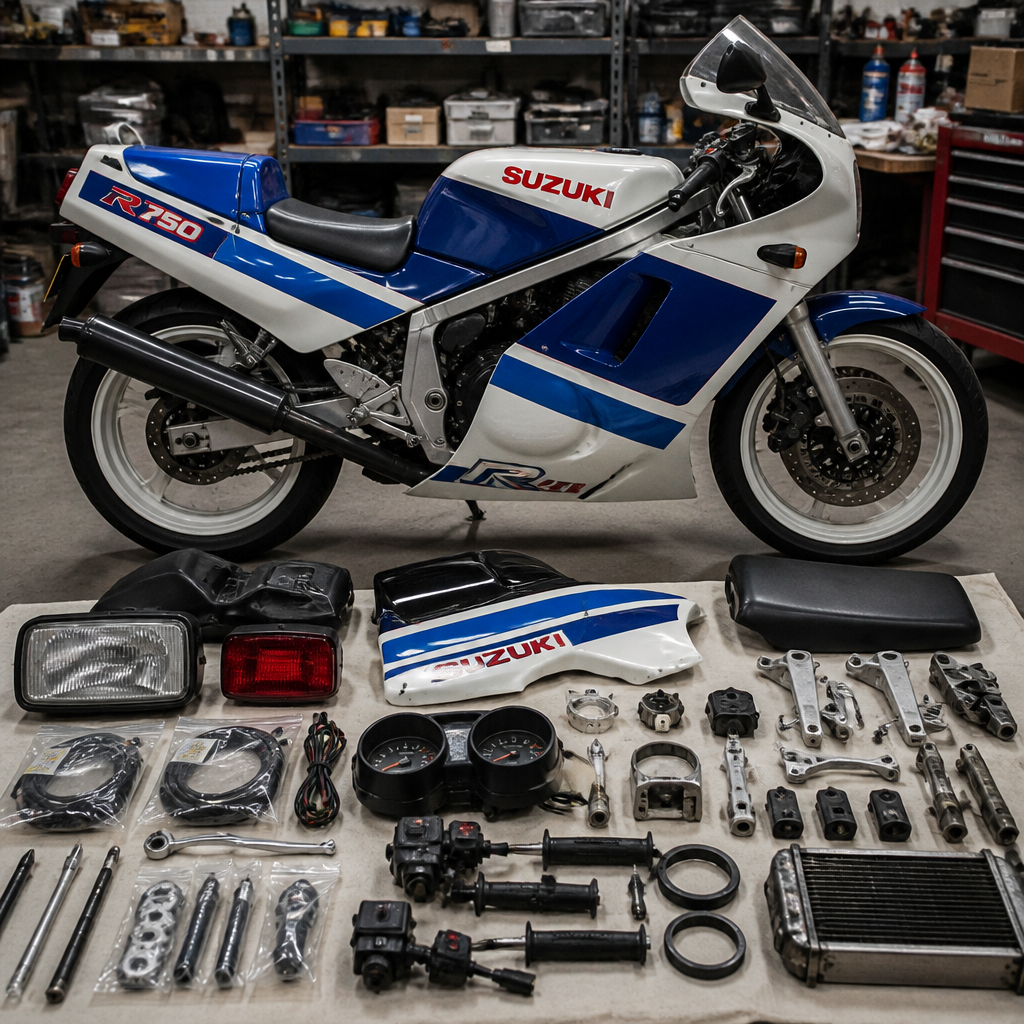
The 1985 Suzuki GSX-R750 changed sportbike history by bringing race-bike thinking to a street-legal machine, and sourcing original parts for one today is the foundation of any credible restoration. In the workshop, I have learned that owners rarely struggle because they lack enthusiasm; they struggle because the first-generation GSX-R750 sits at the intersection of rarity, mythology, and technical specificity. A correct project requires more than buying used spares online. It means understanding what makes a part original, which components were market-specific, how age affects materials, and where authenticity matters most.
This hub article covers restoration guides for metric classics built from 1970 to 1991, using the 1985 GSX-R750 as the anchor example because it is one of the most searched, most misunderstood, and most frequently altered Japanese performance motorcycles of the era. “Metric classics” generally refers to Japanese and other non-imperial motorcycles built to metric standards, especially machines from Honda, Yamaha, Suzuki, Kawasaki, and major European makers sold in the same ecosystem. “Original parts” means genuine new old stock, period-correct used components, or exact-spec replacements documented to match factory fit, finish, and function. “Restoration” can range from a safe rider refurbishment to concours-level factory re-creation.
The topic matters because value, reliability, and historical accuracy all depend on sourcing decisions made early. On an oil-cooled GSX-R750, one incorrect fastener finish, body panel profile, or carburetor bank can undermine a high-end build. More important, a poor choice in consumables, bearings, brake parts, or electrical connectors can create safety problems that do not appear until the bike is ridden at speed. For collectors, documentation and provenance influence market price. For riders, originality affects fitment, serviceability, and the feel that made these motorcycles famous in the first place. If you are building a restoration plan for any metric classic from 1970 to 1991, this page gives you the framework, terminology, and sourcing logic to do it right.
Why the 1985 GSX-R750 Is the Benchmark for Metric Classic Restoration
The first GSX-R750 is a benchmark because it represents a turning point: aluminum frame, race-inspired ergonomics, advanced aerodynamics for the period, and Suzuki’s air/oil-cooled engine architecture packaged with unusually low weight. Depending on market, the model codes and minor details vary, but the restoration challenge remains consistent. Many survivors were raced, crashed, repainted, modified for street use in the 1990s, or broken for parts before collector demand accelerated. As a result, a complete, untouched bike is uncommon, and parts inventories are fragmented across countries.
That makes the GSX-R750 the ideal hub example for the wider “Restoration Guides for Metric Classics: 1970–1991” topic. The same issues appear on Honda CBs, Kawasaki Z models, Yamaha FZ and RD variants, and Suzuki GS and Katana platforms: superseded part numbers, regional trim differences, reproduction bodywork of inconsistent quality, perished rubber, missing brackets, and title-frame-engine mismatches. What changes is the severity. On the 1985 GSX-R750, originality is unusually visible. Body panels, saddle shape, instrument cluster, mirrors, exhaust, and even decal placement are scrutinized by knowledgeable buyers.
In practical terms, this motorcycle teaches every core restoration discipline. You need factory literature, patient parts authentication, a budget for the unobtainable items, and the discipline to separate cosmetic needs from mechanical priorities. If you can source correctly for a first-generation GSX-R750, you can build a sound process for almost any metric classic from the same era.
What “Original Parts” Really Means on a 1985 Suzuki GSX-R750
Original does not always mean boxed genuine parts from a Suzuki dealer shelf. For a 1985 machine, original usually falls into three categories. First is NOS, or new old stock: genuine period-manufactured parts never installed. These are ideal for decals, switchgear, trim, lenses, and hardware, but they are not automatically better if rubber or seals have aged on the shelf. Second is OEM used: factory parts removed from donor motorcycles. This is often the only route for bodywork, airboxes, brackets, and unobtainable chassis pieces. Third is exact-spec restoration replacement: a modern seal, bearing, piston ring set, or brake component from a respected supplier that matches the original specification and improves service life without changing appearance or function.
The distinction matters because concours standards and rider standards are not identical. If I am restoring a GSX-R750 for regular road use, I will still search hard for original fairing stays, gauges, and wheels, but I will not insist on thirty-nine-year-old brake hoses or fork seals. For safety-critical systems, specification outranks old inventory. For visible signature components, authenticity has greater weight. The trick is documenting these decisions so future owners understand what is original, what is refurbished, and what has been sympathetically replaced.
You should also understand the language sellers use. “Fits GSX-R750” is not the same as “correct for 1985 first-generation slabside.” “Period correct” can mean from the right decade but the wrong year. “Restored original” may hide plastic welding, filler, aftermarket paint, or replaced tabs. Ask for part numbers, date codes where applicable, detailed photos, and measurements. On rare motorcycles, precision in language saves thousands.
How to Verify Parts Before You Buy
Verification starts with factory documentation. For Suzuki projects, the essential references are the official parts catalog, workshop manual, and period sales literature. The parts catalog is your map because it shows exploded diagrams, fastener relationships, superseded numbers, and market-specific variations. A workshop manual confirms service specs and assembly order, which helps identify missing spacers, collars, and brackets on disassembled bikes. Brochures and road tests help with finishes, decals, and trim details that parts books do not fully explain.
Cross-check every expensive purchase against at least two sources. I routinely compare part numbers using dealer fiche archives, scanned microfiche, marque forums with documented restorations, and auction listings from sellers who photograph packaging labels. For the 1985 GSX-R750, I also look for signs of known substitutions: later wheels fitted because originals were damaged, different carb tops, replica side panels with incorrect venting, and exhaust systems from neighboring model years that bolt up but change silhouette and collector value.
Photos should answer specific questions. Are fairing tabs intact or repaired? Do gauge faces have the right typography? Are wheel date stamps plausible for the production year? Do fork lowers show original casting texture or heavy polishing? Is the aluminum frame brushed correctly rather than mirror-finished? A serious seller will tolerate serious questions. If not, walk away.
| Part Category | Best Source Type | What to Verify | Common Risk |
|---|---|---|---|
| Bodywork and fairings | OEM used or NOS | Tab integrity, vent shape, decal location, paint code | Aftermarket replicas with poor fit |
| Engine internals | OEM or exact-spec modern replacement | Part number supersession, clearances, seal age | Old stock rubber and mismatched kits |
| Carburetors and intake | Complete used assemblies | Correct bank, jets, slides, airbox compatibility | Mixed-year components |
| Electrical components | Tested OEM used or specialist rebuild | Connector condition, resistance values, loom repairs | Hidden heat damage and brittle insulation |
| Brakes and suspension | Refurbished originals plus new service parts | Casting numbers, straightness, piston condition | Unsafe seals, hoses, and corroded bores |
Where Original GSX-R750 Parts Come From Today
The supply chain for a 1985 GSX-R750 is global. Dealer inventories still matter, especially in Japan and in long-established European dealerships with obsolete stock rooms, but most restorers now rely on a mix of online auctions, specialist breakers, owners’ clubs, marque forums, and private collectors. Yahoo! Auctions Japan, Buyee-style proxy services, eBay, CMSNL, and regional Suzuki specialists regularly surface hard parts. The challenge is separating usable stock from fantasy pricing and incorrect listings.
Motorcycle breakers are underrated because they often understand compatibility better than general sellers. A knowledgeable breaker can tell you whether a loom has been cut, whether a tank has internal corrosion near the petcock standpipe, or whether a fairing stay has subtle crash distortion. Owners’ clubs are even better for uncommon trim pieces because long-term members know what was replaced under warranty, what differed by market, and which reproductions are acceptable. For high-value projects, networking beats searching.
Do not ignore local sources. Estate sales, old race shops, and independent Suzuki specialists sometimes hold shelves of parts that never made it online. I have found original turn signals, switch blocks, and complete airboxes in dusty back rooms simply by asking mechanics who worked through the late 1980s. Many of the best finds come from people who are not marketing to collectors; they are clearing space.
Restoration Priorities: What to Buy First and What Can Wait
On any metric classic, and especially on a slabside GSX-R750, buy the rare structural and cosmetic pieces first. Fairings, screens, seat units, instrument clusters, airboxes, exhaust systems, side covers, and model-specific brackets disappear fastest and rise fastest in price. Mechanical service parts can often be sourced later through OEM channels or specialist manufacturers. If your project is missing bodywork and intake components, solving those gaps early prevents a stalled restoration.
Second, secure documentation and identity. Make sure frame and engine numbers align with your market’s expectations and that your title status is clear. In many restorations, owners spend heavily on paint and plating before confirming the machine’s legal and historical basis. That is backwards. A beautiful motorcycle with a problematic identity is harder to insure, register, and sell.
Third, protect what you already have. Original fairings should be stored correctly, away from heat and stress on mounting tabs. Tanks should be drained and stabilized. Wiring looms should be labeled before disassembly. Fasteners should be bagged by subsystem. The most expensive part is often the one you misplace.
Common Mistakes in Metric Classic Restorations from 1970 to 1991
The biggest mistake is treating all old parts as equal. A 1985 GSX-R750 fuel tap, for example, may look serviceable but contain aged diaphragms that create erratic fueling. Originality does not excuse worn internals. Another frequent error is over-restoration. Powder coating every bracket, mirror-polishing aluminum, and replacing all hardware with stainless may produce a shiny bike, but it can erase period-correct finishes and reduce value to informed buyers.
Another mistake is ignoring model-year nuance across the broader metric-classic category. A 1978 Honda differs from a 1980 facelift in ways that affect side cover mounting, carb calibration, and wiring. A Kawasaki KZ, Yamaha RD, or Suzuki Katana may have export-market lighting and emissions differences that matter during reassembly. Good restoration is not generic; it is year, market, and production-run specific.
Finally, many owners underestimate the cost of “small parts.” Cush drives, grommets, collars, clips, heat shields, intake boots, battery straps, and decal sets can consume a startling part of the budget. Build a spreadsheet from the parts fiche and mark every missing item before you start buying. That discipline turns restoration from emotional scavenger hunt into manageable project planning.
Building a Complete Hub Strategy for Metric Classics
Because this page serves as a hub for restoration guides covering metric classics from 1970 to 1991, the most effective approach is to organize research by system rather than by brand alone. Every serious project should branch into dedicated guides for engines, carburetors, fuel tanks, electrical systems, brakes, suspension, frames, bodywork, wheels, fasteners, and documentation. That structure mirrors how motorcycles are actually restored and lets you compare best practices across Honda, Yamaha, Suzuki, and Kawasaki platforms.
The GSX-R750 illustrates why this systems approach works. A sourcing guide for bodywork should connect naturally to paint-code references, decal-placement diagrams, and fastener-finish standards. An engine guide should connect to oil-cooling service procedures, cam-chain inspection, clutch wear points, and compression testing. A chassis guide should connect to steering-head bearings, fork tube inspection, anti-dive units where applicable, wheel bearings, and brake-caliper refurbishment. When articles interlink at the component level, readers solve problems faster and avoid duplicate purchases.
This wider hub should also separate preservation from restoration. Some metric classics deserve careful conservation rather than full strip-down work, especially low-mileage survivors with original finishes. Others, particularly bikes with crash damage, corrosion, or poor modifications, require full restoration. Knowing the difference protects history and money. The best projects begin with a written condition report, a sourcing list ranked by rarity, and a realistic target: rider, show bike, or investment-grade restoration.
Sourcing original parts for a 1985 Suzuki GSX-R750 is not just about completing one iconic motorcycle; it is the clearest possible lesson in how to restore any metric classic from 1970 to 1991 with discipline and credibility. The essentials are straightforward: define originality carefully, verify every major purchase against factory documentation, buy rare model-specific parts before common service items, and balance authenticity with safety. The first-generation GSX-R750 rewards that approach because every correct detail sharpens the riding experience, visual impact, and long-term value.
As a hub for restoration guides, this topic works best when you think in systems. Document identity first, inspect mechanical condition honestly, protect irreplaceable pieces, and use marque knowledge instead of guesswork. Whether you are rebuilding a Suzuki superbike, a Honda four, a Yamaha two-stroke, or a Kawasaki muscle machine, the process is the same: research deeply, source patiently, and restore only what you can justify with evidence. That is how great metric-classic projects avoid expensive mistakes and age into trusted reference bikes.
If you are starting a restoration, begin with the parts book, a condition spreadsheet, and a list of missing rare components. Then build outward into the detailed engine, chassis, electrical, and bodywork guides that support this hub. Done properly, the result is more than a finished motorcycle. It is a preserved piece of engineering history that starts, runs, and tells the truth about its era.
Frequently Asked Questions
Why is sourcing original parts for a 1985 Suzuki GSX-R750 so much harder than restoring many other 1980s sportbikes?
The 1985 Suzuki GSX-R750 occupies a very unusual place in motorcycle history. It is not simply an old Japanese sportbike; it is the first GSX-R750, the model that redefined what a street-legal performance motorcycle could be. Because of that, demand for correct parts comes from several different groups at once: collectors who want authenticity, restorers who want factory-correct finishes and fitment, and riders who want period-correct replacements that still function reliably on the road. That combination drives up competition for genuine components and makes the wrong part easy to buy if you are not deeply familiar with the model.
Another challenge is that many surviving bikes have been modified over the decades. First-generation GSX-R750s were often raced, repainted, crashed, upgraded, or “improved” with later-model pieces. On the surface, a bike may appear complete, but once disassembly begins, it is common to find substituted fasteners, non-original bodywork, replacement wheels, incorrect carburetors, aftermarket exhaust systems, or electrical repairs made with whatever was available at the time. As a result, sourcing original parts becomes less about replacing one missing item and more about reversing years of changes while verifying what should actually be there.
There is also the issue of technical specificity. Early GSX-R parts are not interchangeable in the simplistic way many buyers assume. Components may look similar across model years or between domestic and export variants, but differences in brackets, castings, finishes, graphics, and hardware can matter significantly in a credible restoration. This is why successful sourcing depends on documentation, part-number research, and physical comparison rather than impulse buying. In short, the difficulty comes from rarity, historical importance, widespread modification, and the need to distinguish “fits” from “correct.”
Which parts are the most important to find as genuine originals when restoring a 1985 GSX-R750?
If the goal is a credible restoration, the most important original parts are the ones that define the bike’s identity, value, and correctness at a glance. The first category is bodywork and cosmetics: fairings, side panels, front fender, fuel tank, windscreen, seat unit, graphics, mirrors, and lighting. Original body panels are particularly important because reproduction pieces often differ in shape, mounting points, material thickness, or surface detail. Even when aftermarket panels fit reasonably well, experienced enthusiasts can usually spot the differences immediately.
The second critical category is model-specific mechanical equipment. On a 1985 GSX-R750, that includes the correct engine cases and covers, intake components, carburetors, airbox, exhaust system, oil-cooling hardware, brake components, fork assemblies, wheel set, and original switchgear. These are the parts that preserve the engineering character of the bike. A restoration may still be visually attractive with substitute mechanical parts, but it stops being truly representative of the original machine if too many core assemblies have been swapped.
The third category is often overlooked but hugely important: small hardware and finishing details. Factory bolts, brackets, clips, reservoir mounts, heat shields, chain guards, fastener finishes, decals, and warning labels contribute more to authenticity than many owners expect. A bike with rare major components but incorrect detail parts can still feel assembled rather than restored. By contrast, a machine with proper hardware, finishes, and fittings usually presents as cohesive and correct.
If you must prioritize due to budget, start with hard-to-find model-specific parts first. Mechanical wear items can often be rebuilt or sourced later, but original fairings, tanks, exhausts, brackets, and other one-year or early-production items are far harder to replace once they disappear from the market. Restoration planning should always separate “available eventually” from “buy immediately if verified,” because the latter category is what determines whether the project remains historically credible.
How can I verify that a part is truly correct for a 1985 GSX-R750 and not just a close substitute?
The best approach is to treat verification as a layered process rather than relying on a seller’s description. Start with factory parts books, service literature, period brochures, and known original reference bikes. A genuine part should be judged by part number, physical dimensions, finish, casting or stamping details, mounting design, and application history. Many mistakes happen because a component appears visually similar in a listing photo, but the bracket angle, connector style, or surface treatment reveals it to be from a later model or a different market.
Part numbers are a strong foundation, but they are not the only tool. Numbers can supersede, labels can be missing, and some used parts are sold loose without packaging. That is why detailed photographs matter so much. Ask for images of mounting tabs, backside molding, casting marks, fastener holes, wear patterns, and any identification stamps. A seller who cannot provide clear detail shots may simply not know what they have. For a model as significant as the 1985 GSX-R750, uncertainty usually favors patience over a rushed purchase.
It also helps to understand the difference between “period-correct” and “factory-correct.” A period aftermarket exhaust, for example, may be entirely appropriate for a rider or a display reflecting 1980s ownership culture, but it is not the same as the original exhaust system installed by Suzuki. Likewise, a later replacement component from Suzuki may fit and function perfectly but still differ from what a 1985 bike originally carried. Decide early whether your project is aiming for factory restoration, sympathetic refurbishment, or period-modified presentation, because that standard determines how strict your sourcing criteria must be.
Finally, build relationships with marque specialists, long-time owners, and restorers who know the first-generation GSX-R platform intimately. On rare bikes, expertise is often as valuable as the part itself. A knowledgeable second opinion can save you from expensive errors, especially on high-value items such as bodywork, wheels, instrument clusters, and engine-related pieces. Verification is not about being overly cautious; it is about protecting the integrity of the restoration and avoiding the domino effect of buying one wrong part after another.
Where are the best places to find original 1985 GSX-R750 parts today?
The best sourcing strategy is broad, patient, and highly organized. Online marketplaces are often the starting point because they provide volume and geographic reach, but they should never be the only source. Auction platforms, enthusiast classifieds, specialist breakers, vintage Japanese motorcycle dealers, salvage networks, and model-specific forums all play a role. The most valuable finds often come from owners who have held parts for years rather than from polished retail listings. In other words, the visible market is only part of the real market.
Motorcycle communities remain especially important for first-generation GSX-R parts. Dedicated Suzuki groups, vintage superbike forums, restoration circles, and social media communities can lead to private sales, parts stashes, or referrals to individuals known for specific inventories. These networks also help validate parts before you buy them. A listing that seems uncertain to a general buyer may be instantly recognized by an experienced GSX-R owner who knows exactly what is missing, altered, or valuable.
Swap meets and vintage motorcycle shows should not be underestimated either. While they require more time and physical effort, they offer one advantage the internet cannot fully replicate: direct inspection. You can evaluate condition, compare pieces by hand, and ask detailed questions in real time. For delicate or often-damaged items such as fairings, gauges, brackets, and aluminum components, this can be invaluable. It also opens the door to long-term supplier relationships, which often matter more than any single purchase.
When buying internationally, factor in more than price. Shipping risk, customs delays, packaging quality, return practicality, and market differences all matter. A cheaper part from overseas may become expensive if it arrives damaged or turns out to be from a regional variant that differs from your project. The smartest buyers track every lead, keep records of seller credibility, and maintain a wishlist of priority items. Sourcing original GSX-R750 parts is not a single shopping trip; it is a disciplined, ongoing process built on research, timing, and trusted contacts.
Should I restore with only original parts, or is it acceptable to use reproduction and refurbished components?
That depends on your restoration goal, but in practice most successful projects involve a careful blend of original, refurbished, and selectively reproduced parts. If your aim is a top-tier collector restoration, original components should be prioritized wherever authenticity, appearance, and historical value are most visible. That usually means bodywork, instruments, major chassis pieces, airbox components, original controls, and model-defining hardware. These are the areas where originality most strongly influences both credibility and long-term value.
Refurbishment is often the smartest route for components that are present but tired. Original brackets can be refinished, calipers rebuilt, forks restored, wheels corrected, and many metal parts replated or recoated to closely match factory appearance. Preserving and restoring an original part is usually better than replacing it with an inferior substitute. On a historically important bike like the 1985 GSX-R750, retaining as much original material as possible gives the finished motorcycle a level of integrity that purely replacement-based builds often lack.