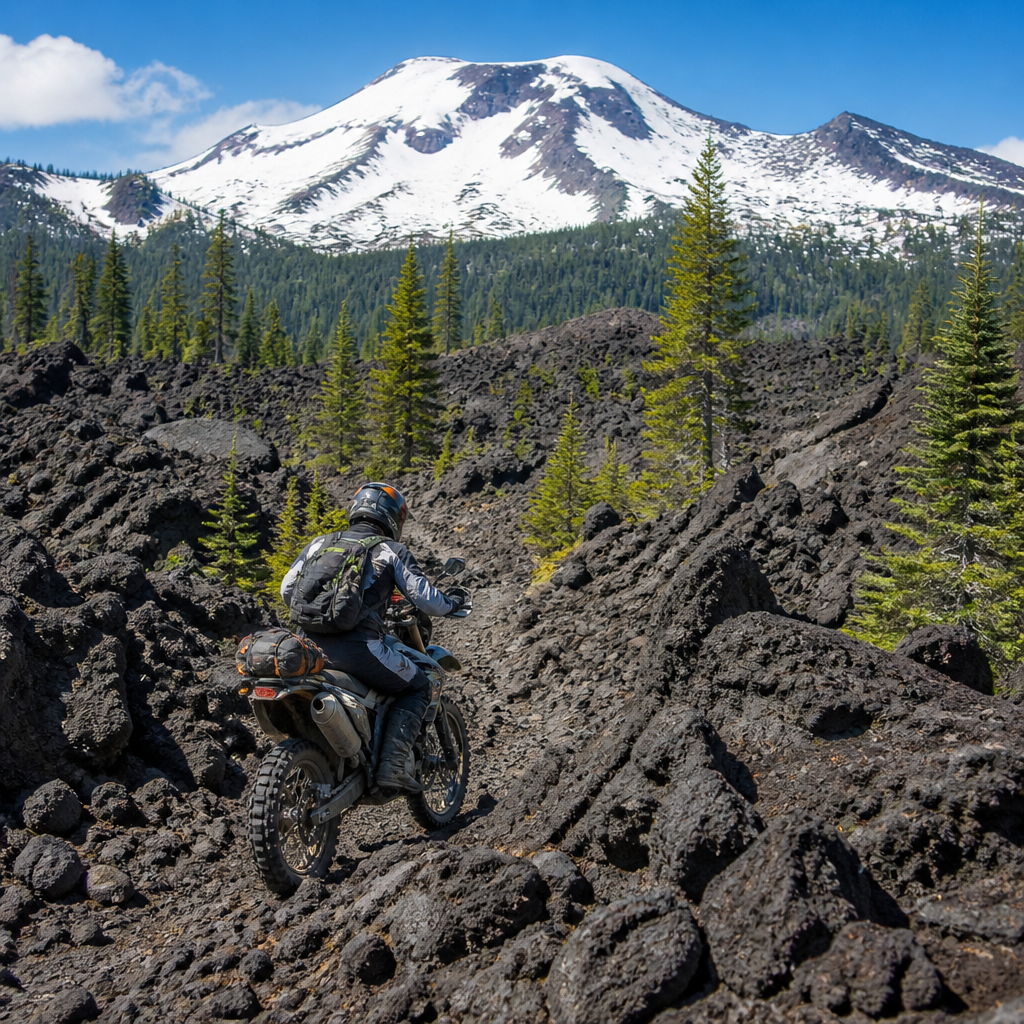
The 2026 Washington BDR demands more than route enthusiasm; it requires technical prep, current seasonal intelligence, and a clear understanding of how volcanic terrain in the Cascades changes the riding equation. Washington BDR refers to the Backcountry Discovery Route that strings together remote dirt, forest roads, rocky climbs, and long service gaps across the state. For adventure riders, the phrase “lava rocks of the Cascades” is not poetic branding. It describes sharp basalt, pumice, embedded baby-head stones, erosion shelves, and loose volcanic debris that punish poor line choice, weak tires, and overloaded bikes.
I have prepped riders and bikes for Cascade sections where a machine that felt perfectly sorted on gravel became exhausting within ten miles of volcanic rubble. That gap between general ADV readiness and true BDR readiness is why this topic matters. The 2026 and 2027 seasons add another layer: wildfire closures, timber activity, washouts, snowpack variability, and evolving digital navigation practices can alter route execution quickly. A hub article for ADV and BDR technical prep must therefore cover the rider, the motorcycle, the luggage, the navigation stack, and the operational realities of Washington travel.
Technical prep means configuring an adventure motorcycle and rider system for traction, durability, self-sufficiency, and recovery in backcountry conditions. Updates for 2026 and 2027 means tracking route revisions, land-management notices, bridge or road changes, permit expectations, and the shift toward offline-first navigation with redundant devices. Washington magnifies every weakness because Cascade riding often combines elevation changes, moisture, volcanic aggregate, ruts, and long days in the saddle. If you want to ride the Washington BDR efficiently and safely, start by treating the route as a logistics project and a terrain-specific skills test, not simply a scenic weekend ride.
Why Washington’s Cascade terrain feels harder than the map suggests
Many riders underestimate Washington because average daily mileage on paper can look modest compared with desert routes. In practice, the Cascades slow progress. Volcanic rock tends to be angular and unstable, which increases deflection at the front wheel and accelerates rider fatigue. A 500-pound ADV bike with camping load behaves very differently on loose basalt than on packed county gravel. Add rain, meltwater, or dust hiding square edges, and the route quickly demands proper standing posture, clutch control, and strategic braking.
The key technical challenge is inconsistency. One hour may be smooth forest service road, the next a climb strewn with embedded rock and rain channels. Riders who set suspension and tire pressure only for comfort on easy sections usually pay for it later. The Washington BDR also includes remote stretches where recovery is slow and expensive. Cell service is unreliable, and tow access can be limited by gate systems, downed timber, or fire restrictions. That is why technical prep is inseparable from travel planning on this route.
Another factor is pace management. On Cascade routes, speed often creates the very instability riders try to escape. Hitting loose volcanic rock too fast magnifies impacts, breaks luggage mounts, and increases pinch-flat risk on tubed bikes. Too slow, however, and heavy motorcycles lose momentum on climbs. The answer is not bravado. It is practiced throttle control, selective packing, and bike setup matched to rider ability. Riders who finish comfortably are rarely the most aggressive; they are the most systematic.
Motorcycle setup for lava rock, washboard, and loaded ADV travel
The most important Washington BDR question is simple: is your bike set up for impact resistance and predictable handling while fully loaded? Suspension comes first. Sag must be measured with luggage on the bike, not guessed in the garage with empty panniers. On most midweight and heavyweight ADV motorcycles, stock springs are too soft once camping gear, tools, water, and fuel are added. Correct spring rate preserves geometry, improves front-end accuracy, and reduces bottoming on rocky hits. Rebound damping should control kick without packing down over repeated chop.
Wheels and tires deserve equal attention. Spoked wheels should be inspected for tension and runout before departure. Cast wheels can survive easier BDR segments, but Washington’s volcanic rock strongly favors robust spoked setups. Tire choice should prioritize sidewall strength and bite on mixed surfaces. Riders commonly use aggressive 50/50 or 60/40 patterns such as the Motoz Tractionator Adventure, Dunlop Trailmax Raid, Mitas Enduro Trail+, or Continental TKC 80 depending on bike weight and expected mileage. No tire solves every condition, but a street-biased pattern is usually a mistake here.
Protection is not vanity. A true skid plate, hand guards with aluminum backbone, radiator protection where applicable, and foldable levers reduce trip-ending failures. I also recommend securing vulnerable items with threadlocker and marking critical fasteners with torque paint so movement is visible during daily checks. Chain condition, wheel bearings, brake pad life, and air filtration should be addressed before the trip, not during it. Washington dust can be surprisingly fine in late summer, while wet sections can turn neglected chains into grinding paste within days.
Rider skills, fitness, and packing discipline
Bike setup cannot compensate for weak fundamentals. For Washington BDR success, riders need confident standing technique, eyes-up scanning, smooth throttle transitions, and the ability to relax their grip in rock gardens. On loose volcanic surfaces, a death grip causes more instability because the front end cannot self-correct. The rider must let the motorcycle move underneath while maintaining balance through the pegs. This sounds abstract until you practice it, but the effect is immediate: the bike tracks better and fatigue drops.
Fitness matters more than many admit. Repeated stand-sit transitions, heat management inside protective gear, and low-speed wrestling on climbs tax legs, core, and forearms. A realistic prep block includes mobility work, grip endurance, and at least several loaded shakedown rides. I have seen skilled street riders struggle simply because they never trained for six consecutive hours of standing and lifting a bike after a tip-over.
Packing discipline is the easiest performance gain. Heavy items should sit low and central. Excess camping luxuries, duplicate clothes, and oversized hard luggage increase the penalty for every technical section. Soft luggage usually handles crashes better and reduces leg injury risk. Water capacity should reflect stage length and heat exposure, while food should emphasize compact calories. Every item on the bike should answer a clear question: does it help me ride, repair, navigate, sleep, or stay safe?
| Prep Area | Best Practice for Washington BDR | Common Mistake |
|---|---|---|
| Suspension | Set sag with full luggage and tune rebound for repeated rock hits | Running stock preload despite extra 40 to 70 pounds |
| Tires | Use aggressive dual-sport tires with strong sidewalls | Choosing quiet road-oriented tires for highway comfort |
| Luggage | Keep weight low, central, and minimal with soft bags | Overpacking top-heavy hard cases |
| Navigation | Carry offline primary and backup route files on separate devices | Relying on one phone with no charging redundancy |
| Recovery | Pack tools, inflation, plugs or tubes, and tow plan details | Assuming another rider will have everything |
Navigation, communications, and route management for 2026 and 2027
For 2026 and 2027, the best Washington BDR navigation strategy is offline first, cloud second. Use the official route resources, current GPX files, and land-manager notices before departure, then load the route onto at least two devices. A common stack is a rugged GPS or dedicated tablet as primary, with a smartphone backup running Gaia GPS, onX Offroad, CalTopo, or OsmAnd. Each platform has strengths: Gaia is intuitive for track following, onX Offroad excels in land-use context, and CalTopo is excellent for fire overlays, slope visualization, and custom planning.
Do not assume a line on a screen equals open passage. Seasonal gates, active logging, bridge damage, and wildfire closures can force legal detours. Riders should monitor U.S. Forest Service alerts, Washington State Department of Natural Resources notices, InciWeb incident pages during fire season, and county emergency posts where route segments approach local roads. In recent seasons, the most successful groups have reviewed conditions nightly rather than treating route status as fixed.
Satellite communication is now standard, not optional. A Garmin inReach, Zoleo, or similar messenger provides check-ins, emergency SOS capability, and basic coordination if a group separates. Share your itinerary with a home contact, include planned fuel stops, and define your overdue threshold. Charging should be redundant as well: fused USB power on the bike, a power bank, and cables packed in waterproof storage. Navigation failure in the Cascades becomes a logistical problem quickly, especially if smoke, weather, or darkness compresses decision time.
Mechanical spares, field repairs, and self-recovery planning
Washington BDR riders should pack for the failures most likely to end the trip: punctures, bent controls, loose hardware, chain issues, dead batteries, and crash damage that affects rideability. The exact kit depends on whether you run tubed or tubeless wheels. Tubeless riders need quality plugs, insertion tools, a compact compressor, and a pressure gauge. Tubed riders need front and rear tubes or a front tube that can temporarily fit both wheels, tire levers, patches, and practice using them before the trip.
A compact but effective tool roll should match your bike’s fasteners exactly. Include axle tools, Torx or hex sizes for bodywork and controls, spare master link if appropriate, safety wire, zip ties, electrical tape, and a few critical bolts. JB Weld SteelStik or a similar epoxy can rescue cases or covers long enough to reach pavement. Spare levers, fuses, and a clutch cable for cable-operated bikes are worth the grams on remote sections.
Self-recovery planning also means knowing when not to force progress. If a washout, snow drift, or active closure blocks the route, the correct move is to reroute early, not after burning fuel and daylight on repeated failed attempts. Groups should establish simple protocols: who carries medical kit, who has tow strap, who leads navigation decisions, and how separation is handled at intersections. Mechanical competence is not just wrenching skill. It is disciplined problem solving under fatigue.
Seasonal timing, wildfire reality, and hub-level planning for linked route content
The practical window for the Washington BDR usually centers on summer through early fall, but exact timing varies with snowpack, storm damage, and fire conditions. Early season can leave high sections blocked by snow or softened by runoff. Late season often offers better access but raises smoke, closure, and dust concerns. Riders planning 2026 and looking ahead to 2027 should watch mountain snow data, wildfire outlooks, and agency maintenance updates months in advance, then verify again in the final week.
As the hub page for ADV and BDR technical prep and 2026 or 2027 updates, this article should connect your broader planning. Fuel range analysis, tire selection by bike class, packing lists, satellite communication comparisons, Washington weather strategy, and route-specific skill drills all deserve dedicated supporting articles. That internal structure helps riders move from overview to execution. It also mirrors how successful trips are actually built: terrain analysis first, bike prep second, logistics third, and day-to-day adaptation throughout the ride.
The main lesson is straightforward. Washington’s Cascade lava rock rewards preparation and exposes shortcuts. A well-sprung bike, durable tires, minimal luggage, offline navigation backups, and a practiced repair kit turn the route from a stress test into a demanding but manageable expedition. Start your prep early, verify route conditions close to departure, and build your 2026 Washington BDR plan around reality rather than optimism. If you are using this page as your hub, make your next step specific: choose your bike setup checklist, load current route files, and schedule a loaded shakedown ride before you point north.
Frequently Asked Questions
What makes the 2026 Washington BDR especially challenging in the lava rock sections of the Cascades?
The biggest factor is that Cascades volcanic terrain changes the normal adventure-riding equation. On many Backcountry Discovery Routes, riders expect washboard, loose gravel, mud, or occasional embedded rock. In the Washington BDR’s volcanic zones, the surface can become much more punishing: sharp basalt edges, fractured lava rock, pumice, and loose angular stone all create a traction and durability problem at the same time. That means you are not just managing line choice and throttle control. You are also managing tire carcass stress, wheel impact risk, heat buildup, and the possibility of rapid punctures far from services.
Lava rock terrain can feel inconsistent even within a short stretch. One moment you may be on firm forest road, and the next you are crossing baby-head-sized angular rock with ledges, shelves, and eroded ruts. Those transitions catch riders off guard, especially when fatigue sets in or speed increases. In the Cascades, volcanic rock also tends to stay sharp rather than rounding off like river rock, which is why sidewall cuts and dented rims are a recurring concern. Add in elevation changes, seasonal runoff damage, dry dust hiding impacts, and the remote nature of the Washington BDR, and these sections become more than “rocky roads.” They become technical, consequential terrain that rewards preparation and punishes assumptions.
Another reason the 2026 route can be demanding is that seasonal conditions in Washington can dramatically reshape the ride year to year. Winter snowpack, spring melt, wildfire response, logging activity, and late maintenance can change traction, accessibility, and hazard exposure. A route that was manageable one season may be looser, more rutted, or more chewed up the next. Riders who treat the BDR as a static GPS line instead of a living backcountry route usually discover that volcanic terrain amplifies every small mistake. The smartest approach is to treat the lava sections as a combined skills, equipment, and decision-making challenge—not just a scenic feature of the Cascades.
How should I prepare my motorcycle for the Washington BDR’s sharp basalt, pumice, and rocky climbs?
Preparation starts with accepting that this route is hard on motorcycles, especially heavier adventure bikes carrying luggage. Tires are the first major decision. For volcanic terrain, a more aggressive off-road-oriented tire is usually the safer choice than a 50/50 setup if your riding plan includes technical sections and variable conditions. You want a tire with strong sidewalls, predictable bite on loose rock, and enough durability to survive long mileage on abrasive surfaces. Fresh or nearly fresh tires are strongly recommended. Starting the Washington BDR with half-worn rubber may save money at home and cost you traction, confidence, and repair headaches in the field.
Wheels, tubes, and inflation strategy matter just as much. If you run tubes, carry front and rear spares, patch gear, and the tools to fully remove wheels and complete the repair trail-side. If you run tubeless, carry a serious plug kit, inflation method, and a backup plan for cuts that a simple plug cannot solve. In lava rock country, many experienced riders also think hard about rim protection and realistic tire pressures. Extremely low pressures may improve grip in some terrain, but they can also increase rim damage and pinch-flat risk when sharp impacts pile up. The right pressure is bike-dependent and load-dependent, but the guiding principle is balance: enough compliance for traction and control, enough support to defend the wheel and carcass.
Protection and maintenance should be addressed before departure, not after the first impact. A sturdy skid plate, hand protection, radiator protection where appropriate, and attention to chain, brake pads, wheel bearings, and suspension setup all matter. Suspension, in particular, is often overlooked. A bike loaded for multi-day travel that is under-sprung or poorly damped will deflect more violently off angular rock and wear out the rider faster. Set sag correctly for luggage weight, make sure the bike is mechanically current, and verify every fastener that tends to loosen in rough terrain. Finally, range and repair planning are part of bike prep too. The Washington BDR includes long service gaps, so fuel range, water capacity, and a compact but complete tool kit are just as important as tires and armor.
When is the best time to ride the 2026 Washington BDR, and how important are seasonal updates?
Seasonal timing is critical on the Washington BDR because access and ride quality are heavily influenced by snowpack, snowmelt, downed trees, fire restrictions, washouts, and temporary closures. In general, riders target the window after high-country snow has receded but before autumn weather becomes unstable. That said, there is no single “safe” calendar date that works every year. A heavy winter can delay access deep into the season, while a hot, dry summer can bring wildfire smoke, active closures, and extremely dusty conditions that make lava rock hazards harder to read. The route must be evaluated in the context of the specific year, not just the month.
This is where current seasonal intelligence becomes essential. Before leaving, riders should check official route updates, regional forest and land management notices, local weather, recent rider reports, and any BDR-specific advisories available for 2026. You are looking for more than a green light. You want to know whether problem areas have changed character: Are there fresh washouts? Is a rocky climb now deeply rutted from runoff? Has logging altered traffic or road surfaces? Are there fire-area restrictions affecting camping, detours, or fuel plans? Conditions across Washington can vary dramatically section to section, so broad assumptions are not enough.
Seasonal updates also influence your daily pacing. Early season may mean more water crossings, lingering snowbanks in shaded areas, and softer roadbeds. Late season often means deeper dust, hidden rocks, brake-wearing descents, and increased fire concerns. In both cases, route timing affects safety margins, resupply strategy, and how much daylight you can count on for unexpected delays. The best time to ride is therefore the period when high-elevation access is open, fire and closure risk are acceptable, and you can verify current conditions from reliable sources. For the Washington BDR, good timing is not a convenience issue—it is a risk-management decision.
What riding techniques work best on Cascades lava rock and loose volcanic surfaces?
The most effective technique is controlled momentum paired with disciplined line choice. On sharp, loose volcanic rock, charging blindly is rarely the answer. At the same time, riding too slowly can make a heavy adventure bike unstable and increase dab-heavy, energy-draining corrections. The goal is to carry enough momentum to let the bike track forward without smashing every obstacle. That usually means staying loose on the bars, looking well ahead, weighting the pegs intelligently, and allowing the bike to move beneath you instead of fighting every deflection.
Standing is often beneficial in rougher lava sections because it improves balance, visibility, and the bike’s ability to absorb hits, but “stand up” is not a magic fix. Body position still matters. Keep your hips and chest in a posture that matches the terrain—neutral and ready on general rock, slightly rearward when descending over loose, chattery surfaces, and centered with active lower-body control when climbing. On ascents, maintain smooth throttle application and avoid abrupt bursts of power that spin the rear tire and bounce the bike sideways into sharper edges. On descents, prioritize brake control and commitment to a line; panic braking on loose volcanic stone can break traction instantly.
Vision and decision-making are what separate efficient riders from exhausted ones. In lava rock, the “best” line is often not the shortest line. It may be the one with fewer square-edged impacts, less loose rubble, or a cleaner exit. Dust can hide embedded hazards, so increase spacing if riding in a group and slow down when visibility drops. If the trail steepens or a rocky climb looks questionable, stop early, walk it, and choose a plan before entering the obstacle. There is no penalty for scouting, but there can be a real penalty for charging into a pumice-and-basalt chute with poor footing and no momentum strategy. The Washington BDR rewards riders who stay smooth, patient, and deliberate.
What should I carry and plan for in case something goes wrong on a remote section of the Washington BDR?
Remote-route planning on the Washington BDR should assume that a small mechanical issue, navigation mistake, weather change, or minor crash can quickly turn into a long delay. At a minimum, carry enough water, calories, layers, and first-aid capability to remain self-sufficient for longer than your planned riding day. Because service gaps can be significant, fuel planning deserves the same seriousness. Know your real-world range on dirt with luggage, not just the number you see on pavement. If your margin is thin, carry extra fuel safely and make refueling points part of your route strategy rather than an afterthought.
Mechanical self-recovery is the next priority. Your tool kit should match your bike, your fasteners, and your tire system. That means not just a generic pouch, but the actual tools required to remove wheels, adjust controls, repair flats, tighten critical hardware, and address common field issues such as a broken lever, loose shifter, damaged chain guide, or