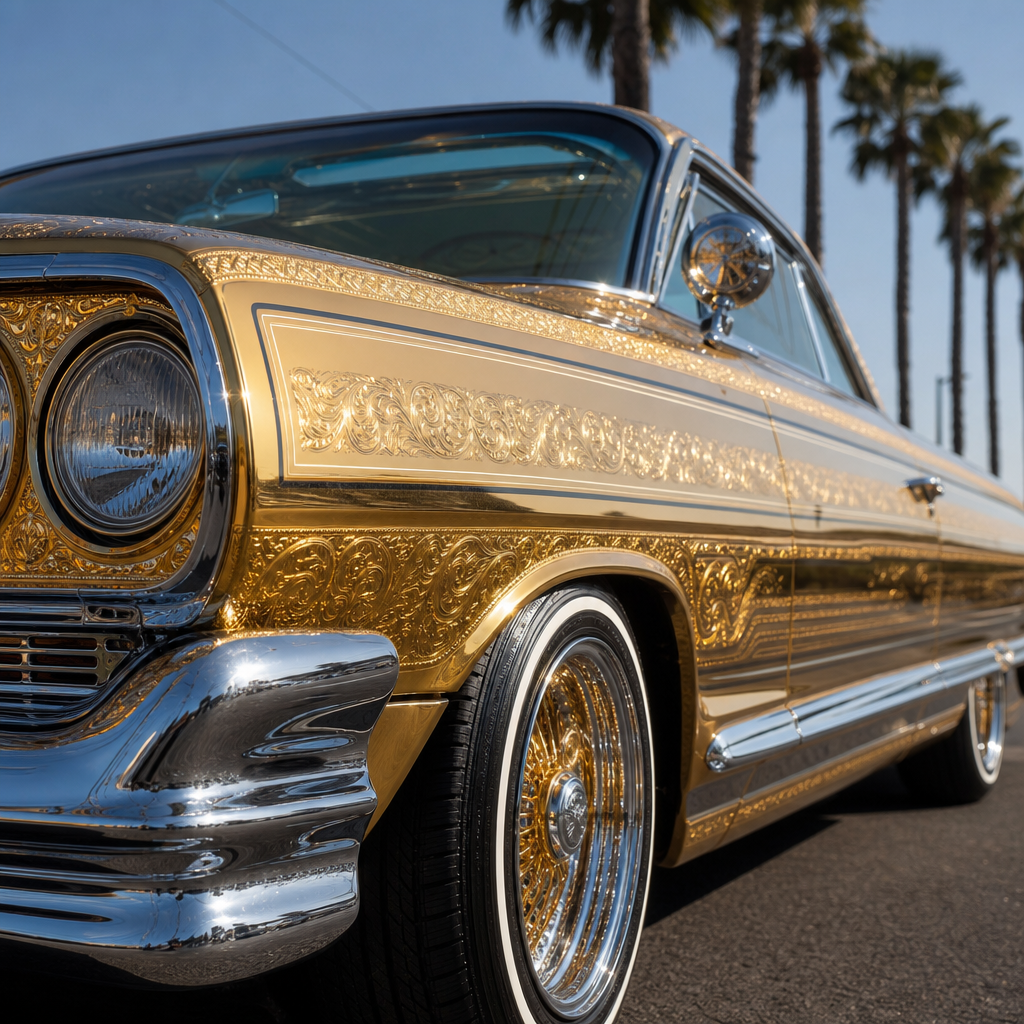
Chicano Chrome is more than a styling trend; it is a design language built from lowrider heritage, hand-finished metalwork, and a renewed demand for craftsmanship that looks unmistakably real in an era of shortcut finishes. In custom motorcycle and lowrider circles, the phrase points to a specific visual standard: deep, mirror-bright triple-plated chrome, authentic gold leaf striping and lettering, elegant engraving, and silhouettes that borrow from Chicano aesthetics without flattening them into costume. As builders and riders push beyond bolt-on customization, these finishes are trending because they signal time, skill, and cultural fluency in a way powder coat and vinyl cannot. I have watched this shift firsthand at bike shows, fabrication shops, and paint booths where owners are no longer asking only for “black it out” packages; they are asking who can plate properly, who can pull a clean leaf line, and who understands the difference between influence and imitation.
To understand why this matters, define the core terms clearly. Real gold leaf is ultra-thin beaten gold applied by hand over size, then sealed or protected depending on the use case. It reflects light differently from metallic paint or foil because it is actual metal, not printed effect. Triple-plated chrome usually refers to copper, nickel, and chrome applied in sequence, with polishing between stages to create depth, adhesion, and corrosion resistance. Chicano design, in this context, draws from the visual traditions shaped in Mexican American communities, especially in lowriding: long lines, ornate lettering, religious and familial iconography, pinstriping, velvet-like color depth, and a respect for dignity, memory, and presentation. Performance bagger style comes from modern V-twin touring performance culture, where carbon parts, suspension travel, and big-inch drivetrains meet aggressive bodywork. Frisco style points to stripped, narrow, upright customs with high bars, peanut tanks, and a raw San Francisco-influenced silhouette. “Beyond” matters because today’s best builders increasingly blend these schools instead of treating them as sealed categories.
The surge in real gold leaf and triple-plated chrome is not nostalgia alone. It is a reaction against disposable customization, a search for higher-fidelity finishes on social platforms that reward visual detail, and a broader movement in custom culture toward provenance. Buyers want to know who plated the fork legs, who engraved the rocker covers, who laid the leaf, and whether the bike carries coherent design theory from frame stance to fastener choice. This hub article maps that landscape comprehensively: how Chicano visual principles translate onto motorcycles, where they intersect with performance baggers and Frisco bikes, why premium finishing processes are resurging, and how builders can use fabrication tech without losing soul.
Why Real Gold Leaf and Triple-Plated Chrome Are Trending Now
The short answer is that people can now see the difference instantly, and they are willing to pay for authenticity. High-resolution phone cameras, close-up reels, and event photography expose finish quality in brutal detail. Spray-on “chrome” and printed faux leaf often look acceptable from ten feet away but fall apart under sunlight or macro shots. Triple-plated chrome, by contrast, has visual depth because the copper layer fills micro-imperfections, nickel provides much of the brightness and corrosion resistance, and the final chrome layer adds blue-white reflectivity and hardness. Good platers still spend enormous labor on prep, and that labor is exactly what viewers register even if they cannot name the process.
Real gold leaf is trending for a similar reason. On tanks, side covers, dashes, and mural borders, leaf throws warm, directional light that metallic paint cannot replicate. Traditional sign painters and custom painters have known this forever, but the wider custom scene is rediscovering it. On a Chicano-influenced bike, leaf is not random decoration; it creates hierarchy. It can frame script, emphasize body lines, echo jewelry and engraving traditions, or connect the bike visually to lowriders and hand-lettered cultural spaces. That resonance matters. The strongest current builds use gold as punctuation, not wallpaper.
There is also an economic reason. In a softening market for generic customs, true craft is becoming a differentiator. Owners financing premium builds want parts and finishes that retain bragging rights and, in some cases, resale value. A documented plating job from a respected chrome shop and leaf work from a known artist are easier to justify than trend-driven accessories with no story. This is why established names in paint, engraving, and metal finishing continue to attract clients even as mass-market accessory catalogs expand. The market is rewarding process, not just appearance.
Design Theory: What Makes Chicano Styling Distinct
Chicano styling is often misunderstood as a list of motifs, when it is really about composition, symbolism, and finish discipline. The visual grammar starts with line control. Fenders, tanks, bars, crash bars, and saddlebag contours should lead the eye in long, graceful sweeps. Crowded silhouettes fight the style. Surface treatment follows the same rule: scrollwork, filigree, lace, murals, and leaf need breathing room so they read as intentional. The best Chicano customs feel formal without becoming rigid, celebratory without becoming gaudy.
Color theory matters. Deep blacks, candy reds, root beer browns, maroons, navy, pearl white, and jewel tones provide the classic base for chrome and leaf because they create contrast and perceived depth. Over the years I have seen many builds fail because the owner added every effect available: flake, candy, lace, etching, mural, engraving, LEDs, and billet accents all competing at once. Strong Chicano design edits aggressively. If the tank carries script and leaf, the fender may need cleaner striping. If the saddlebag lids are engraved and chromed, the side covers may need restraint. This balance is what separates influence from pastiche.
Iconography should also be handled with care. Religious images, memorial portraits, Old English lettering, roses, hands, doves, and neighborhood references can be deeply meaningful, but they should come from the owner’s story or the builder’s cultural understanding, not from a generic mood board. The style carries history tied to family, place, cruising, and visibility in public space. That is why builders who listen well generally produce stronger Chicano-influenced work than shops that treat the look as a catalog theme.
How Performance Bagger Design Changes the Conversation
Performance baggers introduced a different design logic: speed, lean angle, braking, airflow, and rider control. Big rotors, radial calipers, inverted forks, stepped seats, taller shocks, and lightweight wheels changed the silhouette of the American touring bike. At first, this seemed opposite to chrome-heavy custom traditions. In practice, it created a new hybrid opportunity. Riders wanted performance without giving up visual identity, and builders began combining race-informed geometry with highly finished surfaces.
The key is selective emphasis. A modern bagger with a big-inch Milwaukee-Eight or tuned Twin Cam can wear chrome engine covers, polished exhaust shields, engraved floorboards, and leafed fairing details if the design still supports function. Heat management, serviceability, and rider position remain primary. I have seen the best examples use chrome where the eye naturally lands, then leave control-critical or heat-intensive areas in coated or machined finishes. That mix keeps the bike rideable while preserving the ceremonial quality that many owners want when the bike is parked under show lights.
Performance bagger influence also changed expectations around precision. Builders now blend CAD-modeled brackets, CNC-machined triples, 3D-printed prototyping, and laser-cut tabs with old-school finishing. The result can be remarkably coherent when the underlying design brief is strong. A stretched saddlebag line may borrow lowrider elegance, while the chassis underneath carries Öhlins or Fox suspension, Brembo braking components, and dyno-proven engine work. This combination is one reason premium chrome and leaf are resurging: modern platforms are technically capable enough that owners can allocate more budget to finish.
Frisco Style, Minimalism, and the Push-Pull of Finish
Frisco style sits on the opposite end of the spectrum from fully dressed chrome-laden touring customs, yet it belongs in the same design conversation because it clarifies what finish means. Traditionally associated with tall bars, a narrow tank, stripped bodywork, and a direct mechanical stance, Frisco bikes foreground structure. You see the frame, engine, and line of travel immediately. That makes every surface choice more obvious. Chrome on a Frisco build cannot hide behind bodywork; it either supports the minimalist statement or interrupts it.
Done well, Chicano influence on a Frisco bike tends to be concentrated and surgical. A gold-leaf tank script, chromed narrow glide, polished sissy bar, or engraved primary cover can add ceremony to an otherwise stark machine. Done poorly, excessive ornament overwhelms the bike’s purpose. The lesson for builders is simple: style families are not costumes to drape over any platform. Each platform establishes visual bandwidth. Frisco offers less bandwidth, so each decorative move must earn its place.
That tension is why Frisco remains relevant to the broader “and beyond” discussion. It teaches editing. Builders working on baggers or softail-based customs can learn from the Frisco instinct to protect the line of the machine. Even a highly decorated build needs negative space. Chrome and leaf trend most strongly today on bikes where the maker understands restraint.
Where Fabrication Tech Fits in a Craft-Heavy Aesthetic
New fabrication technology is not replacing hand craft; it is raising the ceiling for what hand craft can finish. Digital design allows tighter fitment, cleaner symmetry, and faster iteration before expensive metal or paint work begins. A builder can scan a frame neck, model a custom nacelle, print a test part, adjust steering clearance, and only then commit to metal shaping and final plating. That workflow saves rework and protects finish budgets.
At the same time, no machine eliminates surface prep. Chrome is brutally honest. Any waviness in steel, porosity in castings, sanding scratch left under copper, or contamination before plating will telegraph through the final finish. The same is true of gold leaf over poor paint foundation. That is why the current trend rewards shops that combine digital accuracy with analog patience. A CNC bracket may fit perfectly, but it still needs edge refinement, polish planning, and fastener strategy so the finished bike looks intentional rather than assembled.
| Style direction | Core visual cues | Best use of chrome and gold leaf | Common mistake |
|---|---|---|---|
| Chicano | Long lines, script, deep paint, cultural iconography | Use chrome for ceremonial highlights and leaf for hierarchy | Overloading every panel with effects |
| Performance bagger | Aggressive stance, suspension, braking, stretched bodywork | Mix chrome focal points with functional modern components | Sacrificing serviceability for show finish |
| Frisco | Minimal bodywork, tall bars, direct mechanical silhouette | Apply finish sparingly on tank, front end, or key covers | Adding ornament that obscures the bike’s simplicity |
| Hybrid custom | Cross-genre influences, bespoke fabrication, rider-specific details | Use finish to unify mixed references into one narrative | Combining trends without a design brief |
This is where the best builders now operate. They use SolidWorks, Fusion, or hand templates as needed; they TIG weld, metal finish, polish, and then collaborate with platers, engravers, and painters who understand sequencing. On a high-end build, the order of operations is strategic. Mock-up determines spacing. Metalwork locks in stance. Prep plans for plating thickness. Paint and leaf account for assembly points. Final assembly protects fresh surfaces. None of this is accidental, and that professionalism is part of the trend’s appeal.
Materials, Process, and Why Premium Finishes Cost What They Cost
Triple-plated chrome is expensive because most of the cost is labor and rejection risk. Parts must be stripped, repaired, copper plated, polished, nickel plated, and chrome plated, with cleaning and inspection throughout. Pot metal and mixed-alloy castings are especially difficult. Environmental regulation also affects pricing because plating shops must manage hazardous chemicals under strict rules. When riders compare a bargain chrome part with a premium replated OEM component, they are not only comparing shine; they are comparing substrate quality, prep time, and process control.
Gold leaf costs are similar in principle. The metal itself may be only part of the invoice. The expensive portion is layout, masking, sizing, transfer, cleanup, outlining, and protection. Curved motorcycle surfaces make this harder than flat sign panels. Fuel exposure, vibration, edge durability, and clearcoat compatibility all matter. If the bike is ridden regularly, the painter has to plan around abrasion points and maintenance habits. That is why experienced artists ask detailed questions before quoting the work.
For owners, the practical lesson is to budget holistically. A coherent design with fewer, better-executed details almost always beats a crowded build with compromised finishing. Premium chrome and real leaf trend because they force discipline. You cannot fake your way through prep, and you cannot rush them without visible consequences.
How to Build a Cohesive Cross-Genre Custom
If this page is your hub for design theory across Chicano, performance bagger, Frisco, and adjacent styles, the main takeaway is to start with intent. Ask what the bike must do, what story it should tell, and what visual family should dominate. Then pick one primary language, one secondary influence, and one finishing strategy. For example, a road-trip bagger might lead with performance geometry, borrow Chicano paint hierarchy, and reserve chrome for engine and front-end focal points. A city cruiser might lead with Frisco silhouette, borrow Chicano lettering, and keep the rest brutally clean.
The strongest customs also respect rider use. Show bikes can tolerate fragile detailing in ways daily riders cannot. Long-distance baggers need easier cleaning, durable coatings around heat, and practical access to service items. Garage-kept weekend bikes can carry more delicate chrome and leaf if the owner understands maintenance. There is no universal formula, only good alignment between platform, use case, and finish plan.
Study proven builders, document your references, and work with specialists early. Chrome shop, painter, metal finisher, and engraver should not be isolated decisions made at the end. Bring them into the plan while the bike is still in mock-up. That collaboration is how modern customs achieve both technical integrity and cultural depth.
Real gold leaf and triple-plated chrome are trending because they restore consequence to custom work. They demand better prep, clearer design thinking, stronger cultural awareness, and closer collaboration between fabrication and finish specialists. In the Chicano lane, they amplify elegance, identity, and storytelling. In performance baggers, they prove speed and ceremony can coexist. In Frisco builds, they show how a single refined detail can carry enormous visual weight. Across every branch of this subtopic, the lesson is the same: premium finishes matter most when they serve a disciplined concept rather than a pile of parts.
For builders and riders navigating Chicano, performance bagger, Frisco, and beyond, use this hub as your foundation. Define the silhouette first, choose influences with intention, and invest in authentic processes where the eye will remember them. When chrome has depth, leaf has purpose, and fabrication supports the story, the bike does more than trend well online; it earns respect in person. Review your current project, identify the dominant design language, and make the next finish decision like it will define the whole build, because it usually does.
Frequently Asked Questions
What does “Chicano Chrome” actually mean in custom motorcycle and lowrider culture?
“Chicano Chrome” refers to a highly specific visual and craftsmanship standard rooted in lowrider history, custom paint traditions, and hand-finished metalwork. It is not just “a lot of chrome” or a generic retro style. In practice, the term points to deep, liquid-looking triple-plated chrome; real gold leaf used for striping, scrollwork, lettering, and accents; careful engraving; and silhouettes influenced by Chicano aesthetics, especially the dramatic, elegant lines seen in classic lowriders and custom bikes. The look is rich, reflective, and intentional, designed to communicate pride, artistry, and authenticity rather than mass-produced shine.
What makes the style significant is its cultural and craft lineage. Chicano visual language in custom vehicles emerged through communities that transformed cars and motorcycles into moving expressions of identity, discipline, neighborhood pride, and artistic skill. That is why people who know the scene tend to distinguish between true craftsmanship and imitation. A build can borrow surface-level cues, but if the finish is thin, the details are printed instead of laid by hand, or the chrome lacks depth, it misses the standard that “Chicano Chrome” implies. The current trend is really a return to that standard: real materials, visible labor, and finishes that look earned rather than faked.
Why are real gold leaf and triple-plated chrome trending again instead of cheaper modern finishes?
They are trending because enthusiasts are increasingly pushing back against finishes that look good only from a distance or for a short period of time. In an era full of vinyl simulations, spray-on metallic effects, and lower-cost plating shortcuts, real gold leaf and properly executed triple-plated chrome stand out immediately. Gold leaf has a depth, edge definition, and light response that printed graphics and metallic paints cannot fully replicate. Triple-plated chrome, when done correctly, has exceptional clarity and reflectivity, giving parts a deep, mirror-bright appearance that signals quality before anyone even asks how the build was done.
There is also a broader cultural reason behind the resurgence. Buyers and builders increasingly value evidence of handwork. They want details that reward close inspection: hand-pulled lines, engraved surfaces, layered materials, and finishing techniques that require patience and specialized skill. In lowrider and custom motorcycle circles, authenticity matters, and these materials are part of that language. Trends come and go, but genuine craftsmanship tends to reassert itself because people can see and feel the difference. Real gold leaf and triple-plated chrome are trending not simply because they look luxurious, but because they represent permanence, heritage, and a refusal to settle for shortcut aesthetics.
What is triple-plated chrome, and why is it considered superior for this look?
Triple-plated chrome is a multi-stage plating process typically involving layers of copper, nickel, and chrome over carefully prepared metal. Each layer serves a purpose. Copper helps fill minor imperfections and creates a workable foundation. Nickel contributes corrosion resistance and much of the final shine. The outer chrome layer adds hardness, brightness, and the clean, unmistakable reflective finish people associate with show-quality plating. When all three layers are applied over a properly polished substrate, the result is a finish with depth and brilliance that lighter or cheaper plating methods usually cannot match.
For the Chicano Chrome aesthetic, this matters because the style depends on visual richness. Flat, thin, or poorly prepared chrome can look harsh, dull, or lifeless. Triple-plated chrome creates that deep mirror effect that complements gold leaf, engraving, and elegant body lines. It also tends to hold up better when the underlying prep work is done right, which is critical on custom motorcycles and lowriders where parts are viewed up close and under strong light. The superiority is not just about brightness; it is about optical depth, smoothness, durability, and the fact that the finish amplifies every design choice around it. In a style built on refinement, the plating quality is foundational, not optional.
How can you tell the difference between authentic gold leaf and imitation decorative finishes?
Authentic gold leaf has a distinct visual character that becomes more obvious the closer you look. Real leaf tends to catch light with a warm, dimensional glow rather than a flat metallic sparkle. Its edges, layering, and texture reveal the hand-applied process, especially in striping, lettering, and ornamental accents. When laid by an experienced artist, gold leaf appears crisp but alive, with subtle variations that signal human craftsmanship instead of machine uniformity. It integrates beautifully with pinstriping, shading, and clear coats in a way that feels embedded into the design rather than printed on top of it.
Imitation finishes often rely on metallic paint, foil substitutes, or digital graphics meant to mimic the look at lower cost. These can be attractive in their own right, but they usually lack the same richness and precision. Under changing light, imitation gold often looks too yellow, too glittery, or too flat. It may not have the same refined edge quality, and it rarely delivers the same high-end interaction with chrome and engraving. In custom culture, the distinction matters because real gold leaf is not only a material choice; it is proof of intent and investment. It tells viewers that the builder chose a traditional technique that requires patience, skill, and respect for the craft.
Is Chicano Chrome just a trend, or does it have long-term value for custom builds?
It has long-term value because it is tied to enduring craftsmanship, not just temporary fashion. Styles always cycle through the custom world, but finishes and design languages grounded in heritage tend to outlast trend-driven imitations. Chicano Chrome draws from decades of lowrider and custom motorcycle artistry, where visual drama is balanced by discipline in execution. Triple-plated chrome, real gold leaf, hand engraving, and carefully considered silhouettes are not gimmicks. They are established markers of quality that continue to command respect among builders, collectors, and enthusiasts.
There is also practical value in the way these elements influence perception and collectibility. A build with authentic materials and high-level finish work often reads as more serious, more complete, and more memorable. Even people outside the culture can recognize when a vehicle has been done to a higher standard. That does not mean every chrome-heavy or gold-accented project automatically gains value, but when the work is well executed and culturally aware, it tends to age better than shortcut finishes chasing a momentary look. In that sense, Chicano Chrome is not merely trending; it is being rediscovered as a benchmark for real custom work—one that honors heritage while meeting modern demand for authenticity.