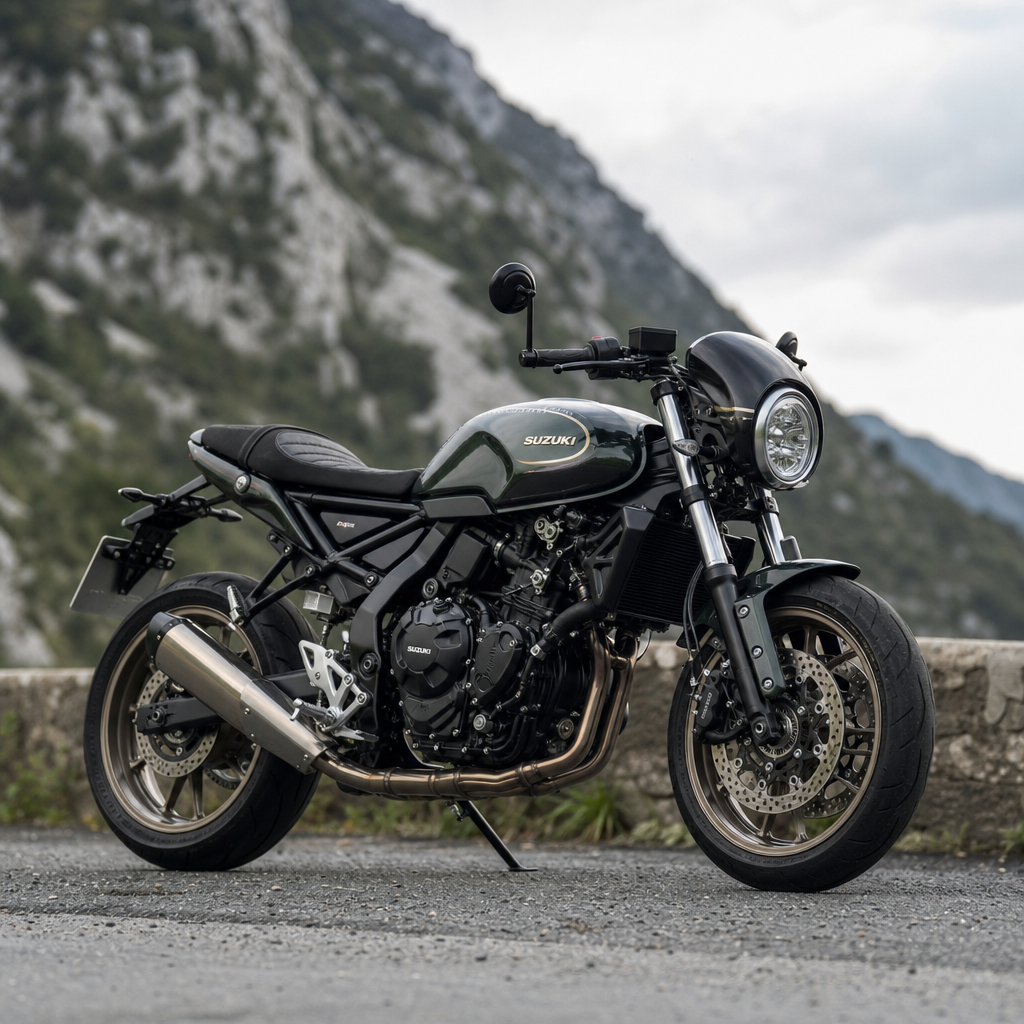
The Suzuki GSX-8TT arrives at a moment when motorcycle design is no longer split between pure nostalgia and pure futurism. Riders want emotional cues from the past, but they also expect modern reliability, electronics, emissions compliance, and everyday usability. That tension is exactly what makes neo-retro design worth studying. In this case study, the “Retro Spirit” Suzuki GSX-8TT is more than a styling exercise. It is a useful lens for understanding how manufacturers and custom builders translate heritage into contemporary form, and how that translation connects to wider custom culture, from Chicano lowrider influence to performance bagger aggression to stripped-back Frisco minimalism.
Neo-retro design, in plain terms, means creating a new machine that references recognizable forms from earlier eras while retaining current engineering underneath. The best neo-retro motorcycles do not copy old bikes panel for panel. They select a few dominant signals, such as tank shape, seat line, headlight treatment, paint, stance, or wheel proportion, then support those signals with modern chassis geometry, materials, and interfaces. I have worked on product positioning and custom concept reviews where the difference between a convincing neo-retro build and a confused one came down to discipline: too many references produce costume, while a tightly edited set of cues produces identity.
The GSX-8TT matters because it sits at the intersection of factory design and custom inspiration. As a sub-pillar hub for design theory across Chicano, performance bagger, Frisco, and adjacent styles, this article maps the language builders use when they discuss silhouette, rake, negative space, trim strategy, and cultural authenticity. It also clarifies a central point: style categories are not just aesthetics. They encode geography, social history, rider posture, intended use, and fabrication decisions. If you understand why the GSX-8TT feels “retro” without becoming a museum replica, you can better understand how every modern custom scene balances lineage and innovation.
What Makes the GSX-8TT a Strong Neo-Retro Case Study
The GSX-8TT is compelling because it shows how a contemporary platform can carry historical references without compromising baseline performance. Suzuki’s current middleweight architecture, including a modern parallel-twin layout, liquid cooling, digital instrumentation, and current suspension expectations, provides the hard points. Over that, the design language does the interpretive work. Instead of imitating one exact vintage Suzuki, the bike appears to borrow from late 1970s and early 1980s sport and standard forms: a shaped tank, a flatter seat relationship, a more deliberate graphic package, and a front-end treatment that suggests endurance racing and classic roadgoing sport machines.
In design review terms, the bike succeeds when three elements line up. First, the silhouette must read instantly from twenty feet away. Second, close inspection must reveal enough material and graphic detail to reward ownership. Third, the riding experience cannot betray the visual promise. A retro-themed motorcycle with abrupt fueling, awkward ergonomics, or cheap trim quickly loses credibility. Modern buyers may be drawn in by a colorway or fairing edge, but they stay because the machine works on real roads in real conditions. That is why neo-retro design is not skin deep; it is a systems problem.
The model also helps explain why factory neo-retro motorcycles now influence customs in both directions. Ten years ago, builders often retrofitted modern performance into older frames. Today, they also start with fresh platforms and backdate the emotional language. That reversal matters in custom culture because emissions law, parts availability, warranty expectations, and financing all affect what people can actually own and modify. A bike like the GSX-8TT gives riders a compliant, dependable base that already carries retro legitimacy, making it easier to branch into style-specific customization rather than beginning from a blank and expensive fabrication slate.
Reading the Design Language: Proportion, Surface, and Stance
The fastest way to assess neo-retro design is to ignore individual parts for a moment and study proportion. The eye tracks wheel-to-body relationship first, then the tank-to-seat line, then how visual mass sits over the engine. On the GSX-8TT, the intended effect is compact but not cramped, sporty but not supersport, heritage-driven but not antique. That balance depends on managing visual density. A modern engine is inevitably busier than an air-cooled vintage motor, so the upper bodywork has to simplify the picture. Clean side panels, disciplined graphics, and a coherent color split help the viewer process the bike as a single statement rather than a pile of components.
Surface treatment matters just as much. In a convincing neo-retro motorcycle, the surfaces should look intentional under both daylight and close showroom lighting. Rounded tank shoulders suggest older pressings, but the transitions must still work with contemporary manufacturing tolerances. Matte and gloss finishes must be used strategically. Too much satin black can flatten the bike and make it read generic. Too much bright trim can push it into parody. The best examples use contrast to guide attention: one highlight at the tank, one at the fairing or headlight surround, one at the wheel or fork area, then restraint elsewhere.
Stance is where theory becomes visceral. If the front appears too tall, the bike can read adventure-adjacent instead of road classic. If the rear is too kicked up, the retro claim disappears into streetfighter territory. The GSX-8TT demonstrates that neo-retro success often depends on subtle moderation. Bar position, seat height, wheelbase impression, and visual rake must support confidence and familiarity. Builders across many scenes use the same principle. Before discussing paint, chrome, engraving, or billet, they ask whether the motorcycle sits correctly. Stance communicates intention faster than any badge.
How Chicano Design Theory Shapes Motorcycle Interpretation
Chicano design theory comes from a wider visual and social world rooted in lowrider culture, neighborhood identity, craftsmanship, family presence, and ceremonial display. On motorcycles, that influence often appears through elongated lines, deep paint, layered pinstriping, engraved metal, chrome, velvet or leather detail, and a sense that the machine is built to be seen as much as ridden. It is not simply “ornate.” The point is dignity, smoothness, and controlled visual rhythm. A Chicano-influenced bike carries itself with grace. Even when lavish, it should feel composed rather than chaotic.
Applied to a neo-retro platform like the GSX-8TT, Chicano thinking is less about direct imitation and more about attitude toward finish and storytelling. A builder might preserve the factory tank silhouette but add candy paint with fine-line graphics, a custom seat with period-appropriate tuck-and-roll, polished covers, and a carefully selected sissy bar or rear treatment. The key is that modifications must honor the bike’s lines. In weak builds, decorative layers fight the base design. In strong builds, every added element extends the existing flow from headlight to tail. That is why understanding line quality matters before choosing any color or metal finish.
There is also a cultural responsibility here. Chicano style is not a mood board detached from people. It comes from communities with specific histories in California and the American Southwest, linked to car clubs, boulevard cruising, mural traditions, lettering, and intergenerational craft knowledge. Builders who borrow from this language need to know what they are referencing. Authenticity does not require copying every convention, but it does require respect, context, and restraint. The best work acknowledges source culture through coherent visual decisions, not by scattering stereotypes across an otherwise unrelated motorcycle.
Performance Bagger Theory: Speed, Mass, and Visual Authority
Performance bagger design starts from a contradiction that gives it energy: a large touring motorcycle is optimized for long distance and comfort, yet builders push it toward cornering speed, braking competence, and visual menace. The style uses stretched side profiles, substantial front wheels, muscular fairings, hard luggage, and lowered visual mass to communicate authority. Modern examples also rely on upgraded suspension, radial brakes, lightweight wheels, and tuned engines. This is not decoration pretending to be performance. In the best builds, the chassis and drivetrain are upgraded to match the aggressive appearance.
At first glance, the GSX-8TT is far from a bagger, but it still offers a valuable comparative lesson. Performance baggers teach that visual weight can be managed, not merely reduced. A machine can look substantial and fast at the same time if the lines pull forward and the bodywork is anchored. Neo-retro middleweights can use that lesson by giving the front cowl, tank, and side profile a more planted relationship. Designers often solve this with color blocking and wheel emphasis. Dark lower zones visually lower the center, while brighter upper surfaces highlight the heritage cues riders are meant to remember.
Another lesson from performance bagger culture is function-led customization. In my experience, the most convincing bagger-inspired projects begin with geometry, brake package, suspension travel, and rider triangle, then move to bodywork. The same sequence improves neo-retro customs. If you want a GSX-8TT-inspired build that feels premium, sort the ride first. Cartridge internals, spring rates, tire profile, and lever ergonomics shape the owner’s perception more than an extra trim panel ever will. A motorcycle that looks serious but rides poorly never keeps respect for long in builder circles.
Frisco Style and the Power of Deliberate Sparseness
Frisco style has a very different philosophy. Associated with Northern California custom history, especially stripped and elevated chopper forms, Frisco thinking emphasizes narrowness, directness, and an almost confrontational honesty about what the motorcycle is. Typical cues include tall bars, slim tanks, minimal bodywork, exposed mechanicals, and a high-mounted, purposeful stance. On a conceptual level, Frisco style rejects excess visual smoothing. Where Chicano influence often celebrates layered finish, Frisco celebrates reduction and mechanical immediacy.
That matters for understanding the GSX-8TT because neo-retro design often succeeds through selective subtraction. Every modern motorcycle carries unavoidable complexity: catalytic exhaust routing, sensors, radiator packaging, wiring, and safety hardware. A designer can either hide that complexity with more bodywork or frame it with restraint so the bike still feels elemental. The GSX-8TT leans on the second strategy. It tries to preserve enough open space around the engine and enough directness in the side profile that the bike does not feel over-dressed. This is where Frisco theory becomes useful even when the bike itself is not remotely a chopper.
Builders can apply Frisco lessons to modern retro platforms by focusing on what they remove rather than what they add. Do you need a bulky tail assembly, oversized signals, layered badging, or multiple conflicting finishes? Often the answer is no. A cleaner cockpit, a tighter rear section, and fewer visual interruptions can make a bike feel more assertive and more timeless. Sparseness, when intentional, is not emptiness. It is composition.
Comparing Major Design Languages in This Subtopic Hub
For readers using this page as a hub, the most practical way to compare styles is to look at the design objective behind each one. Chicano aims for elegance, ceremony, and cultural expression through finish and flow. Performance bagger aims for speed, dominance, and long-wheelbase athleticism supported by real chassis upgrades. Frisco aims for stripped identity, narrow profile, and uncompromising mechanical presence. Neo-retro factory design, represented here by the GSX-8TT, aims to translate memory into a product that works for present-day ownership. These are not mutually exclusive categories, but each has a primary logic that should guide every build decision.
| Style | Core Visual Goal | Typical Cues | Main Risk |
|---|---|---|---|
| Chicano | Graceful presence and cultural storytelling | Candy paint, chrome, engraving, flowing lines | Over-decoration that disrupts line quality |
| Performance Bagger | Large-scale speed and authority | Fairings, hard bags, big wheels, upgraded suspension and brakes | Appearance outrunning actual chassis capability |
| Frisco | Minimal, direct mechanical identity | Reduced bodywork, narrow silhouette, exposed components | Confusing rawness with poor execution |
| Neo-Retro | Modern usability with heritage cues | Classic tank forms, retro graphics, contemporary electronics | Nostalgia becoming pastiche |
This comparison also clarifies why hub articles matter. Readers exploring custom culture need a shared vocabulary before moving into narrower topics such as paint processes, fairing selection, frame modifications, CNC fabrication, or additive manufacturing. Once you can identify a style’s governing principle, you can judge whether any individual part belongs on the bike. That prevents one of the most common beginner mistakes: mixing admired components from different genres without asking whether they tell the same visual story.
Fabrication Technology and the New Guard Approach
The “New Guard” builder scene has changed design execution as much as design taste. Today, custom motorcycles are shaped by CAD modeling, CNC machining, 3D scanning, laser cutting, hydrographic and advanced coating processes, and rapid prototyping for brackets, mockups, and trim pieces. Even small workshops now combine digital tools with traditional metal finishing. For neo-retro projects, that matters because precision lets builders create parts that look period-correct while fitting modern tolerances. A seat hump can echo a vintage racer profile, but the mounting tabs, clearances, and wiring provisions can be engineered far more cleanly than they were decades ago.
The GSX-8TT, as a case study, benefits from this shift because modern platforms invite modular customization. Builders can scan the tank, side cover, and subframe geometry, then design reversible components that preserve serviceability. That is a major cultural change. Older custom scenes often accepted crude fitment as the price of uniqueness. The newer standard is much higher. Customers expect panel gaps to be consistent, powder coat and paint interfaces to be durable, and electrical systems to remain diagnosable with proper connectors rather than improvised splices. Good fabrication now means invisible problem solving.
Technology also sharpens the difference between authentic design and random modification. When manufacturing tools make almost anything possible, taste becomes the real limiter. I have seen exquisitely machined parts ruin otherwise coherent bikes because the designer chased technical complexity instead of visual purpose. The best New Guard builds use digital fabrication to support a clear thesis. On a neo-retro motorcycle, that might mean custom rearsets that tuck neatly into the line of the frame, a bracket that relocates instrumentation without clutter, or a cowl mount that looks factory because its geometry has been properly resolved.
Conclusion: Why the GSX-8TT Matters Beyond One Motorcycle
The “Retro Spirit” Suzuki GSX-8TT matters because it demonstrates a central truth about modern motorcycle design: heritage only works when it is translated, not copied. The bike gives us a practical framework for reading proportion, finish, stance, and cultural reference across the wider world of custom building. It shows how neo-retro design can borrow emotional cues from the past while meeting present demands for reliability, usability, and technical polish. That same framework helps explain why Chicano builds prioritize flow and ceremonial finish, why performance baggers fuse visual mass with real chassis upgrades, and why Frisco style finds strength in reduction.
As a hub for this subtopic, the main takeaway is simple. Every successful build starts with a governing idea. Once that idea is clear, parts selection, fabrication method, paint strategy, and ergonomic choices become easier to judge. The GSX-8TT is useful not because it answers every design question, but because it shows how disciplined answers are made. If you are exploring Custom Culture and Builders, use this article as your baseline, then move deeper into the individual style branches, fabrication methods, and builder profiles that define the New Guard.
Frequently Asked Questions
What makes the Suzuki GSX-8TT a strong case study in neo-retro motorcycle design?
The Suzuki GSX-8TT is a particularly useful case study because it sits at the exact intersection where heritage styling and modern engineering now meet. Neo-retro design is not simply about making a new motorcycle look old. It is about selecting the right visual references from earlier eras, translating them into contemporary form, and making sure the machine still performs, complies, and survives in a modern market. In that sense, the GSX-8TT represents a broader industry trend: motorcycles are no longer forced to choose between sentimental design and up-to-date capability. They are increasingly expected to deliver both.
What makes this model especially interesting is that its “retro spirit” can be examined as a deliberate design language rather than a random collection of vintage-inspired details. A neo-retro motorcycle succeeds when the tank shape, stance, lighting, proportions, seat line, color treatment, and cockpit all work together to evoke an earlier emotional memory without undermining function. If the bike feels dated rather than timeless, the design fails. If it looks modern but emotionally empty, it also fails. The GSX-8TT is valuable to study because it helps explain how manufacturers balance that tension with precision.
It also highlights an important distinction between restoration culture and neo-retro production design. A true vintage machine asks the owner to accept compromises in comfort, emissions, electronics, fuel delivery, and maintenance. A neo-retro machine like the GSX-8TT instead promises the appearance and mood of a classic motorcycle while retaining features riders now consider non-negotiable, such as reliable starting, predictable fueling, advanced chassis development, and rider-assistance systems. That dual identity is exactly why the model works as a lens for examining where motorcycle design is heading.
How does neo-retro design balance nostalgia with modern rider expectations?
At its core, neo-retro design is an exercise in controlled contradiction. Riders want the romance of the past, but they also want the reassurance of the present. They may love the silhouette of a classic roadster or sport machine, yet still expect LED lighting, modern brakes, efficient engines, clean emissions behavior, refined suspension, and dependable day-to-day usability. The challenge for designers is deciding which elements should feel historic and which elements must remain visibly contemporary to preserve trust and performance credibility.
On a motorcycle like the GSX-8TT, that balance usually begins with proportion. Older motorcycles often communicated their character through simple, memorable shapes: a strong tank profile, a clean tail, a defined seat, and a compact front view. Designers can borrow those cues while integrating current packaging needs, such as radiator placement, catalytic equipment, electronic hardware, and stricter ergonomic demands. The result is not a replica of the past but a modern motorcycle filtered through a heritage-oriented visual grammar.
The same balancing act appears in rider interface and functionality. A neo-retro machine must feel emotionally familiar without becoming inconvenient. That means it may reference analog-era simplicity in its lines and overall stance, but it still needs to deliver smooth power, accessible controls, manageable heat, comfortable riding positions, and confidence-inspiring safety systems. The emotional goal is nostalgia; the practical goal is zero regression. When done well, the rider experiences the bike as soulful rather than compromised. That is the defining achievement of successful neo-retro design.
Which design elements typically create the “retro spirit” on a motorcycle like the GSX-8TT?
The “retro spirit” usually emerges from a carefully layered set of visual and tactile choices rather than one obvious styling gesture. The most important factor is often the overall silhouette. A neo-retro motorcycle tends to prioritize clear, readable shapes over aggressively fragmented surfaces. The tank may appear more sculpturally simple, the tail section more concise, and the side profile more balanced than on a purely contemporary sport-oriented design. These proportion-based decisions matter because riders often register a motorcycle’s era-inspired identity in a split second, long before they notice specific details.
Lighting and front-end treatment also play a major role. Round or classically framed headlights, restrained fairing elements, heritage-inspired graphics, and period-referencing paint schemes can all signal continuity with earlier generations of motorcycles. Likewise, the seat design, bar position, mirrors, side panels, and wheel presentation can subtly reinforce a sense of authenticity. The key is cohesion. If the details all point to different historical periods or design intentions, the motorcycle can feel costume-like. If they reinforce the same emotional reference, the bike feels intentional and believable.
Materials and finishes are equally important. Neo-retro design often relies on contrast: painted surfaces that recall older color traditions, metallic accents that suggest mechanical honesty, and modern components treated with enough restraint that they do not overpower the classic cues. Even the engine presentation matters. A fully modern parallel-twin or other contemporary powerplant can still contribute to the retro mood if its surrounding design communicates clarity, compactness, and visual discipline. In that sense, the “retro spirit” is less about literal imitation and more about preserving the emotional architecture of classic motorcycles while accepting modern mechanical realities.
Why is the GSX-8TT more than just a styling exercise for manufacturers and custom builders?
The GSX-8TT matters beyond aesthetics because it demonstrates how design can shape market positioning, brand storytelling, and rider identity all at once. For manufacturers, a neo-retro bike is often a way to connect historical credibility with present-day product relevance. It allows a brand to remind riders of its legacy without relying entirely on museum-piece nostalgia. That can be commercially powerful, especially in a market where emotional differentiation matters as much as raw specification. The motorcycle becomes not just transportation, but a statement about what the brand remembers and how it chooses to evolve.
For custom builders, the GSX-8TT is equally revealing because neo-retro design often overlaps with customization culture. Builders have long explored the idea of blending old-school visual cues with modern donor platforms, and production motorcycles in this category effectively institutionalize that instinct. A model like this shows which heritage references have become mainstream, which details are considered essential to the retro vocabulary, and how far a factory can go in offering a curated vintage-modern blend straight from the showroom. In that sense, it serves as a benchmark for what is now possible without sacrificing reliability or daily rideability.
It also raises larger questions about authenticity. Is a neo-retro motorcycle most authentic when it closely resembles a specific historical predecessor, or when it captures the broader feeling of a past era while remaining honest about modern technology? The GSX-8TT helps frame that debate. Its significance lies in the fact that it is not merely decorating a modern chassis with nostalgic trim. It is part of a wider design conversation about how motorcycles preserve emotional continuity in a time defined by changing regulations, digital systems, and evolving rider expectations.
What does the GSX-8TT suggest about the future of neo-retro motorcycle design?
The GSX-8TT suggests that the future of neo-retro design will be increasingly sophisticated, less literal, and more integrated. Early retro-inspired motorcycles sometimes leaned heavily on obvious references: round lamps, classic paint, and a vaguely vintage shape. The next phase is more nuanced. Manufacturers are learning that riders can tell the difference between superficial nostalgia and deeply resolved design. Future neo-retro motorcycles will likely place even greater emphasis on proportion, tactile quality, ergonomic coherence, and visual authenticity rather than relying on a checklist of retro cues.
It also points toward a future in which emotional design becomes a practical necessity rather than a niche preference. As powertrains become more standardized in performance and as regulation shapes what engines can do, styling and rider experience become more important tools for differentiation. In that environment, neo-retro design offers brands a flexible framework: it provides emotional depth, historical continuity, and broad appeal while still accommodating modern platforms, electronics, and production efficiencies. That makes it strategically valuable, not just stylistically fashionable.
Perhaps most importantly, the GSX-8TT indicates that the old debate between nostalgia and futurism is becoming less relevant. The motorcycles that resonate most strongly may be the ones that fuse both instincts with confidence. Riders do not necessarily want to live in the past, but they do want machines that feel connected to motorcycling’s cultural memory. At the same time, they expect ease of ownership, performance consistency, and modern safety. The future of neo-retro design, as illustrated by the GSX-8TT, lies in making that blend feel natural, honest, and complete.