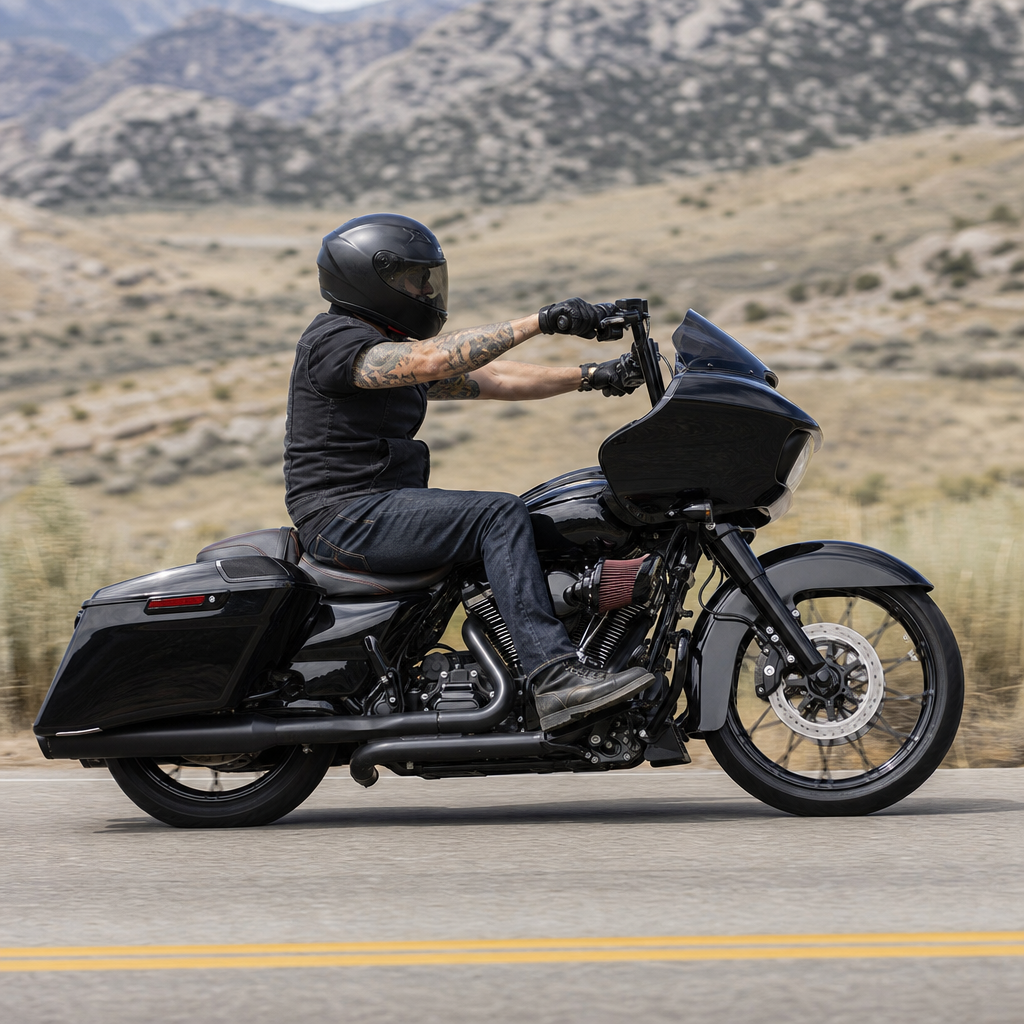
Performance bagger ergos sit at the center of modern V-twin design because bar shape, riser height, seat relationship, and foot control placement determine whether a motorcycle feels planted and fast or awkward and fatiguing. In builder terms, ergonomics means the rider triangle formed by hands, hips, and feet. Flat-out bars describe bars with minimal pullback, modest rise, and a forward, aggressive hand position. Mid-control positioning moves the feet under the rider instead of far ahead, creating leverage for braking, corner entry, and body support. This matters because the current custom scene no longer treats style and function as separate worlds. The best builds blend visual identity with real dynamic gains.
I have spent enough time around fabrication shops, dyno rooms, and suspension tuners to know that ergonomics is where fashionable parts either become a coherent motorcycle or a collection of expensive compromises. Riders often ask why one bagger can hustle through a canyon while another with similar power feels vague and cumbersome. Usually the answer is not horsepower. It is rider placement. On a heavy touring chassis, every inch of bar sweep, riser setback, seat pocket depth, and control position changes steering input, upper-body load, and confidence under braking. Good ergonomic design lets the rider command the motorcycle rather than hang onto it.
This hub covers the wider design theory behind Chicano style, performance bagger execution, Frisco stance, and adjacent builder directions shaping the new guard. Those labels describe more than appearance. Chicano often emphasizes long, low lines, tall apes, deep paint, engraving, and a composed boulevard posture. Performance bagger focuses on suspension travel, cornering clearance, stronger brakes, flatter bars, and an athletic rider triangle. Frisco language points toward narrow silhouettes, elevated tanks, slim fenders, and stripped visual mass, usually with a more elemental riding attitude. Beyond those categories are crossover builds using CAD-modeled brackets, CNC-machined triples, TIG-welded subframes, carbon bodywork, and data-driven suspension setup. Understanding the theory behind each approach helps riders choose parts intelligently and helps builders create motorcycles that feel deliberate instead of trend-chasing.
Why ergonomics leads performance bagger design
Performance bagger design starts with a simple truth: a touring motorcycle can only be ridden aggressively if the rider can support their own body without fighting the chassis. On stock floorboard-and-pullback setups, hard braking pushes the rider backward into the seat pocket and then forward into the bars. That forces the hands to do too much. By moving to mid controls or rearward floorboard positions, flattening the bars, and adjusting seat contour, builders create a neutral stance that supports the torso through the legs and core. The result is cleaner steering input, less bar wobble over bumps, and much better endurance over a long day.
Mid-control positioning is especially important on Harley-Davidson touring platforms such as the Road Glide and Street Glide because those motorcycles carry significant weight high and wide. When feet are too far forward, the rider loses the ability to unweight the seat over rough pavement and cannot brace effectively during threshold braking. Bringing the feet rearward and slightly upward increases knee bend and lets the rider lock into the bike. That improves feel at turn-in and reduces the disconnected sensation common on large baggers. Builders working with Kraus, Alloy Art, San Diego Customs, Thrashin Supply, and similar ecosystems often tune the cockpit as a system rather than adding isolated parts.
Flat-out bars serve the same goal. Less pullback puts elbows out in a stronger, more natural position, which improves countersteering authority. Moderate rise keeps weight from collapsing onto the wrists, while limited sweep prevents the shoulders from rolling inward. The exact dimensions depend on rider size, seat height, tank shape, and fairing clearance, but the principle is consistent: bars should encourage an active posture with relaxed shoulders and direct steering. If a rider must reach too far, fatigue increases. If the bars come too far back, leverage under fast transitions suffers. The sweet spot is a forward command position that still works for hundreds of miles.
How Chicano, performance bagger, and Frisco differ in design theory
Chicano, performance bagger, and Frisco styles each express a different philosophy about what a custom motorcycle should communicate and how the rider should inhabit it. Chicano design values presence, craft, and flow. It often uses larger front wheels, stretched bags, long fenders, fishtail pipes, tall handlebars, and intricate paint rooted in lowrider culture. The rider posture is upright and stately. Visual rhythm matters more than lap times, though a well-built Chicano bike can still ride very well if trail, suspension travel, and bar geometry remain sensible.
Performance bagger design treats the touring motorcycle as a sporting platform. The look follows function: taller shocks from Öhlins, Fox, Legend, or Bitubo; cartridge forks; radial brakes from Brembo; lighter wheels from BST or performance-focused forged suppliers; and seats shaped to keep the rider in one place under acceleration. Hard parts exist to improve speed, repeatability, and confidence. The style has become visually distinct, but the best examples earn that identity through measurable capability, not decals and black anodizing alone.
Frisco thinking comes from stripped-down urban utility and mechanical honesty. Historically, it favored narrow bars or compact apes, peanut tanks raised above the backbone, tucked-in proportions, and minimal bodywork. The posture can feel compact, direct, and slightly defiant. On modern interpretations, builders borrow Frisco cues to reduce visual bulk and expose structure. That approach influences some new-guard bagger builds, especially where builders want to make large touring platforms appear slimmer and more mechanical.
Many standout customs now blend these theories. A bike may wear Chicano paint, use performance bagger suspension, and adopt selective Frisco sparseness around the tank and side covers. That hybridization is not confusion when the rider triangle and intended use remain clear. It becomes a problem only when visual references conflict with actual dynamics, such as extremely tall bars paired with short-travel suspension and low cornering clearance on a bike advertised as performance-focused.
The rider triangle: bars, seat, pegs, and fairing as one system
The most important lesson I have learned in fitment sessions is that no ergonomic component works alone. Bars cannot be chosen without considering riser height, riser offset, seat pocket location, tank reach, and where the feet land relative to the hips. On a Road Glide, fairing distance changes the apparent reach. On a Street Glide, batwing clearance and gauge sightline matter more. A one-inch riser change can transform shoulder comfort, but only if the seat does not simultaneously place the rider too far rearward.
Seats are often undervalued in performance bagger builds. A deep touring bucket can trap the pelvis and delay body movement, while a flatter performance seat with a defined lumbar stop lets the rider slide slightly and brace under acceleration. Saddlemen, LePera, and custom upholstery shops all approach this differently, but the principle is the same: the seat should stabilize the rider without locking them into a poor hip angle. When combined with mids, it should let the knees grip the tank or side surfaces enough to reduce hand pressure.
Control placement also affects safety. Brake pedal angle, shifter throw, lever span, and clutch effort matter on heavy motorcycles ridden hard. Builders increasingly use adjustable levers, hydraulic clutch conversions, and revised pedal linkages because fine control counts when entering a decreasing-radius turn or managing a quick downshift. Good ergonomics is not comfort versus performance. Properly done, it improves both.
| Style | Typical bar position | Foot control approach | Primary design goal |
|---|---|---|---|
| Chicano | Taller, more upright, often significant rise | Forward or stock touring placement | Presence, flow, boulevard composure |
| Performance bagger | Flatter, lower sweep, assertive forward reach | Mid controls or rearward floorboard strategy | Control, braking support, corner speed |
| Frisco | Compact and direct, sometimes narrow | Centralized, minimalistic layout | Slim silhouette, mechanical simplicity |
| Hybrid new guard | Fit-specific, often modular and adjustable | Chosen around intended riding use | Blend aesthetics with measurable function |
Fabrication technology shaping the new guard
The new guard in custom motorcycle building is defined as much by process as by taste. Builders now use 3D scanning, CAD packaging studies, CNC machining, laser-cut fixtures, and finite-element-informed bracket design to solve old fitment problems with far greater precision. Instead of eyeballing bar and riser combinations, some shops digitally map rider position before cutting parts. Instead of adapting universal controls, they prototype exact offsets for a given frame, primary, and exhaust path. This has raised the floor for quality and shortened the gap between concept and rideable result.
TIG welding remains a visible badge of craftsmanship, but hidden engineering is what separates serious builds from social media props. A mid-control mount on a heavyweight bagger must account for torsional load, vibration, serviceability, and crash survivability. Material choice matters. Builders commonly use 6061-T6 aluminum for machined brackets, chromoly for structural tabs, and stainless where corrosion or heat cycling is an issue. Bearing selection, fastener grade, and thread engagement are not glamorous subjects, yet they determine whether a bike stays tight after ten thousand hard miles.
Suspension and braking technology have advanced in parallel. Performance baggers benefit enormously from quality damping because rider position only works if the chassis remains composed. In practice, that means setting sag correctly, selecting spring rates for actual rider and luggage weight, and tuning rebound to control chassis pitch. I have seen bikes with excellent bars and mids still feel bad because the rear shocks were undersprung and the fork oil was wrong. Ergonomics gives the rider leverage; suspension converts that leverage into usable grip.
Wheel and tire choices also influence ergonomic feel. Lighter wheels reduce gyroscopic resistance and make a large bagger respond more honestly to bar input. Tire profile changes steering effort and available edge grip. Even grip diameter matters for hand fatigue on long rides. The new guard treats the motorcycle as an integrated system where rider contact points, geometry, and materials all support one outcome.
Practical setup advice for riders and builders
If you are planning a build around performance bagger ergos, start with intended use. A rider doing long highway miles with occasional canyon runs needs a different setup from someone targeting track-oriented bagger events such as King of the Baggers-inspired practice days. Measure inseam, shoulder width, arm length, and current seat-to-bar reach before buying parts. Then define nonnegotiables: wind protection, passenger use, luggage retention, audio needs, and cornering goals. Those factors determine whether mids, relocated floorboards, or simply revised boards and a better seat are the right move.
For most riders, the best bar setup is not extreme. Aim for neutral wrists, elbows slightly bent, and shoulders relaxed when seated in your natural position. Under braking, you should be able to support yourself with your legs, not your palms. If mids are too aggressive for your knee mobility, a halfway solution can still improve control dramatically. Small changes to seat height and board position often unlock the stance riders were trying to achieve with oversized bars alone.
Builders should road test in varied conditions, not just around the block. Evaluate low-speed lock-to-lock behavior, freeway wind load, rough pavement stability, and repeated hard braking. Confirm that cables, brake lines, and wiring do not bind at full steering lock. Check that fairing-mounted mirrors, screens, and hand controls still work with gloved hands. Good design theory becomes credible only when the bike performs without excuses. The strongest customs in this space are beautiful because every visual choice is supported by mechanical logic.
Where this hub leads next
This design theory hub connects the major branches of contemporary V-twin custom culture. Chicano style explains how stance, paint, chrome, engraving, and silhouette create elegance and cultural continuity. Performance bagger thinking shows how flat-out bars, mid-control positioning, suspension geometry, and braking upgrades turn a touring platform into a genuinely athletic machine. Frisco influence demonstrates the lasting value of simplification, proportion control, and exposing the motorcycle’s essential structure. The new guard ties these traditions together with fabrication technology that allows cleaner execution and better real-world function.
The key takeaway is simple: rider ergonomics is not a finishing detail. It is the architecture that makes a custom motorcycle believable. When the hands, hips, and feet are placed with intent, style families become tools rather than costumes. A Chicano bike can ride gracefully because its posture is coherent. A performance bagger can corner hard because its rider triangle supports forceful inputs. A Frisco-inspired build can feel alive because nothing about it is accidental. Across every branch, the best builders begin with how the rider lives on the machine.
Use this page as your starting point for deeper articles on each style, on fabrication methods, and on specific components such as bars, risers, seats, boards, and mid controls. Study the theory, compare parts honestly, and test changes one system at a time. That approach saves money, avoids trendy mistakes, and leads to a motorcycle that looks right because it works right.
Frequently Asked Questions
1. What do “flat-out bars” mean on a performance bagger, and how are they different from traditional cruiser handlebars?
Flat-out bars are handlebars designed to place the rider in a more neutral, forward-focused posture instead of the leaned-back position common on traditional cruisers. In practical terms, they usually have minimal pullback, a modest rise, and a wider, more direct hand position. That changes the entire feel of the motorcycle. Rather than having your hands come back toward your chest, flat-out bars encourage your upper body to stay engaged over the bike, which improves leverage at the front end and gives the rider a stronger sense of control during aggressive riding.
Compared with classic cruiser bars, which often prioritize a relaxed boulevard posture, flat-out bars are built around performance. Traditional cruiser bars can feel comfortable at low effort and straight-line speeds, but they may reduce steering precision when the pace increases. Flat-out bars help the rider load the chassis more naturally, especially during corner entry, braking, and quick transitions. They also tend to reduce the vague or disconnected feeling that can happen when the bars are too pulled back or too high.
On a performance bagger, that difference matters because the motorcycle is heavier, more powerful, and often ridden with a sportier mindset than a standard cruiser. The bars are not just a styling element; they are a key part of the rider triangle and directly affect confidence, fatigue, and front-end feedback. If the bars are too close, too swept back, or too high, the bike can feel awkward and slow to respond. If they are set correctly, the rider feels planted, balanced, and ready to push the motorcycle with far more precision.
2. Why is mid-control positioning so important for performance bagger ergonomics?
Mid-control positioning is important because it puts the rider’s feet underneath the body rather than stretched far out in front. That single change has a major effect on balance, support, and control. When your feet are under you, your lower body becomes part of the motorcycle’s stability system. You can support yourself under braking, brace during acceleration, and shift your body weight more effectively in corners. That creates a much more connected riding experience than forward controls, which often lock the rider into a passive seated position.
For performance baggers, this matters even more because these motorcycles combine substantial weight with strong torque and increasingly capable suspension setups. A rider needs to be able to manage that mass confidently. Mid-controls help keep the hips centered and the spine in a stronger, more athletic position. They also make it easier to absorb road inputs through the legs instead of forcing the lower back and arms to do all the work. The result is better control over longer distances and less fatigue when riding aggressively.
There is also a clear handling advantage. With mid-controls, the rider can make smaller, more intentional body movements, which helps the bike stay composed. It becomes easier to stand slightly over rough pavement, reposition in a corner, and maintain traction awareness through the seat and pegs. On a machine meant to feel planted and fast, foot placement is not a minor detail. It is one of the main reasons a performance bagger can feel athletic instead of cumbersome.
3. How do handlebars, seat position, and foot controls work together in the rider triangle?
The rider triangle is the relationship between your hands, hips, and feet, and it is the foundation of motorcycle ergonomics. On a performance bagger, the bars, seat, and foot controls must work together as one system. If one point is off, the whole riding position feels wrong. For example, even excellent flat-out bars can feel uncomfortable if the seat locks the rider too far back or if the foot controls are too far forward. In the same way, properly placed mid-controls can still feel awkward if the bars force too much reach or put too much weight on the wrists.
A well-designed rider triangle creates a balanced posture where the rider’s core, legs, and arms all share the workload. The seat should locate the hips in a position that supports both comfort and movement. The bars should allow a slight bend in the elbows and a natural shoulder angle, without forcing the rider to shrug upward or collapse forward. The foot controls should let the knees bend enough to support the body while still leaving room to move. When all three are aligned, the motorcycle feels intuitive and settled.
This is why experienced builders and riders talk about ergonomics in terms of the entire package, not individual parts. A great-looking set of bars or a popular control conversion is not automatically the right solution unless it complements the bike’s seat height, tank shape, fairing position, and the rider’s body dimensions. The goal is to create a posture that feels engaged without being cramped, aggressive without being punishing, and stable without becoming rigid. That balance is what gives a performance bagger its confident, capable feel.
4. Do flat-out bars and mid-controls make a performance bagger less comfortable for long rides?
Not necessarily. In fact, when they are set up correctly, flat-out bars and mid-controls can improve long-distance comfort because they support the body more naturally. Many riders assume that a more aggressive posture must always be harsher, but discomfort often comes from poor support rather than a sportier stance. If the bars are too high, too close, or too swept back, the shoulders and lower back can become strained. If the feet are too far forward, the rider cannot use the legs to absorb bumps or brace against wind and braking forces. That tends to create more fatigue over time, not less.
With flat-out bars, the rider usually gains a better upper-body position that promotes control and reduces the tendency to hang on the bars. With mid-controls, the legs can actively support posture, which takes pressure off the tailbone and lower spine. This matters on long rides because a supported, balanced position is often more sustainable than a reclined but unsupported one. The body is able to distribute effort across more muscle groups rather than overloading a few sensitive areas.
That said, comfort depends heavily on fit. Bar width, riser height, seat contour, inseam, torso length, and even wind protection all influence whether the setup feels natural. A properly dialed-in performance bagger should feel purposeful and comfortable enough to ride for hours, with the added benefit of staying controlled when the road turns technical. The best ergonomic setups are not extreme for the sake of appearance; they are carefully matched to the rider so the motorcycle feels equally capable on a freeway, backroad, or fast touring day.
5. How can riders choose the right ergonomic setup for a performance bagger build?
The best approach is to start with riding intent and body fit, not trends. Riders should ask how the motorcycle will actually be used: aggressive canyon riding, high-speed touring, daily street use, or a mix of all three. From there, it helps to evaluate the current rider triangle honestly. Are the wrists carrying too much load? Do the shoulders feel cramped or overstretched? Are the feet too far forward to brace effectively? Does the seat lock the pelvis into a poor position? Those answers reveal what needs to change far more accurately than copying another bike’s parts list.
When choosing flat-out bars, key variables include width, rise, and pullback. The goal is a hand position that gives leverage without forcing an excessive reach. With mid-controls, the main concern is whether the feet land naturally under the rider in a way that allows support, movement, and adequate cornering clearance. Seat shape is just as important, because even a small change in pocket location or height can dramatically alter how the bars and controls feel. This is why successful performance bagger builds are usually the result of testing and refinement rather than a single bolt-on transformation.
Riders should also think in terms of dynamic comfort, not just static showroom comfort. A setup can feel relaxed when parked yet become awkward once wind pressure, braking force, and cornering loads enter the equation. The right ergonomic package should let the rider stay loose, maintain control, and move naturally with the bike. In the end, the ideal performance bagger setup is one that makes the motorcycle feel planted, responsive, and confidence-inspiring while still being comfortable enough to ride hard for real distances. That is the real benchmark of good ergonomics.