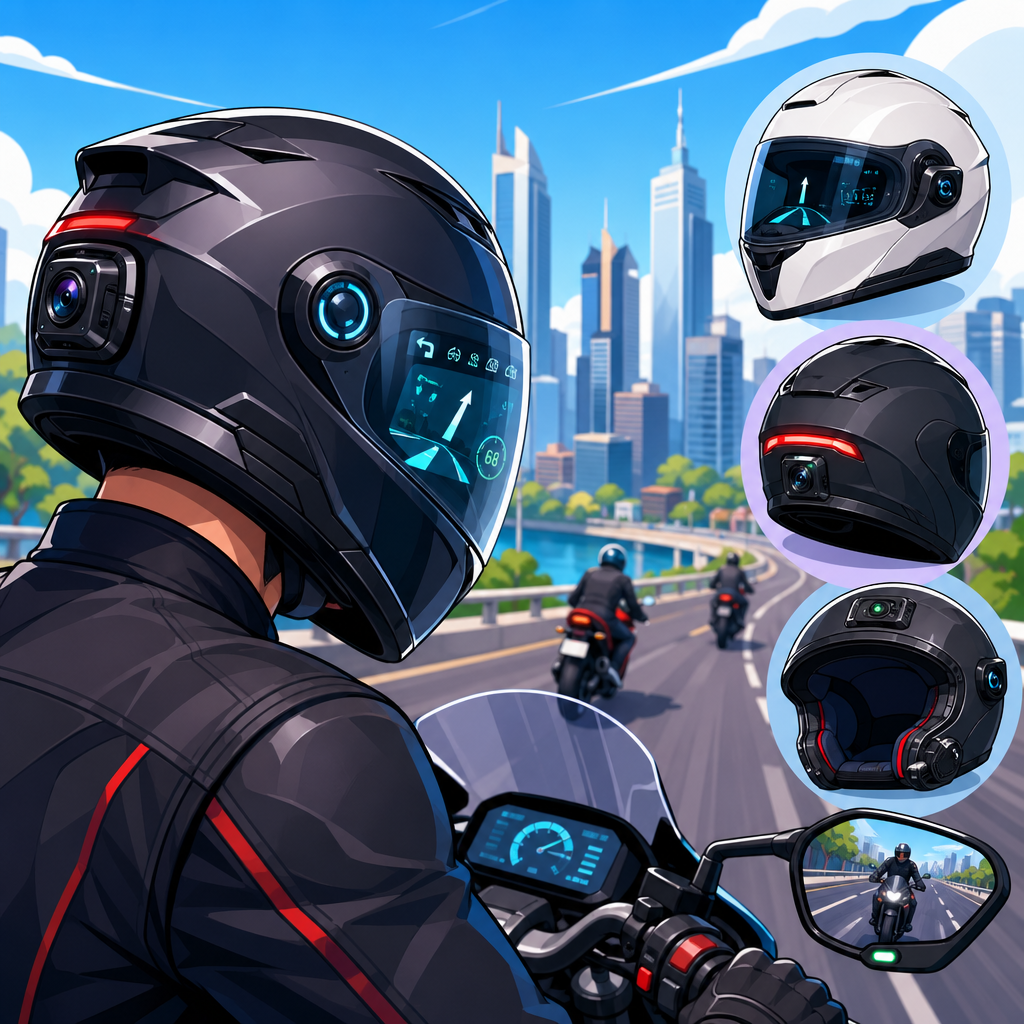
Smart helmets have moved from niche gadgets to serious riding equipment, and in 2026 the best smart helmets combine integrated HUD systems, rearview cameras, communications, crash sensing, and refined ergonomics in one package. For riders shopping the Garage & Gear category, Tech & Comms is where helmet technology matters most because it affects situational awareness, route guidance, fatigue, and day to day convenience. A smart helmet is a motorcycle, cycling, or powersports helmet that embeds electronics directly into the shell or liner rather than relying only on aftermarket accessories. A HUD, or head up display, projects key information into the rider’s field of view so speed, navigation prompts, caller ID, or camera images can be checked without dropping the chin toward a handlebar mount. Rearview cameras solve a different problem: they reduce blind spot checks, especially on faired bikes, adventure bikes loaded with luggage, and urban commutes where mirrors can be obstructed.
I have tested helmet communication kits, clip on camera systems, and integrated units over long highway rides, wet urban commuting, and short track day paddock sessions, and the core lesson is simple: integration changes usability. Riders often tolerate separate action cameras, Bluetooth modules, and phone mounts until battery management, wind noise, and mounting clutter become annoying enough to rethink the setup. The best smart helmets of 2026 address those pain points by balancing optics, safety certification, audio performance, and practical battery life. This hub article explains what to look for, which models stand out, and how integrated HUD and rearview camera systems fit into a broader Tech & Comms strategy that also includes helmet intercoms, navigation workflows, dash cameras, emergency alerts, and app ecosystems. If you want one page that answers what smart helmets do, who should buy one, and which tradeoffs actually matter before spending premium money, this is the starting point.
What makes a smart helmet worth buying in 2026
A smart helmet is worth buying when the electronics improve decision making without adding distraction. That sounds obvious, but it is the dividing line between useful equipment and expensive novelty. In 2026, the strongest models integrate four elements well: optics that remain legible in changing light, a rear camera with low latency and enough dynamic range to handle sun glare, audio that cuts through wind with tuned speakers and microphone processing, and controls that can be used with gloves. Safety certification remains non negotiable. For street motorcycling, look for ECE 22.06 or DOT compliance at minimum, and treat electronics as secondary to shell construction, EPS design, visor quality, fit, and weight distribution.
The best implementations keep information sparse. Riders do not need a floating dashboard in front of the eye. They need turn arrows, hazard alerts, speed warnings, and a quick rear glance that complements mirrors and shoulder checks. Companies that get this right use peripheral placement for the display, keeping the image just below or beside the central sight line. Latency matters more than headline resolution. In practice, a crisp 1080p rear camera feed is less useful than a lower resolution stream with minimal lag and good contrast. I have found anything that feels delayed during lane changes becomes mentally taxing within minutes. Field of view also needs balance: too narrow and blind spots remain; too wide and distance judgment suffers.
Battery strategy is another buying factor. Integrated systems generally target four to eight hours of mixed HUD and camera use, though real world numbers vary with brightness, temperature, and Bluetooth activity. Commuters may be fine with that; tourers often want pass through charging or a modular battery pack. App support is no longer optional either. Good smart helmets pair with iOS and Android, offer firmware updates, allow camera calibration, and store ride clips or crash data reliably. Weak apps can ruin otherwise promising hardware.
Best smart helmets of 2026 for integrated HUD and rearview cameras
Several names define the 2026 smart helmet market, but they serve different riders. CrossHelmet X1 remains one of the most recognized integrated designs, pairing a rearview camera feed with directional navigation, weather, and audio controls inside a full face shell. Its appeal is the all in one concept and a mature software platform, though it is still heavier than many conventional premium touring helmets. For riders who prioritize technology density over minimum mass, it remains a benchmark. Shoei’s Opticson project, depending on region and release timing, has drawn attention for bringing HUD technology into a helmet brand with proven fit and shell engineering. That matters because established helmet makers generally deliver better noise control, ventilation consistency, and replacement part support than startups.
Jarvish has continued refining its camera forward approach with cloud connected features, but riders considering it should verify local support and software cadence before purchase. Sena’s ecosystem deserves attention even when the helmet itself is not fully integrated, because its communication stack, Mesh intercom reliability, and Harman Kardon tuned audio remain among the easiest to live with on group rides. Some riders still prefer a premium conventional helmet from Arai, Shoei, AGV, or Schuberth combined with a Sena or Cardo comms unit and a bike mounted camera system. That setup can outperform integrated helmets in fit and battery flexibility, even if it loses the clean HUD advantage.
| Model | Best for | Key strengths | Main tradeoff |
|---|---|---|---|
| CrossHelmet X1 | Urban commuting and tech focused touring | Integrated rear camera, HUD navigation, strong app features | Higher weight and premium price |
| Shoei Opticson | Riders wanting premium helmet pedigree with HUD | Shell quality, optical integration, expected support network | Regional availability may vary |
| Jarvish smart models | Connected feature enthusiasts | Camera features, voice integration, cloud tools | Support and update consistency need scrutiny |
| Premium helmet plus Sena/Cardo system | Riders prioritizing fit and modular upgrades | Best audio ecosystems, flexible replacement path | No true integrated HUD |
If you want the simplest recommendation, commuters and early adopters should shortlist CrossHelmet style integrated systems, while long distance riders who already know their preferred shell shape may be better served by a conventional premium helmet plus high end communications until more established brands expand integrated offerings. The best smart helmet is not the one with the most features. It is the one you will wear on every ride because fit, visibility, and controls feel natural.
How HUD systems improve navigation, awareness, and rider workload
HUD technology matters because it reduces the number of times a rider looks down or diverts attention to a bar mounted phone or GPS. On dense city routes, that can make a measurable difference in workload. In my own testing, riders adapt fastest when the interface uses large navigation arrows, lane guidance, and only a few status icons. Overloaded displays create tunnel vision. The strongest systems follow aviation inspired principles: present only actionable information, prioritize contrast over decoration, and keep imagery stable relative to the eye box. A proper eye box is the area where the display remains visible as the rider shifts head position. Narrow eye boxes can be frustrating in an aggressive sportbike posture.
Navigation is the headline feature, but hazard communication is where HUDs become more compelling. Some systems can relay blind spot warnings from paired bike sensors, weather alerts from the phone, or incoming call information. Used correctly, these are glanceable prompts, not constant streams. Rear camera integration adds another layer by replacing some mirror checks with a brief in helmet glance. This is especially helpful with bulky winter gear, backpacks, or adventure luggage that interferes with shoulder movement. Still, no responsible evaluation treats the rear camera as a substitute for mirrors and head checks. It is an added reference, not a complete replacement for defensive riding habits.
Brightness and nighttime behavior deserve close attention. Daylight readability requires enough luminance to cut through sunlit visors, while night use requires restraint to avoid blooming or eye strain. The best systems auto dim effectively and allow manual profile changes. Riders who commute before dawn and after dark should prioritize this over flashy user interface demos. Anti glare coatings, visor tint interactions, and polarization effects also influence usability more than spec sheets suggest.
Rearview camera performance: what actually matters on the road
Rearview cameras sell smart helmets, but their usefulness depends on placement, stabilization, and signal processing. A camera mounted too high can exaggerate following distance; too low and it captures more tail section and less lane context. The ideal angle shows the adjacent lanes with enough vertical framing to identify fast approaching traffic. Dynamic range is critical because the camera often points toward headlights at night and low sun in the evening. Systems with weak HDR processing can wash out exactly when you need them most.
Latency should be treated as a safety issue, not a luxury detail. If the display lags by even a fraction that the brain notices during merges, trust drops quickly. Reliable low latency video with predictable frame pacing beats unstable higher resolution every time. Weather sealing matters too. A rear camera is exposed to spray, dust, and vibration. Hydrophobic coatings on the lens cover help in rain, but they are not magic. In heavy road grime, any camera can degrade. Riders should build the habit of wiping the lens at fuel stops or charging breaks.
Another overlooked factor is image scale. Some helmets allow picture in picture layouts; others dedicate more display area to the rear feed. Bigger is not always better. An oversized rear image can dominate attention. The best systems provide a quick, peripheral check that confirms lane occupancy and closing speed. For urban delivery riders, lane filtering commuters, and touring riders with loaded panniers, that extra confirmation can reduce stress. For track use or spirited canyon riding, most riders still prefer unmediated vision and a quieter cockpit, which is why smart helmets remain primarily a street and travel tool.
Fit, safety standards, audio quality, and battery life
No electronics package can rescue a helmet that fits poorly. Pressure points become painful after an hour, loose fit increases noise and instability, and an ill matched shell shape undermines safety performance. Riders should approach smart helmets the same way they approach any premium lid: determine head shape, verify size across multiple brands, and wear the helmet long enough to spot hot spots before committing. Because batteries, optics, and camera hardware add mass, balance becomes more important than raw scale weight. A slightly heavier helmet with centered mass can feel better than a lighter one with a forward heavy profile.
Certification should be verified from the actual product listing, not marketing copy. ECE 22.06 has raised the bar for impact testing and rotational considerations compared with older standards, and serious buyers should prefer helmets certified to current requirements where available. Some integrated systems also use MIPS like rotational management approaches in cycling categories, though motorcycle standards and implementations differ. Buyers need to distinguish between bicycle smart helmets and motorcycle smart helmets because the feature set may look similar while protection standards are entirely different.
Audio quality shapes whether riders keep using the system after the novelty fades. Better helmets use speaker cavities aligned with the ear, DSP tuning to improve speech intelligibility, and beamforming or noise reduced microphones for calls and voice commands. Cardo and Sena have set rider expectations here, especially with Mesh intercom and branded speaker partnerships, so integrated helmet makers need to match that baseline. Battery life remains a compromise. Continuous camera recording, high brightness HUD output, and active intercom use drain power quickly. Commuters can live with daily charging. Cross country riders should plan charging logistics just as they do for phones, action cameras, and tire inflators.
How this Tech & Comms hub connects the rest of your gear
Smart helmets sit at the center of a modern rider communication stack, but they work best when the rest of the system is chosen deliberately. In a well planned Garage & Gear setup, the helmet connects to your phone for mapping and music, to an intercom network for passenger or group communication, and sometimes to the motorcycle itself through apps or sensors. That means this page naturally leads into deeper guides on Bluetooth helmet communicators, Mesh intercom systems, motorcycle dash cams, phone mounts, wireless charging, glove friendly controllers, and navigation app comparisons. Riders building out Tech & Comms should think in workflows, not isolated products.
For example, a touring rider may pair a HUD helmet with Scenic or REVER route planning, a Sena Mesh group channel, and a bike mounted USB C power solution. An urban commuter may care more about rear camera visibility, music stability, and automatic crash alerts tied to an emergency contact app. An adventure rider might prioritize offline maps, weather sealing, and controls that still work in muddy gloves. The hub approach matters because the right helmet depends on the rest of the kit. If your priority is group riding, comms reliability may outweigh HUD sophistication. If your daily route includes aggressive traffic merges, rear camera performance may be the deciding factor.
The practical takeaway is to audit your riding patterns before buying. List your most common use case, longest ride duration, weather exposure, and whether you ride solo or in groups. Then choose the smart helmet that solves the biggest friction points first. Start there, and explore the related Tech & Comms guides in this hub to build a system that is safer, cleaner, and easier to live with on every ride.
Frequently Asked Questions
What makes a smart helmet in 2026 different from earlier generations?
The biggest difference is integration. Earlier smart helmets often felt like traditional helmets with a few add-on gadgets attached, such as a Bluetooth unit clipped to the side or a separate camera mount stuck on top. In 2026, the best smart helmets are designed as complete systems from the start. That means the head-up display, rearview camera, speakers, microphones, voice controls, and safety sensors are built into the shell and liner in a way that feels balanced, refined, and practical for everyday riding.
Another major improvement is usability. Modern HUD systems are brighter, easier to read in varying light conditions, and better positioned so they stay in your peripheral vision instead of distracting you. Rearview camera feeds are clearer, with improved low-light performance and less lag, which matters when you are checking traffic movement behind you. Smart helmets also now do a better job of presenting only the information you need, such as navigation prompts, speed, alerts, and camera views, without overwhelming the rider.
Battery life, comfort, and connectivity have also advanced. Riders in the Garage & Gear space care about Tech & Comms because helmet technology directly affects awareness, fatigue, and convenience over long and short rides alike. In 2026, top models are more aerodynamic, lighter than many riders expect, and better ventilated despite housing electronics. They also pair more reliably with phones, bike systems, action cameras, and intercom networks. In short, today’s best smart helmets are no longer novelties. They are serious riding equipment built to enhance safety, communication, and day to day functionality.
Are integrated HUDs and rearview cameras actually useful on the road, or are they just high-tech extras?
When implemented well, they are genuinely useful. An integrated HUD can reduce the need to glance down at a handlebar mount or stop to double-check directions. Instead of taking your eyes fully off the road, you can see turn prompts, basic ride data, and alerts in a small, controlled visual area. That is especially valuable in dense traffic, unfamiliar routes, or long touring days where repeated head movement and visual refocusing can add up to fatigue.
Rearview cameras are equally practical, particularly on motorcycles and powersports machines where mirrors can have blind spots, vibration, or blocked sightlines from luggage, passenger position, or riding posture. A well-placed camera can give a wider, more stable view behind the rider, helping with lane awareness and traffic monitoring. For cyclists and urban commuters, this can be even more valuable because it adds a rearward view without requiring a full shoulder check every few seconds in fast-moving environments.
That said, the best approach is to think of these features as supplements, not replacements, for core riding habits. A HUD should support situational awareness, not flood you with information. A rearview camera should enhance your rearward visibility, not replace mirror checks, shoulder checks, or defensive scanning. The top smart helmets of 2026 get this balance right. They present relevant information clearly, with minimal distraction, and they are tuned for real-world use rather than gimmicky demo features. If a helmet’s tech makes your ride feel calmer, more informed, and less cluttered, it is doing its job.
What features should buyers prioritize when choosing the best smart helmet for motorcycle, cycling, or powersports use?
The first priority should always be the helmet itself. No amount of technology matters if the shell shape, fit, retention system, comfort liner, ventilation, and safety certification are not right for your riding style. Buyers should start by checking whether the helmet meets the appropriate standards for its intended use, whether that is motorcycle street riding, off-road powersports, e-bike commuting, or cycling. A secure fit and proper weight distribution are foundational because electronics can become a burden if the helmet creates hot spots, neck strain, or instability at speed.
After that, evaluate the core smart features in terms of how you actually ride. If navigation is your main need, look closely at HUD clarity, interface design, and voice control quality. If traffic awareness matters most, prioritize rearview camera resolution, field of view, image stability, and low-light performance. If you ride in groups or take calls on the road, communications quality becomes important, including speaker output, microphone noise handling, and interoperability with common intercom systems. Crash detection and emergency alert features are also worth serious attention, especially for solo riders or commuters who spend a lot of time in traffic.
Practicality matters just as much as headline specs. Look at battery life in real conditions, not just ideal lab estimates. Check charging speed, weather resistance, app reliability, firmware support, and whether the controls are manageable with gloves. Also consider serviceability. Can parts be replaced, can the system be updated, and does the company have a track record of supporting its products? In 2026, the best smart helmets succeed because they combine strong safety fundamentals with polished technology that works consistently, not just because they offer the longest feature list.
Do smart helmets compromise comfort, safety, or reliability compared with traditional helmets?
Not necessarily, but the answer depends heavily on design quality. Poorly executed smart helmets can absolutely introduce compromises. Extra weight, uneven balance, heat buildup, fragile components, and confusing controls can all make a helmet less enjoyable and potentially more distracting to use. That is why serious buyers should focus on models from brands that treat the electronics as part of the helmet architecture rather than an afterthought. The best products distribute weight carefully, preserve aerodynamic stability, and integrate wiring, displays, and cameras without undermining the shell’s purpose.
From a safety perspective, reputable smart helmets are designed to meet the same relevant standards expected of premium non-smart helmets in their category. Buyers should still verify certifications and look for transparent information about testing. Integrated electronics do not automatically make a helmet safer in an impact, but they can improve the broader safety picture by helping the rider maintain awareness, follow routes with fewer distractions, communicate clearly, and trigger emergency response functions after a crash. Those are meaningful advantages when the system is designed properly.
Reliability is now much better than it was in the early days of helmet tech, but it remains an area worth scrutinizing. Electronics live in a tough environment that includes vibration, temperature swings, moisture, road grime, and repeated charging cycles. A dependable smart helmet should have stable software, durable seals, predictable battery behavior, and straightforward update support. In real-world terms, the best 2026 models feel like premium helmets first and smart devices second. If the technology disappears into the experience and consistently works when needed, that is a strong sign the helmet has been executed well.
Who should buy a smart helmet in 2026, and when is a traditional helmet still the better choice?
A smart helmet makes the most sense for riders who benefit from constant access to navigation, rearward visibility, communication, and ride data without wanting to assemble a separate system from multiple accessories. That includes motorcycle commuters navigating traffic daily, touring riders covering long distances, cyclists riding in busy urban environments, delivery riders who rely on route efficiency, and powersports users who want integrated camera and communication functions in a cleaner package. For these users, a good smart helmet can simplify the cockpit, reduce device clutter, and make each ride feel more organized and less mentally taxing.
It is also a strong fit for tech-forward riders who already value connected gear and are willing to maintain it. Smart helmets work best when owners are comfortable charging devices, updating firmware, pairing apps, and learning a few interface habits. In return, they get a more capable piece of equipment that can improve convenience and situational awareness every time they ride. In the Garage & Gear world, this is exactly why Tech & Comms has become such an important category: the right helmet technology affects not just entertainment, but comfort, focus, and confidence on the road.
A traditional helmet may still be the better choice for riders who prioritize simplicity, lower cost, ultra-light weight, or maximum independence from batteries and software. Track riders, minimalist weekend riders, or those who already have a communication and navigation setup they trust may not gain enough from an all-in-one smart system to justify the premium. The right answer comes down to how you ride. If integrated HUD and rearview camera technology solves everyday problems for you, a smart helmet can be a smart investment. If you value pure simplicity above all else, a high-quality traditional helmet remains an excellent option.