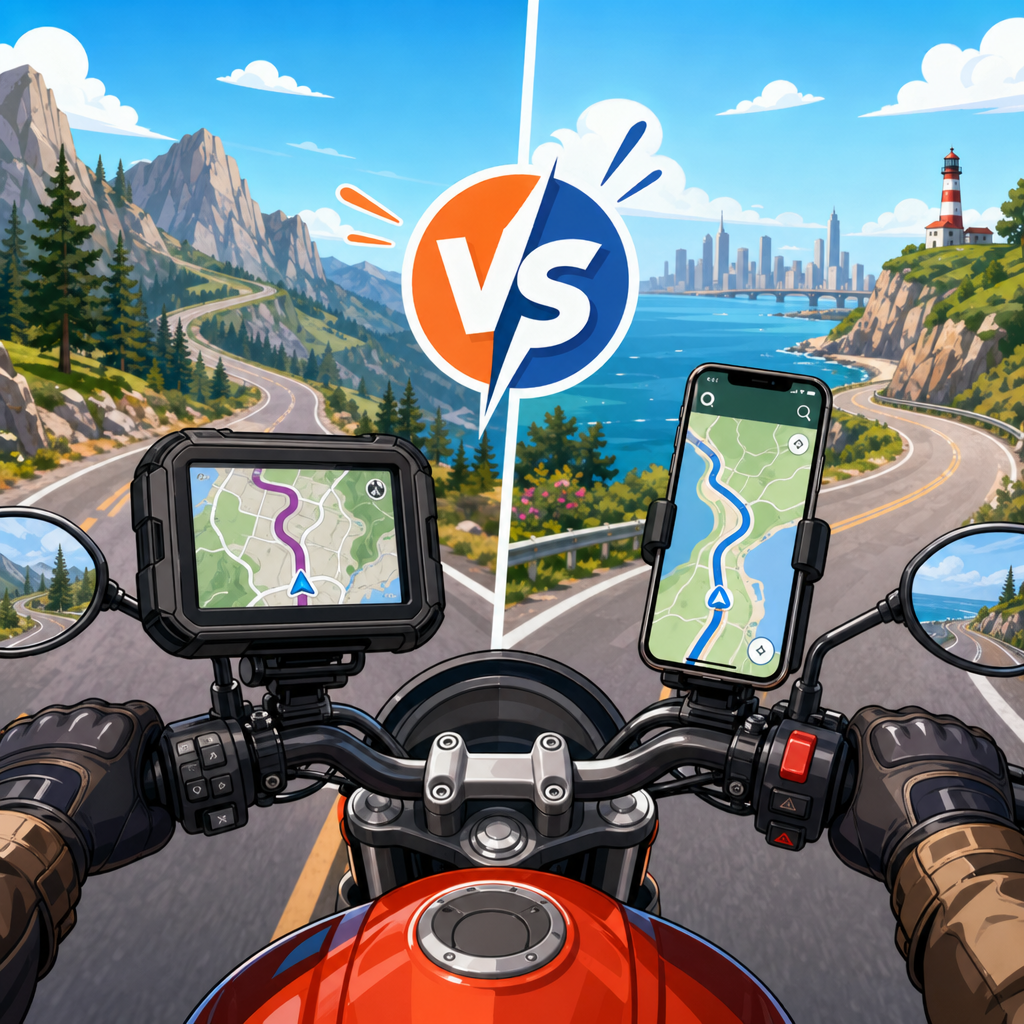
Motorcycle navigation has changed faster in the past five years than in the previous twenty, and riders shopping for a GPS in 2026 face a real decision: buy a dedicated motorcycle GPS unit or rely on smartphone navigation apps. In plain terms, a dedicated unit is a purpose-built device from brands such as Garmin or TomTom, designed for handlebars, glove use, weather exposure, and long-distance routing. A smartphone app is software such as Google Maps, Waze, Calimoto, Rever, Gaia GPS, or OsmAnd running on an iPhone or Android device, usually paired with a bar mount, charging setup, and helmet comms. Both options can guide a rider turn by turn, but they differ sharply in durability, screen visibility, route planning depth, offline capability, integration with helmet communicators, and overall cost of ownership.
I have used both setups on commuting bikes, touring rigs, and ADV machines, and the right answer is rarely universal. A phone on a quality vibration-damped mount can be excellent for city riding and casual weekend trips. A dedicated unit still wins for riders who spend long days in rain, heat, dust, and direct sun, especially when gloves stay on for hours and rerouting needs to happen without drama. The reason this matters is simple: navigation on a motorcycle is not just convenience technology. It affects safety, attention management, trip quality, battery reliability, and how much confidence you have when roads close, weather changes, or cell service disappears.
This guide is the hub for motorcycle Tech & Comms within Garage & Gear, so it covers the full decision framework: hardware, apps, mounting, power, audio, route creation, map data, and use-case fit. If you are asking which motorcycle GPS is best in 2026, whether a phone can replace a Garmin Zumo, which app works offline, or how to protect your camera from vibration, this page answers those questions directly. The short version is that smartphone apps are more flexible and often cheaper, while dedicated motorcycle GPS units remain the benchmark for weather resistance, glove usability, sunlight readability, and long-haul dependability.
To choose well, define your riding first. Daily commuters need fast traffic data and effortless destination entry. Sport-touring riders usually care about scenic route shaping, importable GPX files, and dependable audio prompts through Cardo or Sena systems. Adventure riders need topographic layers, track handling, and offline maps that survive remote travel. Group riders often need route sharing, waypoint discipline, and consistent rerouting behavior across devices. Once those needs are clear, the dedicated-unit-versus-smartphone decision becomes less emotional and much more practical.
What a Dedicated Motorcycle GPS Still Does Better
Dedicated motorcycle GPS devices continue to justify their price because they solve motorcycle-specific problems that phones only partially solve. Modern units such as the Garmin zūmo XT2 use bright displays designed for outdoor readability, glove-friendly interfaces, robust waterproof housings, and powered cradles that lock onto the bike. Most are rated to IPX7 or similar levels, meaning rain is a non-event. They are also built to tolerate sustained vibration and heat in ways consumer phones often are not. On a July highway run, I have seen phones dim dramatically or stop charging because of thermal protection. A dedicated GPS typically keeps working.
Route management is another major advantage. Dedicated units usually handle imported GPX tracks and routes with fewer surprises, especially on multi-day rides with planned stops, fuel points, and custom shaping points. Garmin’s Trip Planner, track support, and direct integration with BaseCamp-style workflows remain relevant for riders who build routes on a laptop before a trip. The interface is not always elegant, but it is reliable once learned. On group tours, consistency matters: if five riders load the same GPX file on similar dedicated devices, rerouting behavior and waypoint handling are often more predictable than when everyone uses a different app.
There are tradeoffs. Dedicated units are expensive, map updates can vary by brand and region, and destination search is usually slower than on a phone. Their points-of-interest databases also tend to feel less current than Google’s search index. If your riding is mostly urban, the value proposition weakens quickly.
Where Smartphone Apps Win in 2026
Smartphone navigation apps dominate in search quality, live data, and software innovation. Google Maps remains the default for fast destination lookup, lane guidance, and current business information. Waze is still strong for traffic and hazard reporting in dense commuter corridors. Calimoto and Rever cater better to riders who want curvy roads, saved rides, and community route discovery. Gaia GPS and OsmAnd are powerful for backcountry and offline use, especially when you need downloadable maps, track recording, and multiple map layers. In 2026, app ecosystems simply evolve faster than dedicated GPS firmware.
Cost also favors the phone route if you already own a capable handset. A premium mount from Quad Lock, Peak Design, SP Connect, or RAM plus a vibration damper and hardwired USB-C or wireless charging setup can still cost far less than a premium motorcycle GPS. Voice input is another practical win. Speaking an address, coffee shop, or fuel stop into a phone while parked is dramatically faster than pecking through menus on a dedicated device. For commuting and mixed daily use, that speed matters more than route-planner purity.
The weaknesses are real. Phones are vulnerable to overheating, rain intrusion on non-waterproof charging ports, and camera damage from prolonged vibration, particularly on some optical image stabilization modules. Battery wear is accelerated by constant charging in heat. Touchscreens can become frustrating with wet gloves. These are manageable issues, but they are not theoretical; I have seen all of them on road tests and customer bikes.
Head-to-Head: Features That Actually Matter on the Road
When riders compare dedicated motorcycle GPS units and smartphone apps, seven factors decide the outcome more often than brand loyalty: readability, weather resistance, route control, offline maps, power management, audio integration, and total system complexity. Readability is not just brightness. It includes anti-reflective coatings, screen orientation, icon size, and whether the map remains legible at a quick glance through a tinted visor. Weather resistance includes not just rain but repeated thermal cycles, washdown exposure, and connector durability. Route control means how well a platform follows a planned path without “optimizing” it into something else.
| Factor | Dedicated motorcycle GPS | Smartphone app setup |
|---|---|---|
| Sunlight visibility | Usually excellent on premium units | Varies widely by phone model and heat state |
| Rain performance | Built for sustained exposure | Good only with proper waterproofing and charging protection |
| Search quality | Adequate, often slower | Excellent, especially with Google Maps |
| GPX and track handling | Strong for touring and ADV workflows | App-dependent; ranges from basic to excellent |
| Traffic data | Limited unless paired to phone services | Typically best-in-class |
| Upfront cost | High | Low to moderate if phone is already owned |
| Long-haul durability | Excellent | Good only with careful setup |
If you want the simplest recommendation, it is this: for frequent touring, rally use, or remote ADV travel, a dedicated motorcycle GPS still offers the best margin of reliability. For commuting, local rides, and riders who prioritize search, traffic, and low cost, smartphone apps are usually the smarter buy.
Mounts, Power, and Helmet Comms: The Supporting Gear Matters
The navigation device is only one part of the system. A poor mount or weak charging setup can make the best app or GPS miserable. For phones, use a motorcycle-specific mount with mechanical retention and a vibration damper. Quad Lock and Peak Design are popular because they balance security and convenience, while RAM remains versatile for unusual cockpit layouts. If your bike vibrates heavily, especially large singles and some V-twins, damping is not optional. Mount placement should keep the screen near the rider’s natural sight line without blocking instruments. Adventure bikes with crossbars are easy; faired sport bikes require more planning.
Power delivery is equally important. Cheap USB ports often fail in rain or provide unstable current. Hardwired USB-C PD chargers or weather-sealed SAE-to-USB solutions are more dependable. Wireless charging sounds elegant, but on motorcycles it can generate extra heat and become unreliable over rough surfaces. For all-day navigation, I prefer a wired setup unless the mount and phone combination has been proven on your bike. Dedicated GPS units usually simplify this with a locking cradle and direct 12-volt connection, one reason long-distance riders still favor them.
Helmet communication adds another layer. Cardo Packtalk and Sena systems generally pair well with both phones and dedicated GPS units, but the pairing order matters. If you want GPS prompts, music, calls, and intercom to coexist cleanly, configure the system deliberately rather than randomly accepting Bluetooth prompts. In most modern setups, the phone acts as the media hub, while the GPS either passes instructions through the phone or connects as a secondary device. Test this at home before a trip.
Best Setup by Riding Style
Commuters should start with a smartphone app. The best commuter motorcycle GPS in practice is often Google Maps or Waze on a securely mounted phone, because real-time congestion, closures, speed-trap alerts, and rapid destination search matter more than elaborate route shaping. Add a weather-resistant charger, a vibration damper, and a headset with clear voice prompts, and the system covers nearly every weekday need at modest cost.
Sport-touring riders sit in the middle. If your weekends involve hand-built routes, scenic byways, and imported GPX files from friends or clubs, a dedicated unit like the Garmin zūmo XT2 remains a strong choice. It is especially good when the trip itself is the point and the route must not change unexpectedly. However, many sport-touring riders now run a hybrid setup: dedicated GPS for the main route, phone for weather radar, lodging search, and live traffic around cities. That combination is expensive, but it is genuinely effective.
Adventure and dual-sport riders should focus on offline maps, track handling, and ruggedness. In this category, the answer is less about phone versus dedicated device and more about software capability. Gaia GPS, OsmAnd, and onX Offroad can be excellent on a ruggedized phone or small tablet, while Garmin Tread and zūmo units remain proven hardware options. If your route depends on tracks rather than turn-by-turn road navigation, make sure the platform handles track visibility, color coding, and off-route behavior well. Many first-time ADV riders buy the wrong device because they shop for street navigation features instead of track management.
How to Choose the Right Motorcycle GPS in 2026
The best buying framework is to score your needs in four areas: environment, route complexity, data dependence, and replacement risk. Environment means heat, rain, vibration, and whether the bike lives outdoors. Route complexity means simple destination entry versus multi-stop GPX touring or backcountry tracks. Data dependence means how much you rely on live traffic, search, and cloud syncing. Replacement risk means what happens if the device fails mid-trip. If losing your phone would damage both navigation and personal communications, a dedicated GPS adds valuable redundancy.
Budget should include the full system, not just the screen. A phone setup may require a $80 to $150 mount, a $50 to $120 charger, a damper, weatherproof cabling, and sometimes a second handset reserved for navigation. A dedicated GPS may require the unit, bike-specific mount hardware, and map subscriptions or accessories. Once riders calculate the whole package honestly, the gap often narrows.
For most riders in 2026, the practical recommendation is simple. Choose a smartphone app setup if you ride mainly in populated areas, want the best search and traffic data, and prefer lower upfront cost with maximum flexibility. Choose a dedicated motorcycle GPS if you tour often, ride in harsh conditions, depend on planned routes or tracks, or want a device built specifically for handlebars, gloves, and weather. If you ride across multiple categories, a hybrid system is not overkill; it is often the most resilient answer.
The bigger lesson is that motorcycle navigation is now part of a connected riding system, not an isolated gadget purchase. Your GPS choice affects helmet audio, charging architecture, cockpit layout, route planning habits, and even phone longevity. Riders who treat navigation as a complete Tech & Comms setup get better results than riders who buy a screen first and improvise the rest. Start with your riding style, build around reliability, and choose the device that reduces workload rather than adding it.
As the hub for Tech & Comms in Garage & Gear, this guide should help you narrow the field quickly and identify the supporting gear that makes either option work properly. From here, the smart next step is to compare mounts, charging solutions, helmet communicators, offline map apps, and route-planning tools in detail, then build a system around your actual miles. Pick the setup that stays readable, powered, and predictable on your worst riding day, because that is the standard that matters most.
Frequently Asked Questions
Should I buy a dedicated motorcycle GPS in 2026, or is a smartphone app enough?
The right choice depends on how and where you ride. If you mainly commute, take weekend day rides, and already use apps like Google Maps, Waze, Calimoto, Rever, Gaia GPS, or OsmAnd, a smartphone can absolutely handle navigation in 2026. Modern phones have bright displays, fast processors, reliable app ecosystems, and access to live traffic, road closures, weather overlays, and cloud-synced routes. For many riders, that combination is convenient and cost-effective because the phone they already own can serve as their navigation device with only a mount and charging solution.
A dedicated motorcycle GPS still makes a strong case for riders who spend long hours in the saddle, ride in heavy rain or extreme heat, wear thick gloves, travel in remote areas, or want a purpose-built device that stays on the bike full time. Units from companies such as Garmin and TomTom are designed specifically for handlebar use, weather exposure, vibration resistance, and route planning on two wheels. They are typically easier to read in direct sunlight, less fussy with gloved input, and better suited for all-day operation without the overheating, battery drain, or camera-damaging vibration concerns associated with some phones.
In practical terms, smartphone apps win on flexibility, frequent updates, and lower upfront cost. Dedicated GPS units win on durability, bike-specific usability, and reliability under demanding riding conditions. If your riding is mostly urban or recreational, a phone app may be enough. If you tour regularly, ride across states, depend on offline navigation, or want a navigation setup that does not tie up your primary phone, a dedicated motorcycle GPS is often the better long-term investment.
What are the biggest advantages of a dedicated motorcycle GPS over a phone app?
The biggest advantage is that a dedicated motorcycle GPS is built for the environment a motorcycle creates. That includes rain, dust, constant vibration, direct sun, wide temperature swings, and operation while wearing gloves. Unlike a general-purpose smartphone, a dedicated unit is designed to live on the handlebars and keep working through a full riding season. The hardware, mount, charging contacts, and software are all developed around the needs of motorcyclists, not adapted from a broader consumer device.
Another important advantage is screen usability. Many motorcycle GPS units are engineered for high brightness and strong anti-glare performance, which matters when you are trying to glance down at directions at highway speed in midday sun. They also tend to have interfaces that are simpler and more glove-friendly than phone apps. Menu structures, zoom controls, rerouting prompts, and route previews are often easier to operate with limited attention, which is a real safety and convenience benefit on the road.
Route management is also a major strength. Dedicated units usually support advanced trip planning features such as importing GPX files, creating multi-stop routes, avoiding highways or tolls, selecting curvy or scenic roads, and preserving planned routes without an app unexpectedly changing them. That matters to riders who carefully build day rides or multi-day tours and do not want the system to prioritize the fastest route when the goal is actually the most enjoyable road. For serious touring and adventure riding, that level of control is often worth the higher purchase price.
Finally, using a dedicated GPS keeps your smartphone free for calls, photos, emergency communication, and music. It reduces wear on the phone’s battery, charging port, and camera stabilization system. For riders who spend many hours on the bike, separating navigation from the phone can be more reliable, less stressful, and easier to troubleshoot.
When is a smartphone navigation app the better option for motorcyclists?
A smartphone app is the better option when you want the most features for the least money and your riding conditions are relatively manageable. For commuting, day trips, local exploring, and occasional touring, phone-based navigation is often more than good enough. Many riders already know and trust apps like Google Maps or Waze for traffic-aware routing, while motorcycle-focused platforms such as Calimoto, Rever, Gaia GPS, and OsmAnd add route discovery, offline mapping, track logging, and backroad planning. That app ecosystem is one of the phone’s biggest strengths because you can switch tools based on the ride instead of being locked into one platform.
Phones also tend to receive more frequent software updates and benefit from constant improvements in mapping data, search results, and point-of-interest information. Finding gas stations, restaurants, hotels, repair shops, and road alerts is generally faster and more intuitive on a phone than on a dedicated GPS. If your riding includes city traffic, rerouting around congestion, or spontaneous stops, smartphone apps are often more responsive and more current than traditional GPS databases.
Cost is another major reason riders choose a phone-based setup. If you already own a capable phone, the additional investment may only be a weather-resistant mount, a vibration-damping solution, and a charging setup. That can be dramatically less expensive than buying a dedicated motorcycle GPS. For newer riders, casual riders, or those testing what kind of navigation they actually need, starting with a smartphone is often the smartest move.
That said, the phone is the better option only if you address the known weaknesses properly. You need a secure mount, reliable power, weather protection if the phone is not fully exposed-rated, and awareness that prolonged sun exposure or vibration can still create issues. When those pieces are handled well, smartphone navigation can be powerful, affordable, and surprisingly effective for a wide range of motorcycle use.
Are motorcycle vibrations, weather, and overheating still a problem for smartphones in 2026?
Yes, they can still be a problem, even though phones and mounts have improved. The issue is not that every rider will damage a phone immediately, but that motorcycles expose electronics to a harsher environment than cars do. Engine vibration, rough pavement, direct sun, wind pressure, rain, and heat from the bike itself all add stress. One of the best-known risks is vibration damage to optical image stabilization systems in phone cameras, especially on certain premium smartphones mounted directly to handlebars without sufficient damping. This is why many riders now use vibration-damping mounts or avoid placing their most expensive phone in the highest-vibration position.
Heat remains another real concern. Phones running navigation, maximum screen brightness, Bluetooth audio, and constant charging can generate significant heat on their own. Add summer temperatures and direct sunlight, and thermal throttling or shutdown can still happen. In a car, a phone may sit in shade near air conditioning. On a motorcycle, it often sits behind a windscreen or in direct sun with no cooling advantage. A dedicated motorcycle GPS is generally better suited to sustained outdoor use under those conditions.
Weather resistance has improved across many phones, but there is an important difference between surviving occasional rain and being designed for repeated all-weather exposure while mounted on a motorcycle. Charging ports, cable connections, and touch performance in wet conditions can still become weak points. Even if the phone itself is water-resistant, the entire setup may not be. The mount, cable, power adapter, and case all matter.
So in 2026, smartphone navigation is viable, but it is not invulnerable. Riders should think of a phone setup as something that needs proper mounting, power management, and environmental protection. If you ride long distances in all seasons or regularly face rough roads and high heat, a dedicated GPS still offers a durability advantage that is hard to ignore.
Which is better for touring, adventure riding, and offline navigation: a dedicated GPS or a smartphone app?
For serious touring and adventure riding, the answer depends on how much importance you place on ruggedness versus software flexibility. A dedicated motorcycle GPS is usually the safer choice for riders who spend full days on the bike, travel far from reliable cell coverage, and need navigation to work consistently in changing weather. Dedicated units are especially strong when you have pre-planned routes, GPX files, waypoints, and multi-day itineraries. They are built for repeated use on the bars, tend to handle offline maps well, and usually provide a stable experience when your priority is following a route without distractions.
Smartphone apps, however, have become exceptionally capable for touring and off-pavement exploration. Apps such as Gaia GPS and OsmAnd offer powerful offline maps, topo layers, downloadable regions, and track-based navigation. Calimoto and Rever are popular for scenic riding and route planning, while standard apps like Google Maps can still be useful for lodging, fuel stops, restaurants, and quick rerouting in populated areas. In many cases, a smartphone can actually offer more mapping choices and a richer planning environment than a dedicated GPS, especially for riders who like experimenting with overlays, community routes, and cloud-based tools.
The key distinction is reliability under stress. If you are on a remote route, in bad weather, with gloves on, and you need a device that can stay mounted and powered all day, a dedicated GPS generally inspires more confidence. If you are comfortable managing downloaded maps, battery use, and protective mounting, a smartphone can perform extremely well and may offer a better user experience in terms of search, app options, and map detail.
For many experienced riders in 2026, the best solution is actually a hybrid approach. They use a dedicated GPS as the primary navigation tool for the ride itself, then keep smartphone apps as backup, trip planners, and