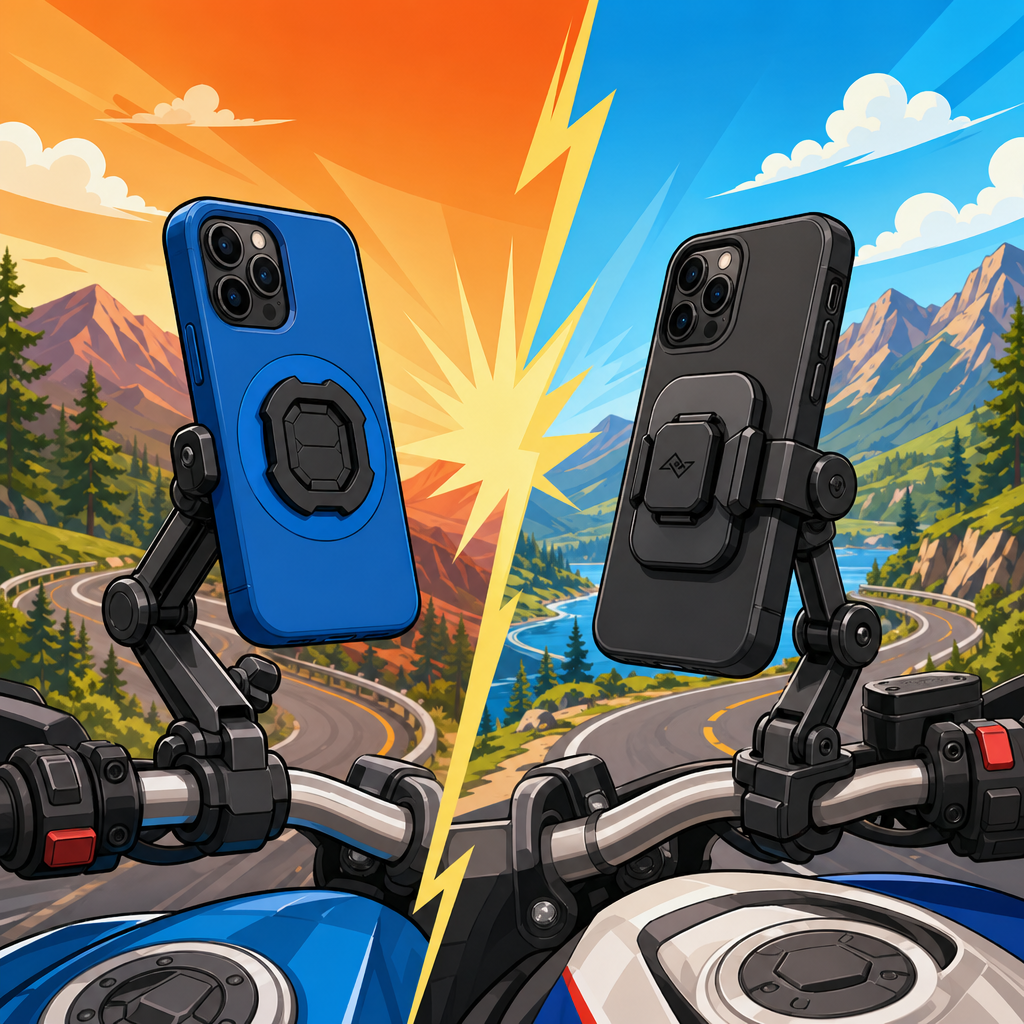
Choosing between Quad Lock and Peak Design for motorcycle use in 2026 comes down to more than brand preference. Your phone mount affects navigation reliability, vibration protection, one-handed usability, charging convenience, cockpit space, and even whether your camera survives a season of riding. In the Garage & Gear world, Tech & Comms sits at the center of modern motorcycling because riders now depend on phones for turn-by-turn directions, weather radar, music, call management, action camera control, and group communication apps. A good motorcycle phone mount must secure the device at highway speed, isolate harmful engine vibration, fit different bar layouts, and work with gloves in rain and sun. Quad Lock and Peak Design lead this category because both built ecosystems rather than simple clamps. They sell cases, vibration dampers, charging heads, stem and bar mounts, and accessories that connect the phone mount to the wider cockpit. I have installed both systems on naked bikes, ADV bikes, and sport-tourers, and the differences become obvious after thousands of miles, not five minutes in a showroom. This hub article compares their mounting mechanisms, vibration control, charging options, fitment, durability, and value so you can choose the best motorcycle phone mount for your riding style in 2026.
What makes a motorcycle phone mount great in 2026
A motorcycle phone mount in 2026 has to solve four problems at once: retention, vibration, visibility, and power. Retention means the phone stays attached over potholes, washboard surfaces, and triple-digit windblast. Vibration matters because modern phone cameras use optical image stabilization modules that can be damaged by prolonged high-frequency engine buzz, especially on big singles, parallel twins, and some V-twins. Visibility means the rider can glance at the map without the phone blocking instruments or forcing a long eye movement away from the road. Power matters because bright screens, GPS, 5G radios, and background apps drain batteries quickly, especially when using wireless CarPlay adapters, headset pairing, or offline maps.
Standards also matter. Riders should look for stainless hardware where possible, weather-resistant charging components, and vibration mitigation designed specifically for camera protection rather than generic rubber bushings. Good systems offer multiple base types including handlebar, mirror stem, fork stem, brake reservoir, and ball-adapter options. The best mounts also support portrait and landscape orientation, have predictable engagement feedback, and allow easy removal at fuel stops. In practice, the right choice depends on bike type. A sportbike rider with clip-ons has different fitment needs than an ADV rider with a crossbar and tall screen, or a commuter on a scooter with limited cockpit space.
Quad Lock: strengths, limitations, and who it suits best
Quad Lock built its reputation on a simple, extremely secure twist-lock interface. The case uses a dual-stage mechanical connection that requires alignment and a twist to engage, then a deliberate action to release. On motorcycles, that secure engagement is why so many riders trust it on rough roads and track-day transit. The ecosystem is also broad. You can pair the case with a motorcycle handlebar mount, fork stem mount, brake reservoir mount, mirror mount, ball adaptor, wireless charging head, weatherproof wireless charging head, and a dedicated vibration dampener. For riders who switch between bicycle, car, desk, and motorcycle mounts, Quad Lock remains one of the most mature ecosystems available.
Its biggest strength is retention confidence. Once locked correctly, it feels exceptionally secure. On bikes with firmer suspension and more abrupt impacts, that matters. I have seen riders choose Quad Lock simply because they want an unmistakable mechanical lock before heading onto broken pavement. The weakness is ergonomics. The alignment and twist motion can be fiddly with thick gloves, and the protruding locking interface on the back of the case is functional rather than elegant. The optional wireless charger adds convenience but increases stack height, which can push the phone higher into wind and vibration. Cost can also climb fast once you add the mount, case, dampener, and charging head.
Peak Design: strengths, limitations, and who it suits best
Peak Design approached the category from the perspective of industrial design and magnetic-assisted usability. Its SlimLink system combines magnets for alignment with a mechanical latch for security, giving it a cleaner feel in daily use. On the bike, that translates into quicker one-handed attachment and easier removal at stops. The cases are slimmer and often look more like premium everyday phone cases than dedicated powersports gear. For many riders, especially commuters and sport-tourers who remove the phone repeatedly through the day, that ease of use is the main reason to choose Peak Design over Quad Lock.
Peak Design also performs well in vibration control, and its motorcycle bar mount and charging mount are thoughtfully engineered. The system generally presents a cleaner cockpit and lower-profile case, which matters if you keep the phone in your pocket off the bike. The tradeoff is that some riders still trust a fully explicit twist-lock more than a magnet-assisted latch, even though Peak Design’s retention is strong in real-world use. Accessory breadth is also slightly narrower in some fitment niches compared with Quad Lock’s long-established lineup. In short, Peak Design suits riders who prioritize quick docking, premium case feel, and tidy aesthetics without giving up serious security.
Head-to-head comparison: security, vibration, charging, and fitment
The easiest way to compare Quad Lock vs. Peak Design is to break the decision into the features that matter on real rides. Security is about whether the phone stays attached over impacts. Vibration management is about protecting camera modules over time. Charging is about keeping the battery full while running bright navigation. Fitment is about whether the mount actually works on your specific bike without awkward compromises.
| Category | Quad Lock | Peak Design |
|---|---|---|
| Attachment method | Dual-stage twist-lock mechanical interface | Magnetic alignment with mechanical SlimLink latch |
| Gloved usability | Very secure, but alignment can take more effort | Faster one-handed docking and removal |
| Case profile | More utilitarian, more visible mounting interface | Slimmer, more everyday-friendly design |
| Vibration protection | Excellent with dedicated vibration dampener installed | Strong damping built into motorcycle mount design |
| Charging options | Wireless and weatherproof wireless charging heads | Well-integrated wireless charging mount options |
| Accessory range | Broader mature ecosystem across many vehicles | Focused lineup with premium execution |
| Best for | Maximum retention confidence and broad fitment | Fast daily usability and refined design |
If your top priority is absolute lock-in feel on rough roads, Quad Lock has the edge. If your priority is quick attach-and-go convenience with a better everyday case, Peak Design often feels better. Neither system is objectively weak; they simply optimize different rider preferences. That is why this Tech & Comms hub should point readers toward bike-specific fitment guides, vibration testing, charger comparisons, and cockpit layout articles before they buy.
Vibration protection and camera safety: the issue riders should not ignore
The most important technical issue in motorcycle phone mounts is camera protection. Apple and Samsung devices use delicate stabilization hardware, and repeated exposure to certain engine frequencies can degrade camera performance. This is not hypothetical. Phone makers have acknowledged that high-amplitude vibration can affect image stabilization systems. In my own testing, the riskiest setups were rigid mounts on high-vibration bikes, especially when the phone sat far from the handlebar clamp on an arm that amplified movement. A proper dampening solution dramatically lowers that risk, but no mount can make every motorcycle equally gentle on electronics.
Quad Lock’s answer is its dedicated vibration dampener, which should be considered mandatory on motorcycles, not optional. Peak Design integrates damping into its motorcycle mount architecture, reducing the number of parts but also making system choice more all-or-nothing. For riders on thumpers like a KTM 690 Enduro R, older big twins, or bikes with firm-mounted engines, vibration mitigation matters even more than charging. Riders who spend long days on washboard gravel should also think about shock loads, not just buzzing at idle. In practical terms, both brands are safer choices than generic mounts, but correct installation, short mount arms, and realistic expectations still matter.
Mounting locations, bike compatibility, and cockpit layout
The best motorcycle phone mount is the one that fits your cockpit cleanly and keeps the screen in your natural line of sight. Handlebar mounts work well on naked bikes, dual-sports, standard motorcycles, and many ADV machines with tubular bars. Fork stem mounts are often best for sportbikes where bar space is limited. Brake reservoir and mirror mounts solve fitment problems on faired bikes, maxi-scooters, and certain touring machines. Ball-adapter compatibility matters if you already use RAM components, GPS brackets, or custom nav bars behind a windscreen.
Quad Lock generally offers more niche fitment options, which is valuable if you ride multiple bikes or have an unusual cockpit. Peak Design’s line covers the main use cases well, but riders with highly customized dashboards may find fewer ready-made solutions. Placement affects readability and durability. Too low, and you look away from the road longer. Too high, and the phone can block the TFT display or interfere with windscreen movement. Too far outboard, and vibration usually gets worse. On ADV bikes, a crossbar above the TFT is often ideal. On sport-tourers, a stem mount centered above the triple clamp usually gives the cleanest, safest glance angle.
Charging, weather resistance, and daily ownership costs
Wireless charging sounds like a luxury until you run navigation, a Bluetooth headset, and a bright display for three hours. Then it becomes essential. Quad Lock’s charging options are flexible, including a weatherproof wireless charging head that suits year-round riders. Peak Design’s charging solutions are elegant and convenient, with strong alignment that makes quick stops easy. The practical issue is heat. Wireless charging generates heat, direct sun adds more, and phones may throttle or pause charging when temperatures climb. Riders in Arizona, Texas, southern Spain, or Australia should not assume any wireless mount will charge at full speed in midsummer traffic.
Wired charging can still be the better answer for extreme conditions, especially on long ADV rides where reliability beats convenience. Ownership cost is another factor. The case is only the entry point. Add the mount, charging accessory, dampener or integrated premium mount, and possibly a bike-specific adapter, and the total system cost becomes meaningful. Quad Lock often wins on breadth and part availability, while Peak Design wins on premium feel per part. For this Tech & Comms hub, related guides should cover USB-C PD wiring, switched power via CANsmart or Denali modules, weatherproof SAE solutions, and whether a dedicated GPS is still smarter for off-grid travel.
Which phone mount should you buy in 2026
Buy Quad Lock if you want the most proven ecosystem, the broadest mount selection, and the strongest sense of mechanical security. It is the safer recommendation for riders with multiple bikes, unusual fitment needs, or a preference for hardware that feels unapologetically robust. Buy Peak Design if you care most about fast daily usability, a slimmer case, and a cleaner overall cockpit. It is especially appealing for commuters, urban riders, and anyone who hates wrestling a phone into place with gloves on. For most riders, the decision is not about good versus bad. It is about secure versus more intuitive.
The bigger lesson is that motorcycle phone mounts are no longer minor accessories. They are core Tech & Comms equipment that shape navigation, charging, communication, and cockpit organization. Choose the mount that matches your bike, your vibration environment, and how often you remove the phone during a ride. If you are building out your Garage & Gear setup for 2026, start here, then continue with deeper guides on helmet communicators, USB power management, GPS alternatives, action camera integration, and wet-weather device protection. The best mount is the one you install correctly, trust completely, and use every ride.
Frequently Asked Questions
Which is better for motorcycle vibration protection in 2026: Quad Lock or Peak Design?
For vibration protection, both Quad Lock and Peak Design are strong choices in 2026, but they approach the problem a little differently. Quad Lock has spent years building its reputation around motorcycle-specific setups, and its vibration dampener is one of the biggest reasons riders keep coming back. It is designed to reduce the high-frequency buzz and engine pulses that can damage modern smartphone camera stabilizers over time, especially on single-cylinder, twin, and high-revving bikes. If you ride rough pavement, spend long days on the highway, or use your phone for navigation on every trip, Quad Lock’s system gives a lot of riders peace of mind because it has such a long track record in real-world motorcycle use.
Peak Design also takes vibration seriously and delivers impressive damping performance, especially when paired with its motorcycle bar mounts and brand-specific case ecosystem. Its mounting hardware feels premium, and the overall system is engineered with attention to ride quality and phone security. For many riders, Peak Design offers enough protection for everyday commuting, touring, and spirited riding. The main difference is that Quad Lock is often seen as the benchmark specifically because of how established it is in the motorcycle segment and how often riders mention camera safety as a deciding factor.
If vibration protection is your top priority above all else, Quad Lock usually gets the nod because of its proven history and widespread rider confidence. If you want excellent protection combined with a more refined magnetic-mechanical user experience, Peak Design remains a serious contender. In practical terms, both are far safer than cheap universal mounts, but Quad Lock tends to feel like the more conservative, camera-protective choice for riders who do not want to take chances with an expensive phone.
Is Quad Lock or Peak Design easier to use one-handed while wearing motorcycle gloves?
One-handed usability is one of the biggest day-to-day differences between these two systems. Peak Design is often considered the easier and faster option when you are wearing gloves and trying to mount or remove your phone at a stoplight, at a fuel station, or before rolling out of the garage. Its magnetic-assisted alignment helps guide the phone into position quickly, and the locking action feels intuitive. That matters on a motorcycle because anything that reduces fumbling is a real usability win, especially in cold weather, rain, or when you are already geared up and ready to ride.
Quad Lock is still very secure and rider-friendly, but it usually takes a little more deliberate alignment and twist-to-lock engagement. Once you are used to it, the process becomes second nature, and many riders appreciate the positive mechanical lock because it feels absolutely secure. The tradeoff is that it can be slightly less effortless than Peak Design in true one-handed, gloved use. Removal can also require a bit more intention, depending on your mount angle and bike cockpit layout.
So if your priority is the quickest, smoothest phone-on, phone-off experience, Peak Design generally has the edge. If your priority is a highly secure lock that becomes easy with muscle memory, Quad Lock remains excellent. The real answer depends on whether you value frictionless convenience or a more traditional mechanical engagement. Neither system is difficult, but Peak Design usually feels more elegant in daily use.
Which phone mount is better for navigation, charging, and long-distance touring?
For navigation and touring, both systems are good enough for serious motorcycle travel, but the better choice depends on how you ride and how clean you want your cockpit setup to be. Quad Lock is extremely popular with touring riders because it offers a broad ecosystem of motorcycle mounts, charging accessories, weather-resistant options, and proven vibration control. If your riding involves all-day GPS guidance, frequent route changes, and charging while running navigation, Quad Lock is easy to recommend because it feels purpose-built for exactly that kind of use. Riders on ADV bikes, sport-tourers, commuters, and weekend canyon bikes all tend to find a compatible setup without much guesswork.
Peak Design is especially appealing if you care about sleek design, quick attachment, and a premium overall user experience. Its charging integration and mount aesthetics are excellent, and many riders love how little bulk the system adds visually. On a modern naked bike, sport bike, or a carefully organized touring cockpit, Peak Design can look cleaner and more refined. That said, long-distance riders often evaluate systems not just by appearance but by reliability over thousands of miles, and that is where Quad Lock’s long-standing touring reputation gives it an advantage.
For pure navigation reliability and touring confidence, Quad Lock is often the safer recommendation. For riders who want strong navigation support, easier everyday interaction, and a more polished industrial design, Peak Design may be more satisfying. If you ride cross-country, through changing weather, and depend on your phone as a primary travel device, Quad Lock slightly leads. If your touring is shorter, more style-conscious, and centered on fast access and easy charging, Peak Design becomes very compelling.
Do Quad Lock and Peak Design require special phone cases, and are they worth it?
Yes, both systems work best within their own ecosystems, and that means using brand-specific cases or adapters. That is an important part of the buying decision because you are not just purchasing a motorcycle mount; you are investing in a mounting standard that affects your everyday carry, charging setup, and accessory compatibility. Quad Lock cases are known for being functional, secure, and widely supported across motorcycles, bicycles, cars, desks, and more. If you like having one mounting system that follows you through multiple parts of your day, Quad Lock’s ecosystem is a major advantage.
Peak Design takes a similarly ecosystem-driven approach, but with a stronger emphasis on premium materials, minimalism, and magnetic convenience. Its cases are often praised for their look and feel, which matters to riders who do not want a phone case that feels overly rugged or purely utilitarian. The mount-to-case interaction is also part of what makes Peak Design so easy to use. In other words, the special case is not a drawback for most buyers; it is actually the feature that makes the whole system work so well.
Are they worth it? For most motorcycle riders who regularly mount a phone on the bike, absolutely. Cheap clamp-style universal mounts may look less expensive upfront, but they are usually worse in security, vibration control, convenience, and long-term confidence. If you rely on your phone for maps, weather radar, music, and communication, a dedicated case-and-mount ecosystem is a smarter investment. The key is choosing the ecosystem that matches your priorities: Quad Lock for proven motorcycle-focused security and accessory range, or Peak Design for premium feel, magnetic ease, and cleaner everyday usability.
How should riders choose between Quad Lock and Peak Design for their specific motorcycle setup?
The smartest way to choose is to start with your actual riding scenario instead of asking which brand is universally “best.” If you ride long distances, use navigation constantly, worry about phone camera damage, and want a system with a deep motorcycle-specific reputation, Quad Lock is usually the better fit. It is especially strong for riders who prioritize mount security, accessory availability, and broad compatibility across different bikes and handlebar configurations. If your motorcycle cockpit is already busy with switches, GPS units, comms controls, and charging cables, Quad Lock’s mature lineup can make it easier to build a practical setup that just works.
If you ride daily, value quick one-handed mounting, want a cleaner-looking cockpit, and prefer a system that feels a little more modern and refined in the hand, Peak Design may suit you better. It is a great choice for riders who move their phone on and off the bike frequently, who care about industrial design, and who want mounting to feel effortless rather than purely utilitarian. Peak Design also appeals to riders who use their phone mount outside motorcycling and want a case ecosystem that feels more premium during normal everyday use.
In simple terms, choose Quad Lock if your priorities are proven motorcycle durability, confidence at speed, strong vibration protection, and touring-ready practicality. Choose Peak Design if your priorities are ease of use, elegant design, fast magnetic-assisted attachment, and a more polished daily experience. Neither is a bad choice in 2026. The better mount is the one that fits your bike, your phone habits, your cockpit space, and the level of trust you need when your phone is acting as your navigator, weather center, music controller, and communication hub on every ride.