Choosing the right motorcycle battery in 2026 is no longer a simple matter of replacing whatever came from the factory. Riders now balance starting performance, charging compatibility, cold-weather behavior, weight, cost, and electronic demands from ABS, ride modes, GPS units, heated gear, and security systems. For anyone comparing lithium vs. lead acid for modern motorcycles, the battery decision affects reliability every day, not just at the moment the starter button is pressed.
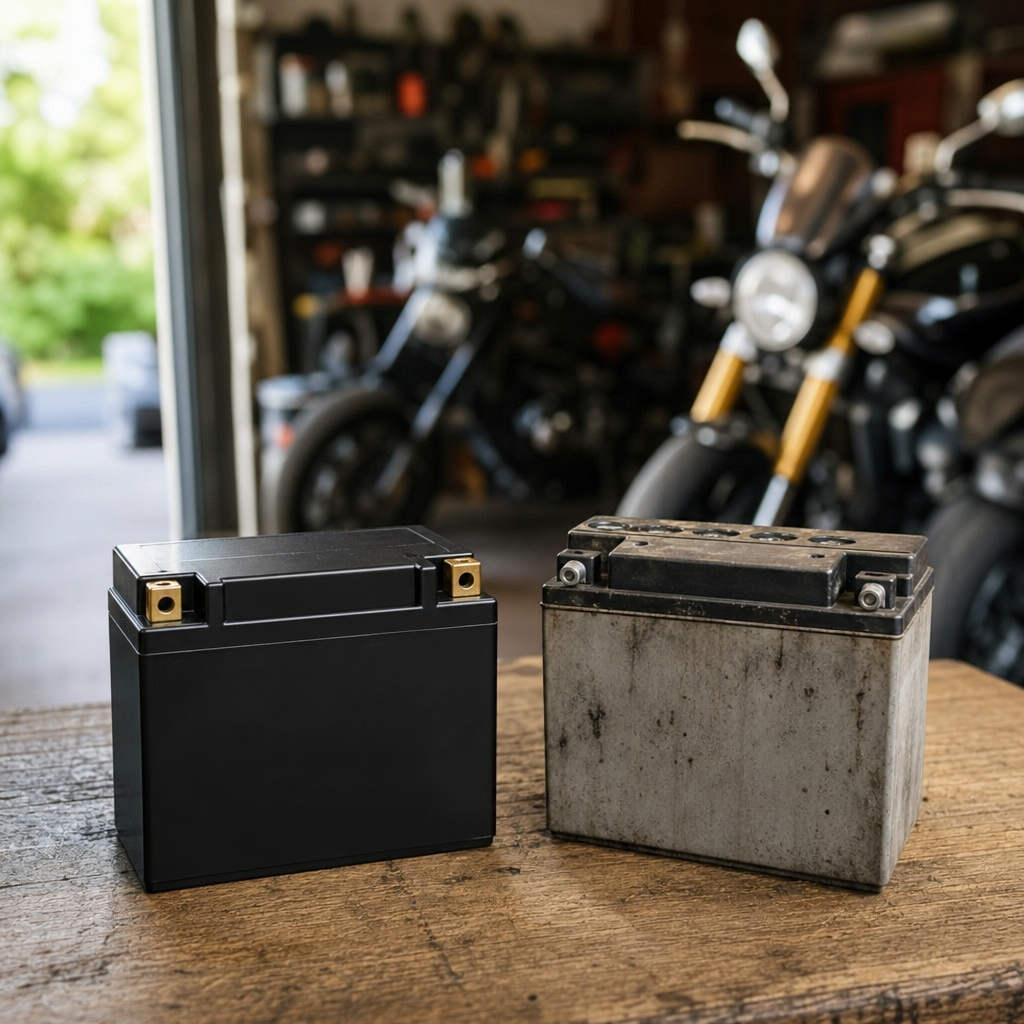
In workshop terms, lead acid usually refers to conventional flooded batteries and sealed AGM batteries, while lithium in the motorcycle market almost always means lithium iron phosphate, abbreviated LiFePO4. These chemistries store and deliver energy differently. AGM batteries use lead plates and electrolyte absorbed in glass mats, making them spill resistant and durable. LiFePO4 batteries use lithium iron phosphate cells managed by internal electronics in many premium packs. They are lighter, hold voltage differently, and demand more attention to charging systems and temperature conditions.
This matters because the battery sits at the center of the entire Tires & Parts conversation in a modern garage. A motorcycle that has the right tires, brake pads, chain kit, and suspension settings still fails its owner if it will not start after two weeks of sitting. In the shop, I have seen riders spend heavily on exhausts and premium tires, then lose riding weekends because an under-specced or poorly matched battery collapsed under parasitic draw. Battery selection is not glamorous, but it is one of the highest-value maintenance choices a rider can make.
As a hub article for Tires & Parts, this guide connects battery chemistry to the broader realities of ownership: fitment, electrical loads, seasonal storage, charging tools, and how supporting parts affect service life. The goal is direct: explain what lithium and lead acid batteries do well, where they fail, and which one makes sense for commuters, tourers, sportbike riders, off-road machines, and bikes with older charging systems.
How motorcycle batteries work in real use
A motorcycle battery has three core jobs. First, it provides cranking current to the starter motor. Second, it stabilizes system voltage for the ECU, fuel pump, dash, ignition coils, and accessories. Third, it acts as a buffer when engine speed is low and the stator is not fully meeting demand. On a carbureted kick-start single, battery requirements can be modest. On a 2026 touring bike with radar sensors, keyless ignition, electronically adjustable suspension, and multiple control modules, battery quality becomes critical.
The most important published specs are voltage, amp-hour capacity, reserve capacity, and cold cranking amps, or CCA. Many riders focus only on CCA, but that is a mistake. A battery can have strong starting numbers and still perform poorly if reserve capacity is too low for alarm systems, tracker modules, or repeated short rides. Lead acid batteries usually advertise amp-hours and CCA in familiar terms. Lithium motorcycle batteries often market “Pb equivalent” ratings that compare loosely to lead acid fitment. Those comparisons are not always standardized, so reading actual watt-hour or amp-hour data is smarter than relying on sticker claims alone.
Charging system health also shapes battery performance. Most motorcycles run a permanent-magnet alternator with a regulator/rectifier controlling output. AGM batteries tolerate the charging behavior of many existing systems well. Lithium batteries require voltage to remain within tighter limits. If the regulator overcharges, a lithium battery can be damaged quickly. Before installing one, I always verify charging voltage at idle and around 4,000 rpm. On most bikes, seeing roughly 13.8 to 14.6 volts under normal conditions is acceptable, but the manufacturer’s specification should always govern the final decision.
Lead acid batteries: strengths, weaknesses, and best applications
Lead acid remains the default recommendation for a large share of road motorcycles because it is predictable, widely available, and forgiving. AGM versions from brands such as Yuasa, GS Yuasa, Interstate, and Motobatt have earned strong reputations because they balance price, cranking performance, and compatibility with stock charging systems. For many commuters and touring riders, AGM is still the sensible baseline.
The biggest advantage of lead acid is stability in mixed real-world conditions. It handles charging from older regulator designs better than most lithium options. It also performs more consistently in freezing temperatures. Capacity drops in the cold, but lead acid does not need the “wake up” process that some lithium batteries do, where current draw slightly warms the cells before full cranking power is available. Riders in northern climates often notice this difference immediately on cold morning starts.
Another practical strength is reserve capacity. A good AGM battery usually tolerates small parasitic draws, accessories left on briefly, and stop-and-go use better than an undersized lithium pack. If your bike has factory heated grips, an always-on USB module, a tracker, or a finicky CAN bus system, AGM often gives fewer surprises. Cost is also favorable. In many markets, a premium AGM battery costs substantially less than a premium lithium replacement of comparable real-world usefulness.
The tradeoffs are weight, self-discharge over long storage periods, and lifespan under abuse. Lead acid batteries are much heavier. On a middleweight bike, switching to lithium can remove several pounds from a high location under the seat or tank, and that can matter for racing or technical off-road use. AGM also hates chronic undercharging. Repeatedly letting voltage sag below about 12.4 volts shortens life through sulfation, and deeply discharging it can permanently reduce capacity.
For everyday street motorcycles, especially those with OEM charging systems and no special performance goal, AGM remains the safest recommendation. It is not the lightest or most advanced option, but it is usually the lowest-risk choice.
Lithium motorcycle batteries: where they excel and where riders get caught out
LiFePO4 batteries became popular because they solve two genuine problems: weight and self-discharge. On performance bikes, adventure bikes, dirt bikes, and customs where every pound counts, the reduction is dramatic. Replacing a 7- to 10-pound lead acid battery with a 2- to 4-pound lithium unit is one of the easiest ways to cut weight without changing handling geometry or compromising braking. On race-prepped machines, that matters.
Lithium batteries also maintain charge exceptionally well during storage. A bike parked for weeks or even months can retain useful voltage better than lead acid, provided there is minimal parasitic draw and the battery management system is sound. That makes them attractive for seasonal riders who hate dealing with a tender all winter.
Voltage behavior is another reason riders like lithium. LiFePO4 tends to hold a higher resting voltage through much of its discharge curve, which can make starting feel stronger and keep electronics happier during cranking. On fuel-injected sportbikes with high compression and compact packaging, that can be a clear advantage.
But the limitations are real. First, not every lithium battery includes a battery management system, and not every BMS offers overcharge, over-discharge, balancing, short-circuit, and thermal protection. Premium brands such as Antigravity, Shorai, NOCO, and Optimate-compatible models often include better safeguards, but feature sets vary. Second, cold-weather performance can disappoint riders who expected miracles. At low temperatures, lithium internal resistance rises. The usual trick is to turn on the headlight for a short period or attempt a brief crank to warm the cells, then crank again with improved output.
Third, charging compatibility matters more than marketing suggests. Standard lead acid chargers with desulfation or high-voltage recovery modes can damage lithium batteries. A proper charger with a dedicated lithium mode is the correct tool. Finally, outright capacity can be modest if riders choose a tiny lightweight unit for a street bike that sits for long periods or runs accessories. In those cases, a featherweight battery can become a liability rather than an upgrade.
Direct comparison: lithium vs. lead acid for modern motorcycles
The best battery is the one that matches the bike, climate, and riding pattern. The table below captures the comparison points that matter most in service bays and garages.
| Factor | Lithium LiFePO4 | Lead Acid AGM |
|---|---|---|
| Weight | Very light, often 50% to 70% lighter | Heavier, but not usually a problem on street bikes |
| Cold weather starts | Can require warming cycle in low temperatures | More predictable in winter use |
| Charging compatibility | Needs lithium-safe charger and healthy regulator | Works with most standard motorcycle chargers |
| Storage behavior | Low self-discharge, good for seasonal bikes | Needs maintenance charging sooner |
| Accessory tolerance | Depends heavily on true capacity and BMS | Usually better reserve for street electronics |
| Purchase price | Higher initial cost | Lower upfront cost |
| Best use case | Performance, off-road, weight-sensitive builds | Commuting, touring, older systems, all-weather use |
If you want the shortest answer, here it is. Choose AGM if reliability across varied conditions is the priority. Choose lithium if weight savings and low storage loss are worth the extra cost and system sensitivity. That rule covers most riders accurately.
How battery choice fits into Tires & Parts maintenance planning
A hub page under Tires & Parts should connect the battery to the rest of the machine because battery failures are often symptoms of broader maintenance issues. I routinely see weak batteries blamed when the actual cause is high rolling resistance from underinflated tires, a dragging chain, a failing stator, corroded grounds, or accessories wired directly to constant power. Parts do not fail in isolation.
Tire choice affects charging more than many riders realize. Aggressive adventure or off-road tires add rolling resistance and can reduce fuel economy slightly, especially on pavement. That by itself does not kill batteries, but short rides on bikes with heated gear and auxiliary lights can become net-negative charging events. The same is true of neglected wheel bearings or brake drag. If the bike spends every commute at low rpm, electrical margin shrinks.
Other supporting parts matter too. A worn starter motor pulls excess current. Corroded battery terminals create voltage drop and heat. Cheap aftermarket regulator/rectifiers sometimes fail to control charging voltage tightly enough for lithium batteries. Even fitment foam supplied with lightweight batteries matters because vibration shortens service life when the case is not properly supported in the battery box. Good battery ownership is really good systems thinking.
For riders building a garage knowledge base, related topics should include charging system diagnostics, tire pressure effects on motorcycle efficiency, how to choose a battery tender, stator and regulator testing, and seasonal storage procedures. Those articles belong naturally under the same Tires & Parts umbrella because they solve the same ownership problem: keeping the motorcycle dependable between rides.
Choosing the right battery for your riding style
Commuters should usually buy AGM. Daily starts, varied weather, occasional forgotten accessories, and the need for predictable winter operation all favor lead acid. Touring riders also benefit from AGM unless they have verified charging health and specifically need weight reduction. Extra electronics and overnight stops make reserve capacity more important than a small performance gain.
Sportbike riders split into two groups. Street sport riders often do best with a high-quality AGM because many bikes are ridden irregularly and have alarms or chargers attached. Track-day riders and racers gain the most from lithium because every pound removed helps, and the bikes are typically maintained more carefully. The same logic applies to dirt bikes and enduro machines, where low weight and reduced self-discharge are valuable.
Adventure riders should decide based on trip style. For remote travel in mixed temperatures, AGM is still the conservative pick because replacement availability is better worldwide and charging system tolerance is broader. For shorter domestic trips where weight and packaging matter more, lithium can make sense. Older motorcycles, especially those with marginal charging systems or vintage wiring, should generally stay with lead acid unless the electrical system has been upgraded and tested thoroughly.
Installation, charging, and storage best practices
Battery life depends as much on setup as chemistry. Before installation, confirm terminal orientation, case size, venting needs, and polarity. Clean both cable ends to bright metal, inspect the ground point, and tighten hardware to specification. Loose terminals are still one of the most common causes of intermittent no-start complaints.
After installation, test resting voltage and charging voltage, then recheck after the first few rides. A healthy AGM at rest is typically around 12.7 to 12.9 volts when fully charged. A healthy LiFePO4 battery rests higher, often around 13.2 volts or more depending on the pack design. Numbers vary by manufacturer, so use the battery maker’s chart, not a generic internet guess.
For storage, AGM batteries benefit from a smart maintenance charger such as units from Battery Tender, CTEK, or Optimate. Lithium batteries should be charged with a lithium-compatible model and usually stored partially charged rather than held at maximum for months unless the manufacturer states otherwise. Most importantly, fix parasitic drains. No battery chemistry wins against a faulty accessory harness or a tracker that pulls too much current.
For most modern motorcycles in 2026, the lithium vs. lead acid decision comes down to priorities rather than hype. AGM lead acid remains the best all-around battery for commuters, tourers, older bikes, and riders who want proven compatibility, strong reserve capacity, and dependable cold-weather behavior. Lithium LiFePO4 is the smarter choice for weight-sensitive machines, race bikes, dirt bikes, and carefully maintained street motorcycles where storage loss and mass reduction matter more than initial cost.
The practical lesson is simple. Match the battery to the motorcycle’s charging system, climate, and usage pattern, then support it with the right charger, healthy wiring, and routine voltage checks. When riders do that, battery failures drop sharply and the entire Tires & Parts maintenance plan becomes more reliable. If you are updating your garage setup, start by checking your current battery age, testing charging voltage, and choosing the chemistry that fits how you actually ride.
Frequently Asked Questions
What is the biggest difference between lithium and lead acid motorcycle batteries in 2026?
The biggest difference is how each battery delivers power, handles real-world riding conditions, and fits the needs of today’s electronically equipped motorcycles. Traditional lead acid batteries, including AGM types, are still widely used because they are affordable, familiar to most riders and shops, and generally tolerant of standard charging systems. They provide dependable cranking power and tend to behave predictably in a broad range of temperatures. Lithium motorcycle batteries, most commonly lithium iron phosphate in powersports use, are much lighter, hold their voltage very well, and can deliver very strong starting performance for their size.
In practical terms, the choice is no longer just about “old versus new.” It is about matching battery characteristics to the motorcycle and the rider. A modern bike with ABS, traction control, ride modes, immobilizers, GPS accessories, heated gear, and frequent short-trip use may benefit from the stable voltage and low self-discharge of lithium, but only if the charging system is compatible and the battery includes a quality battery management system. Lead acid still makes strong sense for riders who want lower upfront cost, broader charger compatibility, and proven cold-weather behavior without additional considerations.
Another important difference is how the batteries age and communicate problems. Lead acid batteries often show a gradual decline, with slower cranking and more obvious warning signs before failure. Lithium batteries can perform extremely well for long periods, then become less forgiving if deeply discharged, overcharged, or exposed to poor charging conditions. That is why, in 2026, the “best” battery is not automatically the lightest or the cheapest. It is the one that fits the bike’s electrical system, climate, riding habits, and maintenance routine.
Is a lithium battery always better for a modern motorcycle with ABS, ride modes, and accessories?
No, not always. It is true that many riders assume a lithium battery is the automatic upgrade for a modern motorcycle, especially on premium sport, adventure, and touring machines packed with electronics. Lithium batteries offer excellent weight savings, fast cranking, and strong voltage retention, all of which can be appealing on bikes with sensitive electronics. A stable voltage supply can help electronic systems operate more consistently during startup, especially when the starter motor places a heavy load on the battery.
However, “better” depends on the motorcycle’s charging profile and the owner’s use case. Some motorcycles are perfectly happy with lithium, while others are better served by a high-quality AGM lead acid battery. If the bike has a charging system that runs outside the preferred range of the lithium battery, or if the owner uses an older trickle charger not designed for lithium chemistry, the battery may not perform as expected and could even be damaged. Likewise, bikes that sit for long periods with parasitic draws from alarms, keyless systems, or tracking devices need careful battery selection. Lithium can handle storage very well when the draw is low and the battery has proper internal protection, but deep discharge is more problematic than it is for many lead acid setups.
Accessory use matters too. Heated gear, auxiliary lights, USB charging, communication systems, and navigation units increase demand on the charging system, not just the battery. The battery’s job is to start the bike and support voltage stability, but the stator and regulator must keep up once the engine is running. In that context, choosing lithium does not fix an overloaded electrical system. For many riders, a premium AGM battery remains the more practical and forgiving choice. For others, especially those seeking weight reduction and long storage life, lithium is a smart upgrade. The key is compatibility, not marketing.
How do lithium and lead acid batteries compare in cold weather starting?
Cold weather is one of the most important areas where the two battery types differ in ways riders actually notice. Lead acid batteries, especially AGM designs, usually behave in a more familiar and predictable way when temperatures drop. Their output does decline in the cold, but many riders and technicians know what to expect: slower cranking, a more labored start, and reduced capacity until the battery warms. If the battery is healthy and properly charged, lead acid can still be very dependable for cold-weather commuting and seasonal riding.
Lithium batteries are different. They can deliver excellent starting power, but in low temperatures they often need a brief “wake-up” period before reaching their best output. On a cold morning, a lithium battery may seem weak at first crank. Drawing a small load by turning on the ignition or lights for a short time can help warm the cells internally, after which cranking performance improves noticeably. Riders familiar with this behavior often have no issues, but someone expecting instant peak performance in freezing conditions may be surprised.
That does not mean lithium is a bad choice for cold climates. It means the rider needs to understand how the battery behaves and select a high-quality unit sized correctly for the motorcycle. Cheap or undersized lithium batteries are far more likely to disappoint in winter than reputable models with proper engineering and internal protection. If the bike lives outdoors, sees frequent sub-freezing starts, or must crank a large-displacement engine in very cold conditions, a robust AGM battery may still be the safer and less finicky option. If the rider values weight savings and is willing to follow cold-start best practices, lithium can still work very well.
Do modern motorcycles need a special charger for lithium batteries, and can the wrong charger cause problems?
Yes, charger compatibility matters a great deal, and using the wrong charger can absolutely cause problems. This is one of the most common workshop issues when riders switch from lead acid to lithium without updating their charging equipment. Many lead acid chargers, especially older trickle chargers and desulfation units, are designed around charging behavior that does not apply to lithium iron phosphate motorcycle batteries. A charger with a desulfation or recovery mode may send pulses or voltages that are suitable for lead acid maintenance but inappropriate for lithium chemistry.
In 2026, many premium battery chargers have selectable modes for AGM, standard lead acid, and lithium. That is the ideal solution because it allows the charger to apply the correct voltage and charging logic for the battery installed in the bike. Riders should also understand that “battery tender” has become a generic term in conversation, but not every maintainer is safe for every battery. Before connecting any charger, the battery manufacturer’s guidance and the charger’s specifications should be checked carefully.
It is also important to separate charging from diagnosis. If a modern motorcycle repeatedly drains batteries, the answer may not be a different charger. It may be parasitic draw from accessories, a weak regulator/rectifier, poor ground connections, or a failing stator. A charger can maintain a healthy battery, but it cannot compensate for an electrical fault. For lead acid batteries, regular maintenance charging is often helpful during storage. For lithium batteries, less frequent maintenance may be needed because self-discharge is low, but correct charging remains essential. In short, yes, a special or lithium-compatible charger is often necessary, and using the wrong one is a preventable mistake.
Which battery type is the better value for most motorcycle riders: lithium or lead acid?
For most riders, value depends on how long they keep the bike, how they ride, and what they expect from the battery. Lead acid, particularly AGM, usually wins on initial cost. It is easier on the budget, widely available, and compatible with a broad range of motorcycles and charging tools. For riders who simply want reliable starts, straightforward replacement, and lower purchase price, lead acid remains a very strong value in 2026. If the motorcycle is a daily rider, commuter, or weekend machine with no extreme weight-saving goals, AGM often provides the best balance of cost and practicality.
Lithium can become the better long-term value in the right scenario. Riders who store motorcycles for extended periods, care about every pound of weight, or want compact packaging and strong cranking performance may find the higher upfront cost worthwhile. On performance bikes, dual-sport builds, custom projects, and premium modern motorcycles, the reduction in weight alone can be a meaningful benefit. Lithium batteries also tend to maintain voltage well during storage, which is attractive for seasonal riders, provided the bike does not have excessive parasitic draw and the battery is not allowed to deep discharge.
The smartest way to look at value is total ownership experience, not shelf price. A cheap battery that struggles in cold weather, fails early because of charging incompatibility, or causes repeated no-start situations is not a bargain. Likewise, an expensive lithium battery installed on a motorcycle with an unsuitable charging system is money poorly spent. The best value comes from choosing a battery that matches the bike’s charging characteristics, electrical load, climate, and maintenance routine. For many riders, that still means AGM lead acid. For others, especially those prioritizing performance and low weight, lithium justifies its premium. The right answer is the one that delivers reliable starts and fewer headaches over time.