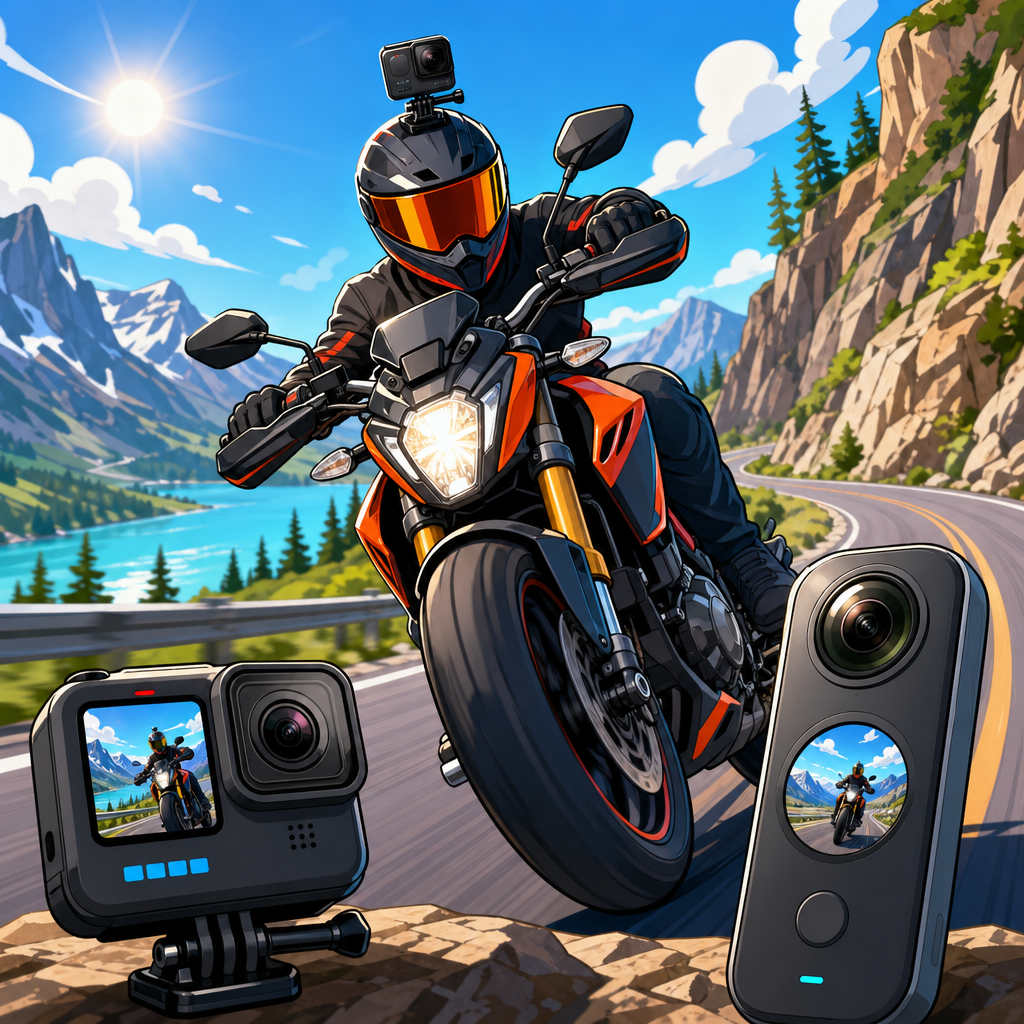
Action cameras have become essential gear for riders who want to document routes, review technique, improve safety, and share the reality of life on two wheels. In 2026, the best 4K action cameras for bikers are no longer simple point-and-shoot devices. They are stabilized recording systems with advanced microphones, horizon leveling, GPS overlays, Bluetooth control, and fast app workflows that matter just as much as raw image quality. When riders compare GoPro vs. Insta360, they are usually asking a bigger question: which camera works best on a helmet, chest harness, handlebar, or crash bar when vibration, wind noise, rain, and changing light all show up in the same ride?
In practical terms, a 4K action camera records video at roughly 3840 by 2160 resolution, giving enough detail to crop, stabilize, and still retain a sharp final image for YouTube, social clips, insurance documentation, or training review. For bikers, that resolution matters because road signs, license plates, lane markings, and rider inputs can disappear quickly at lower bitrates or weaker sensors. I have tested action cameras on sportbikes, ADV bikes, and naked motorcycles, and the difference between a camera that looks good in a studio and one that survives a cold sunrise commute at 70 mph is huge. Battery behavior, glove-friendly controls, mount security, and app reliability decide whether a camera becomes part of your riding kit or ends up in a drawer.
This Garage & Gear hub for Tech & Comms covers the core buying logic behind motorcycle camera choice: image quality, stabilization, durability, connectivity, mounting compatibility, and total ownership cost. It also acts as a central guide for related topics such as helmet communicators, bike-to-bike comms, charging setups, GPS integration, phone mounts, and power management. If you are choosing the best 4K action camera for bikers in 2026, start here. The cameras below are the strongest options because they solve real riding problems, not because they win a spec-sheet argument.
What bikers should prioritize in a 4K action camera
The first priority is stabilization that can handle engine vibration and road chatter without producing digital warping. GoPro HyperSmooth and Insta360 FlowState remain class leaders because they keep footage usable on rough pavement, dirt transitions, and helmet-mounted head checks. The second priority is mounting flexibility. A rider may need one camera to move between a chin mount for immersive perspective, a handlebar mount for touring documentation, and a rear-facing setup for group rides. Third is wind management. Built-in microphones are often overwhelmed above city speeds, so riders should look for usable internal audio processing, external mic support, or easy syncing with a helmet communicator.
Battery and thermal behavior matter more than many buyers expect. Continuous 4K recording in summer traffic, especially with stabilization enabled, can expose weak heat management fast. Cold weather has the opposite effect, reducing battery life at the exact time many commuters need proof-of-ride footage. Storage performance also matters. Reliable UHS-I V30 microSD cards from Samsung Pro Plus, SanDisk Extreme, or Lexar Professional reduce dropped frames and file corruption. Riders who plan all-day touring should also consider USB-C pass-through charging from a bike-mounted power source, though weather sealing can be compromised if the camera door is open without a purpose-built pass-through solution.
Finally, app workflow decides whether footage gets used. Fast pairing, sensible file transfer, automatic highlight creation, and stable firmware are not luxury features. They are the difference between reviewing a near miss that evening and postponing it forever. That is especially relevant across the wider Tech & Comms category, where cameras increasingly intersect with helmet intercoms, navigation devices, and cloud backup workflows.
Top 5 best 4K action cameras for bikers in 2026
The best overall choice for most riders is the GoPro Hero13 Black. It remains the easiest recommendation because it combines consistently strong 5.3K and 4K capture, class-leading stabilization, dependable accessory support, and the broadest aftermarket mount ecosystem. For bikers, that ecosystem matters. Chin mounts, billet handlebar clamps, magnetic quick-release systems, ND filters, waterproof housings, and USB-C pass-through doors are widely available, which makes setup easier and safer. In real riding use, the Hero13 Black delivers predictable exposure transitions when entering shade, readable road detail, and reliable horizon leveling for helmet and chest mounts. Its app remains more mature than many rivals for quick editing and clip export.
Second place goes to the Insta360 Ace Pro 2. This camera is especially strong for riders who value low-light performance and simple reframing. Co-engineered imaging hardware, a large sensor class, and effective processing give it an edge at dusk, in forests, and during bad-weather commutes where other action cams produce smeared detail. The flip screen is useful when positioning the camera on unusual motorcycle mounts, and voice control works surprisingly well during stops. Where it trails GoPro slightly for core motorcycle use is accessory breadth and long-term familiarity across the rider community. Still, for solo creators and commuters riding in mixed light, it is one of the smartest buys in 2026.
Third is the DJI Osmo Action 5 Pro. DJI has become impossible to ignore because its action cameras now deliver excellent battery life, good thermal consistency, clear menus, and strong magnetic mounting convenience. For bikers, that combination is attractive on touring days, especially when swapping between bike and helmet mounts. The image is crisp, stabilization is competitive, and color is easier to grade than many assume. DJI also tends to do well on cold-weather endurance compared with some rivals. If you ride long distances and want less battery anxiety, the Osmo Action 5 Pro deserves serious consideration.
Fourth is the Insta360 X5, the best option for riders who want maximum flexibility from one recording device. A 360 camera is not the purest answer for every biker, but it solves a specific problem brilliantly: capturing everything around the bike and choosing the angle later. For scenic routes, group rides, and travel content, that is powerful. Mount it on an invisible selfie stick extension from the bike or rear mounting point, and the footage can simulate a drone-like follow shot without another operator. The tradeoff is more processing time, greater vulnerability of exposed lenses, and slightly less straightforward workflow than a standard action camera. For creative riders, though, nothing else matches it.
Fifth is the GoPro Hero12 Black, which remains a value pick if discounts continue through 2026. It still records excellent 4K footage, supports strong stabilization, and works with a massive mount ecosystem. Many bikers do not need the latest sensor tuning or incremental hardware updates. They need a durable camera with proven accessories and easy replacement parts. In that role, the Hero12 Black stays relevant, especially for commuters, track-day riders wanting an extra angle, or anyone building a multi-camera setup on a budget.
| Camera | Best for | Main strength | Main tradeoff |
|---|---|---|---|
| GoPro Hero13 Black | Most riders | Best all-around motorcycle usability | Premium price |
| Insta360 Ace Pro 2 | Low-light commuters and creators | Strong image quality in mixed lighting | Smaller accessory ecosystem |
| DJI Osmo Action 5 Pro | Touring and long rides | Battery life and easy mounting | Fewer moto-specific accessories |
| Insta360 X5 | Scenic rides and social content | Reframe any angle after the ride | Lens fragility and heavier editing |
| GoPro Hero12 Black | Value buyers | Proven performance at lower cost | Older feature set |
GoPro vs. Insta360 for bikers: which brand wins?
If your priority is dependable motorcycle footage with the least friction, GoPro still wins overall. Years of accessory development give it a practical lead that matters every time you install a chin mount, replace a door, add a media accessory, or borrow a mounting solution from another rider. GoPro’s stabilization remains the benchmark in many real-road scenarios, especially for helmet and chest perspectives. The company also benefits from broader familiarity among editors, riding channels, and gear reviewers, which means troubleshooting is easier.
Insta360 wins when flexibility and creative control are the priority. The Ace line is increasingly competitive as a conventional action camera, while the X-series has no direct substitute if you want a single device that captures front, side, rear, and rider reactions at once. For riders producing destination content, urban commute vlogs, or short-form clips, Insta360 often generates more usable angles per ride. Its software tools for reframing and quick edits are genuinely helpful, not gimmicks.
The deciding factor is your recording style. A rider who wants set-and-forget reliability for daily commuting, track sessions, or road documentation should lean GoPro. A rider who treats filming as part of the adventure and wants more edit freedom should consider Insta360 first. Neither brand is automatically better. The better choice is the one that matches your mount strategy, editing tolerance, and lighting conditions.
Mounting, audio, and connectivity in the wider Tech & Comms ecosystem
A great camera can still produce bad motorcycle footage if mounting is wrong. Helmet chin mounts usually create the most natural perspective because they follow your line of sight and show mirrors, controls, and lean angle convincingly. Chest mounts are stable and excellent for off-road or naked-bike airflow, but they can sit too low on sportbike tanks. Handlebar mounts are useful for scenery and instrument overlays, yet they often transmit more vibration. Crash bar and rear mounts add context shots but require careful checking for heat, road debris, and legal visibility. Use tether backups on every external mount. I have seen adhesive mounts hold for months and fail on one hot day after repeated helmet flex.
Audio is another overlooked part of Tech & Comms. Riders often assume the camera mic will capture commentary, but wind buffeting usually destroys speech above moderate speeds. Better results come from recording voice through a helmet communicator such as Cardo Packtalk or Sena units, then syncing in post. Some riders run a lav mic inside the helmet cheek pad with a foam windscreen and USB-C adapter, but this requires testing for noise isolation and cable strain relief. For safety and convenience, many motorcycle creators now separate environmental camera audio from spoken narration entirely.
Connectivity ties the whole system together. The best setups use a rugged phone mount, a stable charging solution, and a file workflow that does not depend on perfect cellular service. On-tour riders often back up footage each night to a phone, tablet, or portable SSD. Cameras with reliable Bluetooth wake control and Wi-Fi transfer reduce friction, especially when checking framing at fuel stops. This is why a camera hub article belongs inside Garage & Gear and Tech & Comms: the camera is only one part of a larger riding electronics system.
How to choose the right camera for your riding style
Commuters should prioritize quick start-up, weather resistance, loop recording options, and low-light clarity. Adventure riders should favor battery endurance, durable mounts, replaceable lens protection, and stabilization that handles standing on the pegs over rough surfaces. Track-day riders need wide but not distorted field of view, high frame-rate modes for line analysis, and secure mounting that passes organizer rules. Touring riders benefit most from long battery life, easy charging, and an app workflow that makes nightly backups painless.
Budget matters, but so does the cost of the whole kit. A discounted camera can become expensive once you add spare batteries, a dual charger, metal mount hardware, wind reduction accessories, larger memory cards, and replacement doors. Before buying, list your intended mounting locations, how long you ride between stops, and whether you actually enjoy editing. That simple exercise usually points to the right choice faster than obsessing over sensor size alone.
The best 4K action cameras for bikers in 2026 are the GoPro Hero13 Black, Insta360 Ace Pro 2, DJI Osmo Action 5 Pro, Insta360 X5, and GoPro Hero12 Black. Each earns its place for a clear reason: all-around reliability, better low-light performance, stronger endurance, unmatched reframing flexibility, or proven value. For most riders, GoPro still offers the safest recommendation because its stabilization, accessory support, and motorcycle-friendly ecosystem remain hard to beat. For riders who want more creative freedom or stronger mixed-light results, Insta360 is the most compelling alternative.
The bigger lesson is that camera choice should match riding style, not internet hype. A commuter needs dependable operation and simple review. A touring rider needs battery management and easy backup. A creator may benefit more from 360 capture and reframing than from a marginal gain in traditional image sharpness. The right answer is the one that works on your bike, in your weather, and within your editing routine.
Use this page as your starting hub for Tech & Comms inside Garage & Gear, then build outward into related topics like helmet communicators, mounting systems, on-bike charging, and navigation integration. Pick the camera that fits your rides, mount it securely, test it before a major trip, and start recording with a setup you will actually use.
Frequently Asked Questions
1. What should bikers look for in a 4K action camera in 2026?
The best 4K action camera for bikers in 2026 should do much more than simply record sharp video. Riders need a camera that can handle wind, vibration, changing light, weather exposure, and long hours on the road without creating shaky, unusable footage. That means the most important features are strong image stabilization, reliable horizon leveling, clear audio options, durable mounting compatibility, and a battery system that can support longer rides. A camera may advertise 4K, but if the footage is unstable, the microphone is overwhelmed by wind, or the app is frustrating to use, it will not perform well in real riding conditions.
Stabilization is especially important for motorcycles, scooters, mountain bikes, and road bikes because handlebars, helmets, and chest mounts all introduce movement. Advanced electronic stabilization and horizon lock can make the difference between watchable footage and a clip that feels chaotic. Riders should also consider low-light performance, since many rides begin at sunrise, end after sunset, or pass through shaded roads, tunnels, and tree cover. Good dynamic range helps preserve detail in bright skies and darker road surfaces at the same time.
Other practical features matter just as much. GPS overlays can be useful for route review and storytelling, Bluetooth remote control can make operation easier with gloves on, and fast mobile editing apps save a lot of time after a ride. Water resistance, replaceable batteries, easy file transfer, and support for external microphones are also valuable. In short, bikers should choose a camera based on real-world riding usability, not just headline resolution. In 2026, the best models from GoPro and Insta360 stand out because they combine image quality with stabilization, rider-friendly controls, and efficient post-ride workflows.
2. Which is better for bikers in 2026: GoPro or Insta360?
For bikers, the better choice between GoPro and Insta360 in 2026 depends on how the camera will actually be used. GoPro is often the preferred option for riders who want a traditional action camera experience with excellent straight-out-of-camera footage, strong stabilization, familiar accessories, and a simple setup for helmet, chest, or handlebar mounting. It is usually the brand riders choose when they want to press record and trust that the footage will be polished, consistent, and easy to use without much reframing later.
Insta360, on the other hand, is especially appealing for riders who want flexibility, creative angles, and stronger reframing options in post-production. If a biker wants to capture everything around them and decide later whether to focus on the road ahead, the side scenery, or the rider perspective, Insta360’s 360-degree ecosystem offers a major advantage. Even its standard action cameras are often praised for stabilization and app tools that make editing fast and intuitive. That can be a huge benefit for content creators, moto vloggers, and cyclists who regularly post to social platforms.
From a practical riding perspective, GoPro often appeals to users who prioritize reliability, accessory support, and a classic action camera workflow, while Insta360 tends to attract riders who value editing versatility and unique cinematic shots. Neither brand is universally better in every situation. If the goal is straightforward ride recording, route documentation, and dependable everyday use, GoPro may be the stronger fit. If the goal is creative storytelling, dynamic reframing, and more control after the ride is over, Insta360 may be the smarter choice. For many bikers in 2026, the decision is less about brand loyalty and more about whether they want simplicity or flexibility.
3. Is 4K enough for motorcycle and cycling footage, or should riders look for higher resolutions?
For most bikers, 4K is still the ideal resolution in 2026. It offers an excellent balance between image quality, file size, battery efficiency, and editing convenience. A well-shot 4K video with strong stabilization, accurate exposure, and good audio will almost always be more useful than a higher-resolution file that drains the battery faster, overheats more quickly, or creates unnecessary storage problems. On a helmet cam, chest mount, or bar mount, the quality difference between strong 4K footage and higher resolutions is often less important than how stable and usable the footage is.
That said, higher resolutions can be helpful in specific situations. Riders who crop aggressively, deliver content professionally, or pull multiple angles from a single wide shot may benefit from 5.3K, 6K, or 8K recording, depending on the camera. Extra resolution gives more room for reframing and can help preserve detail after digital zoom or stabilization adjustments. This is especially relevant for creators comparing GoPro and Insta360 models, because some cameras are designed to support more advanced editing workflows where resolution overhead matters.
Even so, resolution should never be treated as the only buying factor. For biking content, stabilization, horizon lock, lens quality, low-light handling, wind-noise management, and mounting stability have a greater impact on the final result. A rider filming weekend road trips, commutes, trail rides, or group rides will usually be best served by a camera that records excellent 4K consistently. In practical terms, 4K remains more than enough for YouTube, social media, safety review, and personal archives. The smarter question is not whether 4K is enough, but whether the camera can produce clean, stable, dependable 4K in real riding conditions.
4. Are action cameras useful for biker safety and technique review, or are they mainly for content creation?
Action cameras are extremely useful for far more than content creation. In fact, many riders first start using them for practical reasons rather than social sharing. For motorcyclists, cyclists, and adventure riders, an action camera can serve as a visual record of traffic conditions, rider decisions, road hazards, close passes, and unexpected incidents. While a camera should never replace safe riding habits or proper awareness, it can provide valuable footage for reviewing events, understanding mistakes, and improving judgment on the road or trail.
Technique review is another major benefit. Cyclists can study body position, cornering lines, braking habits, and group riding behavior. Motorcyclists can review lane choices, throttle smoothness, entry and exit lines, head checks, and situational awareness. Riders who train regularly often find that watching footage reveals habits they do not notice in the moment. A camera mounted on the helmet, chest, or bike can create a useful record for skill improvement, especially when combined with GPS data, speed overlays, or ride telemetry where available.
At the same time, modern action cameras absolutely remain powerful content tools. Riders use them to document scenic routes, touring adventures, commuting life, track days, off-road sessions, and everyday moments that would otherwise be forgotten. The reason cameras from GoPro and Insta360 are so relevant in 2026 is that they now do both jobs well. They can capture cinematic footage for sharing, while also giving riders practical value through route documentation, awareness review, and training feedback. For many bikers, that combination is exactly what makes an action camera worth carrying on every ride.
5. What features matter most for motorcycle and bike audio, mounting, and app workflow?
For bikers, audio, mounting, and workflow are often the difference between a camera that gets used every week and one that ends up in a drawer. Audio is challenging on two wheels because wind noise can quickly overpower everything else. Riders who want clear voice, engine tone, or ambient road sound should look for cameras with improved onboard microphones, wind reduction modes, and support for external mics or wireless audio setups where possible. No action camera completely defeats wind at highway speed on its own, but the better models can produce far more usable sound, especially with thoughtful mounting and protective accessories.
Mounting is equally important because poor placement can create unstable footage, vibration artifacts, and frustrating framing. Bikers should make sure the camera supports secure mounting on helmets, handlebars, crash bars, chest harnesses, or bicycle stems, depending on the type of riding. A lightweight camera with good stabilization is often easier to live with for long rides, while a bulkier setup may be better for dedicated filming sessions. Durability also matters. The camera and mount should stay secure over rough pavement, gravel, trail chatter, and changing weather.
App workflow is one of the most underrated factors when comparing GoPro vs. Insta360. After a ride, many users want to transfer clips quickly, trim highlights, apply stabilization or horizon correction, add overlays, and export for sharing without spending hours editing. A smooth app experience is especially valuable for riders who film often. If the app is slow, unreliable, or confusing, even a great camera becomes harder to enjoy. In 2026, the best action cameras for bikers are the ones that make the entire process efficient: easy to control on the bike, stable when mounted, clear enough in audio, and simple to review and edit once the ride is over.