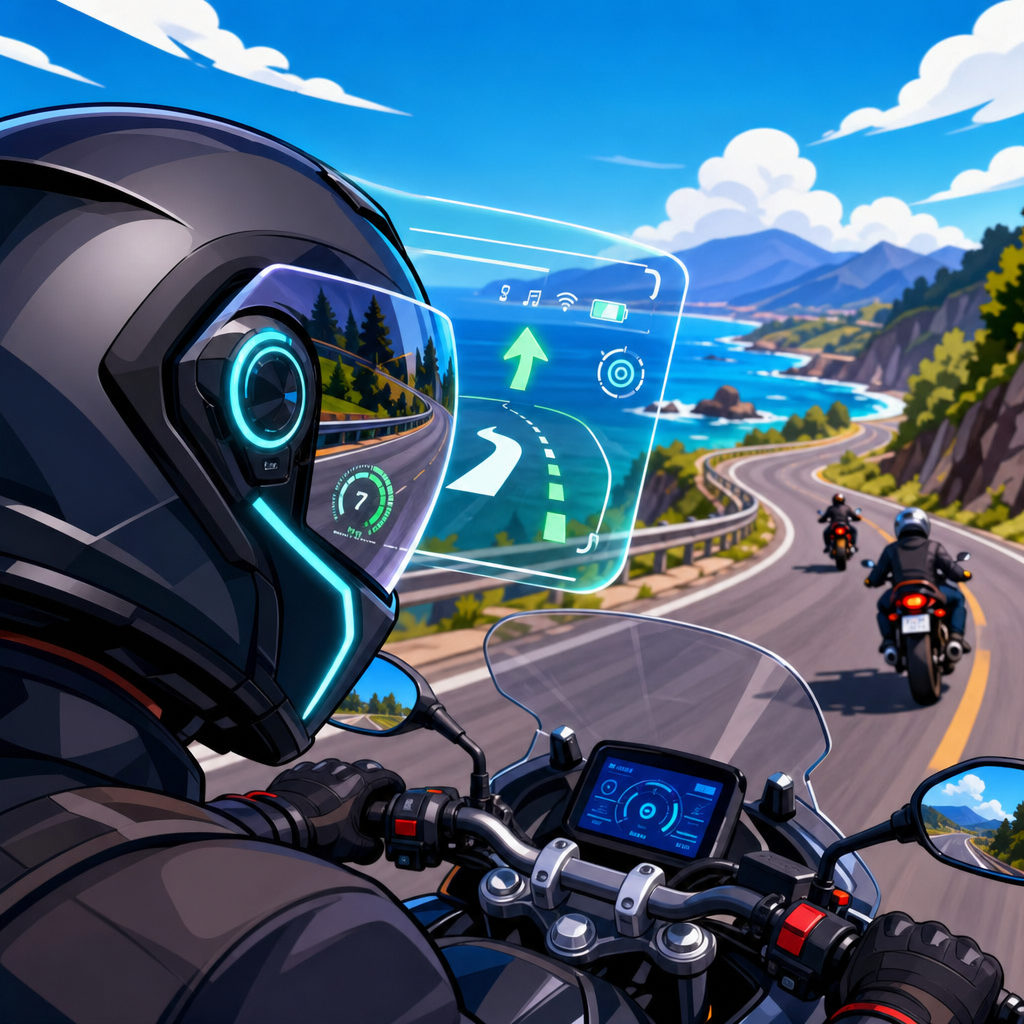
Motorcycle head-up displays have moved from novelty to serious riding equipment, and 2026 is the first year many riders can reasonably ask whether smart helmets are finally worth the money. A motorcycle HUD projects critical information into the rider’s line of sight, usually through a transparent combiner, visor insert, or microdisplay tucked into the eye box. Smart helmets go further by integrating cameras, Bluetooth intercom, navigation, crash alerts, voice control, and sometimes rear-view video. In the garage, I have tested early clip-on units that felt distracting and half-finished, then newer systems that actually reduce glances down at the dash. That difference matters because motorcycles demand visual discipline: every extra half-second looking away from traffic increases risk.
For riders shopping the best motorcycle HUDs of 2026, the core questions are straightforward. What information should a HUD show? How bright is it in full sun? Does it work with common comms systems such as Cardo and Sena? Is the battery life enough for a full-day ride? Can the system survive rain, vibration, and repeated helmet use without becoming a fragile gadget? Price matters too, because a smart helmet can cost as much as a premium conventional lid plus a top intercom. This hub article covers the current market, the practical strengths and weaknesses of motorcycle HUDs, and how to choose the right setup if you ride for commuting, sport, touring, or mixed use.
What a motorcycle HUD actually does, and why 2026 is different
A motorcycle HUD displays selected information without forcing the rider to drop their gaze to the instrument cluster or phone mount. The best systems limit that information to high-value data: turn-by-turn navigation, speed, hazard warnings, caller ID, music status, and rear traffic or camera views. In engineering terms, success depends on three things: optical clarity, cognitive load management, and interface reliability. If the display is dim, cluttered, laggy, or hard to align, it fails even if the feature list looks impressive.
What changed by 2026 is not a single breakthrough but the maturity of several pieces at once. Micro-OLED displays are brighter and more legible. Battery density has improved enough to support all-day mixed use in some helmets. Mobile apps now handle map caching and firmware updates more reliably. Helmet makers also learned an old lesson from aviation and automotive HUD design: less is more. The best current products show fewer data points, place them at the edge of vision, and rely on clean iconography instead of dashboard-style overload. That makes the system easier to trust on real roads, especially in dense traffic or during quick lane changes.
Another major shift is integration. Early units often felt like action-camera projects bolted to a helmet shell. Today’s better options are either purpose-built smart helmets with balanced weight distribution or refined add-on HUD modules designed around known helmet geometries. That means better aerodynamics, less neck strain, and fewer weird pressure points inside the liner. Riders who dismissed HUDs three years ago should take a second look, because usability has improved more than the marketing often explains.
Best motorcycle HUDs and smart helmets to watch in 2026
The strongest products in 2026 fall into three categories: fully integrated smart helmets, premium camera-first helmets with HUD-adjacent safety functions, and modular add-on displays. CrossHelmet remains one of the most recognized names because it combines navigation, rear-view augmentation, and communications in a unified shell. Its appeal is convenience: one purchase, one app ecosystem, one charging routine. The tradeoff is cost, weight, and less flexibility if you already own a favorite premium helmet from Shoei, Arai, AGV, Schuberth, or HJC.
For riders focused on safety tech more than literal projection optics, Sena’s smart helmet line and units like the Impulse or related connected models matter because they normalize integrated comms, voice prompts, mesh networking, and camera ecosystems. They are not always true HUD products, but they sit in the same buying decision. In practice, many riders asking for a HUD really want fewer distractions and better information flow. A refined audio-navigation system with excellent voice control can solve that problem more effectively than a mediocre visual display.
Then there are add-on systems, including Nuviz-style successors and newer startup modules that clip to the chin bar or visor area. These products can be compelling because they let you keep a helmet that already fits your head shape and safety preferences. Fit is not a side issue. A poorly fitting smart helmet is never a smart buy. I have seen riders tolerate a feature-rich helmet that created forehead hotspots after an hour, then return to a standard shell plus Cardo Packtalk because comfort wins every time on long rides.
| Category | Best for | Main strengths | Main compromises |
|---|---|---|---|
| Integrated smart helmet | Commuters and early adopters | Clean installation, unified controls, built-in cameras and comms | High price, heavier shell, limited upgrade path |
| Camera-first connected helmet | Touring and group riders | Strong audio ecosystem, recording, mesh intercom, easier learning curve | May lack true in-eye display, battery dependence |
| Add-on HUD module | Riders who already own a premium helmet | Lower switching cost, flexibility, keep preferred fit | Bulkier appearance, setup complexity, variable compatibility |
If you are building a Garage & Gear tech setup, this is the decision tree to start with. From here, the useful follow-up topics are helmet communicator comparisons, action camera mounting, USB power management, motorcycle phone mounts, and navigation app testing. Those adjacent gear choices affect whether a HUD adds value or duplicates equipment you already use.
How to judge value: display quality, safety benefit, and real riding conditions
The best motorcycle HUD is not the one with the longest feature list. It is the one you can read instantly, ignore when necessary, and trust in ugly conditions. Start with optical performance. Brightness must be adequate in direct sunlight, but not so intense at night that it blooms or ruins dark adaptation. The image needs enough contrast to stay readable through tinted shields and variable weather. Alignment also matters. If the eye box is too narrow, the display disappears when you tuck on a sportbike or shift posture on an adventure bike.
Next, evaluate whether the HUD creates a real safety benefit. A useful system reduces frequent downward glances and supports situational awareness. A poor system competes for attention. In testing, the most valuable elements have been simple navigation arrows, speed limit prompts, blind-spot or rear camera cues, and hazard alerts tied to route conditions. Constant message notifications, album art, social pings, or dense telemetry are counterproductive. On a motorcycle, attention is a finite resource. Good design protects it.
Battery life and weather resistance separate weekend toys from practical gear. For daily commuting, I treat six to eight hours of realistic runtime as a minimum threshold unless the unit supports pass-through charging from a bike-mounted USB-C source. Check the IP rating if the manufacturer provides one, but read real owner reports too. A device that survives a lab splash test can still fail after repeated summer heat cycles, winter condensation, and helmet drops from seat height. This is why recognized testing standards matter. A helmet still needs to meet certifications such as DOT FMVSS 218, ECE 22.06, or relevant regional standards before any smart feature deserves attention.
Are smart helmets finally worth the money?
For some riders, yes. For everyone else, not automatically. Smart helmets are worth the money in 2026 when three conditions are true: the helmet fits your head correctly, the display solves a frequent riding problem, and the tech stack replaces gear you would otherwise buy separately. If a $1,400 smart helmet gives you navigation, rear camera awareness, integrated comms, crash alerts, and decent battery life, the value can be rational for a year-round commuter or touring rider. That same purchase makes less sense if you ride twice a month on local roads and already own a premium helmet plus a high-end communicator.
The strongest value case is commuting. Dense traffic, frequent turns, speed-camera awareness in some markets, and the need to keep eyes high all favor HUD use. Touring is second. Long-distance riders benefit from navigation prompts, intercom integration, and less dependence on exposed phone mounts in rain. Sport riding is more mixed. On a track day, most smart features are unnecessary and some are banned by event rules or simply distracting. On spirited street rides, a minimal speed and nav display can help, but only if the eye box remains stable in an aggressive tuck.
The weakest value case is buying a smart helmet to compensate for weak core gear. If your current pain point is wind noise, poor fit, or bad visor sealing, spend money there first. The smartest purchase sequence for most riders is helmet fit, hearing protection, communicator, power management, then HUD. When those basics are solved, a HUD becomes a meaningful upgrade rather than an expensive workaround.
What to check before you buy: fit, compatibility, and hidden ownership costs
Fit remains the first filter. A motorcycle helmet should match your head shape, secure evenly without pressure spikes, and stay stable at speed. Integrated electronics can complicate shell sizing, liner thickness, and weight balance, so try before you buy whenever possible. A spec sheet cannot tell you whether a battery pod creates turbulence or whether side modules interfere with a jacket collar on a naked bike.
Compatibility is the second filter. Confirm support for iOS and Android versions you actually use. Check whether the system pairs cleanly with Cardo, Sena, OEM TFT dashboards, and navigation apps such as Google Maps, Apple Maps, Rever, Calimoto, or Waze. Some systems handle only one Bluetooth profile cleanly at a time; others juggle media, calls, and nav prompts without constant reconnect drama. Firmware update history is a useful proxy for product maturity. If a brand has not issued meaningful updates in a year, assume long-term support may be weak.
Ownership costs go beyond retail price. Replacement visors, batteries, charging cables, microphones, and mounting hardware can be proprietary and expensive. Crash replacement policies matter too. Traditional premium helmet brands often have clearer parts support than startups. Insurance and theft risk should enter the equation if you park on city streets. A detachable module may be less elegant, but replacing a stolen accessory is easier than replacing a stolen smart helmet with embedded electronics.
Also consider privacy. Rear cameras, ride logs, cloud sync, and crash detection can be helpful, but they generate data. Read the app permissions and storage policies. Riders increasingly care where footage lives, how location history is retained, and whether microphones are always listening for wake words. A good product earns trust by making these settings easy to understand and easy to disable.
The 2026 bottom line for riders building a smarter gear setup
The best motorcycle HUDs of 2026 prove that smart helmets are no longer gimmicks, but they are still not universal recommendations. The technology is finally good enough to benefit riders who need constant navigation, cleaner information flow, and integrated communications without a handlebar-mounted screen dominating the cockpit. The winners are products that respect motorcycle realities: bright but restrained displays, dependable battery life, weather durability, stable fit, and software that works every ride instead of only after troubleshooting.
If you are deciding whether smart helmets are finally worth the money, judge them against your actual riding patterns, not marketing demos. Commuters and frequent tourers have the clearest case. Riders with occasional leisure use may get better value from a premium conventional helmet, quality earplugs, and a proven communicator. Either path can be correct if it improves comfort, focus, and safety.
Use this hub as your starting point for every Tech & Comms decision in Garage & Gear: helmet communicators, navigation apps, power solutions, action cameras, and connected safety tools all intersect here. Choose the helmet that fits, the display that stays out of your way, and the ecosystem you can trust on the road. Then ride with less clutter and more attention where it belongs.
Frequently Asked Questions
Are motorcycle HUDs and smart helmets actually worth the money in 2026?
For many riders, 2026 is the first year the answer can realistically be yes. Earlier motorcycle HUD systems often felt like expensive tech demos: limited battery life, dim displays, unreliable connectivity, and too many distractions for too little practical benefit. The best current-generation motorcycle HUDs and smart helmets are much more mature. They now deliver brighter optics, cleaner navigation overlays, more stable Bluetooth connections, better voice control, improved wind-noise handling, and more useful safety features such as rear-view awareness, crash detection, group intercom, and turn-by-turn directions that stay visible without forcing you to glance down at a phone or tank-mounted GPS.
Whether they are worth the money depends on how and where you ride. Commuters, touring riders, and anyone who regularly navigates unfamiliar roads tend to see the biggest benefit because a HUD reduces repeated downward glances and consolidates information into a more natural sightline. Riders who spend long days in the saddle may also appreciate integrated comms, music control, camera features, and alert systems enough to justify the premium. On the other hand, if you mostly ride short local routes, avoid electronics, or prioritize the lightest and quietest possible helmet above all else, a traditional premium helmet plus a separate comms unit may still be the better value. In short, smart helmets are no longer just gadgets for early adopters, but they are still best viewed as purpose-driven upgrades rather than universal must-buys.
What information does a motorcycle HUD typically show while riding?
A modern motorcycle head-up display is designed to present only the most useful information in a compact, glanceable format. The most common features include turn-by-turn navigation, speed, posted speed limit data, caller ID, music or intercom status, battery level, and simple warning alerts. Depending on the model, you may also see lane guidance, hazard notifications, weather prompts, camera indicators, blind-spot or rear-view feeds, and basic bike telemetry if the system integrates with the motorcycle or a companion app. The key goal is not to replicate a full dashboard inside your visor, but to surface high-priority information at the right moment.
The best HUDs do this without cluttering your view of the road. In a well-executed setup, the image appears slightly off-center or in a controlled part of your field of vision so it is easy to reference but not constantly intrusive. That distinction matters. A good motorcycle HUD should support situational awareness, not compete with it. The strongest systems let riders customize what appears, how bright it is, and when certain notifications are suppressed. For example, many riders want navigation and safety alerts visible, but do not want message previews, social notifications, or constant media pop-ups. The most useful HUD is usually the one that shows less, but shows the right things consistently and clearly.
Are smart helmets safer than regular motorcycle helmets?
Smart helmets can improve riding awareness, but that does not automatically make them safer in every situation. The core safety function of any helmet is still impact protection, and that depends on shell construction, liner design, fit, retention system, and certification standards such as DOT, ECE, or other region-specific approvals. A smart helmet is only worth considering if it first performs as a high-quality protective helmet. The electronics are secondary. If a smart helmet fits poorly, feels unstable at speed, or compromises comfort to the point that you ride distracted, its added tech does not help.
Where smart helmets can offer meaningful safety advantages is in information delivery and communication. Turn-by-turn navigation in your line of sight can reduce the temptation to look down at a phone. Rear-view or blind-spot assistance may help detect traffic approaching from behind. Integrated voice control can make it easier to manage calls, route changes, or music without fumbling with buttons. Some models also include automatic crash alerts that can notify emergency contacts if the helmet detects a serious impact. Still, more features do not always equal more safety. A poorly designed interface, excessive notifications, dim or distracting visuals, or unreliable software can work against the rider. The safest choice is a smart helmet or HUD that adds clear, restrained utility on top of proven helmet fundamentals.
What should riders look for before buying a motorcycle HUD or smart helmet?
Start with the basics: helmet safety certification, fit, comfort, weight, and noise control. These matter more than any display feature. If the helmet is uncomfortable after an hour, creates hot spots, or feels heavy and front-loaded because of added electronics, you will notice it every ride. For standalone HUD systems, pay close attention to compatibility with your helmet shape, eye position, and visor setup. A display can have impressive specs on paper and still perform poorly if it sits in the wrong place for your line of sight. Optical clarity, brightness in direct sunlight, low-light behavior, and whether the image remains legible with tinted visors or prescription glasses are all critical buying considerations.
From there, evaluate the real-world tech. Battery life should match your riding style, especially for touring and all-day commuting. Navigation software should be stable and easy to read at a glance. Bluetooth pairing should be quick and dependable, and voice commands should work in wind and traffic noise, not just in demos. If rear-view video or camera recording is included, check latency, field of view, storage options, and image quality. App support also matters more than many buyers expect. A great helmet can be undermined by a buggy app, abandoned firmware, or poor customer support. Finally, think about use case instead of shopping by feature count alone. The best motorcycle HUD for urban commuting may not be the best choice for long-distance touring or sport riding.
Do motorcycle HUDs distract riders, or do they help keep attention on the road?
They can do either, which is why execution matters so much. In principle, a HUD helps by reducing the need to glance down at handlebars, instrument clusters, or phone mounts. That is especially useful for navigation prompts, speed awareness, and urgent alerts, because the information is delivered closer to your natural line of sight. When done well, this can support smoother scanning habits and better road awareness. Riders often find that simple directional arrows, distance-to-turn prompts, and discreet alerts are genuinely easier to process than repeatedly looking away from traffic.
Distraction becomes a problem when the display is too bright, too busy, poorly positioned, or overloaded with nonessential information. Message previews, constant media changes, social notifications, and unnecessary graphics can turn a useful riding aid into visual clutter. This is why the best 2026 systems focus on minimalist interfaces, customizable notifications, and voice-first control. Riders should also spend time setting up the system before riding and testing it in low-stress conditions rather than learning it in traffic. A motorcycle HUD should feel like an unobtrusive extension of your situational awareness. If it keeps demanding attention, it is configured poorly or designed poorly. The right system helps you stay heads-up; the wrong one just puts another screen in front of your face.