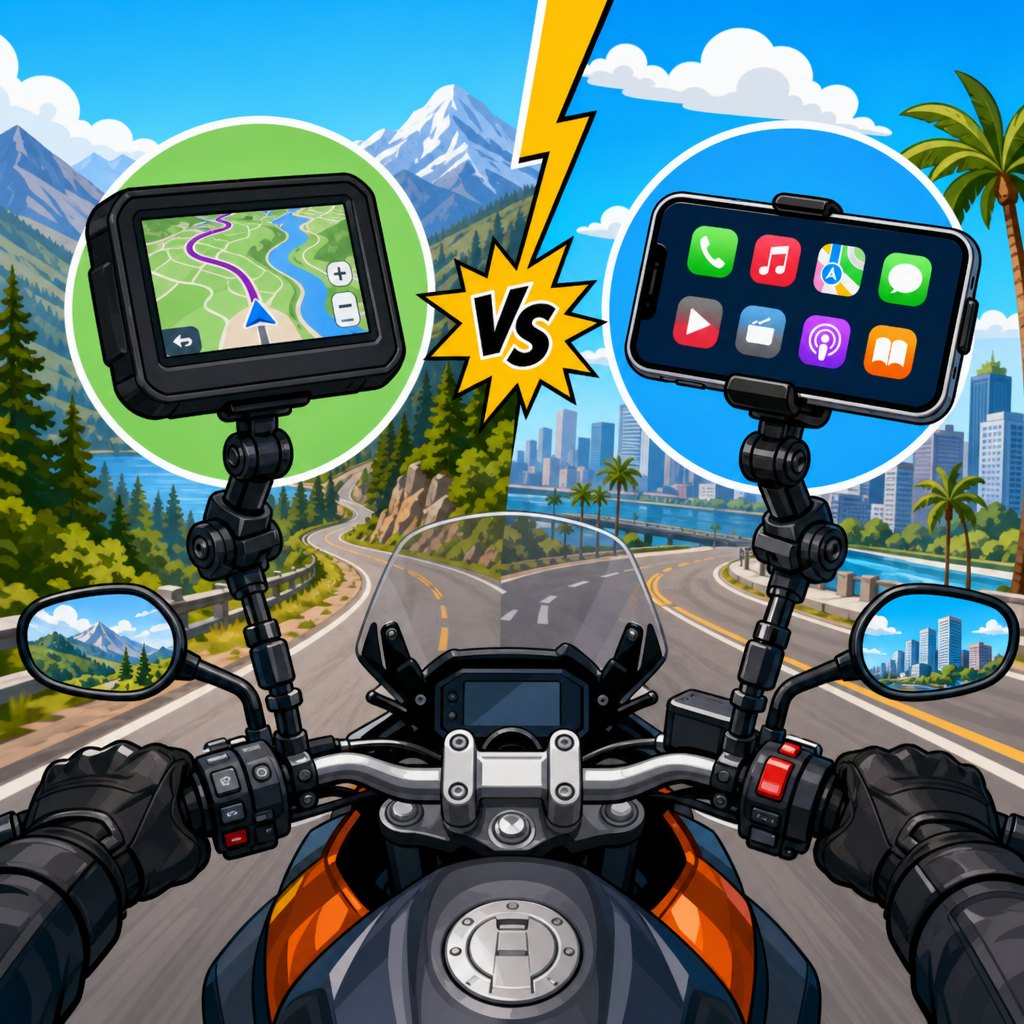
Choosing between a dedicated motorcycle GPS unit and Apple CarPlay for bikes is no longer a niche gear question; it is a core decision that affects navigation reliability, safety, communication, trip planning, and how cleanly your cockpit works in real riding conditions. In the Garage & Gear world, Tech & Comms sits at the center of modern touring, commuting, and adventure riding because today’s rider expects turn-by-turn directions, traffic data, weather awareness, headset integration, music control, and gloved usability from one system. The two main paths are clear: a rugged motorcycle GPS, built specifically for powersports, or a CarPlay-enabled display that mirrors key iPhone functions onto the bike. Both can get you to the same destination, but they solve the job in very different ways.
A motorcycle GPS unit is a standalone navigation device engineered for vibration resistance, rain exposure, bright sunlight, and glove-friendly operation. Models such as the Garmin zūmo XT2 and TomTom Rider series use onboard maps, dedicated route-planning features, and hardware mounts meant to stay stable on rough pavement and gravel. Apple CarPlay for bikes usually means an external waterproof display mounted to the handlebar and connected wirelessly or by cable to an iPhone, giving access to Apple Maps, Google Maps, Waze, calls, messages, and media through a simplified interface. Some motorcycles integrate this at the factory, but many riders add it through aftermarket screens from brands like Chigee, Carpuride, and Aoocci.
This comparison matters because the wrong choice creates friction every ride. I have set up both systems on touring bikes, nakeds, and ADV machines, and the practical differences show up immediately. A standalone GPS keeps working when cell coverage disappears and usually offers better route shaping for scenic or multi-stop rides. CarPlay feels more familiar, updates faster, and handles live traffic and communication better when your phone has signal. Budget matters too: a capable CarPlay screen can cost less than a premium GPS, but the total setup may include a vibration damper, charging solution, weatherproof phone storage, and headset integration. The right answer depends on where you ride, how long you ride, and whether your priority is robust navigation or broader connected convenience.
How motorcycle GPS units work and where they still lead
Dedicated motorcycle GPS units are purpose-built navigation computers. Their biggest advantage is independence. They store maps locally, calculate routes without relying on a data connection, and remain usable in remote areas where your phone would otherwise be reduced to a blank tile map or cached fragments. On multi-day rides through mountain regions or deserts, that matters more than most buyers realize. Garmin’s zūmo line, for example, supports offline mapping across large regions, route import through GPX files, waypoint management, curvy-road routing, and track recording. These are not fringe features; they are everyday tools for riders who plan rather than simply follow the fastest route.
Hardware design is another reason motorcycle GPS units remain relevant. The best units meet IPX7 water-resistance standards, use transflective or high-brightness displays that stay readable in direct sun, and include locking powered cradles wired to switched power. They are also built for glove use. On a cold, wet ride, tapping a thickly gloved finger on a zūmo is usually easier than interacting with a mirrored phone interface. Vibration resistance is critical as well. Modern smartphones, especially iPhones with optical image stabilization, can suffer camera damage from prolonged engine vibration. A dedicated GPS avoids risking your main phone, which is one reason many long-distance riders still prefer it.
Where a motorcycle GPS leads most clearly is route control. If you want to build a day with six fuel stops, a lunch waypoint, a scenic pass, and a hotel destination, a GPS handles that structure better than most phone-first apps exposed through CarPlay. Garmin BaseCamp has a learning curve, but once a rider understands shaping points, via points, and tracks, route precision improves dramatically. TomTom’s winding-road tools are also useful for riders who actively want enjoyable roads rather than merely efficient ones. For touring and adventure use, that specificity is often the deciding factor.
How Apple CarPlay for bikes works and why riders like it
Apple CarPlay for bikes takes a different approach: instead of relying on a separate navigation brain, it turns your iPhone into the source and uses the bike-mounted display as the interface. The appeal is obvious the first time you use it. The menus are familiar, contacts sync automatically, music and podcasts are already there, and live traffic from Apple Maps, Google Maps, or Waze is usually better than what a dedicated GPS provides. For commuters and weekend riders in urban or suburban areas, this convenience is hard to beat.
Aftermarket motorcycle CarPlay displays have improved quickly. Many now offer 5- to 7-inch screens, wireless CarPlay, Bluetooth passthrough to a helmet headset, dual dashcam support, and IP67-rated housings. Setup is usually simpler than riders expect: mount the screen, wire it to 12-volt power, pair the iPhone, pair the display or headset, and ride. Because the software layer lives on the phone, app updates come faster than they do on dedicated GPS platforms. That means map corrections, lane guidance improvements, business listings, and traffic intelligence evolve continuously. In practice, CarPlay often feels more current.
CarPlay also excels at communications management. With a Sena or Cardo headset, riders can hear directions, answer calls, send dictated replies, and switch audio sources with less friction than on many standalone GPS systems. Siri integration is a genuine usability advantage because voice input reduces touch interaction. Saying “navigate to the nearest gas station” or “play downloaded playlist” is faster than poking at menus on the roadside. For riders using one bike for commuting, errands, and occasional day trips, that smooth integration can outweigh the limitations of phone-dependent navigation.
Motorcycle GPS vs. Apple CarPlay for bikes: direct comparison
The best choice depends on your riding profile, not marketing claims. If you ride beyond cell coverage, build complex routes, or need maximum weather and vibration tolerance, a dedicated motorcycle GPS is usually the better tool. If you ride where signal is common, value live traffic, and want seamless access to calls, messages, and streaming audio, CarPlay is usually the more efficient system. Here is the practical comparison riders ask for most often.
| Factor | Motorcycle GPS Unit | Apple CarPlay for Bikes |
|---|---|---|
| Navigation reliability | Excellent offline; full local maps | Best with phone signal or downloaded maps |
| Route planning | Strong GPX, waypoints, tracks, scenic routing | Simpler point-to-point, fewer advanced controls |
| Traffic updates | Often weaker or phone-dependent | Usually excellent with Apple Maps, Google Maps, or Waze |
| Glove and weather use | Purpose-built and rugged | Good on quality screens, but varies by brand |
| Communications | Functional, but less integrated | Excellent for calls, messages, media, Siri |
| Phone risk | Phone stays protected in pocket | Phone remains essential and may need charging |
| Cost | Higher upfront for premium units | Often lower entry cost, depending on screen and mount |
One detail many buyers miss is failure mode. When a GPS fails, you still have your phone as backup. When a CarPlay setup fails, loses power, overheats the phone, or drops the wireless connection, your entire system can degrade at once. That does not make CarPlay bad; it means redundancy matters more on remote rides. The reverse is also true: in city traffic, the GPS may feel clunky compared with the speed and accuracy of a live phone-based mapping stack.
Key buying factors: screen, power, mounting, audio, and maps
Screen readability is the first specification to take seriously. Peak brightness, anti-glare coating, and polarization behavior affect whether you can actually read directions at noon. Premium motorcycle GPS units tend to perform better in harsh sun, though top-tier CarPlay displays are closing the gap. Touch response with gloves also varies more on CarPlay screens than many product listings admit. If possible, prioritize real rider reviews over generic marketplace ratings.
Power management is the next deciding factor. A motorcycle GPS usually runs from a powered cradle, so battery drain is not a concern. CarPlay depends on the phone, and wireless CarPlay increases heat and battery use. On summer rides, an iPhone in a tank bag or pocket can overheat, especially while charging and handling navigation plus music. A stable USB-C or USB-A charging setup, weatherproof cable routing, and a shaded phone location help, but they add complexity. Riders who ignore power planning often end up blaming the display for problems caused by the phone.
Mounting and vibration control matter because cockpit stability affects both usability and durability. RAM Mounts, Quad Lock, and SP Connect all have solutions, but the best setup depends on bar diameter, windscreen clearance, and whether the bike sees off-road use. For CarPlay systems, the display mount should not obstruct the instrument cluster or create excess shake at highway speed. For GPS units, the powered cradle should be wired cleanly to switched ignition through a fused lead. Audio is equally important. Cardo Packtalk and Sena 50-series units generally integrate well, but pairing order and firmware updates can make or break reliability.
Map strategy deserves a final check before buying. If your riding includes national parks, backcountry routes, or cross-border travel, confirm offline support and map coverage. Garmin and TomTom have long histories here. CarPlay can work brilliantly with downloaded regions in Apple Maps or Google Maps, but not every rider prepares in advance, and some features degrade without data. The safest rule is simple: the farther you ride from coverage and services, the more valuable a self-contained GPS becomes.
Best use cases for touring, commuting, adventure, and daily riding
For long-distance touring, a dedicated motorcycle GPS remains the strongest all-around choice. Touring riders benefit from route shaping, fuel and lodging waypoints, dependable offline maps, and a device that can live on the bike for years. If your typical day is 300 to 500 miles, weather changes quickly, and you regularly ride through weak-signal regions, a GPS reduces uncertainty. Many touring riders still run a phone in reserve for hotel searches and weather while letting the GPS handle the core route.
For commuting and city riding, Apple CarPlay is usually the better fit. Traffic rerouting, speed trap alerts through supported apps, easy audio control, and quick destination entry are more useful in urban riding than GPX precision. If your ride includes congestion, changing schedules, and frequent stops, CarPlay feels faster and smarter. It is also a strong match for riders who already live in the Apple ecosystem and want one interface across car, bike, and phone.
Adventure riding splits the field. On paved ADV touring, either system can work. Once terrain gets rough and remoteness increases, dedicated GPS hardware pulls ahead again, especially when paired with tracks and offline topographic mapping. Daily riding, however, often rewards simplicity. If most rides are familiar local loops, the best system may be the one you can trust instantly with no setup friction. Choose the platform that matches your riding reality, then build the rest of your Tech & Comms kit around it: headset, mount, charging, cameras, and route-planning tools. Start with your ride style, audit your current gear, and pick the system that removes the most friction every time you leave the garage.
Frequently Asked Questions
1. What is the main difference between a dedicated motorcycle GPS unit and Apple CarPlay for bikes?
The biggest difference is purpose-built reliability versus smartphone-powered flexibility. A dedicated motorcycle GPS unit is designed specifically for riding environments. That means it is usually built with weather resistance, glove-friendly controls, bright sunlight-readable screens, vibration tolerance, and routing features that work well even when you are far from cell coverage. Many motorcycle GPS devices also include rider-focused functions such as winding-road routing, off-road track support, route importing, fuel stop planning, and durable mounts engineered for long-distance use.
Apple CarPlay for bikes, by contrast, is typically a way to extend your iPhone onto a motorcycle-compatible display or infotainment screen. It excels at giving riders a familiar interface for navigation apps, music, calls, messages, and real-time traffic. If you already live in the Apple ecosystem and use apps like Apple Maps, Google Maps, Waze, Spotify, or podcast platforms every day, CarPlay can feel more intuitive and more connected right away. It also reduces the learning curve because you are working with apps and menus you already know.
In practical terms, a dedicated GPS is often the stronger choice for riders who prioritize all-weather durability, remote travel, route planning depth, and predictable performance when signal quality is poor. Apple CarPlay is often the better fit for riders who want live traffic, easy communication, seamless app integration, and a cleaner digital lifestyle centered around their phone. The decision is less about which one is universally better and more about which system matches how and where you ride.
2. Which option is better for long-distance touring and adventure riding?
For long-distance touring and especially adventure riding, a dedicated motorcycle GPS unit usually has the edge. The reason is simple: these devices are built for consistency in difficult conditions. On multi-day trips, riders often deal with rain, dust, direct sun, vibration, charging concerns, and intermittent mobile coverage. A motorcycle GPS is engineered with those realities in mind. It can remain mounted all day, often with a more robust weatherproof housing and a screen that stays easier to read in bright outdoor light than many phone-based setups.
Another major advantage is route management. Touring and adventure riders often want more than point-to-point navigation. They may want to preload scenic routes, create complex multi-stop itineraries, follow GPX tracks, avoid highways, find remote fuel, or navigate across areas with weak service. Dedicated GPS units typically support these tasks better than a CarPlay-based workflow. Many also store maps locally, which is critical when your ride takes you into mountains, deserts, forests, or cross-border regions where data access is unreliable or expensive.
That said, Apple CarPlay still has real strengths for touring riders who stay mostly on paved roads and near populated areas. Real-time traffic updates, easy access to streaming audio, and simpler voice-driven communication can make highway travel and urban transitions much easier. For riders who value convenience over expedition-grade ruggedness, CarPlay can be excellent. But if the trip includes rough roads, changing weather, remote stretches, or serious route planning, a dedicated motorcycle GPS tends to provide more confidence and fewer compromises over the long haul.
3. Is Apple CarPlay reliable enough for everyday commuting and weekend rides?
Yes, for many riders Apple CarPlay is absolutely reliable enough for commuting and casual to moderate weekend riding, especially if the setup is high quality and the rider mainly stays in areas with solid cellular coverage. In these use cases, CarPlay offers several advantages that are hard to ignore. It gives fast access to familiar navigation apps, current traffic conditions, alternate routes, ETA updates, music, podcasts, and communication tools. For urban and suburban riding, where traffic changes quickly and road closures are common, those real-time updates can be more useful than the static routing of older standalone GPS devices.
CarPlay is also appealing because it simplifies the cockpit. Instead of juggling separate devices for navigation and communication, riders can use one integrated interface tied to the iPhone already in their pocket. If paired with a helmet headset, it can create a very smooth commuting experience with spoken directions, hands-free calls, and media control. For riders who prioritize convenience and connected features, this can make daily use feel modern and efficient.
However, reliability depends on the weak points of the phone-based system. Your iPhone needs power, signal, and a stable connection to the CarPlay display. Heat buildup, wet weather exposure, mount vibration, cable issues, wireless pairing glitches, or app instability can all affect performance. Those risks are manageable, but they are real. For commuters and weekend riders who want the latest app features and live data, CarPlay is often an excellent solution. For riders who want maximum independence from the phone itself, a dedicated motorcycle GPS remains the more self-contained and purpose-built option.
4. How do motorcycle GPS units and Apple CarPlay compare for safety and distraction while riding?
Safety depends less on the logo on the screen and more on how the system is implemented in the cockpit. Both motorcycle GPS units and Apple CarPlay can improve safety when they reduce uncertainty, provide clear turn-by-turn directions, and minimize the need to stop and check a device. Both can also become distractions if the interface is cluttered, the screen is poorly placed, or the rider tries to manage too many features while moving.
Dedicated motorcycle GPS units often have an advantage in riding-specific ergonomics. They are usually designed with larger on-screen buttons, simplified navigation menus, and glove-compatible interaction. Many are meant to be glanceable, with layouts optimized for quick visual confirmation rather than deep app interaction. Because they focus mainly on navigation, they can reduce temptation to bounce between messages, playlists, and notifications. That narrower purpose can be a genuine safety benefit.
Apple CarPlay can also be safe and effective, especially when it is used with disciplined settings. Voice commands, Siri integration, and straightforward app launching can reduce manual input. But CarPlay’s strength is also its risk: it opens the door to communication and entertainment features that may compete for the rider’s attention. The best practice is to configure routes before moving, keep notifications limited, use audio prompts through a helmet comms system, and avoid touching the screen except when stopped. If your priority is the most focused navigation environment possible, a dedicated GPS often wins. If your priority is integrated connectivity and you can manage it responsibly, CarPlay can still be a safe and practical choice.
5. Which is the better value: a dedicated motorcycle GPS or Apple CarPlay for bikes?
Value depends on what you already own, how often you ride, and what kind of riding you actually do. At first glance, Apple CarPlay can seem like the better deal because many riders already have an iPhone and subscriptions to the apps they use every day. If your bike has built-in CarPlay support or you are adding a reasonably priced CarPlay display, the cost of entry may be lower than buying a premium dedicated motorcycle GPS. You also benefit from regular app updates, current maps, real-time traffic, and integration with your broader digital life without learning a completely separate navigation ecosystem.
But upfront cost is not the whole value story. A dedicated motorcycle GPS often justifies its higher price with durability, long-term dependability, offline mapping, route planning depth, and hardware designed specifically for motorcycles. If you ride in all weather, take longer trips, go off the beaten path, or simply want a system that does one job extremely well, the added investment can pay off in reduced hassle and greater confidence. In that sense, the GPS is often higher value for serious tourers and adventure riders, even if it costs more initially.
Apple CarPlay tends to offer better value for riders who want modern connected features, mostly ride in covered areas with good service, and prefer a familiar app-driven experience. A motorcycle GPS tends to offer better value for riders who treat navigation as a mission-critical tool rather than just a convenience feature. The smartest way to decide is to match the system to your real riding habits, not the spec sheet. If your riding is mostly commuting, local weekend loops, and paved touring with strong connectivity, CarPlay may be the best value. If your riding includes big mileage, unpredictable conditions, and remote destinations, a dedicated motorcycle GPS is often money well spent.