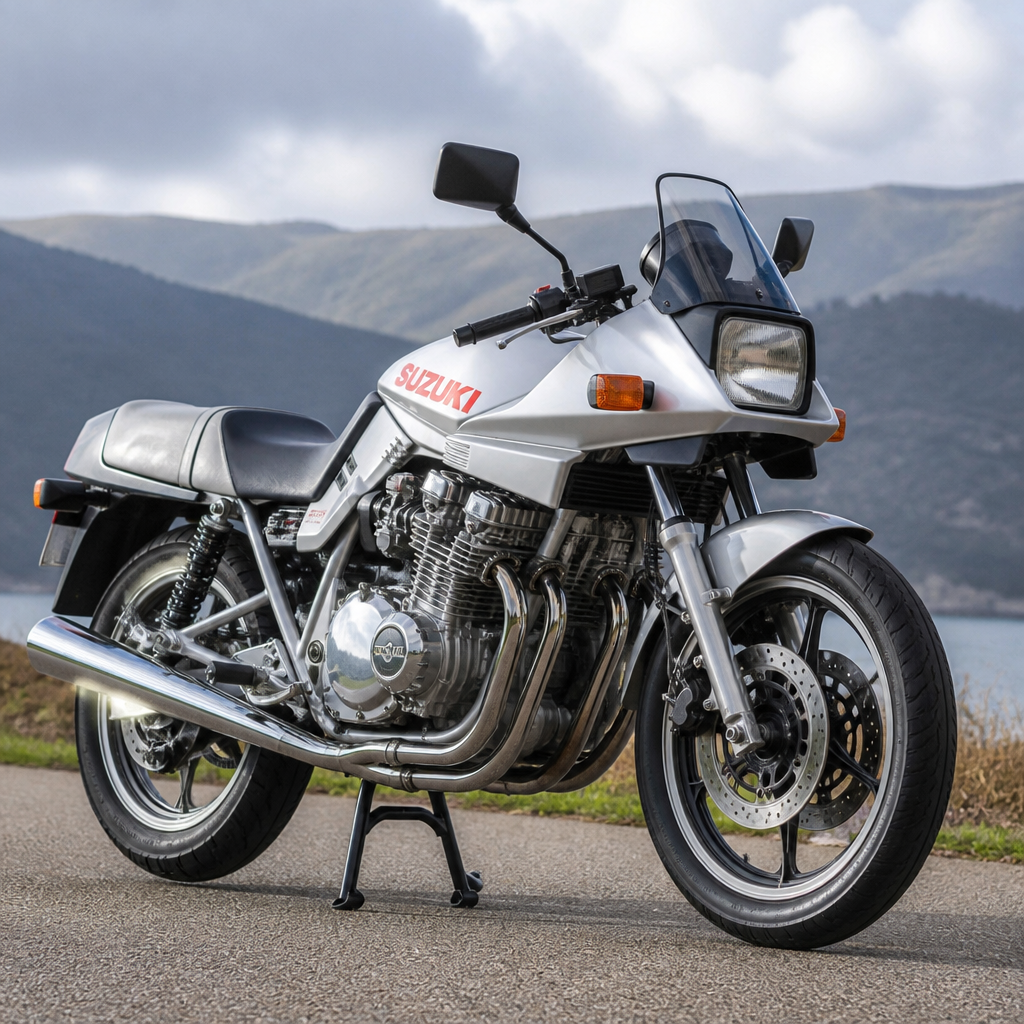
The 1981 Suzuki Katana is one of the few motorcycles that changed design language across the entire industry, and restoring one properly means preserving more than a machine. It means protecting a milestone in metric motorcycle history. As a hub for restoration guides covering metric classics built from 1970 to 2014, this article uses the Katana as the defining example because it combines radical styling, advanced period engineering, and the practical restoration problems that owners actually face in workshops today.
In collector terms, a metric classic is a motorcycle from a Japanese or other non-imperial-market manufacturer that uses metric hardware, metric service standards, and modern mass-production methods rather than the hand-built conventions associated with earlier British or American machines. In practical restoration terms, that means JIS fasteners instead of Whitworth, shim-under-bucket valve trains instead of pushrods, transistorized ignition instead of points on many models, and a parts ecosystem shaped by model codes, production revisions, and interchangeability charts. The Suzuki Katana sits squarely in that world. Introduced in Europe for 1981 and strongly associated with the GSX1100S, it translated the vision of Hans Muth and Target Design into a production motorcycle with a stepped seat, knife-edged tank profile, compact fairing, and rider-forward stance that still looks intentional today.
Why does that matter for restoration? Because the Katana rewards accuracy and punishes shortcuts. I have seen several restorations that were mechanically competent but visually wrong: incorrect stripe proportions, over-restored frame finishes, modern mirrors that distort the silhouette, or replacement handlebars that ruin the riding triangle. On this bike, details are not decoration. They are part of the design thesis. The same is true across restoration guides for metric classics from 1970 to 2014. A Honda CB750K, Yamaha RD350LC, Kawasaki ZRX1200R, or Suzuki GSX-R750 all ask the same core questions: what is original, what is serviceable, what should be upgraded for safety, and what should remain untouched to preserve historical character?
This hub article answers those questions by outlining a restoration process that works for the Katana and scales across the wider category. It defines the standards, identifies the common failure points, explains how to judge originality, and shows where model-specific research matters most. If you are planning a concours restoration, a reliable rider rebuild, or a sympathetic preservation project, the goal is the same: make informed decisions before spending money, disassembling rare parts, or erasing evidence the motorcycle can never give back.
What Makes the 1981 Suzuki Katana a Restoration Benchmark
The 1981 Suzuki Katana is a benchmark because it sits at the intersection of collectible design and conventional air-cooled superbike engineering. Under the dramatic bodywork, the large-capacity Katana shared much with the GSX platform: double-cradle steel frame, inline-four engine, twin rear shocks on early versions, and robust period Suzuki componentry. That makes it mechanically approachable compared with exotic homologation machines. Yet its bodywork, cockpit layout, trim, and finish standards are specific enough that a generic GSX rebuild is not a true Katana restoration.
Hans Muth’s influence matters here. Target Design’s work for Suzuki brought automotive-level wedge themes into motorcycle form without making the machine unusable. The small fairing, low bars, and elongated tank line were not random styling flourishes. They directed rider posture and visual mass. As a result, parts that many owners treat as interchangeable often are not. Seat foam shape, screen contour, side cover graphics, and even the angle of the front indicators contribute to the whole composition. Replace them casually and the bike stops reading as a Katana.
From a market perspective, this model also teaches an important lesson about restoration economics. First-generation, correctly restored Katanas command strong interest, especially in Europe, Japan, Australia, and North America. However, values are not infinitely forgiving. A bike assembled from mixed-year parts, poor paint, and missing trim can consume more money than it returns. This is typical of metric classics. The purchase price is only the opening number. Correcting previous owner modifications, finding scarce OEM pieces, and reworking machine-shop mistakes often cost more than the obvious mechanical rebuild.
That is why the Katana belongs at the center of any guide to restoring metric classics from 1970 to 2014. It demonstrates every major discipline at once: provenance research, parts authentication, paint and graphics accuracy, chassis refurbishment, carburetion, electrical diagnosis, and sympathetic modernization. Learn to restore a Katana properly and you build habits that transfer directly to a CBX, GPz900R, FJ1200, VFR750F, Bandit 1200, or early fuel-injected superbike.
Planning a Restoration: Documentation, Scope, and Parts Strategy
The best restorations begin before the first bolt is removed. Start with documentation. For a Katana, that means factory service manuals, factory parts fiches, period brochures, road tests, homologation information where relevant, and a large photo archive of known original bikes. I also recommend creating a model-year change log. Suzuki, like other Japanese manufacturers, made running production changes that do not always show up clearly in casual online discussions. Fastener finishes, decal dimensions, harness routing, and carburetor specifications can vary.
Next, define the scope. A museum-grade restoration is different from a high-quality rider restoration. On a museum build, original finishes, correct hose markings, proper cadmium-appearance plating substitutes, and OEM pattern hardware matter deeply. On a rider build, you may reasonably choose modern brake lines, upgraded regulator-rectifier units, and improved tires while keeping visible originality intact. The key is consistency. Problems arise when a project is half concours and half custom, because buyers and judges can see the indecision.
Then assess parts supply. Many metric classics benefit from broad mechanical support but weak cosmetic support. Katana engine internals, bearings, seals, and common service items are generally manageable through OEM legacy channels, specialist suppliers, or cross-reference sourcing. Bodywork, trim, instrument surrounds, intake pieces, and model-specific brackets can be far harder. Before teardown, list every scarce part already on the bike and note its condition. That inventory determines whether the project is viable and whether conservation is wiser than replacement.
| Restoration Area | What to Verify First | Typical Katana Risk | Best Practice |
|---|---|---|---|
| Frame and VIN | Matching identity, straightness, weld integrity | Crash damage hidden by repaint | Measure before blasting or coating |
| Bodywork and trim | Original panels, tabs, screen, decals | Rare pieces replaced with poor replicas | Photograph and repair original parts where possible |
| Engine | Compression, leakdown, cam wear, oiling history | Top-end noise and neglected valve service | Inspect fully before ordering cosmetic work |
| Fuel system | Tank rust, petcock condition, carb completeness | Corroded internals and incorrect jetting | Rebuild to factory baseline before tuning |
| Electrical system | Charging output, harness alterations, connectors | Heat-damaged charging components | Test stator and regulator before final assembly |
| Brakes and suspension | Caliper corrosion, fork pitting, shock condition | Unsafe performance despite cosmetic restoration | Rebuild every wear component as standard |
This planning approach applies across the whole 1970 to 2014 metric-classic range. A late-1970s UJM, a 1980s two-stroke sport bike, and a 2000s aluminum-frame superbike all benefit from the same sequence: verify identity, inspect structure, inventory irreplaceable parts, and only then commit to restoration level and budget.
Mechanical Restoration Priorities for Metric Classics
Mechanical restoration should always outrank cosmetics, especially on a Suzuki Katana that may have sat for years. Begin with the engine as a diagnostic unit, not a paint subject. Check compression and leakdown, inspect cam lobes and journals, verify valve clearances, and look for evidence of oil starvation or neglected maintenance. Air-cooled Suzuki fours are durable, but worn cam-chain components, hardened valve stem seals, and carburetor neglect are common. A smooth-running Katana depends on carb synchronization, correct float heights, clean passages, and factory-baseline jetting before any tuning changes are attempted.
The fuel system is usually the first place where restoration budgets go sideways. Internal tank corrosion, failed petcock diaphragms, stale fuel varnish, and damaged carb boots can turn a complete motorcycle into a long parts hunt. Preserve the original tank whenever possible. Modern lining products can work, but only when preparation is meticulous; a poorly sealed tank creates more problems than surface rust. On many metric classics, including the Katana, original airbox components matter for drivability. Pod filters often create flat spots that owners then chase with incorrect jets and needle shims.
Chassis work deserves the same rigor. Steering-head bearings, swingarm bushings or bearings, wheel bearings, fork seals, and brake hydraulics should be treated as automatic service items. Brake calipers on older Japanese bikes frequently suffer from corrosion behind dust seals, and master cylinders may look clean externally while failing internally. Rebuild them with quality kits and verify disc thickness against service limits. If the bike will be ridden regularly, modern tires in period-correct sizes deliver the single biggest safety improvement without altering character.
Electrical reliability is another defining issue across restoration guides for metric classics from 1970 to 2014. Charging systems, grounds, aged connectors, and previous-owner splices are recurring faults. On many Japanese motorcycles, the smartest invisible upgrade is a modern regulator-rectifier from a reputable supplier combined with refreshed connectors and proper crimping. Done neatly, this preserves the appearance while eliminating one of the main causes of roadside failure. The rule is simple: restore function to a measurable standard, not a visual guess.
Preserving Design Integrity: Paint, Finish, and Originality
On a 1981 Suzuki Katana, cosmetic work is not merely about shine. It is about geometry, proportion, and restraint. The original silver-and-graphics scheme is iconic because it works with the sharp tank crease, angular fairing, and stepped seat. Repainting without exact stripe placement, correct metallic tone, or appropriate gloss level weakens the bike immediately. This is where many restorations fail. Owners spend heavily on powder coating and polished alloy, then use inaccurate decals or modern paint interpretations that make the machine look customized rather than restored.
My advice is to preserve original finishes whenever they are structurally sound. Factory paint with minor patina usually carries more credibility than a perfect but inaccurate respray. The same principle applies to hardware finishes, zinc-plated brackets, black-oxide fasteners, and textured plastic surfaces. Over-restoration is real. A Katana with mirror-finish engine covers, excessive clear coat, and generic stainless fasteners throughout may impress at first glance, but experienced enthusiasts spot the loss of period correctness instantly.
Authenticity does not mean refusing every improvement. It means choosing upgrades that respect the design and can be reversed. Stainless brake pistons, improved friction materials, modern fork internals concealed within stock sliders, and better charging components all make sense. Cutting the rear mudguard, fitting an oversized aftermarket screen, or replacing the seat profile with a flatter custom unit does not. The wider metric-classic category follows the same logic. The best restorations retain the manufacturer’s visual intent while discreetly addressing age-related weakness.
Provenance supports originality claims. Keep receipts, photograph stampings, record paint codes, and document assembly methods. If you source NOS parts, note their packaging and supplier. If you reproduce decals, record dimensions from verified originals. Detailed records help with resale, judging, insurance, and future maintenance. More importantly, they keep the restoration honest. Memory is unreliable; documentation is not.
Using the Katana as the Hub for 1970–2014 Metric Classic Restoration
The Katana works as a hub topic because it connects directly to the broader restoration landscape. Early metric classics from the 1970s, such as the CB750, Z1, and GS-series standards, teach fundamentals in corrosion control, carburetors, and steel-frame refurbishment. Performance-focused 1980s bikes add fairing plastics, anti-dive forks, rising-rate suspension, and more complex graphics. The 1990s introduce aluminum frames, ram-air systems, and increasingly model-specific electronics. By 2000 to 2014, restorers must also handle fuel injection, immobilizers, ABS on some models, and emissions hardware.
Yet the core method remains stable across all of them. Research the exact model and market, inspect before disassembly, save every original part until the project is finished, and separate safety upgrades from stylistic deviations. That is the organizing principle behind restoration guides for metric classics from 1970 to 2014, and the Katana demonstrates it perfectly because it demands discipline in every category. It is mechanical enough to rebuild in a well-equipped home workshop, but distinctive enough that poor decisions stay visible forever.
If you are building out your own restoration library, use the Katana article as the starting point, then branch into model-specific guides for engines, carburetors, paint codes, suspension, electrical systems, and authenticity references. The payoff is significant. A correctly restored metric classic starts easily, rides as intended, retains collector value, and tells the truth about its era. That is the real objective of restoration. Not making an old motorcycle look new, but making it correct, reliable, and legible for the next owner. Start with a careful assessment, write a parts plan, and restore your Katana with the same precision its original design deserves.
Frequently Asked Questions
Why is the 1981 Suzuki Katana considered such an important motorcycle to restore correctly?
The 1981 Suzuki Katana matters because it was not just another fast early-1980s superbike; it was a design event that altered the visual direction of performance motorcycles worldwide. Hans Muth’s angular bodywork, integrated fairing, aggressive stance, and purposeful ergonomics broke sharply from the rounded shapes that had dominated the previous decade. In restoration terms, that means the Katana should never be treated as a generic old Suzuki project. Its historical value is tied as much to proportion, finish, and silhouette as it is to engine performance or parts completeness.
Restoring one correctly means preserving the details that make the bike instantly recognizable: the shape and fit of the tank and fairing, the seat line, the blacked-out chassis elements, the wheel style, the instrumentation, and the visual balance between bodywork and mechanical components. Owners sometimes focus first on horsepower upgrades or cosmetic repainting, but on a Katana, authenticity and coherence matter more than flash. A poorly matched paint shade, incorrect handlebars, aftermarket seat profile, or non-period exhaust can disrupt the design language that made the motorcycle famous in the first place.
It is also important because original Katanas occupy a unique place in metric motorcycle history. They represent a moment when Japanese manufacturers proved they could lead, not follow, in both engineering and industrial design. A proper restoration protects that legacy. Done well, the result is more than a collectible motorcycle—it becomes a rolling reference point for one of the most influential production designs of the modern era.
What are the biggest challenges when restoring a 1981 Suzuki Katana today?
The biggest challenges usually fall into three categories: originality, parts sourcing, and correcting old repairs. Many surviving Katanas have lived hard lives. They were fast, desirable, and often modified, raced, crashed, or updated over the years. As a result, restorers frequently encounter non-original paint, replacement bodywork, incorrect fasteners, wiring alterations, aftermarket suspension, exhaust swaps, and improvised repairs that may have been acceptable decades ago but compromise authenticity and reliability today.
Bodywork is often one of the most difficult areas. The Katana’s styling depends on crisp edges, correct panel alignment, and exact visual relationships between the fairing, tank, side covers, and tail section. Damaged or repaired fiberglass and plastic pieces can be hard to return to original shape, and reproduction parts vary widely in accuracy. Even when replacement panels are available, getting the fit and finish right takes patience. Small deviations in contour or mounting can make the entire motorcycle look “off” to anyone familiar with the model.
Mechanical issues are more straightforward, but still significant. The engine and running gear come from a period when Suzuki built robust, serviceable machines, yet age brings predictable concerns: carburetor wear, deteriorated intake boots, electrical corrosion, charging system weaknesses, tired suspension, brake system contamination, fork pitting, and neglected valve service. Restorers also need to assess whether the bike still carries matching components appropriate to its model year and market specification. This is especially important on a motorcycle whose collector value depends heavily on originality.
Another common challenge is deciding how far to go. A rider-quality Katana can be made reliable and visually honest without becoming a museum piece, while a concours-level restoration demands research into finishes, decals, hardware plating, factory paint lines, and even hose routing. The smart approach is to define the end goal at the start. That keeps the project from drifting into a mix of custom, survivor, and over-restored choices that dilute both usability and historical integrity.
How do you preserve the original Hans Muth design while still making the Katana safe and usable?
The key is to separate preservation of appearance from sensible renewal of wear items. On a Katana, the original visual formula is the heart of the bike, so preserving it means retaining stock bodywork lines, factory-correct finishes, original riding position, proper instrumentation, and period-appropriate wheel and exhaust presence whenever possible. If the motorcycle still has salvageable original components, those should usually be restored rather than replaced with modernized alternatives. The bike’s impact comes from the complete package, not from any single feature in isolation.
At the same time, safety and reliability upgrades can be done discreetly. Brake calipers and master cylinders can be professionally rebuilt with modern seals. Brake lines can be renewed, whether with stock-style replacements for originality or subtle upgraded lines for improved feel if the owner prioritizes regular road use. Tires should always be modern, high-quality replacements in correct sizes, because old rubber undermines both safety and handling. Wheel bearings, steering head bearings, swingarm bushings, fork internals, and rear suspension components deserve close inspection and replacement where needed, even if the bike looks clean cosmetically.
Electrical reliability is another area where thoughtful intervention helps without harming character. Charging system components, connectors, grounds, and fuse arrangements often benefit from careful refurbishment. The best restorations hide that work in plain sight. The goal is not to turn the Katana into a modern restomod unless that is clearly the project’s purpose; the goal is to make it start, run, charge, brake, and handle confidently while still looking and feeling like a 1981 Katana.
In practice, that means respecting the motorcycle’s original intent. The Katana should still feel taut, mechanical, and unmistakably early 1980s, but it should not be unreliable, unsafe, or frustrating to use. A successful restoration preserves the drama of the design while quietly removing the risks created by age and neglect.
Which parts and details matter most if you want an authentic 1981 Suzuki Katana restoration?
The parts that matter most are the ones that define the bike’s identity at a glance and confirm its correctness on closer inspection. Start with the bodywork: fairing, fuel tank, side panels, tail section, windscreen, seat shape, and trim all need to match the original design language. The tank and fairing relationship is especially important, because it is central to the Katana’s forward-leaning, blade-like profile. Paint accuracy also matters enormously. The correct color, striping, decal placement, and finish quality can make the difference between a restoration that looks convincing and one that looks merely inspired by the original.
Controls and cockpit components deserve just as much attention. The handlebar type, switchgear, mirrors, instruments, and mounting hardware strongly affect the riding position and the visual authenticity of the front half of the bike. Many Katanas were altered with different bars or aftermarket controls, so bringing those elements back to correct specification often transforms the machine. The same is true for the seat cover pattern, grab rail details where applicable, and rear lighting assembly. Small items are often what knowledgeable enthusiasts notice first.
Below the surface, authenticity extends to finishes and hardware. Correct fasteners, plating tones, engine cover finishes, frame coating, fork appearance, and wheel treatment all contribute to a factory-correct presentation. An engine that runs beautifully but wears mismatched hardware, polished covers that should not be polished, or incorrect hoses and clamps can undermine an otherwise strong restoration. Exhaust systems are another major factor. An original or faithful replacement system helps preserve both the visual stance and the sound character that belong to the model.
Documentation also matters. Frame and engine numbers, market-specific details, and evidence of original configuration help verify what the bike should be. Before ordering parts or refinishing components, it is wise to gather period brochures, factory manuals, parts fiches, and reference photos of known-correct machines. The Katana is iconic enough that people tend to assume they know what “right” looks like, but authentic restoration depends on research, not assumptions.
Is it better to restore a Suzuki Katana to factory condition or upgrade it for regular riding?
That depends on the motorcycle you have, your budget, and your long-term goal, but in most cases the best answer is a balanced restoration with a strong bias toward factory appearance. A highly original 1981 Katana with correct major components is usually best preserved in near-stock form, because originality is a large part of its historical and collector appeal. Once a complete, correct example is heavily modified, it is difficult and expensive to bring it back. For that reason, owners of solid original bikes are usually wise to restore conservatively and make only reversible changes where necessary.
If the bike is already incomplete, modified, or missing key original parts, a sympathetic rider-focused restoration can make a lot of sense. In that scenario, the priority becomes preserving the spirit and design integrity of the machine while improving dependability for real-world use. That might include upgraded suspension internals, improved brake components, modern tires, refreshed charging system parts, and careful carburetor tuning. Those changes can make the motorcycle far more enjoyable on contemporary roads without visually erasing what makes a Katana special.
The mistake to avoid is building a machine that falls awkwardly between categories. A factory-correct exterior combined with random modern parts, or a performance build that still carries fragile neglected systems elsewhere, often creates a motorcycle that satisfies neither collectors nor riders. It is better to choose a philosophy and execute it consistently. If the aim is concours authenticity, follow factory specifications closely. If the aim is a reliable road bike, preserve the defining styling