Choosing between a lithium-ion and lead-acid motorcycle battery in 2026 is no longer a niche garage debate; it is a practical decision that affects starting reliability, charging behavior, weight, maintenance, cost, and compatibility with the increasingly electronic motorcycles riders use every day. In this Tires & Parts hub, the battery sits alongside tires, chains, brake pads, stators, regulators, and charging leads as one of the parts most likely to leave a rider stranded without warning. I have replaced failed batteries on commuter scooters, high-compression twins, ADV bikes loaded with heated gear, and track motorcycles with dataloggers and quickshifters, and the pattern is consistent: the best battery is not the one with the newest chemistry, but the one that matches the bike’s charging system, climate, storage habits, and electrical load.
For clarity, lead-acid motorcycle batteries usually mean flooded, AGM, or gel designs that store energy through lead plates and sulfuric acid. In modern powersports use, AGM is the common benchmark because it is sealed, vibration resistant, and comparatively affordable. Lithium-ion in motorcycle marketing usually refers to lithium iron phosphate, or LiFePO4, not the cobalt-heavy cells used in many phones and laptops. That distinction matters because LiFePO4 is more thermally stable, can deliver high cranking current, and tolerates vibration well, but it also behaves differently in cold weather and demands the right charging profile. Riders shopping in 2026 also need to understand battery management systems, parasitic draw from factory electronics, and charger compatibility.
This comparison matters more now because motorcycles have more electronics than they did even five years ago. Ride-by-wire throttles, cornering ABS, GPS modules, alarms, Bluetooth dash units, USB charging ports, and keyless ignition create new demands on both battery reserve capacity and charging stability. At the same time, manufacturers are chasing lower weight, and aftermarket brands are selling drop-in lithium upgrades as performance parts. The result is a market full of strong claims and half-true rules. Some riders are told lithium is always better because it is lighter. Others are told lead-acid is always safer because it is traditional. Neither statement is accurate. The right answer depends on how you ride, what you ride, and how carefully the rest of your electrical system is maintained.
How motorcycle battery technology actually differs
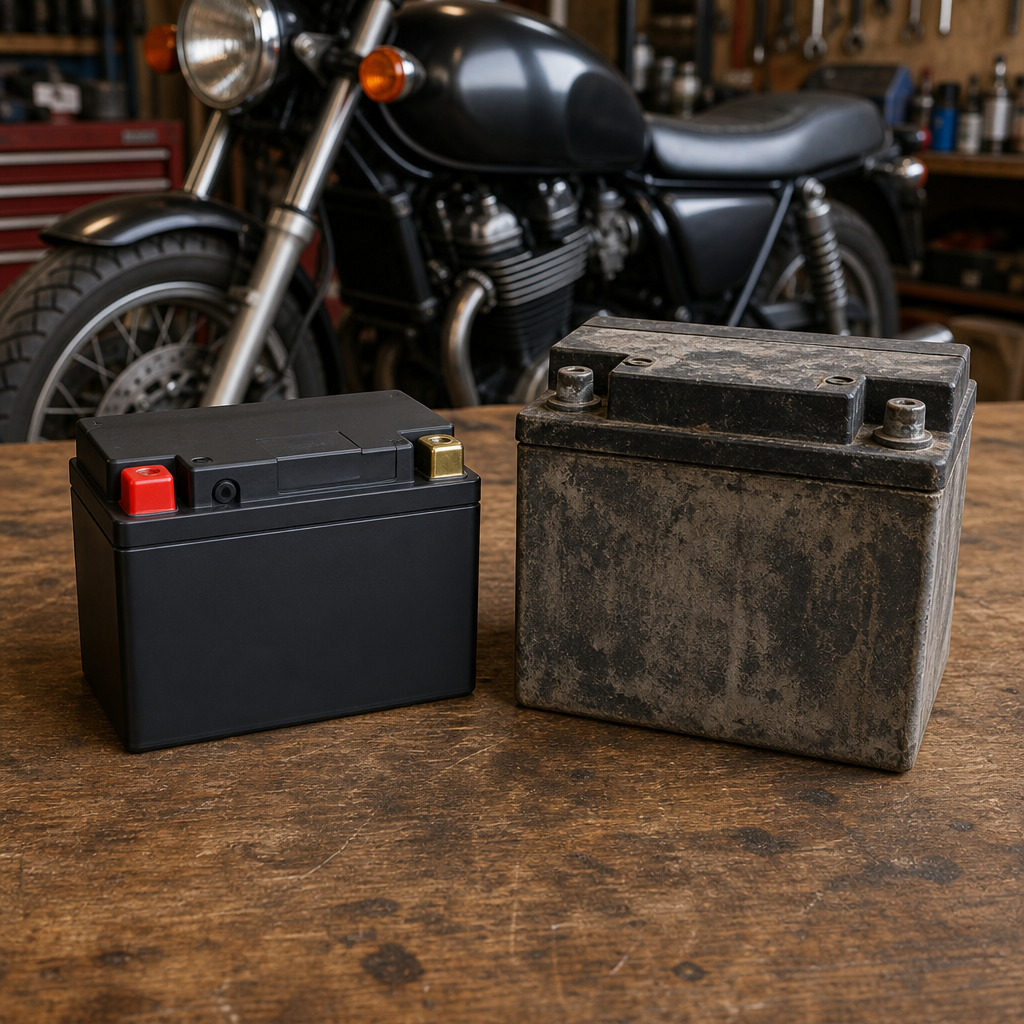
The core difference between lithium-ion and lead-acid is not just chemistry; it is how each battery delivers voltage under load, recovers after starting, and tolerates mistakes. A healthy AGM battery typically sits around 12.7 to 12.9 volts at rest and sags more noticeably during cranking. A healthy LiFePO4 battery can hold a higher resting voltage, often around 13.2 volts, and maintain stronger voltage during engine start. That is why a lithium battery can feel dramatically stronger on a bike with a big single or a high-compression four-cylinder, even when the case is much smaller. Less voltage sag means the ECU, fuel pump, and ignition system stay happier during crank.
However, the stronger starting feel of lithium does not automatically mean better all-around service. Lead-acid batteries generally provide more usable reserve for accessories left on accidentally, and they are often more forgiving when a bike sits partially discharged. AGM also works predictably with older charging systems that may run at less consistent voltages. On many carbureted or minimally electronic motorcycles, a quality AGM battery from Yuasa, Motobatt, or BS Battery still delivers excellent service life. On the other hand, premium lithium brands such as Antigravity, Shorai, NOCO, and EarthX can offer substantial weight savings and high cranking output, especially when paired with a modern regulator/rectifier and a healthy stator.
In real workshop terms, I think of lead-acid as the more tolerant chemistry and lithium as the more performance-oriented chemistry. Tolerant means it is less likely to punish small charging mistakes, less sensitive to low-temperature starting habits, and easier to support with a common smart charger. Performance-oriented means lower mass, stronger cranking per pound, lower self-discharge, and better fit for riders who monitor their electrical system closely. If your motorcycle is a lightweight sportbike or a race-prepped machine, dropping several pounds from high in the chassis can be worthwhile. If your motorcycle is a daily rider parked outside through winter, tolerance often beats theoretical performance.
Weight, packaging, and performance gains in real riding
Weight is the headline advantage of lithium-ion motorcycle batteries, and it is a real advantage. Swapping an AGM battery for a LiFePO4 unit can save anywhere from roughly 4 to 10 pounds depending on the bike. On a 400-pound motorcycle, that is meaningful. It will not transform a touring bike into a supersport, but it can improve flickability, reduce top-heaviness during low-speed maneuvers, and make race tech inspections or custom builds easier because the battery box can be smaller. Builders of café racers, scramblers, and track bikes often choose lithium partly because the compact case helps with packaging.
Still, battery weight should be kept in perspective within the broader Tires & Parts conversation. If a rider wants the biggest improvement in handling, fresh tires with the correct profile and compound, proper suspension setup, and well-maintained wheel bearings matter more than battery chemistry. The battery is one piece of the parts ecosystem. A lighter battery can complement those upgrades, but it does not replace them. I have seen riders spend heavily on lithium batteries while ignoring a worn chain, aged rubber, or a marginal regulator/rectifier that kills any battery installed. The performance benefit is real only when the supporting systems are healthy.
Another practical point is fitment. Many lithium batteries are physically smaller than the lead-acid batteries they replace, so brands include foam spacers. That works fine if installed carefully, but poor fit can increase vibration and terminal stress. Terminals on compact lithium batteries also require attention because accessories such as heated grips, GPS leads, battery tenders, and auxiliary lights all compete for limited fastening space. If the terminals are stacked badly or not torqued correctly, intermittent starting issues follow. In other words, lithium packaging flexibility is useful, but it is only an advantage when installation quality is high.
Cold weather, charging systems, and reliability tradeoffs
The most important reliability tradeoff in 2026 remains cold-weather behavior. Lead-acid batteries lose performance as temperatures drop, but LiFePO4 batteries have a distinctive quirk: on a very cold morning they may appear weak until the cells warm internally. Riders sometimes manage this by turning on the headlight for a short period or making a brief first crank to wake the battery before the main starting attempt. That works, but it is still a compromise. If you routinely start a motorcycle below freezing, especially one stored outdoors, AGM remains the safer recommendation for consistent winter behavior.
Charging system compatibility is the second major issue. Most motorcycles charge between about 13.8 and 14.6 volts, and many lithium batteries work well in that range. But not all regulators are equally clean or stable. Older bikes, modified bikes, and some budget machines can produce charging spikes or weak charging at idle. A lead-acid battery may absorb that abuse for a while. A lithium battery may not. Before upgrading, measure charging voltage at idle and around 4,000 rpm with a multimeter. Also inspect stator output, regulator grounding, and battery cable condition. If the system is unstable, replacing the battery alone treats the symptom rather than the cause.
| Factor | Lithium-Ion (LiFePO4) | Lead-Acid (AGM/Flooded/Gel) |
|---|---|---|
| Weight | Much lighter, often 4–10 pounds less | Heavier but usually easier drop-in fit |
| Cold starts | Can need warming in low temperatures | More predictable in winter |
| Cranking power | Strong voltage under load | Good, but more voltage sag |
| Charger needs | Requires compatible charger profile | Works with most standard smart chargers |
| Cost | Higher upfront price | Lower purchase cost |
| Storage | Lower self-discharge | Needs more frequent maintenance charging |
Parasitic draw deserves special mention. Keyless systems, alarms, trackers, USB modules, and CAN bus accessories can drain any motorcycle battery, but lithium batteries often have lower amp-hour capacity than the lead-acid units they replace. That means a bike with constant draw may go flat sooner than expected even if it starts brilliantly when full. Some lithium batteries include built-in protection or reserve-start functions, which can help, but those features are not universal. If your bike sits for weeks with accessories connected, install a fused pigtail, use the correct charger, and consider whether a higher-capacity AGM is the smarter choice.
Cost, lifespan, maintenance, and total ownership value
Upfront price is where many riders pause. A quality AGM battery for a mainstream motorcycle may cost a fraction of a premium lithium unit. For budget-conscious riders, that gap matters because the battery is rarely the only part due for replacement. Tires, brake fluid, sprockets, chain kits, air filters, and wheel service often compete for the same maintenance budget. From a total ownership standpoint, the question is not simply which battery lasts longer, but whether the battery reduces failures, suits the bike’s charging system, and justifies its premium over the period you actually keep the motorcycle.
Lead-acid lifespan depends heavily on maintenance and discharge depth. In everyday use, an AGM battery often delivers three to five years of service, sometimes more if kept charged and not overheated. Lithium batteries can also last several years and may outperform AGM in low-self-discharge storage scenarios, but only when they are not repeatedly overcharged, deeply discharged, or exposed to mismatched chargers. I have seen cheap lithium batteries fail early because riders assumed all tenders were universal. They are not. Desulfation modes intended for lead-acid can damage lithium batteries. The charger must specifically support LiFePO4 chemistry.
Maintenance routines differ as well. Flooded lead-acid batteries may require electrolyte checks, while AGM is largely maintenance free aside from charge management. Lithium batteries do not need acid level checks and generally hold charge better during storage, which is excellent for seasonal riders. But the hidden maintenance requirement is electrical discipline. You need clean terminals, a healthy charging system, compatible charging hardware, and awareness of parasitic draw. Riders who are meticulous often love lithium. Riders who install a battery and never think about charging system health are usually better served by AGM.
There is also a safety and quality distinction between reputable and low-cost brands. A premium lithium battery with a proper battery management system, short-circuit protection, and published charging specifications is not the same product as an unbranded marketplace battery with vague fitment claims. The same is true in lead-acid, though the downside risk is usually lower and the behavior is more familiar to shops. Buying by chemistry alone is a mistake. Buy by brand reputation, warranty support, verified dimensions, terminal layout, and real cold cranking data.
Best battery choice by motorcycle type and riding style
For sportbikes, track bikes, and performance-focused naked motorcycles, lithium-ion often makes the most sense. The weight savings are noticeable, the cranking strength is excellent, and these bikes are more likely to have owners who monitor charging health and use the correct tenders. It is especially compelling on motorcycles where every pound matters and where the bike is stored indoors. Riders chasing cleaner packaging for custom rearsets, undertail exhausts, or relocated electronics also benefit from compact lithium form factors.
For commuters, touring motorcycles, and ADV bikes used in mixed weather, AGM remains the default recommendation unless there is a clear reason to change. These motorcycles often carry more accessories, see more cold starts, and may spend nights outside or weeks between rides. Reliability in imperfect conditions is worth more than maximum weight reduction. A quality AGM battery paired with periodic voltage checks and a modern smart charger is hard to beat for all-season practicality.
For older motorcycles, especially carbureted machines with aging stators or regulators, start by fixing the electrical system before deciding on battery chemistry. On classics and budget bikes, lead-acid is usually the prudent choice because it is more forgiving and easier to source. For high-end touring rigs with keyless systems and extensive electronics, the decision should be based on actual parasitic draw and manufacturer guidance. Some riders assume expensive modern bikes demand lithium. Many do not.
Across the Tires & Parts hub, the practical lesson is simple: a battery should be chosen as part of a system. Tire grip, charging output, starter health, cable resistance, and accessory load all influence real-world performance. If you are building your maintenance plan for 2026, inspect the whole bike rather than buying the most fashionable part. Start with the owner’s manual, confirm charging voltage, calculate accessory draw, then choose the battery that matches your use. For many riders, that will still be AGM. For riders prioritizing weight, storage efficiency, and strong cranking on a healthy modern bike, LiFePO4 is the better upgrade. Compare your current setup, test your charging system, and choose the battery that will start your motorcycle every time.
Frequently Asked Questions
Is a lithium-ion motorcycle battery better than a lead-acid battery for most riders in 2026?
For many riders in 2026, a lithium-ion motorcycle battery is the better choice, but it is not automatically the best choice for every bike, climate, or riding style. Lithium batteries stand out for their very low weight, fast cranking performance, low self-discharge, and minimal maintenance. On modern motorcycles packed with electronics, ride modes, ABS, TFT displays, GPS modules, alarm systems, and accessory loads, a quality lithium battery can deliver strong starting power while trimming several pounds from the bike. That weight savings is especially attractive on sportbikes, adventure bikes, dual-sports, and custom builds where every pound matters.
Lead-acid batteries, however, still make a strong case because they are typically less expensive, widely available, and more forgiving with older charging systems. Many riders value their predictable behavior, broad compatibility, and lower upfront replacement cost. If the motorcycle uses a basic charging system, sits for long periods in cold weather, or is an older machine with less precise voltage regulation, a conventional AGM lead-acid battery may be the safer and simpler option. In real-world ownership, “better” depends on whether you prioritize weight and performance or cost and tolerance. If your bike’s charging system is healthy and the manufacturer approves lithium use, lithium-ion often wins on technology and convenience. If you want a budget-friendly, proven solution with fewer compatibility questions, lead-acid remains highly relevant.
How do lithium-ion and lead-acid motorcycle batteries compare for cold-weather starting and everyday reliability?
Cold-weather behavior is one of the biggest practical differences between these battery types. Lead-acid batteries generally provide more familiar and consistent starting behavior in low temperatures. As long as the battery is healthy and fully charged, a good AGM lead-acid unit tends to crank predictably on cold mornings. That reliability matters for commuters and year-round riders who cannot afford hesitation when it is time to leave for work.
Lithium-ion batteries can still be very reliable, but they behave differently in the cold. In low temperatures, lithium chemistry may seem weak at first crank because internal resistance rises. Many riders use a simple “wake-up” method: turning on the ignition or briefly engaging the starter allows the battery to warm internally, after which cranking performance improves. Once understood, this is manageable, but it is not as intuitive as lead-acid behavior. In moderate and warm climates, lithium batteries often feel exceptionally strong and stable, and their low self-discharge makes them excellent for bikes that are not ridden daily. For everyday reliability, the real deciding factor is matching the battery chemistry to your climate and usage pattern. If you live where winter starts are common, lead-acid still has an edge in user-friendliness. If you ride mostly in temperate conditions and want strong performance with low maintenance, lithium-ion is highly dependable when correctly specified and properly charged.
Will a lithium-ion battery work with any motorcycle, or do charging system compatibility and electronics matter?
Charging system compatibility absolutely matters, and this is where many battery decisions are won or lost. A motorcycle battery does not operate in isolation; it depends on the stator, regulator/rectifier, wiring health, and overall voltage control of the bike. Lithium-ion batteries are more sensitive to charging irregularities than traditional lead-acid batteries. If a motorcycle has an aging regulator, unstable charging voltage, parasitic drain, or electrical modifications such as heated gear ports, auxiliary lights, USB chargers, or aftermarket alarms, those issues should be diagnosed before switching chemistries. Installing a lithium battery on a bike with a marginal charging system can expose problems faster rather than solve them.
On newer motorcycles with well-regulated charging systems, lithium batteries are often an excellent fit. Many are designed with battery management protection or balancing features, but not all units offer the same safeguards, so product quality matters. Riders should confirm the bike manufacturer’s charging voltage range and compare it with the battery maker’s specifications. They should also check whether the bike has high standby draw from security systems, keyless ignition, or connected electronics, because some lithium batteries dislike prolonged deep discharge. Lead-acid batteries are usually more tolerant of imperfect systems, which is one reason they remain common on older and high-mileage motorcycles. In short, if the charging system is healthy and the battery is approved for the application, lithium can work extremely well. If compatibility is uncertain, lead-acid is often the more forgiving choice until the electrical system is verified.
Which motorcycle battery lasts longer and costs less over time: lithium-ion or lead-acid?
Lithium-ion batteries usually cost more upfront, while lead-acid batteries usually cost less to buy initially. Over time, though, the value equation can shift depending on care, climate, and charging conditions. A quality lithium motorcycle battery can last a long time if it is not overcharged, deeply discharged, or exposed to a faulty electrical system. Its low self-discharge is a major advantage for seasonal riders, because the battery tends to hold charge well during storage compared with many traditional batteries. If a rider stores the bike properly and uses a compatible charger when needed, lithium can deliver strong long-term value despite the higher purchase price.
Lead-acid batteries, especially AGM types, often provide a lower-risk financial choice because they are cheaper, easier to source, and simpler to replace on short notice. However, they are generally heavier, can self-discharge faster during storage, and may require more attention if the motorcycle sits for extended periods. Repeated undercharging, sulfation, and storage neglect can shorten their lifespan. So the “cheapest” battery is not always the least expensive in the long run. Riders who maintain their bikes carefully and want premium performance may find lithium cheaper over years of ownership. Riders who prioritize affordability, easy availability, and acceptable service life may find lead-acid the better cost strategy. The long-term winner depends less on chemistry alone and more on whether the battery is matched to the bike and maintained correctly.
What should riders consider before upgrading from lead-acid to lithium-ion in 2026?
Before upgrading, riders should look at more than the battery label. First, confirm fitment, terminal layout, and true performance requirements rather than simply choosing the lightest option. A battery that physically fits but lacks adequate cranking power or reserve capacity can create starting issues, especially on larger twins, high-compression engines, or motorcycles with multiple electronic systems running before startup. Second, inspect the health of the stator and regulator/rectifier, because weak charging components can damage any battery but are especially problematic for lithium. Third, consider climate. If the bike is used regularly in near-freezing conditions, understand the cold-start characteristics of lithium and whether that tradeoff is acceptable.
Riders should also evaluate charging habits and accessories. A standard lead-acid trickle charger is not always suitable for lithium, so charger compatibility matters. If the bike has parasitic draw from alarms, trackers, keyless systems, or USB ports left connected, that should be measured and corrected if necessary. It is also smart to think about the motorcycle’s mission. A track bike, performance street bike, or off-road machine benefits greatly from lithium’s weight savings. A daily commuter, older tourer, or budget rebuild may be better served by a durable AGM lead-acid battery. Finally, buy from a reputable manufacturer with clear motorcycle-specific specifications rather than generic claims. In 2026, the smartest battery upgrade is not just about choosing newer technology; it is about choosing the chemistry that best matches the motorcycle’s electrical system, the rider’s environment, and the bike’s real-world use.