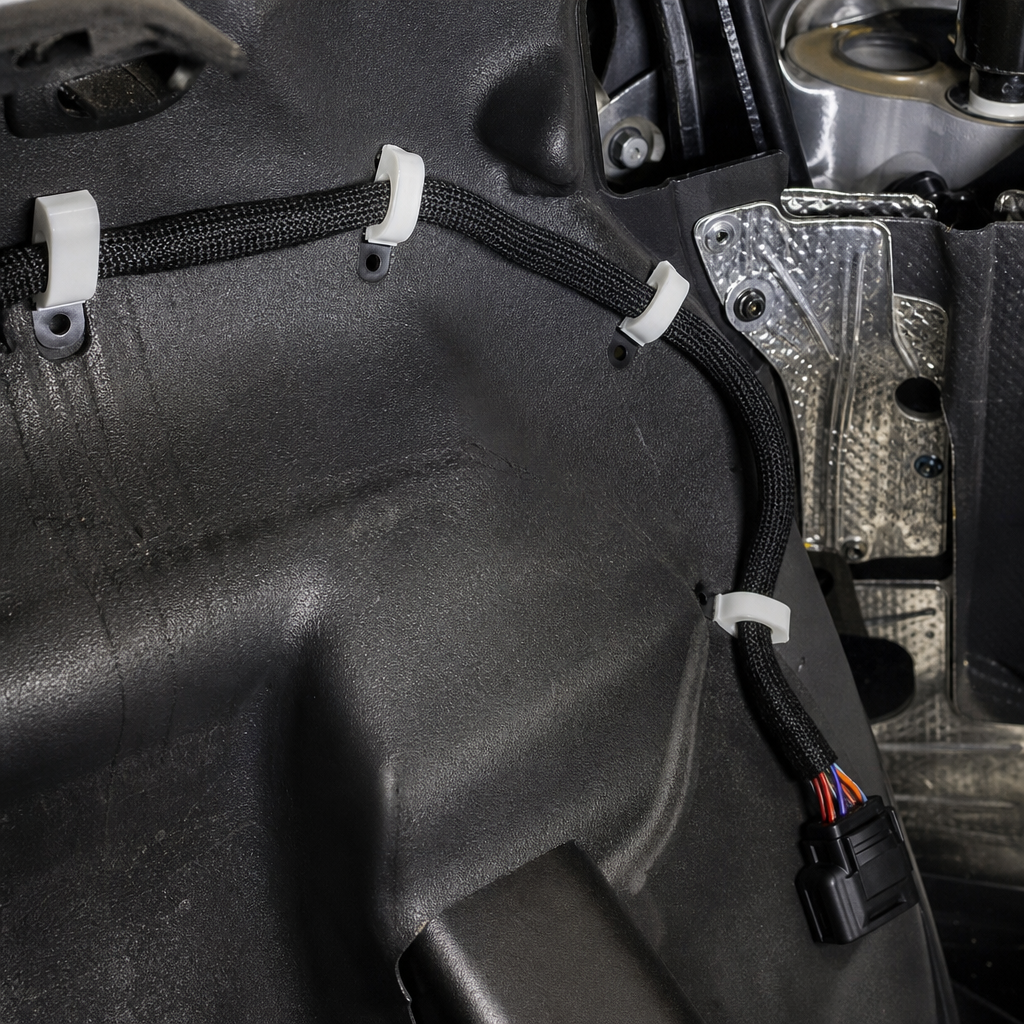
Custom wiring harnesses have become a defining skill in modern vehicle fabrication because they solve three problems at once: electrical reliability, visual cleanliness, and packaging efficiency. In the custom scene, a wiring harness is the organized bundle of conductors, terminals, connectors, shielding, and retention hardware that distributes power and signals through a vehicle. Stealth routing means placing that harness where it is protected and nearly invisible, often behind panels, inside frame channels, under carpet lines, or through fabricated bulkhead passages. Adding 3D-printed clips to that equation changes the process dramatically. Instead of forcing universal retainers into places they were never designed for, builders can print clip geometries that match exact panel thicknesses, tubing diameters, connector bodies, and service-access requirements. That precision is why this topic matters across fabrication tech, especially where 3D printing, carbon fiber parts, and advanced wiring now intersect in the garages and shops shaping the new generation of custom builds.
I have built harnesses for engine-swapped street cars, track builds, and restomods, and the same lesson repeats: the electrical system is only as good as its routing strategy. A harness can use top-tier TXL wire, Raychem DR-25, Deutsch DT connectors, and proper open-barrel crimps, yet still fail early if it chafes on a bracket, bakes near a downpipe, or gets pinched when a carbon interior panel flexes. Conversely, a carefully routed harness with solid strain relief and application-specific clips will outlast flashier components. For builders, this article serves as a hub for fabrication tech in wiring: how to design custom harnesses, where 3D printing fits, how stealth routing is planned, what carbon fiber changes about mounting and protection, and which methods produce serviceable, professional results rather than one-off guesswork.
The key terms are straightforward. Wire gauge defines conductor size, usually in AWG. Loom refers to the protective outer layer, such as braided sleeve, cloth tape, or heat-resistant tubing. Branch points are locations where the harness divides to feed separate circuits. Strain relief prevents force from reaching a crimp, solder joint, or terminal interface. Retention hardware includes P-clamps, fir-tree clips, saddle mounts, and now printed clips tailored for a specific job. Service loops are small intentional slack sections that allow connector removal and component movement without stressing conductors. Fabrication tech, in this context, means using digital design, additive manufacturing, composites knowledge, and disciplined electrical practice together. When those disciplines are coordinated, the result is not just a neat engine bay; it is a vehicle that is easier to troubleshoot, safer to operate, and more credible as a finished custom build.
Good harness work also supports future upgrades. A builder adding digital dashes, solid-state power distribution, drive-by-wire throttles, CAN-based modules, or hidden audio systems needs routing capacity from the beginning. This is why harness design sits at the center of modern custom fabrication rather than at the end of a project. The harness dictates where modules can live, how interior and carbon trim can be mounted, and whether a build feels engineered or improvised.
Why custom wiring harnesses matter in modern fabrication
A custom wiring harness matters because modified vehicles rarely match factory assumptions. Once a car gets an engine swap, shaved bay, relocated battery, standalone ECU, air suspension, motorsport sensors, hidden lighting, or custom rear tubs, original branch lengths and mounting points no longer fit. Adapting the stock loom with splices and extensions often creates bulky joints, inconsistent voltage drop, and messy service paths. Building a harness from scratch or re-engineering a major section lets the builder size each circuit correctly, place splices where they are protected, and remove unnecessary complexity. The practical benefit is measurable: fewer intermittent faults, cleaner voltage supply to sensitive electronics, and much faster diagnosis when something goes wrong.
In my own projects, the biggest gain from a custom harness is predictability. Every wire has a purpose, every branch has a drawing, and every clip location is chosen before final assembly. That approach mirrors accepted motorsport and aerospace habits. Standards such as IPC/WHMA-A-620 for cable and wire harness assemblies provide benchmarks for crimp quality, insulation support, and workmanship. While a street build does not need full aerospace processes, the same principles apply. Controlled routing, proper bend radius, abrasion protection, and secure retention are not cosmetic upgrades; they are what keep a car from developing electrical gremlins after a few thousand miles of vibration and heat cycling.
Designing a harness before a single wire is cut
The best harnesses begin with architecture, not tools. Start by listing every load, sensor, module, and connector in the vehicle. Group circuits by zone: engine bay, cabin, doors, rear body, undercarriage, and roof or trunk if applicable. Next, identify current draw, fuse strategy, relay logic, grounding method, and communication networks such as CAN bus or LIN. This planning stage is where builders decide whether to centralize power distribution with systems like ECU Master PMU, Motec PDM, or Haltech PD16, or use conventional fuse and relay panels from Bussmann, Littelfuse, or Eaton. The choice affects harness bulk, branch count, and serviceability.
After the electrical map, create a physical map. I prefer using masking tape and temporary string lines directly on the chassis to establish branch paths, then transferring those dimensions into CAD or a harness board. This reveals conflict points early: steering columns, pedal boxes, exhaust primaries, seat mounts, and sharp flange edges. It also shows where stealth routing is realistic and where it creates avoidable complexity. Hidden is not automatically better. A harness buried behind bonded carbon structure may look perfect and become terrible to repair. The right solution balances concealment with access by using removable panels, bulkhead connectors, and documented branch locations.
How 3D-printed clips improve retention, fit, and service access
3D-printed clips are valuable because they let retention hardware match the exact geometry of the build. Universal P-clamps and adhesive mounts still have a place, but custom cars regularly present nonstandard surfaces: square tubing, staggered wall thicknesses, hidden channels, carbon seat shells, and one-off inner fender panels. With a printed clip, the builder can set the cable diameter, offset, panel grip depth, snap force, anti-rotation feature, and even integrated labeling. That level of fit reduces movement, minimizes abrasion, and keeps the harness line consistent through the entire vehicle.
Material selection matters. PLA is fine for mockup but poor for permanent underhood use because heat resistance is limited. PETG performs better in moderate cabin environments. ABS and ASA are stronger choices where elevated temperatures and UV exposure exist, with ASA offering better weather stability. Nylon, including PA12, is excellent for toughness and vibration resistance, particularly when printed well and not overly brittle from moisture issues. For harsher zones, builders should still consider machined clips, rubber-lined metal clamps, or molded parts. Printed hardware is a tool, not a blanket replacement. I often print clips for interior channels, trunk areas, dash support bars, and cool engine-bay perimeters, then switch to insulated metal retention near turbo plumbing and headers.
A good printed clip also improves service access. Instead of zip-tying a branch permanently to a bracket, a hinged or snap-release clip can let a technician open the run, inspect a splice, and close it again without destroying consumables. Captive fastener designs can hold an M5 nut or thread-forming screw. Fir-tree geometries can be tuned to a specific hole size in aluminum or composite panels. When doing repeated prototype revisions, that flexibility saves hours.
| Clip Material | Best Use Area | Main Advantage | Main Limitation |
|---|---|---|---|
| PLA | Mockup only | Easy, accurate printing | Low heat resistance |
| PETG | Cabin and trunk | Good toughness and printability | Can creep under load |
| ABS | Interior and mild underhood zones | Better heat tolerance | Warps if printed poorly |
| ASA | Exterior-adjacent and UV-exposed areas | Weather stability | Still limited near high exhaust heat |
| Nylon PA12 | High-vibration retention points | Tough and fatigue resistant | More demanding process control |
Stealth routing principles that keep a harness invisible and reliable
Stealth routing works when it follows disciplined physical rules. First, avoid heat. Even high-quality insulation has limits, and radiant heat is often underestimated. Maintain distance from exhaust components, use reflective sleeves where necessary, and route above splash paths rather than through them. Second, control motion. A harness should be supported often enough that it cannot oscillate into brackets or body seams. Third, preserve service loops at terminals, headlights, seat connectors, and removable body panels. Fourth, separate noisy circuits from sensitive ones. Injector and ignition runs, pump feeds, and high-current charging cables should not be bundled tightly with low-level sensor wiring for long distances.
Common stealth paths include rocker cavities, upper firewall recesses, cowl spaces, behind kick panels, under rear seat pans, inside center consoles, and through inner fender double-wall areas with sealed access points. In shaved engine bays, I often route the front lighting and horn circuits through the inner fenders and bring them out at hidden grommeted exits behind lamp buckets. For hatchbacks and wagons, roof rail paths can hide rear camera, antenna, and hatch-release wiring cleanly, provided flex points at hinges are protected with high-strand-count wire and proper boots. The goal is not merely to hide the loom but to maintain graceful branch geometry so that each exit looks intentional.
Working with carbon fiber panels, composite parts, and mixed-material structures
Carbon fiber changes wiring strategy because composites behave differently from steel or aluminum. A carbon panel may be stiff in one direction, flexible in another, sharp at trimmed edges, and electrically conductive through the fiber network. That means harnesses cannot simply be clipped and forgotten. Edge protection is essential at pass-throughs, and conductive contact should be considered wherever insulation might wear over time. In custom interiors with carbon door cards, center consoles, seat backs, and trunk floors, I prefer stand-off mounting that keeps the loom slightly separated from the panel surface rather than trapped directly against it.
Builders also need to think about bonding and grounding. Carbon is not a reliable substitute for a designed ground path, and galvanic corrosion can become a concern where carbon, aluminum, and moisture interact. The correct practice is to run dedicated grounds, use sealed terminals, and isolate hardware where necessary. Printed clips help here because they can create nonconductive stand-offs between loom and composite. They also adapt to unusual backside access limitations common with bonded panels. If a carbon bulkhead is removable, bulkhead connectors from Deutsch HDP20, Autosport, or Souriau can turn a hidden harness into a modular system, allowing panels to be removed without cutting ties or disturbing branch integrity.
Tools, materials, and methods that separate professional results from hobby shortcuts
Professional harness work depends on repeatable processes. Use the correct stripper for the wire insulation type, a calibrated crimp tool matched to the terminal, and continuity testing before looming. Open-barrel crimps from TE Connectivity, Delphi-Packard, Molex, and Deutsch all require the right die profile. Generic crush crimpers produce inconsistent compression and are a common source of high resistance and pull-out failures. Where sealing is required, use proper cavity plugs, wire seals, and connector wedgelocks. For looming, DR-25 heat shrink tubing, woven PET braid, Nomex sleeve, and Tesa fleece tape each serve distinct roles. There is no single best covering; selection depends on temperature, abrasion, noise, and appearance requirements.
Documentation is equally important. Label both ends of every conductor, maintain a pinout sheet, and record final routing with photos before interior trim goes on. A custom harness without documentation becomes tribal knowledge that disappears the moment the builder moves on. For hub-level fabrication tech, this is the point that ties 3D printing, carbon work, and wiring together: digital files matter. Clip models, panel hole sizes, branch drawings, and connector maps should live in the same project archive as CAD brackets and composite templates. That is how modern builders scale quality across multiple projects instead of reinventing every solution from memory.
Common mistakes, troubleshooting habits, and where this fabrication tech is heading
The most common mistakes are predictable: undersized wire, poor grounds, unsupported branches, cheap heat shrink, mislabeled connectors, and routing that ignores future disassembly. Another frequent error is over-customization. Builders hide everything so aggressively that replacing a tail light or dropping a transmission becomes an electrical disassembly job. Good stealth routing hides the harness from view, not from the mechanic. When diagnosing a problem, start with voltage drop testing under load, connector pin tension inspection, and harness movement checks at clip points and transitions. Intermittent faults often come from retention failures long before a terminal fully breaks.
Looking ahead, fabrication tech is pushing harnesses toward more modular, digitally planned systems. Desktop CAD, accessible FDM and SLS printing, compact power distribution modules, and affordable scanning tools are making professional-grade retention and routing possible in small shops. Builders are already printing clip families for entire platforms, embedding QR code labels that link to schematics, and using distributed modules to shorten branch lengths dramatically. Carbon structures are becoming more common in interiors and aero, which increases the need for smart isolation and service-friendly mounting. For anyone building within custom culture’s new guard, the lesson is clear: wiring is no longer an afterthought hidden behind fabrication. It is fabrication.
Custom wiring harnesses, 3D-printed clips, and stealth routing belong together because each one solves a different part of the same problem. The harness delivers power and data. The routing strategy protects it and preserves the design language of the build. The printed clip gives that strategy a precise, repeatable mounting method that off-the-shelf hardware rarely matches. Add carbon and composite parts to the mix, and precision becomes even more important because panel geometry, conductivity, and service access all change. Builders who plan the system early, choose materials by environment, and document every branch end up with vehicles that look cleaner and behave better.
The main benefit is reliability with intention. A clean engine bay or minimalist cabin is valuable, but the deeper win is electrical stability over time: fewer abrasion points, fewer connector failures, cleaner service procedures, and easier upgrades when the build evolves. If you are developing this part of your fabrication process, start by mapping one zone of the vehicle, modeling one clip family, and routing one branch for both concealment and access. Then apply that discipline across the whole project.
Frequently Asked Questions
What is a custom wiring harness, and why is stealth routing such a big deal in vehicle fabrication?
A custom wiring harness is a purpose-built electrical system that organizes the wires, terminals, connectors, shielding, branch points, and mounting hardware needed to power and control a vehicle’s components. Unlike a universal or loosely assembled wiring setup, a custom harness is designed around the exact layout of the build. That means every circuit length, connector location, fastening point, and protective covering is intentional. In modern fabrication, that matters because electrical performance is only one part of the job. A harness also has to fit cleanly, survive vibration and heat, remain serviceable, and complement the overall finish quality of the vehicle.
Stealth routing takes that idea further by placing the harness in protected, low-visibility paths such as behind interior panels, inside frame rails where appropriate, under trim, along structural channels, or through concealed bulkhead pass-throughs. The goal is not just to hide wires for cosmetic reasons. Good stealth routing protects the harness from abrasion, moisture, UV exposure, road debris, and accidental damage during maintenance. It also helps free up visual space in the engine bay, cabin, or trunk, which is especially important in high-end custom builds where cleanliness and presentation are part of the final result.
From a practical standpoint, stealth routing improves packaging efficiency. Space is limited in custom vehicles, especially when modern electronics, upgraded drivetrains, HVAC systems, audio equipment, and lighting controls all compete for room. A well-routed harness reduces clutter, avoids hot or moving parts, and makes it easier to mount other components. When done correctly, it also improves reliability because wires are properly supported, bend radii are controlled, and strain is reduced at connectors and branch points. In short, stealth routing is a fabrication skill because it combines electrical planning, mechanical packaging, durability engineering, and aesthetics into one system.
How do 3D-printed clips improve a custom wiring harness compared to generic zip ties or off-the-shelf clamps?
3D-printed clips give fabricators a level of control that generic retention methods simply cannot match. A zip tie can hold a bundle in place, and a universal clamp can secure a loom to a panel, but both are compromises. They are not usually designed for the exact bundle diameter, mounting surface, insertion angle, or service access required in a custom build. A 3D-printed clip can be designed around the precise outer diameter of the harness, the number of branches in that area, the available clearance, and the exact hole spacing or fastener style on the vehicle. That custom fit reduces movement, prevents pinching, and helps maintain a consistent, professional routing path.
Another major advantage is repeatability. If a vehicle has multiple identical clip locations, or if the builder plans to produce more than one harness, printed clips make it possible to standardize the installation. Every mount can place the harness at the same height, offset, and angle. That is useful not only for appearance, but also for ensuring the loom stays away from heat sources, sharp edges, pedals, hinges, steering components, and suspension travel. With printed clips, it is much easier to account for branch exits, connector orientation, and service loops in a way that looks engineered rather than improvised.
3D-printed clips can also integrate multiple functions into one part. A single clip might retain the harness, snap into a factory hole, isolate it from panel vibration, and provide a separation channel between power and signal wires. Some designs can include labels, directional markers, connector indexing, or pass-through geometry tailored to grommets and bulkheads. That level of integration is difficult to achieve with universal hardware. The result is a cleaner installation, better long-term support, and often faster assembly because each clip is designed to solve a specific mounting problem efficiently.
That said, material choice and design quality matter. A poorly chosen plastic or weak clip geometry can fail under heat, vibration, or chemical exposure. When 3D-printed retention is done correctly, however, it becomes a genuine fabrication tool rather than a novelty. It allows the harness mounting system to be treated with the same attention as brackets, ducting, or trim panels, which is exactly what separates a refined custom build from an average one.
What should you consider when designing 3D-printed clips for wiring harnesses in automotive environments?
The first consideration is material performance. Automotive environments are harsh, and clip material must be chosen for the actual location where it will live. A clip inside a climate-controlled cabin sees very different conditions than one mounted near the firewall, under the dash, in the engine bay, or underneath the vehicle. Heat resistance, creep resistance, chemical exposure, UV stability, and layer adhesion all matter. Some materials are fine for interior mounting but will soften or become brittle in hotter or more exposed areas. As a rule, the clip material should be selected based on real service conditions, not just ease of printing.
Geometry is equally important. The clip should support the harness without crushing it, and it should control movement without making removal impossible. A proper design includes adequate wall thickness, rounded internal contact surfaces, and enough engagement to resist vibration. Sharp internal edges should be avoided because they can wear through loom coverings over time. If the clip is a snap-fit design, the retention arm needs enough flexibility to install without cracking and enough strength to remain secure over repeated cycles. If a fastener is used, the part should distribute clamping load so the harness is supported rather than squeezed unevenly.
Mounting strategy matters as much as the clip itself. Builders should think about whether the clip will snap into an existing factory hole, use a threaded insert, attach with a rivet nut, mount to a bracket, or bond to a panel. Serviceability should be built into the design from the beginning. A harness may need to be inspected, repaired, or removed later, so clips should not trap connectors or make routine disassembly unnecessarily difficult. In high-end fabrication, a good clip is one that disappears visually but still makes future maintenance straightforward.
There is also the issue of load and vibration. Wiring harnesses are rarely static. They are influenced by engine movement, chassis flex, thermal expansion, and repeated road input. This means clip spacing and branch support are part of the design. One excellent clip cannot compensate for poor harness retention over a long span. Designers should place clips often enough to prevent sagging, oscillation, and connector strain while still allowing natural movement where required. In areas near the engine or body transitions, some compliance may be beneficial so the harness is not forced into a rigid path that creates stress concentrations.
Finally, the best printed clips are designed as part of the entire harness system. They should work with the loom type, branch layout, connector dimensions, and route planning. If the harness uses braided sleeve, DR-25, cloth tape, convoluted tubing, or molded boots, the retention method should suit that outer surface. In other words, clips are not an afterthought. They are part of the harness architecture, and treating them that way leads to a more durable, cleaner, and more professional result.
How do you plan a stealth-routed harness so it stays hidden but still remains reliable and serviceable?
The best stealth-routed harnesses begin with planning before any wire is cut. Start by mapping every electrical load, signal path, grounding point, connector location, and control module position. Once the electrical architecture is clear, identify the physical routes that protect the harness and minimize visibility. This usually means tracing possible paths through inner body structures, behind interior trim, under carpet, along transmission tunnels, inside console cavities, beneath package trays, or behind engine bay panels. The ideal route is one that shields the harness from damage while allowing logical branch exits close to the devices they serve.
Reliability comes from respecting the fundamentals of harness design even when the goal is concealment. Hidden does not mean buried carelessly. The route must avoid exhaust heat, turbo components, steering shafts, pedal assemblies, sharp stamped edges, suspension travel, fuel system hazards, and water-prone areas unless the harness is specifically protected for those conditions. Every penetration through sheet metal or panels should use the correct grommet, bulkhead fitting, or sealed pass-through. Every branch should be supported so that connector weight and vibration are not carried by the terminals themselves. If the harness has to cross from body to door, trunk lid, hatch, or moving engine-mounted components, that transition needs a proper flex strategy.
Serviceability is where many stealth builds succeed or fail. A hidden harness should still be accessible in a rational way. That means planning removable panels, accessible fuse and relay locations, reachable connectors, and enough slack or service loop where disconnection may be needed. It also means labeling circuits and documenting branch paths, especially when sections disappear behind finished trim. A beautiful hidden harness can become a nightmare if no one knows where a branch goes or how to reach a diagnostic connector without disassembling half the interior.
A smart approach is to divide the system into logical sub-harnesses with strategic disconnect points. Instead of one giant bundle running everywhere, separate sections can serve the front lighting, engine management, cabin electronics, rear body functions, or auxiliary systems. With proper connector placement, individual sections can be removed or tested without disturbing the entire build. That makes troubleshooting faster and reduces the risk of damage during maintenance. In professional