3D-printed engine covers are changing how CVO owners approach customization, because they combine the visual impact of hand-built parts with the precision, repeatability, and material performance of modern additive manufacturing. In this context, a CVO is Harley-Davidson’s Custom Vehicle Operations line, a premium family of touring and cruiser motorcycles built with upgraded finishes, larger-displacement Milwaukee-Eight engines, and factory-installed components that already sit above standard trim. That matters because modifying a CVO is different from modifying an entry-level bike: owners expect parts that match premium fit, survive heat and vibration, and look intentional rather than improvised. A titanium engine cover produced through metal 3D printing answers those expectations when it is designed correctly, post-processed carefully, and integrated with attention to sealing, tolerances, and serviceability.
I have worked with custom builders, CAD designers, and finish shops on one-off motorcycle parts, and engine covers are where fabrication technology becomes immediately visible. Riders notice the part every time they park, but the real challenge lives below the surface. A decorative cover still has to clear rotating components, manage gasket compression, resist corrosion, and avoid creating maintenance headaches. Once titanium enters the conversation, people often assume the result is automatically stronger and lighter. Sometimes it is. Sometimes it is simply more complex and more expensive. The useful question is not whether titanium sounds exotic, but whether a 3D-printed titanium cover is the right solution for the design goal, the bike’s operating conditions, and the owner’s budget.
This hub article explains that broader fabrication landscape. It uses 3D-printed engine covers as the focal example, then connects the topic to carbon fiber trim, wiring strategy, scanning, CAD workflow, finishing, inspection, and practical installation on CVO platforms. If you are asking what metal 3D printing actually enables, how carbon differs from titanium in custom motorcycle work, or why wiring discipline often determines whether a custom build feels professional, this guide answers those questions directly. The benefit is simple: you can personalize a premium motorcycle without sacrificing reliability, fit, or long-term service access.
Why 3D-Printed Titanium Makes Sense for CVO Engine Covers
For a CVO owner, engine covers are ideal candidates for additive manufacturing because they sit in a harsh environment while also acting as visual centerpieces. Most covers on Milwaukee-Eight-based bikes are either cast, forged, or machined from billet aluminum, then coated or polished. Those methods work well, but they also constrain geometry. Metal 3D printing, usually laser powder bed fusion for titanium motorcycle parts, allows internal ribbing, variable wall thickness, embossed branding, lattice-backed structures, and sculpted venting features that are difficult or uneconomical to machine conventionally.
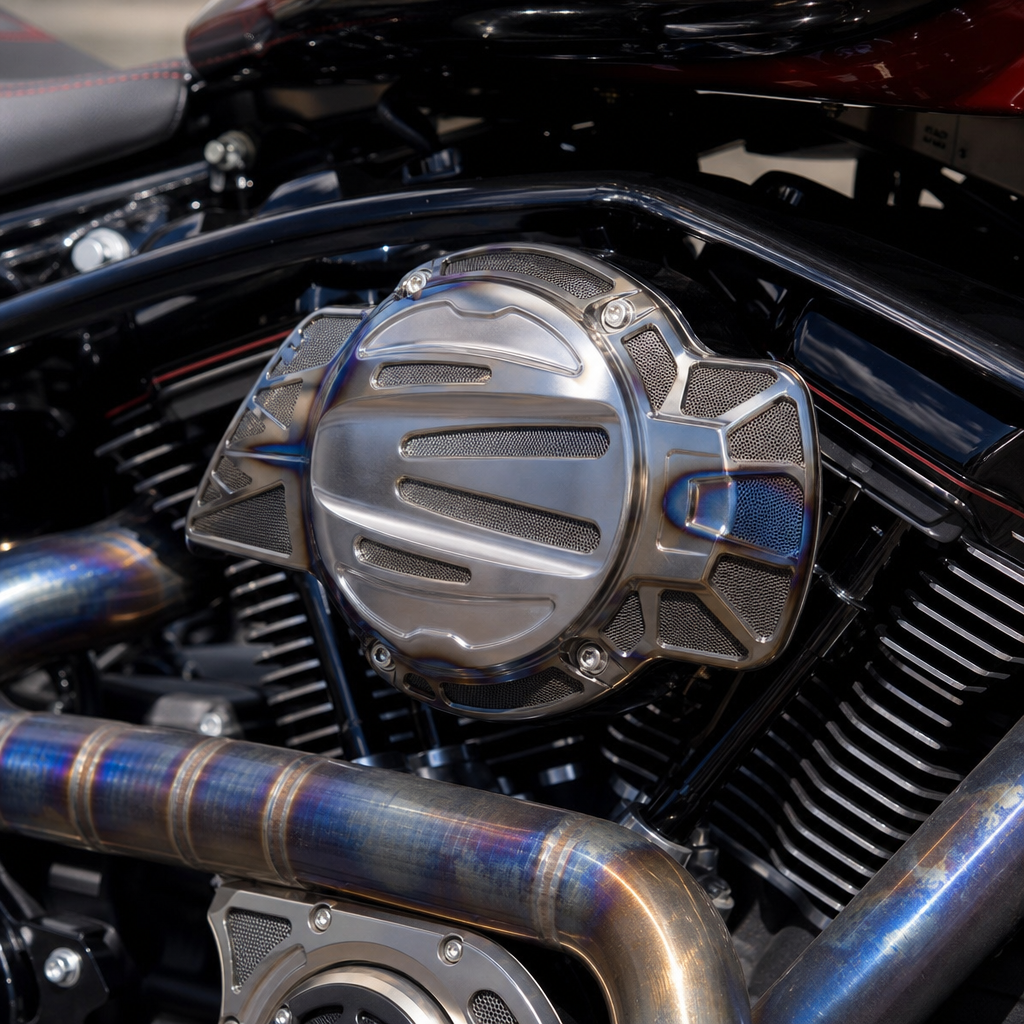
Titanium is attractive for three specific reasons. First, it offers excellent corrosion resistance, which matters on touring motorcycles exposed to road salts, humidity, and frequent washing. Second, it provides high strength-to-weight performance, especially in alloys such as Ti-6Al-4V, the most common aerospace and motorsports grade for additive manufacturing. Third, it carries a distinctive finish potential. A blasted, brushed, or heat-tinted titanium cover looks fundamentally different from chrome or powder-coated aluminum. On a CVO, where factory paint and trim are already premium, that difference can feel deliberate instead of flashy.
There are tradeoffs. Titanium is not cheap, support removal is labor intensive, and printed surfaces usually need machining on gasket faces, fastener seats, and bearing or dowel interfaces. Thermal conductivity is lower than aluminum, so a cover that contributes to heat shedding may perform differently if geometry is copied without engineering review. That is why successful builders start with function, then design the styling around it. In practice, the best titanium engine covers are not replicas of stock parts. They are purpose-built replacements developed from scans, CAD assemblies, and measured mounting data.
The Real Workflow: Scan, Model, Print, Machine, Finish, Validate
Custom fabrication becomes reliable when the workflow is disciplined. The first step is capture. Builders typically use structured-light scanning, probe measurement, or a combination of both to map the stock engine cover, mounting bosses, neighboring cases, floorboard brackets, and exhaust clearances. Popular tools include Creaform scanners, FARO arms, and high-resolution handheld metrology systems. On a CVO touring bike, even a small mismatch near a frame tube or crash bar can ruin an otherwise expensive part, so scan quality matters more than dramatic styling renders.
Next comes CAD. Most shops use SolidWorks, Fusion, Rhino, or Siemens NX to build a parametric model with known gasket surfaces, fastener locations, and critical offsets locked down first. The visual language comes after those constraints are stable. I have seen projects go sideways when a customer approves a beautiful rendering before anyone checks wrench access to the lower fastener or verifies that the clutch cable path stays clear at full steering lock. Proper CAD review prevents those avoidable failures.
Then the part is prepared for print. Orientation determines support strategy, surface quality, and distortion risk. A large side cover angled to reduce unsupported overhangs may print cleaner, but it might also require more finish work on visible faces. After printing, the part is stress relieved, removed from the build plate, support structures are cut away, and critical surfaces are machined. Most credible metal additive vendors also perform inspection with CMM verification, dye penetrant testing where appropriate, and process traceability tied to powder batch and machine parameters. Those details separate a serious custom component from a decorative experiment.
| Stage | What happens | Why it matters on a CVO |
|---|---|---|
| 3D scanning | Capture stock geometry, clearances, and mounting points | Prevents fit issues around premium factory components and accessories |
| CAD modeling | Build parametric part with sealing faces and styling features | Ensures serviceability, fastener access, and intentional design language |
| Metal printing | Produce titanium part, usually in Ti-6Al-4V | Enables shapes not practical in billet or casting |
| Post-machining | Finish gasket lands, threads, bores, and bolt seats | Protects against leaks, distortion, and installation problems |
| Finishing | Bead blast, brush, polish, coat, or tint | Aligns custom part with CVO paint, trim, and hardware |
| Validation | Test fit, heat-cycle, inspect, and road-evaluate | Confirms durability under vibration, heat, and real riding conditions |
How Titanium Compares With Carbon Fiber and Billet Aluminum
Titanium gets attention, but it is only one branch of fabrication tech. Carbon fiber and billet aluminum remain highly relevant, and each material suits different motorcycle parts. For engine covers specifically, titanium and aluminum are usually better structural choices than carbon. A carbon outer beauty panel can work if it is isolated from heat and impact, but a true primary or timing cover replacement needs robust threaded interfaces, consistent sealing, and predictable behavior near hot engine surfaces. Carbon excels more often in side panels, chin spoilers, dash inserts, bag lids, and trim pieces where weight savings and weave aesthetics matter most.
Billet aluminum is still the benchmark for many custom covers because it machines cleanly, dissipates heat well, accepts multiple finishes, and is easier to repair or refinish after road damage. If the design is relatively simple and the shop expects to make several units, billet often wins on cost and turnaround. Titanium earns its place when the geometry is complex, the aesthetic goal is unique, or the customer values exclusivity enough to justify post-processing expense. On one project, a builder chose billet for the cam cover and titanium for a matching accent piece because the cam cover needed excellent thermal behavior and frequent service access, while the visible accent could showcase a printed lattice-backed motif. That mixed-material approach was smarter than forcing one material everywhere.
The lesson for anyone exploring fabrication tech is that material choice should follow use case. Carbon is not a shortcut to a race-bike look if heat shielding, mounting compliance, and UV-stable resin systems are ignored. Titanium is not superior just because it sounds premium. Billet is not outdated simply because it uses subtractive machining. The best CVO builds use all three strategically.
Design Rules That Separate a Premium Part From a Problem Part
Engine covers fail for predictable reasons, and most of them begin in design. Sealing faces must be flat and machined to the gasket specification. Bolt-hole alignment must account for print shrink behavior and machining stock. Wall sections need enough thickness to control resonance without becoming unnecessarily heavy. Sharp internal corners should be minimized because they concentrate stress, especially near fasteners and flange transitions. If the cover includes integrated logos or relief patterns, those features cannot interfere with socket access or create pockets that trap heat and grime.
Ventilation is another common misunderstanding. Some owners want aggressive vent slots because they look mechanical and modern. On a dry decorative outer cover, that can work. On a functional cover protecting lubricated components, open venting may invite contamination or oil misting if the internal environment is not considered. In my experience, the best custom covers use controlled detailing rather than arbitrary openings. That means hidden relief channels, subtle scalloping, or back-faced textures that reveal depth without exposing the internals to dirt and wash water.
Hardware selection matters as much as the cover itself. Titanium parts paired with low-grade fasteners, inconsistent torque, or reused gaskets undermine the whole project. Builders should match thread engagement to the base material, use proper anti-seize where required, and follow Harley-Davidson service manual torque values unless the engineered part specifically calls for a different procedure. A custom part should install like a factory part, not like a prototype that needs persuasion.
Finishing, Fitment, and the Role of Wiring in a Clean Custom Build
Most people focus on the printed metal, but finishing determines whether the part looks integrated with the motorcycle. Bead-blasted titanium gives a technical satin effect that works well with blacked-out CVO powertrains. Brushed titanium highlights surface direction and complements machined wheel accents. Polished titanium is possible, but it takes time and can drift toward a show-bike look that clashes with modern performance styling. Some builders use Cerakote on printed titanium for color consistency across nearby parts, especially when blending a custom cover into black engine cases while leaving selected edges exposed.
Fitment should be verified with the whole motorcycle assembled, not just with the engine on a bench. Floorboards, crash bars, heat shields, lowered suspension settings, and aftermarket exhausts can all change visual spacing. A cover that technically fits may still look wrong if it crowds the collector or breaks the flow line from the derby cover to the air cleaner. Good builders stand back and evaluate proportion, not only clearance.
This is also where wiring enters the conversation. Fabrication tech on modern customs is not just about hard parts. If you add illuminated badges, integrated sensors, or active vent control, the wiring strategy must be planned from the start. Use motorsport-grade sheathing where heat is present, seal connectors properly, and route harnesses so service removal is still straightforward. I have seen beautifully fabricated side covers ruined by visible zip ties, oversized relay blocks, or wires draped across frame sections. On premium bikes, hidden wiring is not a luxury detail. It is a baseline expectation. Clean routing, proper strain relief, and labeled circuits are what make advanced fabrication feel complete rather than decorative.
Practical Buying Advice for Riders and Builders
If you are commissioning a 3D-printed titanium engine cover for a CVO, ask five direct questions before paying a deposit. What alloy is being used? Ti-6Al-4V should be stated clearly. What post-machining will be done on sealing and fastener surfaces? A fully printed gasket land is not acceptable. What inspection method confirms dimensional accuracy? A serious shop will mention metrology, fixture checks, or CMM verification. What finish is included, and how will it age under heat, washing, and road use? Finally, has the design been test-fitted on the exact platform, not just on a similar Milwaukee-Eight engine?
Also ask about service access. Can the oil be changed, primary serviced, or spark plugs reached without removing the custom part? Are replacement gaskets standard Harley-Davidson items or proprietary cut pieces? Does the supplier provide torque guidance and installation notes? The answers tell you whether the builder understands real motorcycle ownership or is simply selling an attractive object.
As the hub for fabrication tech within custom culture, this topic connects directly to deeper articles on metal additive manufacturing, carbon layup methods, surface finishing, harness design, and digital prototyping. Start with the part that excites you visually, but evaluate the full system behind it. That is how the best New Guard builds are being produced now: scan accurately, choose materials rationally, control the workflow, hide the wiring, and validate every custom part like it belongs on the motorcycle from day one. If you are planning your own CVO personalization, use these standards as your checklist before the first design file is ever approved.
Frequently Asked Questions
What makes 3D-printed titanium engine covers a good fit for a Harley-Davidson CVO?
3D-printed titanium engine covers make sense for a Harley-Davidson CVO because they match the premium character of the bike itself. CVO models already sit at the top of Harley-Davidson’s lineup, with upgraded finishes, larger Milwaukee-Eight engines, and a level of factory detail that owners typically want to preserve or elevate rather than replace with generic aftermarket parts. Titanium fits that mindset extremely well. It offers a high-end appearance, excellent strength-to-weight performance, and strong resistance to corrosion and heat, all of which are valuable around the engine area.
What really separates 3D printing from conventional manufacturing is design freedom. Traditional casting or machining often limits the shape, surface detail, and internal structure of a part because tools, molds, and production costs dictate what is practical. Additive manufacturing allows far more flexibility. That means a custom engine cover can be designed with intricate textures, layered geometry, recessed logos, personalized motifs, and highly refined contours that complement the lines of a CVO without looking mass-produced. For owners who want their bike to stand out at shows, events, or even in everyday riding, that level of customization is a major advantage.
There is also a precision benefit. Modern metal additive manufacturing can produce repeatable parts with tight tolerances when the design, printing, and finishing processes are handled correctly. For a component like an engine cover, that matters because fit, mounting alignment, sealing surfaces, and overall consistency are critical. In short, 3D-printed titanium engine covers bring together exclusivity, engineering performance, and visual impact in a way that aligns naturally with what CVO ownership is all about.
Are 3D-printed titanium engine covers durable enough for real-world riding and engine heat?
Yes, when they are properly engineered and manufactured, 3D-printed titanium engine covers are absolutely capable of handling real-world riding conditions. Titanium is well known for its corrosion resistance, fatigue performance, and ability to tolerate demanding environments, which is one reason it is used in aerospace, motorsports, and premium performance applications. On a CVO, where engine heat, vibration, road grime, moisture, and long-distance riding are part of normal use, those properties are highly relevant.
That said, durability is about more than just the raw material. The quality of the final part depends on the entire production chain: alloy selection, print orientation, wall thickness, support strategy, heat treatment, machining, surface finishing, and inspection. A well-designed engine cover should account for thermal cycling, mounting stresses, gasket or sealing requirements, and the vibration characteristics of the Milwaukee-Eight platform. Reputable manufacturers typically validate these factors during design and prototyping so the part is not just visually impressive, but mechanically sound as well.
Surface finishing also plays an important role. A printed titanium cover may be bead blasted, machined, polished, brushed, or coated depending on the desired appearance and service environment. These finishing steps can improve both aesthetics and functional performance by refining sealing surfaces, smoothing contact areas, and helping the part integrate cleanly with adjacent factory components. So while “3D-printed” sometimes leads people to assume experimental or fragile, the reality is that high-quality printed titanium parts can be very robust. The key is to choose a supplier that understands motorcycle applications rather than treating the cover as a decorative art piece alone.
How customizable are 3D-printed engine covers compared with traditionally made custom parts?
3D-printed engine covers are usually far more customizable than traditionally made parts, especially when the goal is true personalization rather than minor cosmetic variation. With conventional manufacturing, creating a one-off or limited-run part can be expensive because each design change may require new tooling, additional setup time, and more complex machining operations. That tends to push manufacturers toward standard shapes and only a few finish options. Additive manufacturing changes that equation by building the part layer by layer directly from a digital model, making it much easier to alter the design without starting from scratch in the traditional sense.
For a CVO owner, that opens up a wide range of possibilities. You can incorporate custom badging, initials, model references, geometric patterns, layered textures, machined contrast surfaces, or styling cues that tie into the bike’s paint, wheels, exhaust, or trim package. Designers can also fine-tune the shape so the cover looks integrated with the premium factory lines of the bike instead of appearing like an aftermarket add-on. This is especially important on CVO models, where the baseline styling is already refined and owners often want modifications that feel bespoke rather than flashy for the sake of being flashy.
Another advantage is repeatability. If you develop a custom design you love, additive manufacturing makes it easier to reproduce that exact part in the future, whether for replacement, matching side components, or limited production. That blend of freedom and consistency is difficult to achieve with fully hand-built metalwork alone. In practical terms, 3D printing gives you the best of both worlds: the artistic individuality associated with custom fabrication and the precision associated with advanced digital manufacturing.
Will a custom titanium engine cover affect fitment, maintenance, or resale value on a CVO?
A properly designed custom titanium engine cover should not negatively affect fitment or routine maintenance, provided it is made specifically for the exact CVO model and engine configuration. This point is important because CVO motorcycles are not generic platforms. Differences in engine components, surrounding hardware, mounting points, and model-year updates can all matter. A quality engine cover should be engineered around those specifics, with attention paid to fastener locations, clearances, access needs, and any sealing requirements. If those details are handled correctly, installation should be straightforward and maintenance access should remain practical.
In fact, some custom covers can improve ownership experience by delivering better material quality, cleaner finishes, or a more intentional design than basic aftermarket alternatives. However, owners should still verify whether the cover is purely decorative, replaces a functional OEM cover, or interfaces with gaskets, breathers, or other critical systems. That distinction affects not only installation but also long-term servicing. It is always wise to use parts from a builder that provides model-specific fitment guidance and installation recommendations.
As for resale value, the answer depends on the buyer and on how tastefully the part is executed. CVO buyers generally appreciate premium upgrades, especially when they align with the bike’s upscale identity. A well-made titanium engine cover that looks integrated, uses top-tier materials, and comes from a respected manufacturer can enhance the bike’s appeal. On the other hand, highly niche styling or poor-quality execution can narrow the buyer pool. The safest approach is to choose a design that feels exclusive but still complements Harley-Davidson’s design language. Keeping the original parts is also smart, since it gives future buyers flexibility and protects the bike’s collectibility.
What should CVO owners look for when buying a 3D-printed titanium engine cover?
CVO owners should evaluate a 3D-printed titanium engine cover the same way they would evaluate any premium performance or cosmetic component: by looking at engineering quality, material authenticity, finishing standards, and fitment support. Start with the basics. Confirm the cover is designed for the exact Harley-Davidson CVO model, year range, and engine setup you own. “Universal” claims are rarely reassuring on a high-end motorcycle where visual integration and precise fit are both essential. Ask what titanium alloy is being used, how the part is post-processed, and whether critical surfaces are machined after printing.
Next, pay close attention to finish quality. One of the biggest advantages of titanium is its visual presence, but that premium look only comes through when the finishing is done correctly. A good manufacturer should be able to explain whether the cover is bead blasted, satin finished, polished, brushed, or coated, and how that finish will hold up near engine heat and regular cleaning products. Detailed product photos, installation images, and close-up shots of edges, fastener areas, and surface texture can tell you a lot about the overall standard of workmanship.
It is also worth asking about testing and support. Reputable builders should understand vibration, thermal exposure, and real motorcycle use, not just CAD rendering and print technology. Look for clear installation instructions, responsive customer service, and a willingness to discuss design intent. Finally, consider the design itself. The best custom engine covers do not just scream for attention; they enhance the personality of the CVO while respecting the bike’s premium factory styling. If the part combines precise fit, strong material quality, thoughtful design, and a finish worthy of a top-tier Harley, you are looking at the right kind of upgrade.