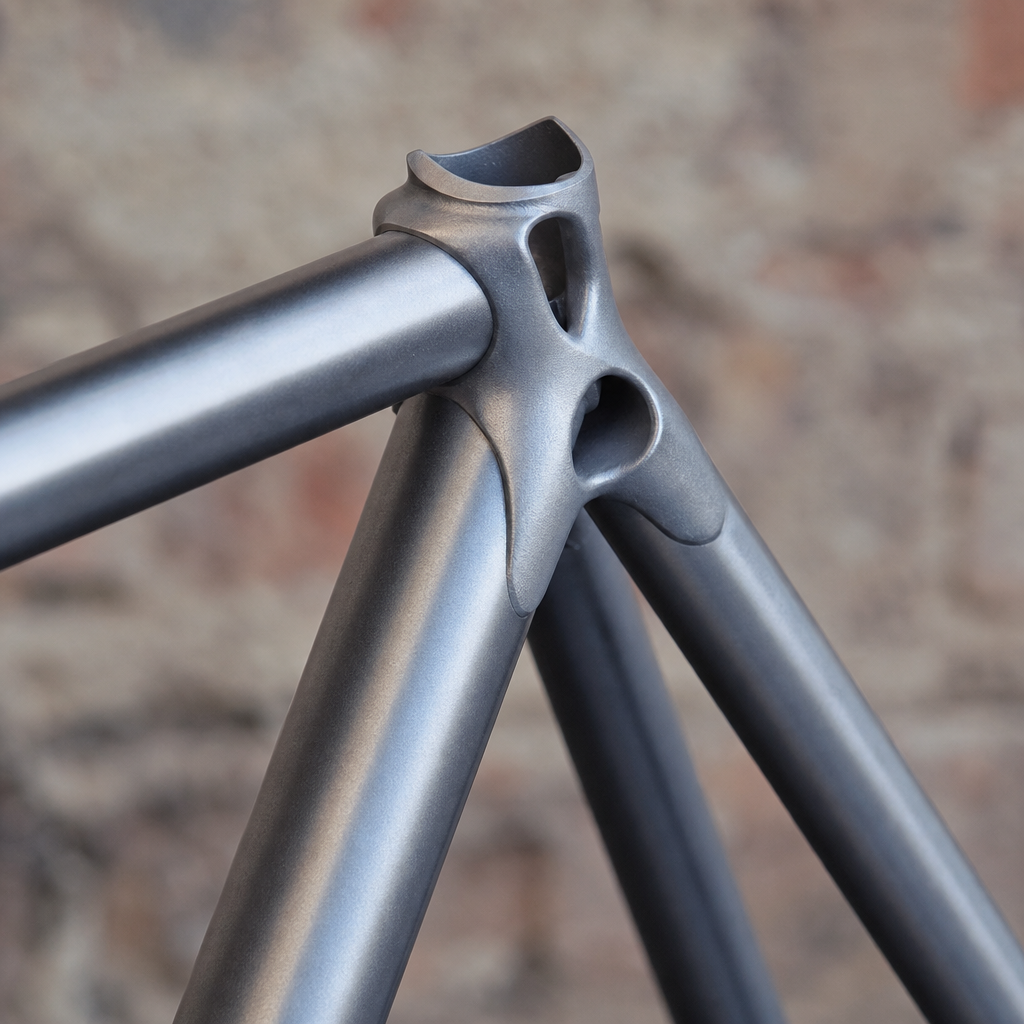
3D-printed titanium lugs are changing how custom bicycle frames are conceived, specified, and built, and the Baumier B01 is one of the clearest examples of why this fabrication shift matters. In framebuilding, a lug is the joint that connects tubes at the head tube, bottom bracket, seat cluster, or dropouts; traditionally, lugs were cast, stamped, or machined to fixed angles and dimensions. Additive manufacturing replaces that constraint with digitally generated titanium junctions built layer by layer, allowing each frame to be tuned around rider fit, tire clearance, routing, stiffness targets, and aesthetic intent. That sounds abstract until you see what it solves in practice: cleaner cable paths, tighter tolerances, lower tooling burden, and frame geometries that no catalog mold or stock lug set could support. The Baumier B01 sits at the center of this conversation because it demonstrates how modern builders are combining printed titanium nodes with carbon tubes, digital design, and integrated wiring to deliver genuinely custom bikes rather than merely personalized paint. For riders, builders, and industry observers, this matters because fabrication technology is no longer a side story. It is reshaping lead times, economics, repair logic, and what “handmade” means in the era of computational design.
When people discuss fabrication tech in custom cycling today, three themes dominate: 3D printing, advanced carbon construction, and internal wiring integration. They are often treated as separate topics, but in workshops I have visited and projects I have specified, they are inseparable. Printed parts determine routing opportunities. Carbon tube selection determines ride character and bond strategy. Wiring choices dictate serviceability, battery placement, bar and headset compatibility, and whether a frame remains practical after the first owner. A useful way to understand the Baumier B01, and the wider future of custom frames, is to see it as a system where these technologies support one another. The printed titanium lugs provide geometry freedom and localized strength. Carbon tubes keep weight competitive and allow directional stiffness. Thoughtful wiring architecture turns a technically ambitious frame into a bike that mechanics can still maintain. This article is the hub for that whole subtopic: how additive manufacturing works in framebuilding, why titanium-carbon hybrids are gaining traction, where internal routing succeeds or fails, and what tradeoffs serious buyers should understand before ordering a made-to-measure machine.
The Baumier B01: why this bike matters
The Baumier B01 matters because it represents a mature application of additive manufacturing rather than a novelty exercise. In practical terms, the concept pairs 3D-printed titanium lugs with carbon tubes to create a modular but deeply custom chassis. That approach gives a builder control over the exact tube-to-tube relationships while avoiding the cost and rigidity of full monocoque molds. With monocoque carbon, customization usually means limited size adjustments around an existing platform unless a builder can justify expensive dedicated tooling. With printed lugs, the digital model is altered at the node level for each rider, and the carbon tubes are cut and bonded to match. The result is not simply a custom geometry chart; it is a frame whose junction shapes, reinforcement, hose ports, and fit clearances can all be tuned at the design stage.
There is also a broader market reason the B01 is significant. Riders now expect race-bike integration, wide tire clearance, electronic shifting compatibility, clean cockpits, and distinctive aesthetics in the same package. Traditional steel and titanium builders can deliver fit and craftsmanship, but fully integrated cable systems and aerodynamic shaping often push those methods into expensive, time-consuming territory. The titanium-lug-and-carbon-tube formula gives small builders a route into contemporary performance design without owning an autoclave program or massive CNC inventory. It creates a plausible business model for the new generation of independent builders: digital first, low tooling, high customization, premium finish, and enough technical sophistication to compete for customers who might otherwise buy a flagship production superbike.
How 3D-printed titanium lugs work in a custom frame
Most bicycle lugs discussed in this context are produced through powder bed fusion, usually selective laser melting or direct metal laser sintering, though naming varies by machine maker and bureau. A digital CAD model is sliced into layers, and a laser fuses titanium powder, commonly Ti-6Al-4V, into the required form. After printing, the part is depowdered, heat treated, supports are removed, and critical bores or faces may be machined. In a bicycle lug, this process allows wall thickness to vary locally, internal channels to be formed, and external shapes to be optimized for load paths and assembly requirements. Builders can add ribs, windows, cable entries, or bonding features that would be difficult or uneconomical with subtractive machining.
That flexibility is especially valuable at the head tube, bottom bracket, and seat cluster, where multiple loads converge. A conventional machined lug may be strong but material-hungry because it starts as a billet and is carved down. A printed lug can place material where stress is highest and remove it where it does little work. This does not make every printed part lighter by default; poor design can easily create overweight structures. But when a builder understands load cases and prints with realistic safety factors, additive manufacturing enables a better strength-to-shape relationship than many legacy methods. The true advantage is geometric freedom with controlled repeatability.
| Fabrication method | Main advantage | Main limitation | Best use in custom frames |
|---|---|---|---|
| 3D-printed titanium lugs | Maximum geometry freedom and integrated features | High part cost and strict process control | Custom junctions, routing ports, fit-specific platforms |
| Machined titanium lugs | Excellent precision and proven metallurgy | Less design freedom, more waste | Small-batch premium frames with simpler shapes |
| Bonded carbon monocoque | Very low weight and aerodynamic shaping | Tooling costs limit true one-off customization | High-volume race platforms |
| Fillet-brazed steel | Repairable, refined ride feel, artisan finish | Harder to integrate modern routing cleanly | Classic road, gravel, and all-road customs |
One point buyers should understand is that the print itself is only part of the job. The design workflow matters just as much. Serious builders use finite element analysis to compare wall thickness, cutout placement, and expected stress concentrations before committing to production. They also account for adhesive bond overlap, galvanic isolation between carbon and titanium, and machining allowances for interfaces like bottom bracket shells or headset seats. The difference between a beautiful concept and a durable frame is not the printer brand. It is the engineering discipline behind the part.
Carbon tubes in hybrid construction: why they pair so well with printed lugs
Carbon tubes are the natural partner for printed titanium lugs because they separate the frame into two problems: create strong, highly customized joints, then connect them with light, efficient structural members. In practice, this means a builder can select round, ovalized, or tapered tubes with specific layups and diameters, then join them to rider-specific titanium nodes. That modularity is useful for tuning ride quality. Want a stiffer bottom bracket area for a powerful rider but more compliance at the seat cluster for rough roads? The builder can alter lug geometry, tube dimensions, and bond lengths rather than redesigning an entire mold set.
This approach also helps explain why hybrid custom frames can feel distinct from both all-metal customs and mass-produced carbon bikes. Carbon’s directional properties allow targeted stiffness in bending or torsion, while titanium contributes toughness, impact resilience, and precise interfaces at loaded junctions. The hybrid system does require careful adhesive selection and surface preparation. In high-quality shops, titanium bonding surfaces are blasted or chemically prepared, carbon tubes are sanded to a controlled profile, and the adhesive cure process is tightly managed. These are not glamorous steps, but they determine long-term reliability far more than marketing language about aerospace inspiration.
There are tradeoffs. Bonded construction can complicate major crash repair depending on where the damage occurs. Replacing a tube is possible in some cases, but not every builder offers that service, and not every failure is economically repairable. Tolerances also stack across the print, tube prep, adhesive, and final alignment process. Good builders address this with fixtures and metrology, not by hoping epoxy will fill mistakes. For buyers, the lesson is simple: ask how the frame is bonded, how alignment is checked, and what repair support exists after delivery.
Internal wiring and routing: clean design versus real-world service
Integrated wiring is now one of the defining tests of fabrication competence in custom frames. Riders want hidden brake hoses, electronic shift wires, dynamo leads, and dropper or light wiring managed without visual clutter. Done well, internal routing protects components, supports aerodynamic goals, and gives a custom bike the visual coherence buyers expect at premium prices. Done poorly, it creates rattles, sharp bend radii, headset friction, and hours of workshop frustration. The reason printed titanium lugs are so promising here is that they let routing paths be designed into the structure from the start instead of added as afterthought holes.
On a frame like the Baumier B01, the designer can shape entry and exit ports around the headset standard, bar system, brake hose diameter, and electronic group requirements. If the build is based on SRAM AXS, routing needs differ from Shimano Di2 or Campagnolo EPS, and they differ again if the bike uses a dynamo light circuit or bar-end junction boxes. Internal channels can be sized to reduce snagging during assembly. Ports can be angled to preserve hose bend radius. Service hatches are not always necessary, but service logic always is. In my experience, the best custom builders think like mechanics at the CAD stage.
The current industry challenge is that integration standards remain fragmented. Headset dimensions, cable-bearing interfaces, bar-stem systems, and battery locations vary by brand. This means a frame optimized for one cockpit may limit future component swaps. A buyer should ask a direct question: if I change bars, stems, or drivetrains in three years, what becomes difficult? A strong builder will answer plainly. Full integration looks exceptional, but partial integration is sometimes the smarter choice for travel, maintenance, and long-term ownership.
What additive manufacturing changes for builders and buyers
Additive manufacturing changes more than shape. It changes workflow, inventory, and the economics of small-scale innovation. Traditional lugged or molded systems require stock sizes, expensive tooling, or large minimum runs. Printed titanium allows one-off parts without creating dedicated molds for each geometry. For an independent builder, that reduces the barrier to offering truly individualized bikes. For a buyer, it means fit coordinates, riding style, tire targets, and accessory needs can all influence the frame without forcing the project into prohibitive costs associated with bespoke monocoque tooling.
Lead time can improve in some respects and worsen in others. A digital design can be updated quickly, and a printing bureau can produce parts without the builder owning the machine. But post-processing, machining, quality inspection, and outsourced dependencies add time and cost. Supply chain discipline matters. So does quality assurance. Reputable builders inspect printed parts for dimensional accuracy, watch for incomplete powder evacuation in enclosed areas, and confirm machining datums before bonding begins. In mature sectors like aerospace and medical devices, additive quality systems are standard. Bicycle builders adopting this technology need the same seriousness, even if their scale is smaller.
For buyers, the biggest benefit is not novelty. It is precision. A frame can be made around exact stack and reach needs, saddle setback, crank length assumptions, tire and fender clearance, and intended components. The biggest risk is buying from a brand that has strong visual design but weak process control. Ask who prints the parts, what alloy is used, whether heat treatment is performed, which interfaces are machined after printing, and how warranty claims are handled. Those answers reveal whether the product is engineered or merely styled.
The future of custom frames: where the next gains will come from
The next phase of custom framebuilding will not be defined by one material winning outright. It will come from smarter combinations of digital design, additive metal parts, advanced composites, and serviceable integration. Printed titanium lugs will likely become more refined through topology optimization, better simulation, and more consistent post-processing. Carbon tube options will expand, giving builders broader control over layup-specific ride tuning. Wiring systems may become simpler as wireless shifting grows, but brake hose integration will still demand thoughtful frame and headset design. The winners will be builders who combine modern appearance with practical service access and documented engineering choices.
We will also see more data-led customization. Professional fit systems such as Retül, motion capture, pressure mapping, and rider power analysis already influence geometry decisions. The logical extension is to feed that information directly into parametric frame models that adjust lug angles, tube lengths, and reinforcement patterns automatically within validated limits. That does not remove craft. It raises the baseline for what craft includes. The new custom framebuilder needs aesthetic judgment, fabrication skill, CAD fluency, materials knowledge, and mechanical empathy.
The Baumier B01 points toward that future because it treats the bicycle as an integrated design problem rather than a collection of premium parts. That is the real promise of 3D-printed titanium lugs. They let builders create frames around riders, not riders around frames. For anyone exploring the new guard of fabrication tech, the lesson is clear: judge the whole system, from printed junctions and carbon tube strategy to wiring serviceability and repair support. If you are considering a custom build, start by defining your fit, riding priorities, and maintenance expectations, then choose a builder whose process is as convincing as the bike’s silhouette.
Frequently Asked Questions
What are 3D-printed titanium lugs, and how do they differ from traditional bicycle frame lugs?
3D-printed titanium lugs are precision-made junction pieces that connect the major tubes of a bicycle frame, including the head tube area, bottom bracket shell, seat cluster, and dropouts. In a traditional lugged frame, these parts were usually cast, stamped, or machined, which meant the builder had to work within a relatively fixed set of angles, diameters, and proportions. That approach can produce beautiful and durable frames, but it also limits how far a builder can tailor a frame to an individual rider without resorting to extensive modification or entirely different fabrication methods.
With additive manufacturing, the lug is designed digitally and then built layer by layer in titanium. That changes the process in a fundamental way. Instead of selecting from a catalog of fixed parts, the builder can create junctions around the rider’s exact fit requirements, tube selections, handling goals, and structural priorities. The result is a far more adaptable platform for custom framebuilding. Angles can be fine-tuned, wall thickness can be adjusted where needed, and the overall shape of the lug can be optimized for strength, weight, stiffness, and aesthetics in ways that are difficult or impossible with conventional manufacturing.
In the context of the Baumier B01, this matters because the frame is not simply using titanium as a premium material. It is using 3D-printed titanium lugs as an enabler of design freedom. The technology allows the framebuilder to pair custom geometry with carefully chosen tube sets and bespoke junction design, producing a frame that feels purpose-built rather than adapted from standard parts. That is the key distinction: traditional lugs support frame construction, while 3D-printed titanium lugs actively expand what a custom frame can be.
Why is the Baumier B01 considered an important example of the future of custom bicycle frames?
The Baumier B01 stands out because it demonstrates that additive manufacturing is not just a novelty or a styling exercise; it is a practical tool that can improve how custom frames are conceived, specified, and built. It shows how digital design and traditional framebuilding knowledge can work together instead of competing with one another. That combination is important because the future of premium bicycle fabrication is likely to belong to builders who can merge craft, engineering, and rider-specific design into a single process.
What makes the B01 especially compelling is that it highlights the real strengths of 3D-printed titanium lugs in a use case where they genuinely matter. In custom framebuilding, no two riders necessarily need the same geometry, fit coordinates, ride quality, or tube dimensions. A builder working with printed titanium lugs can respond to those variables with a level of control that fixed production parts do not offer. That means the frame can be designed around the rider from the start, rather than forcing the rider’s needs into a limited manufacturing template.
The B01 also points toward a broader shift in the industry. As digital workflows become more accessible, framebuilders can prototype faster, make incremental design refinements more efficiently, and create highly individualized frames without the same tooling constraints associated with casting or machining bespoke lugs. For customers, that opens the door to a more personal and more performance-oriented product. For builders, it creates a pathway to offer true customization at a level of precision that was once reserved for large industrial programs. The Baumier B01 is significant because it makes that future tangible and credible right now.
What are the main benefits of using 3D-printed titanium lugs in a custom frame?
The biggest benefit is design freedom. A builder can tailor the junctions to the rider’s geometry, intended use, and preferred ride feel without being boxed in by standard lug dimensions or fixed angles. That flexibility is especially valuable in custom bicycles, where small changes in fit or tube selection can have a major impact on handling, comfort, and power transfer. With printed titanium lugs, the frame can be engineered as a complete system rather than assembled from semi-standardized connection points.
Another major advantage is structural optimization. Because the lugs are digitally modeled, material can be placed where it contributes most to strength and stiffness and reduced where it does not. This can improve efficiency without sacrificing durability. Titanium itself adds another layer of appeal: it offers excellent corrosion resistance, a high strength-to-weight ratio, and long-term fatigue performance that makes it well suited to premium bicycle frames. When additive manufacturing and titanium are combined intelligently, the builder has access to a very sophisticated toolkit for balancing performance and longevity.
There is also an aesthetic and brand-value benefit. 3D-printed lugs can create a frame that looks distinctly modern while still preserving the visual logic of lugged construction. That allows builders to express a unique design language and showcase craftsmanship in a new form. Importantly, this is not just about appearance. The visual complexity often reflects genuine engineering intent, whether that means smoother tube transitions, more accurate interfaces, or better integration with specific tube shapes and diameters.
Finally, printed lugs can streamline certain parts of development. Once a builder has a digital workflow in place, design iterations can be refined with a speed and precision that traditional one-off tooling struggles to match. That can support better customization, more repeatable quality, and a more efficient route from concept to finished frame.
Are 3D-printed titanium lugged frames strong and durable enough for real-world riding?
Yes, when they are properly designed, printed, finished, and assembled, 3D-printed titanium lugged frames are absolutely capable of real-world strength and durability. The key point is that additive manufacturing is not inherently weaker or less trustworthy than traditional fabrication; the final result depends on engineering quality, print parameters, material control, post-processing, and how well the printed parts are integrated into the complete frame. In other words, the technology is only as good as the builder’s understanding of how to use it.
Titanium is already a highly respected frame material because it resists corrosion, handles fatigue well, and maintains its properties over long periods of use. When used in printed lugs, it can produce junctions that are both robust and highly specific to the frame’s intended loads. Builders can reinforce stress areas, tune interfaces for the selected tubing, and create cleaner load paths through the joints. Those are meaningful advantages in a component that sits at the structural heart of the bicycle.
Of course, durability also depends on quality control. Printed parts typically require post-processing, such as heat treatment, surface finishing, machining of critical interfaces, and careful inspection. The joining method matters as well, whether the frame is welded, bonded, or assembled in another specialized way. A high-end builder using 3D-printed lugs must understand not only frame geometry and ride characteristics, but also metallurgy, manufacturing tolerances, and long-term structural behavior. When that expertise is present, the result can be a frame that is every bit as serious, rideable, and durable as other premium custom builds.
For riders considering a frame like the Baumier B01, the takeaway is simple: evaluate the builder, the engineering process, and the execution, not just the novelty of the manufacturing method. Additive titanium is a powerful tool, but its value comes from disciplined application, not hype.
Will 3D-printed titanium lugs replace traditional framebuilding methods entirely?
Probably not entirely, and that is actually one of the most interesting aspects of this technology. 3D-printed titanium lugs are best understood as an expansion of the framebuilder’s options rather than a total replacement for every established method. Traditional steel lugs, fillet brazing, TIG-welded titanium, monocoque carbon construction, and machined components all still have clear strengths depending on the design brief, budget, and builder’s philosophy. The rise of printed titanium lugs does not make those approaches obsolete; it gives custom builders another powerful path to solve specific problems and create different kinds of value.
Where 3D-printed lugs are especially likely to grow is in the high-end custom segment, where clients want individualized fit, distinctive design, and advanced engineering in the same package. That is where the technology offers the most obvious payoff. It allows builders to produce highly tailored junctions without maintaining large inventories of fixed parts or investing in costly one-off tooling for every unique frame. For riders who want a bicycle built precisely around their body, use case, and preferences, that is a meaningful evolution.
At the same time, traditional methods remain deeply relevant because they carry their own advantages in cost, repairability, visual character, production simplicity, and proven craftsmanship. Many riders will continue to choose them for those reasons. The likely future is not one technology winning outright, but a more diverse landscape where additive manufacturing sits alongside established methods and pushes the whole field forward.
The Baumier B01 is a strong signal of that future. It suggests that custom frames will increasingly be shaped by digital design and additive manufacturing where those tools offer real benefits, while still relying on the judgment, experience, and finishing skill of expert framebuilders. In that sense, the future of custom frames is not less handmade. It is more hybrid, more precise, and more responsive to the rider.