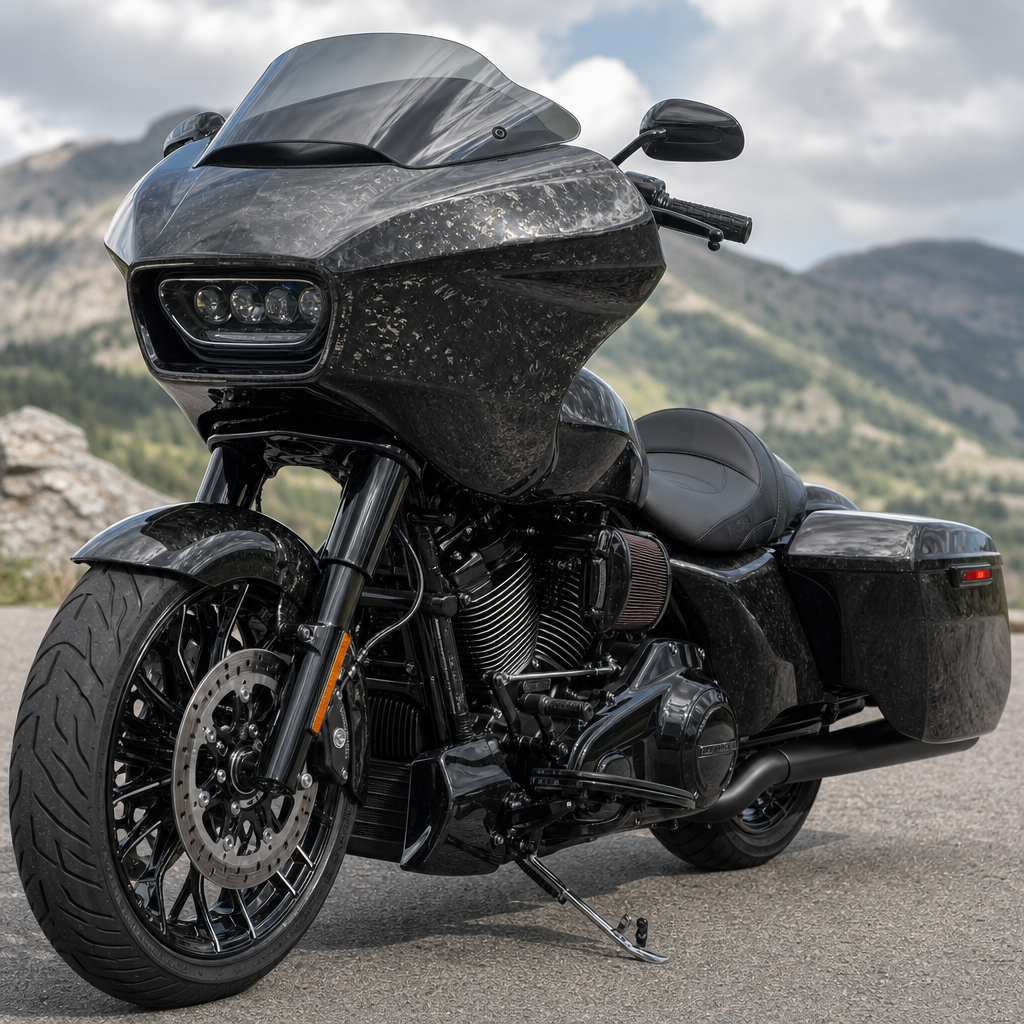
Forged carbon fairings are becoming the defining upgrade for 2026 performance baggers because they combine crash-tolerant strength, precise fit, and modern fabrication methods that suit how today’s custom bikes are actually built. In this context, a fairing is the structural bodywork around the front end or side sections, while forged carbon refers to chopped carbon fiber placed in a mold with resin under heat and pressure, creating a marbled composite that differs from traditional woven carbon sheets. Performance baggers are heavyweight American V-twin touring platforms reworked for speed, braking, cornering clearance, and aggressive style, often using race-inspired suspension, upgraded wheels, and lightweight body components.
I have worked around custom bagger builds where every pound removed from the upper half of the bike improved steering response more than owners expected, and fairings were usually the first place where material choice changed the whole project. Builders once defaulted to fiberglass because it was cheap and easy to repair, then moved to ABS for OEM-like consistency, and later adopted woven carbon for premium projects. Forged carbon now sits at the center of that evolution because it allows complex shapes, local reinforcement, and repeatable production without the visual constraints of fabric weave alignment.
This matters in 2026 because custom culture is no longer separate from fabrication technology. The best shops blend digital design, additive prototyping, composite engineering, and disciplined wiring practices into one workflow. Riders shopping for forged carbon fairings are rarely buying a single cosmetic part; they are entering a broader ecosystem of 3D-printed ducting, bracketry validated through test fitting, CNC-machined mounts, and clean harness integration for audio, lighting, data displays, and rider aids. A well-built bagger does not just look fast in photos. It survives heat cycles, vibration, weather exposure, and service work without rattles, delamination, or electrical gremlins.
As the hub for fabrication technology in the new wave of custom builders, this guide explains what forged carbon fairings do well, where they fall short, and how they connect to 3D printing and wiring strategy. If you are comparing materials, planning a build sheet, or evaluating a shop, the key question is simple: does the fabrication method improve strength, fit, serviceability, and ride performance at the same time?
Why Forged Carbon Works on Modern Performance Baggers
Forged carbon performs so well on modern baggers because these motorcycles impose unusual loads on bodywork. A fixed fairing or large front cowl sees wind pressure at highway speed, buffeting from trucks, torsional movement through rough pavement, and constant engine vibration. On aggressively ridden Road Glide and Street Glide builds, the fairing also has to support speakers, navigation displays, accessory switches, and mounting hardware. Traditional fiberglass can be strong, but strength depends heavily on layup quality, resin control, and reinforcement at mounting points. Woven carbon offers excellent stiffness, yet complex curves can distort the weave and create cosmetic waste. Forged carbon solves several of these issues by distributing chopped fibers throughout the part, producing multidirectional reinforcement and making intricate shapes easier to manufacture consistently.
In practical terms, that means a forged carbon inner or outer fairing can resist cracking around fasteners better when engineered correctly, especially if the mold includes metal inserts or reinforced bosses. It also means builders can create vent contours, speaker pockets, chin spoiler transitions, and saddlebag-adjacent body lines without fighting visible weave orientation. Weight savings are real, but the more important performance gain is where the weight comes off. Reducing mass high and forward helps steering feel, especially during rapid left-right transitions and hard braking when a heavy front body assembly wants to keep moving.
There are tradeoffs. Forged carbon is not automatically stronger than every woven laminate. Mechanical properties depend on fiber length, resin system, fiber volume, compaction, cure schedule, and part design. A poorly engineered forged part can be brittle at thin edges or weak where stress concentrates. Good shops address this with finite element analysis, coupon testing, local reinforcement, and fastener strategies that spread loads instead of pinching the laminate. The material is excellent, but the process matters more than marketing.
How 3D Printing Speeds Design, Fitment, and Production
3D printing has become the invisible backbone of fairing development, and any serious fabrication hub needs to explain how it fits into composite work. In most advanced shops, the process begins with 3D scanning the motorcycle’s front end, crash bar geometry, triple trees, fork clearance, and tank line. Designers then model a fairing digitally in CAD software such as Fusion, SolidWorks, or Rhino. Before committing to an expensive carbon mold, they print prototypes in PLA, PETG, ASA, nylon, or carbon-filled nylon to verify shape, sightline, wind management, and mounting position.
I have seen projects save weeks by printing full-scale mounting tabs and duct sections before touching composite tooling. A prototype may reveal that the fairing clips the brake reservoir at full lock, blocks access to the ignition, or directs hot air onto the rider’s knees. These are expensive mistakes in carbon, but cheap corrections in plastic. Shops also print sacrificial bucks, trim guides, drill templates, and vacuum-form aids. For small production runs, they may print internal ducting, wire channels, gauge pods, and non-structural closeout panels that mate to forged carbon shells.
The technology also helps with rider-specific customization. A customer using a taller windshield, 14-inch bars, or an oversized audio package can have clearances validated before final layup. On a performance bagger where cockpit packaging is tight, that reduces rework and protects the finish. The best use of 3D printing is not replacing carbon. It is de-risking carbon by making sure the expensive composite part is right the first time.
| Fabrication method | Best use on a bagger | Main advantage | Main limitation |
|---|---|---|---|
| 3D printing | Prototypes, ducts, wire channels, templates | Fast design iteration and custom fitment | Limited structural durability in high-heat zones depending on polymer |
| Forged carbon | Fairings, covers, complex visible panels | High stiffness-to-weight ratio with flexible shaping | Higher tooling cost and quality depends on process control |
| Woven carbon | Flat or gently curved premium panels | Predictable laminate behavior and classic carbon appearance | Weave distortion on complex geometry |
| Fiberglass | Budget bodywork and repairable customs | Low material cost and easy field repair | Heavier and more variable finish quality |
Composite Manufacturing Details That Separate Great Parts from Average Ones
When riders ask whether forged carbon fairings are worth the money, the accurate answer depends on manufacturing discipline. The strongest parts start with controlled material selection. Builders choose fiber type, chopped length, resin chemistry, and cure method based on expected loading and finish requirements. Epoxy systems generally provide better mechanical performance and adhesion than cheaper polyester resins, though they demand tighter process control. Compression molding and matched tooling can produce highly consistent parts, while vacuum-assisted processes help reduce voids and improve resin distribution.
Tooling quality is equally important. If the mold surface is unstable, part dimensions drift and panel gaps suffer. That becomes obvious around headlights, dash openings, and windshield interfaces. Heat shielding must also be considered. Large V-twins throw significant radiant and convective heat, especially near oil coolers, cylinder heads, and exhaust routing. A fairing that looks flawless on delivery can soften adjacent plastics, discolor resin, or transfer vibration into mounting points if thermal management is ignored. Reputable shops use insulation barriers, stand-offs, and strategic air paths to keep component temperatures under control.
Hardware integration is another separator. Composite parts fail early when builders drill holes with no edge reinforcement, over-torque stainless fasteners, or mount heavy electronics to unsupported laminate. Better practice includes bonded inserts, aluminum or titanium backing plates, load-spreading washers, rubber isolators, and service loops for attached wiring. OEM engineering teams have used those principles for years, and the better independent builders now apply the same standards. If a shop cannot explain how it handles inserts, torque limits, and vibration isolation, the fairing is probably being treated as a styling exercise instead of a structural component.
Wiring Integration: The Difference Between a Clean Build and a Problem Bike
Wiring is where many custom motorcycles lose reliability, and it is one reason this fabrication hub must treat electrical planning as seriously as carbon construction. Modern baggers often carry more electrical load than owners realize: amplified audio, heated gear ports, adaptive lighting, GPS units, phone interfaces, CAN bus accessories, radar detectors, air-ride systems, and onboard charging. Stuffing those circuits behind a lightweight fairing without a plan creates abrasion points, voltage drop, heat buildup, and impossible service access.
On the best builds, wiring begins at the CAD stage. Harness routing is modeled before fairing molds are finalized, so the finished part includes channels, clips, grommet locations, and removable access panels. Printed loom guides can be test-fitted during prototyping, then translated into final carbon geometry. The harness itself should use proper automotive-grade TXL or GXL wire, adhesive-lined heat shrink, sealed connectors from suppliers such as Deutsch or TE Connectivity, and correctly sized relays or solid-state power distribution modules. Crimp quality matters more than decorative braided sleeving.
Serviceability matters too. I always look for enough slack to remove a fairing without yanking speaker leads, labeled branches for troubleshooting, and isolated grounds that prevent noise in audio systems. Performance baggers vibrate, get ridden in rain, and are often modified again later. That means harnesses should be secured with abrasion-resistant mounts, protected from steering sweep, and fused according to actual current draw rather than guesswork. A forged carbon fairing is a premium component, but it only stays premium if the wiring behind it is built to the same standard.
How Builders and Buyers Should Evaluate a Forged Carbon Fairing Package
If you are buying forged carbon fairings for a 2026 performance bagger, evaluate the package the way a race team would evaluate a new body component. Ask what motorcycle platform and year range the part was designed around, whether it was scanned from OEM geometry, and what other components it assumes, such as bar height, riser setup, windshield type, or speaker configuration. Request information on resin system, cure method, hardware included, and whether mounting points are reinforced. Good answers are specific.
Also inspect finish quality realistically. The marbled look of forged carbon hides some cosmetic inconsistency better than woven carbon, but premium parts still need even resin distribution, clean edges, precise trimming, and no print-through around inserts. Ask whether the part is UV-stable out of the mold or requires a clear coat with inhibitors. Ultraviolet exposure can yellow resins over time, particularly on bikes that live outdoors or travel long highway miles in summer conditions.
Fitment proof is valuable. Shops that have documented installs, repeat customers, and road-tested bikes usually show details that matter, such as full-lock clearance, windshield sealing, instrument visibility, and high-speed stability. This is where the broader fabrication ecosystem shows its value. If the fairing supplier also understands printed prototype development and clean electrical integration, the odds of a quiet, durable install go up dramatically. The best parts are not simply lightweight. They are designed as systems.
Where Fabrication Tech Is Heading in 2026 and Beyond
The next phase of performance bagger fabrication is already visible. More shops are moving toward hybrid workflows that combine scan data, generative CAD modeling, printed tooling inserts, forged carbon skins, and modular internal structures. That approach speeds development while making replacement sections and limited-run variants more practical. Expect to see more integrated aero features, brake-cooling ducts, hidden camera or radar mounts, and fairings engineered around digital dashes rather than adapted after the fact.
Materials will improve as well. Higher-temperature resins, better surface films, and more refined recycled carbon feedstocks are expanding what forged composites can do. At the same time, electrical architecture is becoming cleaner through programmable power distribution, compact CAN-compatible modules, and printed retention systems that make harnesses easier to service. Builders who master all three areas—3D printing, carbon fabrication, and wiring—will keep setting the standard for the new guard of custom culture because they can deliver bikes that look hand-built but function with OEM-level discipline.
Forged carbon fairings represent that shift perfectly. They are not just stylish body panels. They are the visible outcome of a smarter fabrication process that starts with digital validation, continues through controlled composite manufacturing, and finishes with wiring planned for real use. For riders and builders chasing lighter weight, sharper handling, and cleaner execution on 2026 performance baggers, this technology offers a practical advantage, not just a premium look. Use this hub as your starting point, then compare materials, study build quality, and choose components from shops that engineer the whole motorcycle, not only the parts you can see.
Frequently Asked Questions
What makes forged carbon fairings stronger than traditional fiberglass or ABS options for 2026 performance baggers?
Forged carbon fairings stand out because they are engineered to deliver a better balance of rigidity, impact tolerance, and weight control than many conventional fairing materials. Unlike ABS plastic, which can flex excessively, crack under heavy stress, or deform from repeated vibration and heat cycles, forged carbon is a composite built from chopped carbon fiber suspended in resin and compressed under controlled heat and pressure. That process creates a dense, highly stable structure that is well suited to the real-world demands of performance baggers, where higher speeds, harder cornering, upgraded suspension, and more aggressive braking all place greater loads on front-end and side bodywork.
Compared with fiberglass, forged carbon also offers a more refined strength profile. Fiberglass has long been popular because it is affordable and repairable, but it often requires more material thickness to achieve comparable stiffness. That can mean extra weight, less consistent fitment, and more susceptibility to fatigue around mounting points. Forged carbon, by contrast, can be formed with excellent structural integrity while keeping weight lower and stiffness higher in critical areas. For 2026 performance bagger builders, that matters because a fairing is not just cosmetic. It helps manage airflow, supports accessories, and must remain stable under vibration and road shock. A forged carbon fairing is often better able to preserve its shape and mounting alignment over time, which contributes to both durability and a more premium riding experience.
How is forged carbon different from traditional woven carbon fiber fairings?
The biggest difference is in the material architecture and the way the part is manufactured. Traditional woven carbon fiber uses sheets of interlaced carbon strands laid in recognizable patterns, often in layers, before resin curing. That method can produce very strong and lightweight parts, especially in motorsports and aerospace-inspired applications, but it is also more dependent on fiber orientation, hand layup accuracy, and part geometry. Woven carbon tends to show the familiar checkerboard pattern many riders associate with “carbon fiber.” Forged carbon, on the other hand, uses chopped pieces of carbon fiber distributed throughout a mold with resin, then consolidated under heat and pressure. The result is the distinctive marbled appearance that has become popular on high-end custom motorcycles and performance vehicles.
From a bagger application standpoint, forged carbon offers some practical advantages. Because the material can be molded into more complex shapes with consistent density, it is especially effective for fairings with intricate contours, recessed hardware areas, and tight tolerances around modern front-end components. It can also provide more uniform properties across irregular part geometry, which is helpful when building bodywork that has to integrate cleanly with factory or aftermarket mounting systems. While woven carbon remains an excellent choice in certain applications, forged carbon is increasingly favored for 2026 performance baggers because it aligns well with the way custom bodywork is now designed: aggressive styling, precise fit, repeatable production quality, and a finish that looks modern rather than traditional.
Are forged carbon fairings mainly about appearance, or do they offer real performance benefits on a bagger?
They absolutely offer real performance benefits. The visual appeal of forged carbon is undeniable, and the marbled finish gives a bike a highly modern, premium look, but the value goes well beyond styling. A fairing on a performance bagger affects more than cosmetics. It contributes to weight distribution, aerodynamic stability, vibration management, and the long-term integrity of mounted components such as windshields, lighting, speakers, and navigation setups. When a fairing is lighter and structurally more stable, it can help reduce unwanted movement and stress at speed, especially on bikes that are ridden aggressively or equipped with upgraded engines and suspension packages.
For 2026 performance baggers, where riders are increasingly blending touring platforms with performance-focused geometry and components, forged carbon bodywork makes sense because it supports that evolution. Lower weight at the front end can improve responsiveness, and improved stiffness can help a fairing feel more planted rather than shaky or flex-prone over rough pavement. Strong, precise fairings also tend to maintain cleaner panel alignment, which helps airflow remain more predictable. In short, forged carbon is not just a show-bike material. It is a functional upgrade for riders who want bodywork that looks elite but also holds up to high-speed use, custom fabrication demands, and the realities of modern performance bagger riding.
Why is precise fitment such a big advantage with forged carbon fairings?
Precise fitment matters because even the strongest fairing becomes a problem if it does not align correctly with the bike’s structure, mounting points, and surrounding components. On a 2026 performance bagger, fitment is especially important because the front end is often crowded with upgraded bars, audio systems, taller risers, custom gauges, windshields, and performance suspension components. A forged carbon fairing that is molded accurately can reduce installation headaches, minimize the need for trimming or slotting holes, and help ensure that fasteners load the part properly instead of creating uneven stress. That directly affects longevity, because poor fitment is one of the most common reasons bodywork develops cracks, rattles, or mounting failures over time.
Forged carbon manufacturing is well suited to repeatable production and refined mold detail, which means builders and riders can get a part that follows the bike’s lines more consistently. That is important both visually and structurally. When the fairing fits correctly, panel gaps look intentional, airflow around the bike is cleaner, and accessories mount more securely. It also means less tension is introduced during installation, which is crucial for preserving the integrity of composite material. In the custom bagger world, where modifications are common and no one wants a premium part that requires major correction work, accurate fitment is not a luxury. It is part of what makes forged carbon a serious upgrade rather than just an exotic material choice.
Are forged carbon fairings a good long-term investment for riders building or upgrading a performance bagger?
For many riders, yes. Forged carbon fairings are typically a premium purchase, but they often justify that price through durability, reduced weight, stronger structural performance, and elevated visual appeal. A well-made fairing is not something most owners want to replace repeatedly, especially on a carefully built performance bagger. Investing in forged carbon can mean getting a part that resists the fatigue issues, fit inconsistencies, and finish degradation sometimes associated with lower-end materials. Over time, that can translate into fewer problems with cracking around mounting points, less maintenance related to panel instability, and better retention of the bike’s overall presentation.
There is also a resale and brand-value component to consider. In the 2026 performance bagger market, buyers are becoming more educated about materials and fabrication quality. Forged carbon is increasingly recognized as a premium solution that signals thoughtful component selection rather than purely cosmetic spending. For custom builders, it can help differentiate a bike in a crowded market. For individual owners, it can enhance pride of ownership while supporting actual riding performance. When the fairing is built correctly, installed properly, and matched to the bike’s intended use, forged carbon is not just a trend-driven upgrade. It is a forward-looking investment in strength, precision, and modern composite construction that fits exactly where performance baggers are headed.