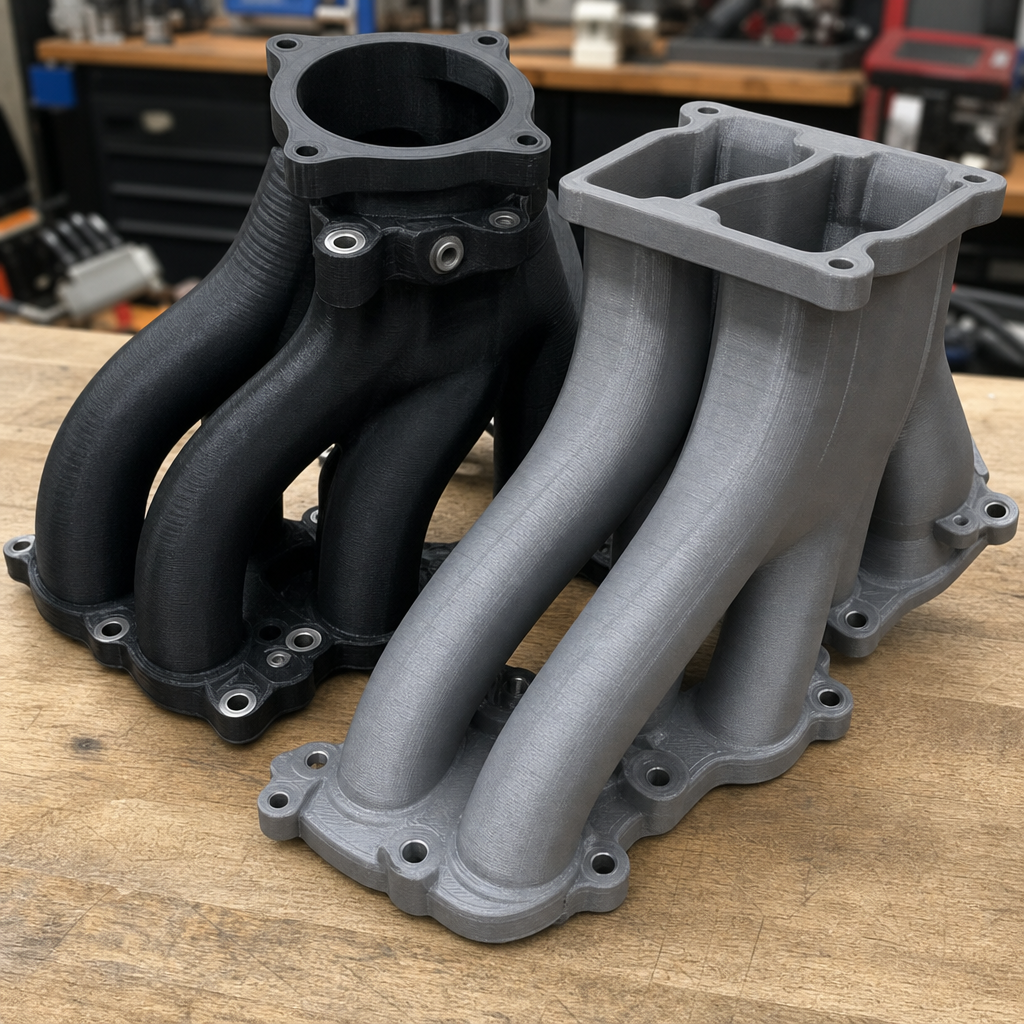
3D-printed intake manifolds are changing how builders approach the 121 HO motor because they let you tune airflow, packaging, and repeatability with a level of control that traditional hand-fabrication rarely matches. In practical terms, an intake manifold routes air from the throttle body or carburetor plenum to each cylinder, and its shape strongly influences torque, throttle response, cylinder-to-cylinder balance, and peak horsepower. On the 121 HO motor, where engine bay space, thermal load, and induction layout often force compromises, additive manufacturing opens a new path: prototype quickly, test on the dyno, revise runner length or taper, and print the next version without remaking every tool. That matters for modern builders who combine classic hot-rodding instincts with digital fabrication, composite work, and cleaner electrical integration. I have used this workflow on custom induction projects, and the biggest advantage is not novelty; it is iteration speed. When the intake is treated as a tunable system rather than a static part, the entire build improves. This article serves as a hub for fabrication technology around the 121 HO motor, with intake design at the center and carbon components plus wiring strategy supporting the complete package.
Why intake design matters on the 121 HO motor
The 121 HO motor responds sharply to intake changes because airflow quality affects combustion stability across the rev range. A good manifold does three jobs at once: it distributes air evenly, preserves velocity, and supports the pressure-wave timing that helps cylinder filling. Runner length generally biases torque lower or higher in the band, while cross-sectional area and taper influence velocity and restriction. A large plenum can support top-end flow, but if it is oversized for the engine’s displacement and camshaft, transient response often softens. Builders chasing only maximum cfm miss this. On a street-driven 121 HO setup, usable torque between corner exits or in midrange roll-ons is often more valuable than a peak number on a dyno chart.
The key terms are simple. Plenum volume is the shared air reservoir feeding the runners. Runner length is measured from the plenum entry to the valve head centerline equivalent, not just the visible tube. Taper is the gradual change in runner area that helps maintain velocity as demand changes. Bellmouth entry radius reduces separation at the runner entrance. These details matter because internal surface behavior is more important than external appearance. A manifold that looks aggressive but has poor entry geometry, abrupt section changes, or uneven runner targeting will underperform a cleaner design every time.
How 3D printing improves manifold development
3D printing improves manifold development by reducing the cost and time required to test ideas. Instead of cutting aluminum, welding sections, pressure-checking joints, and discovering late that one runner clashes with fuel rails or hood clearance, you can model the geometry in CAD, print a prototype, and validate fit in hours. This is especially useful on the 121 HO motor, where custom accessory placement, intercooler plumbing, or swap-specific chassis constraints often force unconventional routing. Additive manufacturing also makes complex shapes realistic. Internal bellmouths, organic transitions, integrated sensor bungs, and equalized runner paths are far easier to print than to machine from billet or fabricate from tube.
The process is not magic, and material choice matters. For concept validation, many shops print in PLA or PETG because they are cheap and dimensionally predictable. For underhood mockups that need higher heat resistance, nylon, carbon-filled nylon, or glass-filled polymers are far more useful. Production-ready printed manifolds usually depend on reinforced nylon systems from industrial printers, or they use the printed part as a pattern for composite layup or casting. I have found that successful projects treat printing as part of a workflow, not the whole answer. You print to verify packaging, test airflow assumptions, and shorten the path to a durable final part.
Core airflow principles: runner length, taper, plenum, and distribution
Optimizing flow for the 121 HO motor starts with runner design. Longer runners generally strengthen low- and midrange torque because intake pulse tuning favors lower engine speeds. Shorter runners shift the effective tuning higher, often helping peak power. There is no universal ideal length because cam duration, valve size, compression ratio, and target rpm all change the answer. What does stay constant is the need for smooth transitions. A runner should not neck down abruptly or expand suddenly. A mild taper can keep mixture speed stable while reducing the chance of localized separation.
Plenum design deserves equal attention. Too small, and the engine sees a restricted reservoir that can hurt high-rpm breathing. Too large, and the pulses lose useful energy, often weakening response. On naturally aspirated four-cylinder and V-configuration performance applications, builders often begin with a plenum volume around one to one-and-a-half times engine displacement as a starting range, then refine through logging and dyno testing. The 121 HO motor may respond differently depending on head flow and throttle placement, but that baseline is practical. Distribution is the final piece. If one cylinder runs leaner because of entry angle or turn bias, total power may look acceptable while reliability suffers. Equal flow to each runner is not optional on a serious build.
Recommended fabrication workflow from scan to dyno
The most efficient workflow begins with measurement and scanning. A handheld scanner or careful CMM-style measurement captures the head flange, injector position, hood clearance, and surrounding components. In CAD, the flange should be modeled first because bolt alignment, port shape, and sealing land set the entire project. Then establish target runner centerlines and decide where compromises are acceptable. I usually prioritize port entry quality and service access before cosmetic symmetry, because a manifold that blocks injectors or makes maintenance miserable will not stay on the engine long.
After the base geometry is fixed, print a fitment prototype. Confirm flange flatness, fastener access, throttle body angle, rail clearance, and sensor placement. Revise before committing to a stronger material. If possible, use CFD as a directional tool, not an absolute truth source. Many software packages predict trends well but cannot fully replicate real valve events or every wall effect. Dyno testing with back-to-back runs remains the standard. Log manifold pressure, air temperature, injector duty, lambda per cylinder if available, and knock activity. The best manifold is the one that improves area under the curve while keeping all cylinders safe.
| Stage | Primary goal | Recommended tools | Common mistake |
|---|---|---|---|
| Measurement | Capture engine and bay constraints | 3D scanner, calipers, contour gauges | Ignoring service clearance |
| CAD design | Set runner paths and plenum volume | Fusion 360, SolidWorks, Rhino | Designing for appearance first |
| Prototype print | Validate fit and assembly | PLA, PETG, desktop FDM printer | Assuming mockup material equals final durability |
| Functional print | Test heat and pressure tolerance | PA12, carbon-filled nylon, SLS/MJF | Poor sealing surface control |
| Dyno validation | Confirm power and cylinder balance | Dyno, wideband, EGT or per-cylinder lambda | Reading only peak horsepower |
Materials, heat, and durability in real engine bays
Material selection determines whether a printed intake manifold becomes a reliable part or a short-lived experiment. Underhood temperatures, fuel exposure, vibration, and clamping force all punish weak materials. PLA should stay in the prototype category because its heat deflection performance is too low for sustained engine bay use. PETG improves chemical resistance but still falls short in many high-heat scenarios. Nylon, especially PA12, is a serious option because it combines toughness, better thermal stability, and decent chemical resistance. Carbon-filled nylon increases stiffness and can help dimensional stability, though it may become less impact-tolerant depending on the formulation.
Printed manifolds also need mechanical strategy. Flanges benefit from metal inserts or bonded aluminum faces to control creep under bolt load. Threaded features should use heat-set or molded inserts, not bare plastic threads for repeated service. If boost is involved, layer orientation and wall count become critical, and pressure testing is mandatory. Even naturally aspirated applications need thermal shielding near headers and careful support for vacuum ports. For some builders, the best hybrid solution is a printed core with composite skin reinforcement or a printed sacrificial form used to create a carbon or fiberglass final part. That approach blends rapid geometry development with proven structural methods.
Carbon fabrication and why it belongs in the same conversation
Carbon fabrication belongs in this hub because intake development rarely happens in isolation. Once you optimize the manifold, the next bottlenecks often involve ducting, airbox shape, heat shielding, and weight distribution. Carbon fiber and fiberglass composites excel here. A printed intake may pair with a carbon airbox that seals to a cold-air feed, reducing inlet temperature and stabilizing repeat performance. Carbon also helps when the 121 HO motor sits in a tightly packaged custom chassis where every millimeter matters. Thin composite panels can create smooth airflow paths that would be bulky in formed metal.
The smart way to combine technologies is to use printing for geometry and composites for final structure where appropriate. For example, a builder can print a velocity stack set, test diameters and entry radii on the dyno, then produce final stacks in composite or high-temp polymer. The same logic applies to wire covers, fuse panel brackets, and ECU mounts. On several builds, I have used printed templates to locate carbon panel cut lines and wiring pass-throughs before committing to expensive cloth and resin. This reduces waste and preserves symmetry. The result looks cleaner, but more importantly, it improves serviceability and repeatability.
Wiring integration: sensors, ECU strategy, and reliability
Wiring is the third pillar because an optimized intake manifold only delivers its full benefit when the engine management system can interpret and control the new airflow. A redesigned plenum may change MAP signal behavior, idle airflow, and transient fueling needs. If the 121 HO motor uses speed-density tuning, plenum stability and sensor location matter a great deal. Place the MAP sensor where it sees a representative pressure signal, not a turbulent dead zone or a single-runner pulse. Intake air temperature sensors should sit where they reflect actual incoming air, shielded from radiant heat soak as much as possible.
Harness quality is equally important. Use automotive-grade TXL, GXL, or cross-linked wire, proper strain relief, adhesive-lined heat shrink, and sealed connectors from suppliers such as Deutsch or TE Connectivity. Avoid routing sensor wiring parallel to ignition coils for long distances, and ground the ECU and sensors according to manufacturer guidance rather than improvising. On custom builds, I prefer documented branch points, printed loom mounts, and labeled service loops so the intake can be removed without cutting ties or stressing pins. These habits seem minor until a tuning session is interrupted by intermittent voltage reference noise. Good wiring turns a promising manifold into a dependable system.
Testing methods that separate good parts from guesswork
To know whether a 3D-printed intake manifold truly improves the 121 HO motor, test beyond simple seat-of-the-pants impressions. Start with bench inspection: flange flatness, leak checks, vacuum port integrity, and injector spray targeting. Then compare baseline and revised manifolds under the same dyno conditions, using identical fuel, timing, coolant temperature, and intake air control where possible. Watch torque shape more than peak output. A gain of five horsepower at redline may be less valuable than ten extra pound-feet across the middle of the band. Also review consistency across repeated pulls, because heat soak and pressure recovery often reveal weaknesses hidden by one hero run.
Road or track validation matters too. Log throttle response, part-throttle drivability, hot restart behavior, and fuel trims. If the manifold was designed for equal cylinder distribution, inspect plugs or use per-cylinder data to verify the assumption. In advanced programs, a flow bench or wet-flow study can add insight, but real engine results still decide the question. Builders who document version changes carefully improve faster. Save CAD revisions, note runner and plenum dimensions, record print orientation, and tie every hardware change to dyno notes. Over time, that creates a reliable development map rather than a pile of disconnected experiments.
The main lesson is straightforward: 3D-printed intake manifolds give 121 HO motor builders a faster, smarter way to optimize airflow, but the best results come when printing is integrated with sound engine theory, composite fabrication, and disciplined wiring. Intake performance depends on runner length, taper, plenum volume, bellmouth shape, and cylinder distribution, not on appearance or novelty. Printing makes those variables easier to refine because prototypes can be modeled, fitted, and revised quickly. Carbon fabrication supports the system by improving ducting, airbox efficiency, mounting solutions, and packaging. Clean wiring and sensor placement ensure the ECU can actually use the airflow improvements you create.
For a sub-pillar hub in custom culture and builder technology, that integrated view is the real advantage. Modern fabrication is no longer about choosing between old-school craftsmanship and digital tools; the strongest builds use both. Start with a measured baseline on your 121 HO motor, define the rpm and packaging goals, print a fitment prototype, test methodically, and only then commit to final materials. If you are building this platform seriously, use this page as your starting point and map every intake, carbon, and wiring decision back to one question: does it improve airflow, reliability, and repeatable performance?
Frequently Asked Questions
What makes a 3D-printed intake manifold a strong option for the 121 HO motor?
A 3D-printed intake manifold gives builders a level of airflow and packaging control that is difficult to achieve with traditional hand-fabricated parts. On the 121 HO motor, that matters because intake design has a direct effect on how evenly air is distributed to each cylinder, how quickly the engine responds to throttle input, and where the powerband is strongest. With additive manufacturing, the manifold can be designed around the actual needs of the engine rather than forcing the engine to adapt to a generic casting or a compromise weld-up. Runner length, cross-sectional area, taper, plenum volume, throttle body placement, injector angle, and even wall thickness can all be adjusted with much finer precision.
Another major advantage is repeatability. A well-developed digital design can be printed again and again with the same geometry, which helps eliminate the variability that often comes with manual fabrication. That consistency is valuable for performance tuning because it gives builders a more reliable baseline when comparing dyno pulls, fuel maps, ignition changes, and camshaft combinations. For the 121 HO motor specifically, where engine bay space and thermal load can create design constraints, 3D printing also allows tighter packaging solutions without sacrificing airflow quality. Instead of simply making the manifold fit, builders can shape it to preserve smoother transitions and more equal runner paths, which typically improves overall drivability and top-end efficiency.
How does intake manifold design affect airflow, torque, and horsepower on the 121 HO motor?
The intake manifold is one of the most influential airflow components on the engine because it controls how air moves from the throttle body or carburetor plenum into each intake port. On the 121 HO motor, small changes in runner shape or plenum design can noticeably alter engine behavior. Longer, appropriately sized runners generally support stronger low- and mid-range torque by helping air maintain velocity and by improving cylinder filling at lower engine speeds. Shorter or larger runners, by contrast, can favor higher-rpm airflow and peak horsepower, but if they are oversized, they may reduce airspeed enough to soften throttle response and hurt torque below the top end.
Plenum design is just as important. A well-sized plenum acts as an air reservoir and helps stabilize airflow demand between cylinders, especially during rapid throttle movement or at higher rpm. If the plenum is too small, the engine may feel restricted as airflow demand rises. If it is too large, response can become lazy and the intended resonance characteristics may shift away from the engine’s operating range. In addition, cylinder-to-cylinder distribution matters tremendously. Uneven runner length, poor turn radius, or abrupt cross-sectional changes can cause some cylinders to run leaner or richer than others, which affects power, reliability, and tuning consistency. A properly engineered 3D-printed manifold lets builders refine these details more accurately, producing an intake that better matches the displacement, cam timing, rpm target, and fuel system of the 121 HO motor.
Are 3D-printed intake manifolds durable enough for real-world heat, vibration, and performance use?
They can be, provided the manifold is designed and manufactured with the correct material, wall structure, and intended use in mind. Durability is not just about whether a part is printed; it is about what it is printed from and how the design accounts for thermal cycling, engine vibration, fastener load, fuel exposure, and pressure fluctuations. On the 121 HO motor, intake manifold temperatures can become significant because of engine bay heat soak, proximity to the cylinder head, and sustained performance driving. That means a suitable engineering-grade polymer, composite-filled material, or a process specifically rated for under-hood temperatures is essential. In some applications, builders also incorporate metal inserts, flanges, or mounting reinforcements to improve gasket sealing and long-term structural stability.
Good design practices make a major difference. Filleted internal and external transitions reduce stress concentration, properly supported mounting points help prevent cracking, and sufficient wall thickness is critical near flange interfaces, vacuum ports, and throttle body attachment areas. It is also common to use hybrid construction, where a printed manifold body is paired with machined aluminum mounting surfaces or hardware inserts. For naturally aspirated street and race setups, a correctly engineered 3D-printed manifold can be very reliable. For boosted or extreme heat environments, the material selection and validation process become even more important. In all cases, the smart approach is to treat the part like a serious engine component: pressure test it, inspect it, verify sealing, and evaluate it under expected thermal conditions before relying on it in hard use.
What should builders prioritize when designing a 3D-printed intake manifold for the 121 HO motor?
The first priority should be the engine’s intended operating range. Before any design work begins, builders need to decide whether the goal is stronger street torque, sharper transient response, broad mid-range power, or maximum top-end horsepower. That target drives nearly every intake choice, including runner length, runner area, plenum volume, throttle body size, and inlet orientation. For the 121 HO motor, packaging often competes with ideal airflow geometry, so the best design is usually the one that balances fitment and flow rather than chasing a single dimension in isolation.
After defining the power target, builders should focus on equal air distribution and smooth flow transitions. That means minimizing abrupt directional changes, maintaining consistent runner taper where appropriate, and avoiding dramatic differences in runner path length from cylinder to cylinder. Injector positioning should also be considered early because fuel targeting affects atomization, wall wetting, and throttle response. If sensors, vacuum ports, idle control hardware, or brake booster provisions are needed, they should be integrated from the start rather than added later as compromises. Thermal management is another key factor. Depending on the engine layout, isolating the manifold from heat sources or choosing a material with favorable thermal characteristics can help preserve inlet charge quality. Finally, builders should leave room for testing and iteration. One of the biggest advantages of 3D printing is the ability to make informed revisions quickly, so a successful project often comes from multiple prototype stages supported by flow data, dyno testing, and real-world tuning feedback.
Can a 3D-printed intake manifold improve tuning consistency and overall engine development on the 121 HO motor?
Yes, and that is one of its biggest practical benefits. A better intake manifold does not just increase airflow; it can make the engine easier to calibrate and more predictable from one test session to the next. On the 121 HO motor, inconsistent airflow distribution between cylinders can create uneven air-fuel ratios, variable combustion behavior, and a tune that looks acceptable in one area of the map but becomes unstable elsewhere. When a 3D-printed manifold is designed for balanced flow and consistent runner geometry, it often reduces those cylinder-to-cylinder differences. That gives tuners a cleaner foundation for dialing in fueling, ignition timing, and transient response.
From a development standpoint, digital design also shortens the feedback loop. If dyno testing shows that the manifold is favoring top-end power but sacrificing too much low-speed torque, the runner geometry or plenum can be revised without starting from scratch. If packaging changes are needed because of hood clearance, throttle body location, intercooler plumbing, or accessory interference, the model can be updated with more precision than is typical in manual fabrication. That repeatable iteration process is extremely valuable because it lets builders make changes based on measured results rather than guesswork. Over time, the combination of repeatability, data-driven revision, and improved airflow control can lead to a 121 HO motor that not only makes stronger power, but also behaves more consistently on the street, on the dyno, and in competition.