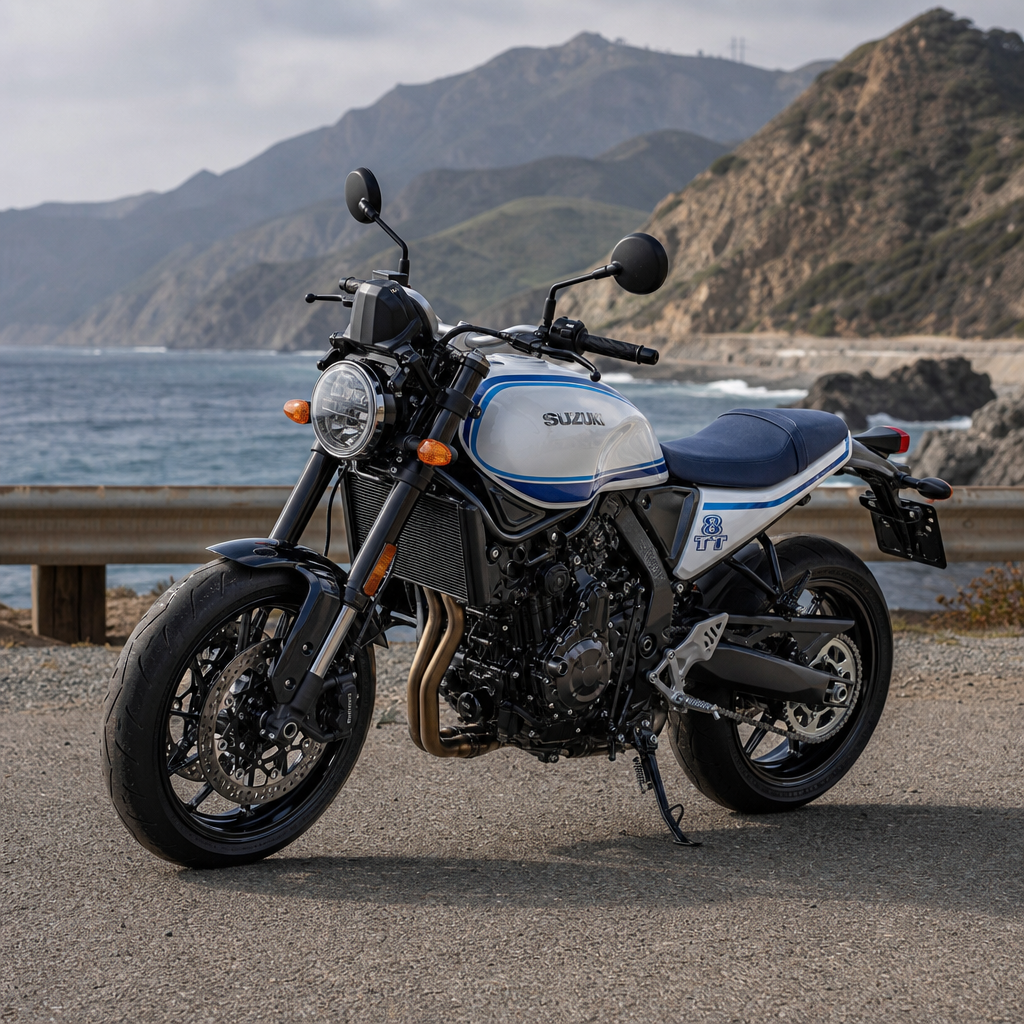
The 2026 Suzuki GSX-8TT arrives at a moment when retro-inspired motorcycles are no longer niche indulgences but a core part of the middleweight market, and Suzuki has judged that moment well. This machine blends classic Japanese sport-bike cues with the company’s modern 776cc parallel-twin platform, creating a motorcycle that speaks to riders who want styling rooted in the past without sacrificing current engineering. For anyone tracking new Japanese metrics, the GSX-8TT matters because it acts as a bridge between heritage design, real-world usability, and the performance expectations riders now bring to the 700cc to 900cc class.
Japanese metrics refers to motorcycles built by Japan’s major manufacturers in metric-displacement categories, typically spanning lightweight commuters to liter-class sport and touring machines. In practice, the phrase often points enthusiasts toward Honda, Yamaha, Kawasaki, and Suzuki models that prioritize reliability, balanced chassis design, and accessible ownership. I have spent years testing and comparing middleweight Japanese platforms on city streets, interstate stretches, and tight secondary roads, and the pattern is consistent: the most successful bikes in this class are not always the most powerful. They are the ones that deliver usable torque, manageable weight, predictable handling, and day-to-day livability. The 2026 Suzuki GSX-8TT fits that pattern.
It also matters as a sub-pillar hub under New Rides because it gives readers a central reference point for how modern Japanese metric motorcycles are evolving. The GSX-8TT is not just another trim package. It represents a broader design and product strategy: take a proven engine architecture, wrap it in emotional styling, tune the ergonomics for broad appeal, and position it against rivals that increasingly blur the line between naked bike, sport standard, and café-inspired roadster. That is the story shaping Japanese metrics in 2026, and Suzuki’s new model is one of the clearest examples.
At its core, the GSX-8TT uses Suzuki’s 776cc parallel-twin, a liquid-cooled DOHC eight-valve engine with a 270-degree crankshaft. That crank layout is important because it changes character as much as it affects sound. A 270-degree twin imitates some of the traction feel and pulse spacing riders associate with a V-twin while retaining packaging efficiency and cost advantages. Suzuki already proved the value of this engine family in the GSX-8S and V-Strom 800 line, where reviewers consistently praised its low- and midrange response. In a retro-styled road machine, those traits make even more sense.
What the 2026 Suzuki GSX-8TT Is and Why It Fits the Japanese Metric Hub
The easiest way to define the 2026 Suzuki GSX-8TT is as a fully modern middleweight roadster dressed in period-inspired bodywork. It is not a recreation of a 1970s or 1980s Suzuki, and that distinction matters. True nostalgia bikes often chase visual authenticity so aggressively that they compromise rider triangle, braking performance, electronics, or practical maintenance access. The GSX-8TT appears to take the smarter route. It uses contemporary architecture first, then layers visual references over a platform already known for competent suspension, stable geometry, and strong street manners.
Within the broader Japanese metrics category, that makes the bike a hub-worthy model because it helps readers understand a major market trend. The most competitive Japanese motorcycles in this displacement class now combine four attributes: emotionally resonant styling, sub-500-pound wet weight, rider aids that support rather than dominate the experience, and engines tuned for broad street performance instead of peak dyno bragging rights. If you are researching middleweight standards, retro sport bikes, urban commuters with character, or practical weekend canyon machines, this is the kind of motorcycle that connects all those buying paths.
Suzuki’s naming also suggests intent. The GSX badge carries sport lineage, while the 8-series links the bike to the company’s current twin-cylinder family. The TT designation implies a more distinct visual and thematic identity than a base naked variant. For buyers comparing New Rides across Japanese metrics, that naming structure is useful because it signals that this is not simply a cosmetic special edition. It is part of an expanding platform strategy, and platform strategies are increasingly how Japanese manufacturers control cost while diversifying appeal.
The 776cc Parallel-Twin: Character, Output, and Street Use
The engine is the headline mechanical feature, and it deserves that status. Suzuki’s 776cc twin has become one of the company’s most important recent developments because it gives Suzuki a flexible powerplant that works across multiple categories. In practical terms, riders should expect horsepower and torque figures in the same neighborhood as the existing 8-series models, which have generally landed around the low-80-horsepower range and roughly the upper-50 lb-ft range depending on market specification and rear-wheel measurement method. Numbers matter, but the delivery matters more. This engine makes its case through accessible thrust from low rpm, a muscular middle range, and enough top-end to keep the bike interesting without demanding constant high-rev riding.
On the road, a 776cc parallel-twin with a 270-degree crank is ideal for a retro sport standard because it supports relaxed commuting and spirited back-road riding equally well. You get immediate roll-on response when passing traffic, less need to downshift compared with smaller twins, and a friendlier power curve than many supersport-derived fours. Suzuki’s Cross Balancer system, first highlighted with this engine family, is also significant. By using a compact dual-balancer arrangement, Suzuki addressed vibration in a way that preserves character without making the bike buzzy at sustained highway speeds. That balance is crucial on a motorcycle positioned as both stylish and genuinely usable.
Fueling and throttle calibration are where bikes in this class often succeed or fail. Riders notice abrupt on-off response far more than they notice a missing two horsepower at redline. Suzuki’s recent ride-by-wire tuning has been competitive, and if the GSX-8TT carries over that calibration logic, buyers should expect smooth low-speed control, predictable corner exits, and electronics that feel integrated rather than intrusive. That translates directly into confidence for newer riders stepping up and satisfaction for experienced riders who care about refinement.
| Model | Engine Layout | Approx. Displacement | Core Strength | Likely Buyer Appeal |
|---|---|---|---|---|
| 2026 Suzuki GSX-8TT | Parallel-twin, 270-degree crank | 776cc | Torque-rich street performance with retro styling | Riders wanting heritage looks and modern usability |
| Yamaha XSR700 | Parallel-twin CP2 | 689cc | Light weight and lively real-world character | Urban riders and custom-minded buyers |
| Honda CB650R | Inline-four | 649cc | Smooth revs and premium fit-and-finish | Riders who prefer four-cylinder feel |
| Kawasaki Z650RS | Parallel-twin | 649cc | Approachable ergonomics and classic presentation | Newer riders seeking easy ownership |
Design Language: Nostalgia Done with Restraint
Retro design fails when it becomes costume. It works when every visual cue serves the silhouette first. The GSX-8TT appears to understand that rule. Rather than forcing a vintage frame layout or skinny-tire proportions onto a modern chassis, Suzuki seems to have used the current platform as the structural truth and then shaped the tank, seat line, side panels, lighting, and front fascia to evoke earlier GS and GSX machines. That approach usually produces a motorcycle that looks cohesive in person, not just in photos.
Classic Japanese sport-bike nostalgia typically centers on a few details: horizontal tank emphasis, a tidy tail section, restrained graphics, and a front-end treatment that suggests endurance-racing fairings or quarter-fairing roadsters from the late 1970s through the 1980s. If Suzuki leans into those references without overdoing chrome, fake fins, or unnecessary trim, the GSX-8TT could land in the sweet spot occupied by the best modern retros. The likely result is a bike that attracts older riders who remember the era and younger buyers who simply like clean industrial design.
Lighting, instrumentation, and switchgear are equally important to this balance. Riders want round or classic-looking lamps, but they do not want weak beam patterns or fragile housings. They appreciate analog-inspired displays, but they also want gear position, fuel data, and clear warning logic. Modern retros that sell well usually hide their sophistication in plain sight. That is exactly what Suzuki should do here, and it is exactly what buyers in the Japanese metrics segment increasingly reward.
Chassis, Suspension, and Real-World Handling
A strong engine can sell a test ride, but chassis quality determines whether a bike stays in the garage or gets ridden every weekend. The GSX-8TT benefits from entering the market with a known middleweight foundation. Suzuki’s recent 8-series platform has shown good mass centralization, neutral steering, and a level of confidence that suits both newer riders and experienced owners who value a planted front end. Assuming the GSX-8TT keeps similar geometry and wheelbase logic, it should offer quick enough turn-in for technical roads without becoming nervous on poor pavement.
Suspension specification will shape the bike’s reception. In this category, manufacturers often use KYB or Showa components with road-biased damping and limited adjustability to control cost. That is not a weakness by itself. What matters is whether the fork and shock are matched to the motorcycle’s weight, intended riding speed, and tire choice. A well-tuned non-premium setup can outperform a flashy adjustable system that was never properly calibrated. On Japanese metric bikes, that engineering discipline has long been a competitive advantage, and Suzuki usually understands where the target customer actually rides.
Braking hardware is another area where buyers have become more informed. Twin front discs, ABS, and a master cylinder that provides progressive feel are now baseline expectations, not premium extras. A retro-styled bike cannot get away with wooden brake feel simply because it looks good parked outside a café. If Suzuki carries over competent radial-style calipers or equivalent modern braking performance, the GSX-8TT will meet the standard serious street riders now demand.
Electronics, Ergonomics, and Everyday Ownership
The best middleweight Japanese metrics make technology useful rather than theatrical. Riders shopping the GSX-8TT should expect selectable ride modes, traction control, ABS, and likely a bidirectional quickshifter depending on trim and market. These features matter because they improve consistency. Ride modes can soften initial throttle response in wet weather. Traction control adds a margin of safety on painted intersections and cold pavement. A quickshifter reduces fatigue in stop-and-go traffic and keeps the bike composed during aggressive acceleration. None of that diminishes rider involvement; it improves it when the systems are calibrated well.
Ergonomics may be the decisive factor in the GSX-8TT’s success. Many retro-styled motorcycles look inviting but fold the rider into cramped knee angles or put too much weight on the wrists. Suzuki has an opportunity to avoid that trap by keeping a neutral seat-bar-peg triangle with only a slight sporty bias. For most riders, especially those using the bike for mixed commuting and weekend rides, a comfortable 60-minute posture matters more than ultimate front-end load at track pace. A seat height in the approachable middleweight range, moderate reach to the bars, and sensible peg placement would make the bike broadly accessible.
Ownership costs are part of the Japanese metrics story and one reason this category stays strong. Parallel-twins are generally cheaper to insure than supersports, easier to service than densely packaged multi-cylinder engines, and more fuel efficient in normal use. Suzuki’s dealer network, parts availability, and history of durable street engines all work in the GSX-8TT’s favor. Buyers looking beyond launch-day excitement should care about valve service intervals, consumable wear, and aftermarket support, because those factors shape long-term satisfaction more than any spec-sheet novelty.
How the GSX-8TT Compares in the 2026 Middleweight Market
The GSX-8TT enters one of the busiest and most interesting classes in motorcycling. Rivals come with distinct identities: Yamaha sells personality and light-footed energy, Kawasaki emphasizes accessibility and value, Honda often wins on refinement and finish, and Triumph, while not Japanese, remains a benchmark for modern classic execution. Suzuki’s opportunity is to combine the dependable core strengths of Japanese metrics with a design language that feels more emotionally charged than a typical standard.
That positioning matters because buyers rarely choose in this segment by horsepower alone. They ask practical questions. Does it feel special at low speed? Can it commute without punishment? Is it stable on the highway? Does it look timeless or trendy? Will it still make sense in three years? The GSX-8TT can answer those questions well if Suzuki prices it intelligently and preserves the accessible, torque-forward nature of the 8-series platform.
As the hub page for Japanese metrics under New Rides, this model also points readers toward the larger conclusion: the category is being reshaped by versatile middleweights with distinct styling identities. The old split between bland practical standards and uncompromising sport bikes is fading. In its place is a richer field of motorcycles that do more things well. The 2026 Suzuki GSX-8TT may be one of the clearest expressions of that shift, pairing nostalgia with modern mechanical honesty in a way that should age well.
The key takeaway is simple: the 2026 Suzuki GSX-8TT is important not because it chases the past, but because it uses the past to give a capable modern platform more meaning. Its 776cc parallel-twin brings the right kind of performance for real roads, its likely chassis package suits everyday riding, and its retro-inspired design broadens its appeal without forcing old-school compromises. That is exactly what many riders want from a new Japanese metric motorcycle.
For shoppers exploring this class, the GSX-8TT deserves attention alongside every major middleweight standard and retro roadster. It embodies the strengths that keep Japanese metrics relevant: reliability, thoughtful engineering, approachable performance, and ownership that makes sense beyond the first month. More importantly, it shows that Suzuki understands where the market is going. Riders want motorcycles with character, but they also want predictable handling, useful electronics, and engines that work in traffic as well as on open roads.
If you are building your shortlist in the New Rides category, use the GSX-8TT as a reference point for evaluating the entire Japanese metrics field. Compare engine character, comfort, technology, and styling honesty, not just headline power. That approach leads to better buying decisions, and it is why this motorcycle stands out. Keep this page bookmarked as your hub, then continue into model comparisons, first-look reviews, and buying guides to find the Japanese metric bike that best fits your riding life.
Frequently Asked Questions
What is the 2026 Suzuki GSX-8TT, and why is it significant in the middleweight motorcycle market?
The 2026 Suzuki GSX-8TT is Suzuki’s retro-inspired middleweight sport-standard built around the company’s modern 776cc parallel-twin platform. Its importance comes from how clearly it reflects where the market is heading: riders increasingly want motorcycles that deliver classic visual character without forcing them to accept outdated chassis design, engine behavior, electronics, or day-to-day usability. Rather than producing a pure nostalgia piece, Suzuki appears to be positioning the GSX-8TT as a bridge between old-school Japanese sport-bike identity and contemporary engineering expectations.
That matters because the middleweight category has become one of the most competitive and strategically important segments in motorcycling. Buyers in this class often want a machine that is exciting and distinctive, but still approachable in terms of cost, comfort, and real-world performance. By combining heritage-flavored styling with a proven modern twin-cylinder architecture, the GSX-8TT gives Suzuki a product that can appeal to newer riders moving up, returning riders seeking familiar aesthetics, and experienced enthusiasts who appreciate retro design but refuse to compromise on reliability and usability.
In broader terms, the GSX-8TT is significant because it shows Suzuki recognizing that nostalgia is no longer a fringe preference. Retro-inspired motorcycles are now central to the buying decisions of many riders, especially those looking for emotional appeal alongside practical ownership. If executed well, the GSX-8TT could become one of the stronger examples of how a Japanese manufacturer can reinterpret its sporting heritage for modern roads.
How does the 776cc parallel-twin engine shape the character of the GSX-8TT?
The 776cc parallel-twin is central to the GSX-8TT’s appeal because it gives the bike a balance of usable performance, manageable weight, and everyday friendliness that suits the middleweight class extremely well. In practical terms, this type of engine configuration tends to deliver a broad spread of torque, strong midrange response, and a more accessible powerband than a high-revving supersport engine. That means the GSX-8TT should feel lively and engaging on public roads without demanding constant high-rpm riding to access its best performance.
For a retro-styled machine, that is especially important. A motorcycle like this is not just about top-end speed or track-day credentials; it is about the overall riding experience. Riders want an engine that feels responsive pulling away from lights, flexible in urban traffic, rewarding on twisty back roads, and relaxed enough for longer weekend rides. The 776cc parallel-twin platform is well suited to exactly that role. It can provide modern refinement and efficiency while still offering enough personality to make the bike feel special.
Another key factor is packaging. Parallel-twin engines are compact, which helps manufacturers design motorcycles with favorable mass centralization and accessible ergonomics. That can translate into easier handling, a slimmer feel between the knees, and a more confidence-inspiring ride for a wide range of riders. On the GSX-8TT, the engine is not just a power source; it is the foundation that allows Suzuki to create a retro-inspired bike that remains modern in weight distribution, chassis integration, and day-to-day practicality.
What kind of rider is the 2026 Suzuki GSX-8TT designed for?
The GSX-8TT looks aimed at riders who value style and identity as much as measurable performance. That includes enthusiasts who grew up admiring classic Japanese sport bikes, younger riders who appreciate vintage-inspired design, and practical owners who want one motorcycle capable of commuting, weekend canyon runs, and casual touring. In other words, it is likely designed for people who want emotional appeal without stepping into the compromises that can come with truly old motorcycles or overly specialized new ones.
It should also appeal to riders who have no interest in extreme ergonomics. Many middleweight buyers want a bike that feels sporty and involving, but they do not want the wrist-heavy riding position, razor-thin comfort margin, or peaky engine behavior associated with more aggressive supersport machines. A model like the GSX-8TT can satisfy that desire by blending a classic performance-bike silhouette with a more usable seating position, tractable power delivery, and the kind of modern rider aids that make ownership easier and less intimidating.
There is also a strong chance the GSX-8TT will resonate with returning riders. Someone who left motorcycling for years may be drawn to familiar styling cues from Suzuki’s past, but still expect dependable starting, clean fueling, modern braking performance, and predictable handling. That is where this concept becomes especially smart. It invites riders in with nostalgia, but keeps them there with contemporary capability. For many people, that combination is more compelling than either a purely retro machine or a fully futuristic naked bike.
How does the GSX-8TT blend nostalgic design with modern motorcycle technology?
The GSX-8TT’s core idea is contrast done carefully. On one side, it leans into nostalgic Japanese sport-bike cues, which may include classic bodywork shapes, period-inspired proportions, and styling elements that evoke earlier eras of Suzuki performance models. On the other side, it is built on a thoroughly modern platform, which means the bike is not trying to mechanically recreate the past. Instead, it uses today’s engineering to deliver the visual and emotional atmosphere of yesterday’s machines in a package that behaves like a current motorcycle should.
That blend is meaningful because modern riders typically expect far more than attractive styling. They want predictable fueling, smooth throttle response, strong brakes, stable chassis behavior, efficient engine management, and a degree of electronic support that improves safety and confidence. A successful retro-modern motorcycle has to integrate those features without losing its aesthetic authenticity. The GSX-8TT appears positioned to do exactly that by using a current middleweight twin platform as the technical backbone while wrapping it in design language that references Suzuki’s heritage.
When this formula works, the result is a bike that feels timeless rather than gimmicky. Riders can enjoy the look of a machine rooted in motorcycling history while benefiting from current materials, manufacturing quality, and rideability. That is the real advantage of the GSX-8TT’s approach. It is not merely styled to look nostalgic; it is engineered to make nostalgia practical, dependable, and relevant for modern ownership.
Why could the 2026 Suzuki GSX-8TT be an important model for Suzuki’s future lineup?
The GSX-8TT could be strategically important because it demonstrates how flexible Suzuki’s 776cc platform can be. In today’s market, manufacturers benefit enormously from developing one strong engine and chassis architecture that can support multiple personalities: naked bikes, adventure-oriented variants, sport-tourers, and retro-inspired models. If the GSX-8TT succeeds, it would validate Suzuki’s ability to use the same modern foundation to reach a broader audience without needing entirely separate engineering programs for every niche.
It could also help strengthen Suzuki’s identity. For years, many manufacturers have wrestled with how to honor their history without appearing stuck in it. A model like the GSX-8TT offers an answer: use authentic heritage as inspiration, but deliver it through modern, competitive hardware. That allows Suzuki to reconnect with longtime fans while also remaining relevant to newer riders who compare motorcycles based on technology, usability, and value as much as brand legacy.
From a commercial standpoint, the bike may be important because the retro-middleweight class offers one of the best opportunities for broad market appeal. These motorcycles are often more attainable than liter-class machines, more versatile than dedicated sport bikes, and more emotionally engaging than purely utilitarian commuters. If Suzuki has judged the moment correctly, the GSX-8TT could become more than a single interesting model. It could serve as a template for how the brand expands its lineup, leverages its heritage, and competes more aggressively in one of the industry’s most visible and profitable segments.