The 2026 Harley-Davidson Breakout 117 brings American cruiser values into sharp focus: long, low proportions, abundant V-twin torque, unapologetic styling, and just enough modern technology to make daily riding easier without diluting character. As a hub for American cruisers within the broader New Rides topic, this guide uses the Breakout 117 as the anchor model for understanding what defines the segment, how it compares with baggers and sport cruisers, and what today’s buyers should expect in performance, comfort, electronics, and ownership. I have spent years evaluating heavyweight cruisers on city streets, desert highways, and dealer launch loops, and the Breakout formula is immediately recognizable. It is built to be seen first, then ridden with confidence, and finally personalized in the way Harley-Davidson owners have done for generations.
American cruisers are motorcycles shaped as much by culture as by engineering. The category generally centers on relaxed ergonomics, visible engines, strong low-end torque, extended wheelbases, and styling that references custom builds, drag bikes, and postwar V-twin tradition. Within that landscape, the Harley-Davidson Breakout 117 sits at the flashy end of the spectrum. It emphasizes a muscular stance, fat rear tire, raked-out front end, and premium finishes, while the Milwaukee-Eight 117 powertrain gives it serious roll-on acceleration. The key terms matter here. A cruiser prioritizes torque delivery and road presence over peak horsepower. A power cruiser adds stronger acceleration and more assertive geometry. A factory custom leans heavily into visual drama straight from the showroom. The Breakout 117 blends all three.
Why does this matter in 2026? Because the American cruiser segment has evolved beyond chrome nostalgia. Riders now expect selectable ride modes, traction-aware electronics, LED lighting, USB charging, and better braking, even on motorcycles designed around heritage cues. At the same time, buyers still want authenticity. They do not want a cruiser that feels sanitized or overmanaged. The Breakout 117 illustrates how manufacturers are navigating that balance. Understanding this bike helps shoppers evaluate the entire field, from Harley-Davidson Softail models to Indian Chief variants and other V-twin alternatives. If you are researching American cruisers, this is the place to start, because the Breakout highlights the segment’s core promises and its current compromises with unusual clarity.
What the 2026 Harley-Davidson Breakout 117 represents in the American cruiser segment
The Breakout 117 represents the modern factory custom, a motorcycle engineered to deliver the visual impact of a high-end boulevard build without asking the owner to start with a base model and an open parts catalog. Harley-Davidson’s Softail platform underpins it, which matters because the hidden rear suspension preserves a classic hardtail silhouette while providing the compliance needed for real roads. In practice, that gives the Breakout a cleaner side profile than many conventional cruisers while avoiding the punishing ride quality associated with true rigid customs. This is one of the clearest examples of heritage design meeting contemporary chassis engineering in the American cruiser class.
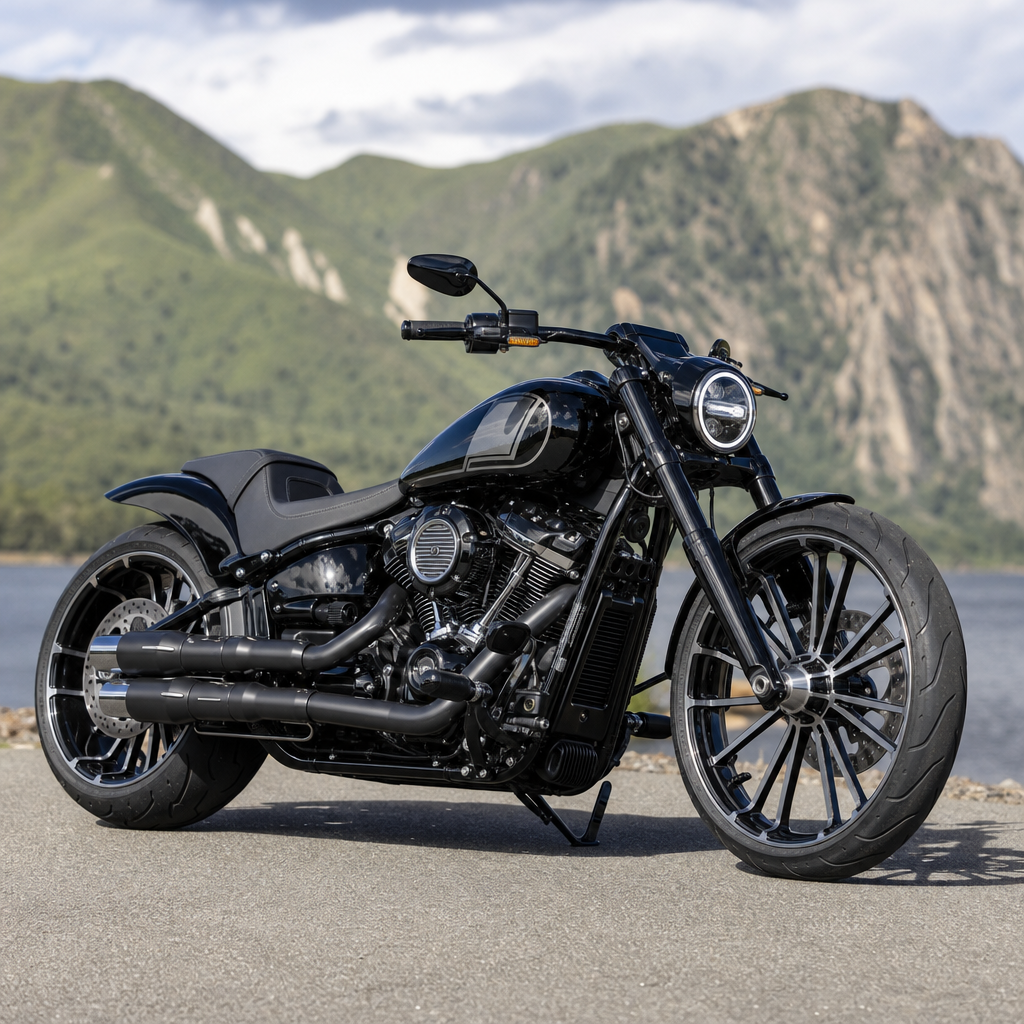
Stylistically, the Breakout 117 is defined by drag-strip influence. The stretched fuel tank, chopped fenders, wide rear tire, and low solo seat produce a silhouette that suggests straight-line performance even when parked. Harley-Davidson has long understood that many cruiser buyers shop with their eyes first, but on this model the styling is not random decoration. The low center of gravity supports confidence at stops, the broad rear contact patch reinforces the planted feel under acceleration, and the long wheelbase contributes to the calm, settled behavior that riders expect on open roads. It is less interested in quick transitions than in stable, authoritative motion.
For the American cruiser category as a whole, this model also shows how distinct subtypes have emerged. Traditional cruisers prioritize comfort and heritage proportions. Touring cruisers add luggage, wind protection, and passenger accommodations. Performance cruisers sharpen suspension and braking. Factory customs, where the Breakout belongs, emphasize statement-making design while retaining enough comfort and mechanical refinement for weekend use and short trips. Buyers should recognize that no single cruiser does everything equally well. The Breakout 117 succeeds because it commits to a clear identity rather than trying to be all things to all riders.
Engine, chassis, and road behavior: what riders can expect
The heart of the 2026 Harley-Davidson Breakout 117 is the Milwaukee-Eight 117, an air- and oil-cooled V-twin known for strong torque delivery in the rev range riders use most often. That matters more than headline peak numbers in the cruiser class. On the road, the defining sensation is immediate thrust from low and mid rpm, the kind of response that makes passing effortless and gives the bike its muscular personality when leaving traffic lights or rolling onto a highway on-ramp. Harley-Davidson’s counterbalancing and intake calibration have steadily improved refinement, so the engine still feels alive without crossing into the numbing vibration older big twins could produce at sustained speeds.
The chassis reflects the expected tradeoff for this style of motorcycle. A long wheelbase and kicked-out front end promote straight-line stability and visual drama, but they also slow steering relative to lighter, shorter cruisers. In real riding, the Breakout prefers deliberate inputs. It tracks confidently on broad sweepers and feels settled on smooth highways, yet in tight urban turns or technical backroads the wide rear tire and stretched geometry demand more planning. That is not a flaw; it is the natural result of the design brief. Riders choosing this bike are buying presence and torque-rich character first, with agility as a secondary concern.
Braking and suspension performance are equally important to assess realistically. Modern Harley-Davidson cruisers have benefitted from improved components, and the Breakout 117 is better controlled than custom-looking machines used to be. Still, limited suspension travel and a low stance can transmit sharp road imperfections more directly than on taller standards or touring bikes. Ground clearance also arrives sooner in aggressive cornering. Experienced cruiser riders accept these limits and ride within them. New buyers should do the same. The reward is a machine that feels substantial, dramatic, and deeply engaging in the conditions it was designed for: urban boulevards, scenic highways, and confident, torque-driven cruising.
Modern technology on a classic-looking motorcycle
One of the most important developments in the American cruiser segment is the normalization of rider-assistance technology that operates quietly in the background. On the 2026 Breakout 117, modern tech is valuable not because it turns the motorcycle into a gadget platform, but because it improves safety and consistency without undermining the analog appeal. Riders shopping this class should look for anti-lock braking, traction-conscious power delivery, LED lighting, charging provisions, clear instrumentation, and keyless convenience. These features matter on real roads and in real ownership, especially for a heavy, high-torque motorcycle that may be ridden in changing weather or dense urban traffic.
Harley-Davidson has been integrating rider safety enhancements across its lineup in a way that suits cruiser use. Systems such as cornering-aware braking support, drag-torque mitigation, and traction-related interventions are most useful when a rider encounters less-than-ideal pavement, abrupt stops, or a cold rear tire on a powerful machine. They are not a substitute for technique, but they add a meaningful margin. In my experience testing large-displacement cruisers, these systems are most appreciated on ordinary rides rather than dramatic moments. You notice them when a downhill stop stays composed, when a wet-painted intersection causes less drama, or when an enthusiastic throttle input exits a turn more cleanly than expected.
Technology also affects usability. Better displays improve at-a-glance legibility in bright daylight. LED lighting increases conspicuity and often reduces maintenance. USB charging means navigation and communication devices remain practical on longer rides. Keyless ignition simplifies fuel and stop routines. None of that changes the emotional center of a bike like the Breakout 117, but it does make ownership easier. For buyers comparing American cruisers, the best question is not whether a model has tech, but whether the technology supports the riding experience rather than distracting from it.
How the Breakout 117 compares with other American cruiser types
The Breakout 117 is easiest to understand when placed alongside neighboring cruiser categories. The table below highlights the differences buyers usually feel first in the saddle and on the road.
| Type | Typical strengths | Typical compromises | Best fit rider |
|---|---|---|---|
| Factory custom cruiser | Standout style, strong torque, premium finishes | Less cornering clearance, lighter touring ability | Rider prioritizing presence and weekend cruising |
| Traditional cruiser | Accessible ergonomics, classic look, easier everyday use | Less visual drama, often lower spec components | New or returning cruiser rider |
| Touring cruiser | Wind protection, luggage, passenger comfort, highway range | More weight, less minimalist style | Long-distance rider |
| Performance cruiser | Sharper suspension, stronger brakes, faster handling | Less relaxed feel, styling may be less classic | Rider wanting V-twin character with pace |
Against Harley-Davidson’s own lineup, the Breakout sits apart from bikes like the Street Bob, Heritage Classic, and Road Glide because it is less utilitarian and less touring-focused. Compared with an Indian Chief or Challenger-derived approach, it remains more overtly custom in stance and presentation. That difference matters to buyers who care about silhouette and emotional appeal as much as practical capability. If your riding includes frequent passengers, luggage, or cold-weather highway miles, a bagger or heritage cruiser will likely serve you better. If your ideal ride is a solo run to a bike night, a scenic loop, or a weekend city escape, the Breakout 117 makes more sense.
This comparison is why the Breakout works well as a hub model for American cruisers. It exaggerates the segment’s most recognizable traits, making it easier to understand what other cruisers dial up or tone down. Learn what the Breakout does best, and you can map the rest of the category around it.
Buying, customization, and ownership considerations
Buying an American cruiser is rarely just a specification exercise. Ownership includes fit, finish, dealer support, accessory depth, insurance cost, and how the bike aligns with your intended riding life. The Breakout 117 scores strongly on customization potential because Harley-Davidson’s ecosystem remains one of the industry’s deepest. Seats, bars, foot controls, exhausts, wind deflectors, luggage options, and cosmetic accessories allow owners to shift the bike toward comfort, style, or mild touring without starting from scratch. That aftermarket depth is a genuine advantage over many competitors, especially for riders who know they will personalize the motorcycle within the first year.
There are practical checks every buyer should make. First, sit on the motorcycle for longer than a quick showroom photo opportunity. Reach to the bars, hip angle, and low-speed confidence matter more than spec-sheet seat height alone. Second, evaluate fuel range and dealer proximity if you plan longer rides. Third, price insurance before signing. Powerful premium cruisers can vary significantly by market and rider profile. Fourth, inspect standard safety and convenience features, because trim differences across brands and even neighboring models can affect value more than buyers expect.
Maintenance and reliability should be viewed soberly. Modern Harley-Davidson big twins are more refined and durable than outdated stereotypes suggest, but every heavyweight cruiser benefits from scheduled service, tire monitoring, battery care, and attention to consumables. A fat rear tire, for example, looks spectacular, yet replacement cost and wear pattern are worth factoring into ownership. The same goes for accessory spending. Many riders budget for a motorcycle and then immediately add parts. Plan for that honestly. The best American cruiser is the one that fits your roads, your body, and your budget after the first round of personalization, not before.
Why this model anchors the American cruiser conversation in 2026
The 2026 Harley-Davidson Breakout 117 matters because it captures the current state of the American cruiser without losing the emotional clarity that made the category famous. It delivers the visual language many riders still dream about: stretched lines, exposed V-twin muscle, and a stance that looks fast standing still. At the same time, it acknowledges contemporary expectations with better safety systems, improved usability, and more polished road manners than older customs could offer. That combination is exactly where the cruiser market lives now. Buyers want tradition, but they want it to start reliably, stop confidently, and function well in modern traffic.
As a sub-pillar hub for American cruisers, this article should help you classify the entire segment. If you value style-first design with genuine torque and factory-backed customization, the Breakout 117 is a benchmark. If you need touring range, cargo capacity, or sharper handling, use it as the point of contrast that guides you toward a heritage model, a bagger, or a performance cruiser. The main benefit of understanding this bike is that it teaches you how to shop the category intelligently. American cruisers are not interchangeable. They serve different moods, roads, and riders.
Start with the question the Breakout answers so well: do you want a motorcycle that turns every fuel stop into a conversation and every short ride into an event? If the answer is yes, this machine deserves a place at the top of your list. From here, explore the rest of the New Rides American cruiser coverage, compare neighboring models, and book a proper test ride before you decide.
Frequently Asked Questions
What makes the 2026 Harley-Davidson Breakout 117 different from other American cruisers?
The 2026 Harley-Davidson Breakout 117 stands out because it leans hard into the traditional American power-cruiser formula while adding just enough contemporary refinement to keep it practical for modern riders. At a glance, its identity is obvious: long wheelbase, stretched stance, muscular rear tire, chopped fenders, and a low-slung silhouette that emphasizes presence as much as performance. This is a motorcycle built to look dramatic even when parked, and that visual impact is a major part of its appeal.
What separates the Breakout 117 from many other cruisers is the way it combines custom-bike attitude with factory-engineered usability. The Milwaukee-Eight 117 engine delivers the kind of broad, immediate V-twin torque cruiser riders expect, especially in real-world roll-on acceleration, but the bike is not just about brute force. Harley-Davidson has shaped the Breakout to feel polished in day-to-day operation, with predictable fueling, modern electronics, and a riding position that fits the bike’s boulevard-focused mission. In other words, it delivers classic American cruiser emotion without feeling stuck in the past.
It also occupies a very specific niche within Harley’s lineup and the wider cruiser category. Compared with more stripped-down cruisers, the Breakout is bolder and more theatrical. Compared with baggers, it is lighter-looking, more style-driven, and less focused on long-distance cargo and weather protection. Compared with sport cruisers, it prioritizes straight-line torque, visual drama, and relaxed confidence over corner-carving aggression. That balance is exactly why the Breakout 117 matters: it is a clear expression of what many riders mean when they talk about an American cruiser in its purest modern form.
Is the Breakout 117 a good daily rider, or is it mainly a style-focused weekend bike?
The honest answer is that the Breakout 117 can do both, but its strengths are clearly centered on style-rich street riding rather than all-purpose utility. Harley-Davidson has given the bike enough modern technology and refinement to make regular use far easier than older-school customs or uncompromising factory cruisers. Riders can expect the benefits of contemporary electronics, more consistent engine behavior, and a generally more user-friendly ownership experience than the category once offered. That matters if the bike will be used for commuting, short errands, evening rides, or frequent city-to-suburban travel.
That said, the Breakout’s personality still drives the experience. The low stance, stretched geometry, and custom-inspired ergonomics prioritize visual drama and a commanding road presence over maximum comfort in every situation. For many owners, that is not a drawback; it is the entire point. If your daily ride involves smooth roads, moderate distances, and a desire to arrive with some style, the Breakout can be a satisfying partner. If your routine includes rough pavement, long freeway slogs, heavy cargo needs, or frequent passenger use, a more practical cruiser or a bagger may suit you better.
In real-world terms, the Breakout 117 is best understood as a motorcycle that has been modernized enough to handle regular use without sacrificing the attitude that attracts buyers in the first place. It is not a utilitarian commuter in disguise, and it does not try to be. Instead, it gives riders a highly emotional, torque-rich, visually striking platform that remains manageable and enjoyable in everyday scenarios, provided those scenarios align with the bike’s boulevard-cruising mission.
How does the 2026 Breakout 117 compare with a bagger or a sport cruiser?
The Breakout 117 sits in a middle ground that helps define the American cruiser category. Compared with a bagger, it is more minimalist, more visually aggressive, and less travel-oriented. Baggers are designed with long-distance use in mind, so they typically offer wind protection, luggage capacity, touring ergonomics, and a feature set intended to support bigger mileage days. The Breakout, by contrast, strips the experience back to the essentials: engine character, bold design, low-slung posture, and a direct connection between rider and machine. If you want highway comfort, cargo capability, and cross-state practicality, a bagger is usually the smarter choice. If you want rawer visual impact and a more elemental cruising experience, the Breakout makes a stronger statement.
Compared with a sport cruiser, the differences are just as important. Sport cruisers generally aim to fuse cruiser styling with sharper chassis responses, stronger lean-angle expectations, and a more performance-oriented riding attitude. They may still deliver strong torque, but they often emphasize handling and aggression in a way that moves them away from classic boulevard traditions. The Breakout 117 remains rooted in straight-line confidence, low-and-long design language, and the kind of relaxed but forceful acceleration that defines many traditional V-twin cruisers. It is about presence and punch, not trying to behave like a naked sportbike with forward controls.
So where does that leave the Breakout? It leaves it as a highly focused power cruiser with unmistakable Harley-Davidson identity. It is for riders who want the emotional core of an American cruiser—heavy visual attitude, strong low-end thrust, and custom-inspired styling—without stepping all the way into full touring or modern performance-cruiser territory. That positioning is a big reason the model works so well as an anchor for understanding the segment as a whole.
What kind of technology should buyers expect on the 2026 Harley-Davidson Breakout 117?
Buyers should expect modern technology that supports the ride without overwhelming the motorcycle’s traditional character. That is one of the key themes of the Breakout 117. Harley-Davidson understands that buyers in this segment often want convenience, safety, and improved ride quality, but they do not necessarily want the motorcycle to feel over-digitized or detached. The result is typically a measured approach: tech that improves confidence and usability while keeping the V-twin experience front and center.
In practical terms, that means riders can look for features aimed at making everyday riding easier and more predictable. Modern electronic rider aids, improved engine management, and systems that help the bike behave more consistently across varying road and weather conditions are all part of what today’s buyers increasingly expect. These features are especially valuable on a torque-heavy cruiser because they help translate big-engine performance into smooth, controllable real-world riding. Riders new to large-displacement cruisers often appreciate this just as much as experienced owners do.
Just as important is what the technology does not do. On a bike like the Breakout, modern systems are there to enhance the experience rather than redefine it. You still get the visual drama, the mechanical feel, and the unmistakable rhythm of a big Harley V-twin. The tech works in the background, smoothing the edges of ownership and operation rather than turning the motorcycle into a gadget-first product. For many buyers, that balance is ideal: enough innovation to reflect 2026 expectations, but not so much that the bike loses its old-school American cruiser soul.
Who is the ideal buyer for the 2026 Breakout 117, and what should they expect before purchasing?
The ideal buyer is someone who wants a motorcycle with strong identity, unmistakable styling, and authentic American cruiser character. This rider is usually drawn to torque, presence, and emotional appeal at least as much as to outright specification-sheet numbers. They are looking for a bike that feels special every time the garage door opens, and they value the Breakout because it delivers a bold interpretation of the Harley-Davidson formula without drifting into touring-bike bulk or sport-cruiser imitation.
Before purchasing, buyers should be realistic about the Breakout 117’s mission. It is designed to excel as a statement-making cruiser with real engine authority and strong visual personality. That means it will be most satisfying for riders who prioritize boulevard riding, weekend escapes, solo cruising, and the kind of ownership experience that blends aesthetics with performance. It can certainly serve broader duties, but it should not be chosen under the assumption that it is secretly a tourer, commuter appliance, or corner-focused performance machine. Its strengths are specific, and buyers who understand those strengths tend to be the happiest owners.
Prospective owners should also think carefully about fit, comfort expectations, intended mileage, and how they define value. On a motorcycle like the Breakout, value is not just about equipment levels; it is also about design presence, brand identity, engine character, and the emotional payoff of owning something distinctive. For riders who want a modern American cruiser that honors classic Harley-Davidson themes while benefiting from contemporary engineering, the 2026 Breakout 117 can be an excellent fit. For riders who need more comfort, storage, passenger capability, or back-road athleticism, another type of cruiser may make more sense. The smartest purchase decision comes from matching the bike’s personality to your real riding life.