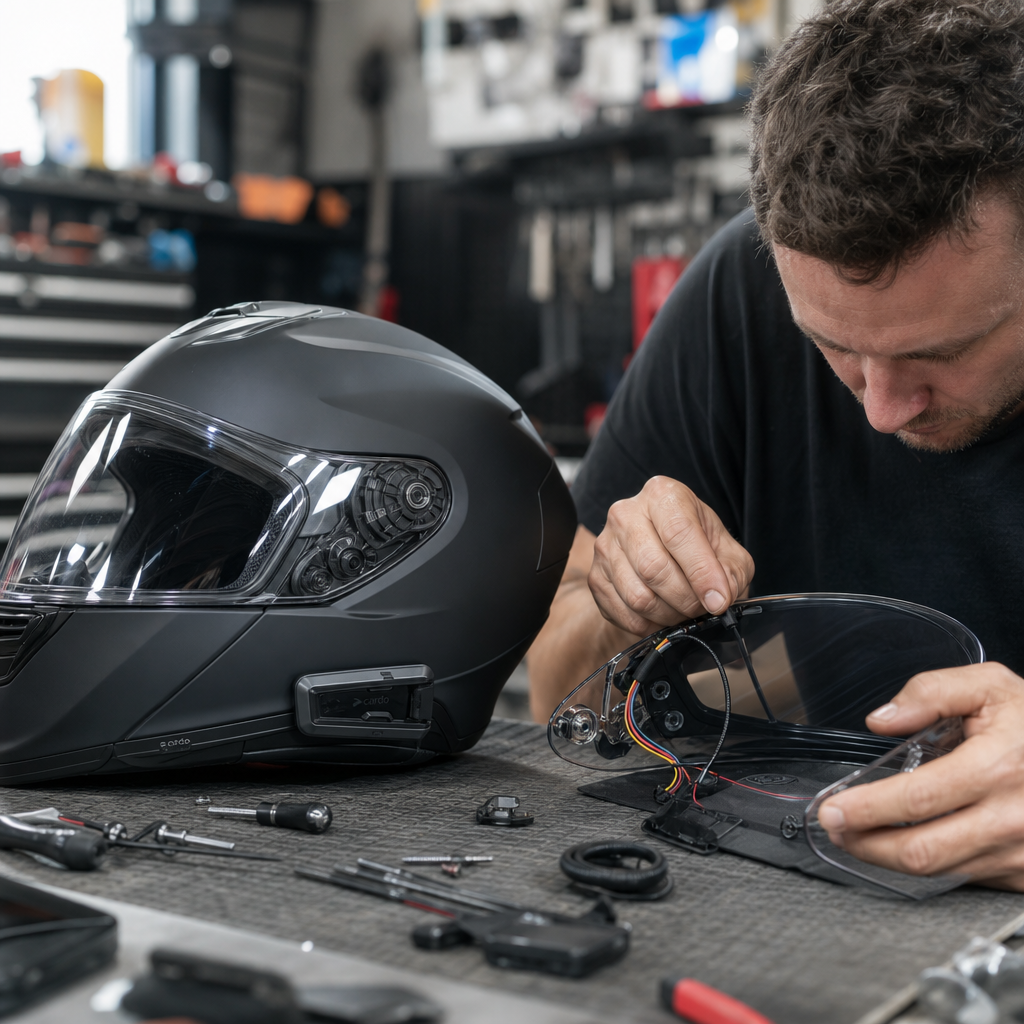
Wiring the smart helmet used to mean hiding a simple speaker set and hoping the microphone survived rain, wind, and repeated visor swaps. Today, builders are integrating Cardo mesh communication into custom visors, carbon shells, printed brackets, and modular harnesses that support navigation prompts, group comms, cameras, and accessory lighting without turning a helmet into a rattling prototype. In fabrication shops, this work sits at the intersection of rider safety, human factors, electronics packaging, and modern materials. “Custom visor” can mean a replacement shield, a bolt-on peak, an internal sun visor retrofit, or a fully fabricated face assembly for show bikes and purpose-built machines. “Cardo mesh” refers to Cardo’s Dynamic Mesh Communication system, a self-healing rider-to-rider network used in units such as the PACKTALK line. The topic matters because custom culture has moved beyond appearance. Riders now expect one-off helmets to function as reliably as premium OEM gear while accommodating printed parts, carbon fiber trims, custom wiring paths, and serviceable electronics. I have wired these systems into handmade builds, and the pattern is always the same: the visual design gets attention first, but the project succeeds or fails on cable routing, component mounting, weight balance, weather sealing, and clean acoustic performance.
This article is the hub for fabrication tech in the new wave of helmet building: 3D printing for mounts and channels, carbon and composite work for stiff lightweight structures, and wiring methods that let communication hardware live inside custom visor systems without compromising comfort or maintainability. A good integration solves four problems at once. It protects the rider by avoiding sharp internal edges and pressure points. It preserves the visor’s seal, hinge motion, and field of view. It gives the Cardo unit a stable place to transmit and receive while keeping speakers aligned with the ear canal and microphones positioned for intelligible speech. And it remains repairable when a battery degrades, a visor gets scratched, or a build evolves. Builders who understand these constraints can create helmets that look bespoke and perform predictably on the road. Builders who ignore them often end up with buffeting noise, broken wires at hinge points, poor mesh range, and shell modifications that should never have been made. The goal is not to overcomplicate a helmet. The goal is to integrate smart features with the same discipline used in motorsport wiring, industrial design, and composite fabrication.
Start with the helmet architecture, not the gadget
The right starting point is a complete map of the helmet’s architecture: shell, EPS liner, comfort liner, cheek pads, visor side plates, hinge arc, eye port gasket, chin bar cavity, and neck roll. Before touching a drill or printer, identify where the Cardo brain, battery, speakers, boom or wired microphone, and charging port can live without interfering with energy management or rider fit. EPS foam is not empty packing material; it is the impact liner, and cutting it casually to create wire channels is a mistake. On most successful builds, I route wiring through existing voids behind comfort padding, along shell edges, or inside add-on trim components rather than modifying protective structure. If a custom visor assembly is being fabricated, the ideal place for wire transitions is usually outside the primary crush zone, often near side plates or external trim covers that can be removed for service.
Custom visor work changes airflow, leverage, and service access. A printed motocross-style peak carrying marker lights has different requirements from a low-profile café shield with hidden speaker leads. Builders should define use case early: daily commuting, group touring, stunt riding, off-road, or show-only. For example, a touring setup benefits from easy charging access, glove-friendly controls, and excellent microphone isolation. An off-road setup may prioritize dust sealing, quick visor removal, and a mount that survives repeated washing. A display bike can accept compromises a road helmet cannot. The architecture phase is also where legal and safety boundaries must be respected. In many regions, altering a certified helmet shell can affect compliance. A disciplined builder minimizes permanent shell changes, favors reversible mounts, and documents every modification for the owner.
3D printing for brackets, cable guides, and visor-side packaging
3D printing has become the fastest way to make custom Cardo integrations repeatable. Instead of improvising adhesive pads and foam wedges, builders can model speaker spacers, side pod saddles, cable clips, microphone docks, and visor pivot shrouds around the exact helmet geometry. PETG, ASA, nylon, and reinforced filaments are common choices, but the material should match thermal and mechanical demand. PLA is easy to print and useful for test fitting, yet it can deform in a parked motorcycle helmet under summer heat. ASA offers better UV resistance for external parts. Nylon handles vibration and impact well, though it needs controlled printing conditions. Carbon-filled filaments look appealing, but they are not the same as structural carbon composite, and their layer adhesion still deserves scrutiny.
For custom visor systems, printed parts do best when they are treated as housings and locators rather than primary load-bearing safety components. A speaker ring can angle audio toward the ear by five to ten degrees, improving intelligibility at speed. A side bracket can hold a Cardo cradle on a curved shell where the stock clamp would never seat correctly. A micro-channel printed into a visor trim piece can protect a low-voltage harness from rubbing at the hinge. Tolerances matter. I usually leave clearance for liner compression and use TPU or thin closed-cell foam where a rigid print contacts painted surfaces. Threaded brass inserts are superior to self-tapping screws when a part will be removed often. If the mount sits near a visor pivot, simulate the full opening arc before printing the final version. Many first prototypes look perfect until the shield opens and pinches the harness.
| Fabrication task | Best-fit material or method | Why it works | Main caution |
|---|---|---|---|
| Prototype speaker spacer | PLA test print | Fast, cheap fit verification | Not heat stable for final road use |
| Exterior side bracket | ASA or nylon print | Better UV and impact resistance | Needs accurate shell contour mapping |
| Wire clip under trim | TPU flexible print | Reduces abrasion and vibration | Can creep if overstrained |
| Lightweight visor stiffener | Carbon composite layup | High stiffness at low mass | Requires controlled layup and edge finishing |
| Serviceable harness join | Micro connector with strain relief | Allows visor removal without cutting wires | Connector must be sealed and secured |
Carbon, composites, and the realities of adding electronics
Carbon fiber is popular in custom culture because it delivers stiffness, low weight, and an unmistakable visual signature, but it complicates electronics integration in ways builders should understand. Carbon composite is electrically conductive. That matters when routing wires, mounting antennas, and isolating connectors. A Cardo unit is designed to work from the exterior of standard helmet shells, and its performance can be affected by how much conductive material surrounds it. In practice, I avoid burying communication hardware behind large carbon panels and instead use carbon for visor peaks, decorative side covers, or stiffeners that preserve open space around the unit. If a carbon part must carry a wire, the wire path should be sleeved or lined so insulation never chafes against cured edges. Every trimmed opening should be radiused and sealed.
Composite fabrication also changes weight distribution. A beautifully made custom visor can still create neck fatigue if it adds mass far forward of the pivot line. That is one reason smart integrations often succeed with hybrid construction: a carbon or fiberglass skin for shape and stiffness, plus printed internal carriers for the electronics and harness. The printed carrier provides repeatable mounting points, while the composite outer layer manages appearance and aero stability. Vacuum bagging can reduce excess resin and keep parts light, but the final part still needs post-cure trimming, edge finishing, and vibration testing on the actual helmet. Builders should also think about RF transparency, not just aesthetics. Fiberglass and many plastics are friendlier to wireless signals than carbon-heavy structures. When range and mesh stability matter, keeping the communicator in its intended external position is usually the smartest choice.
Wiring strategy: power, audio, microphones, and service loops
Helmet wiring should follow the same rules as motorsport and aerospace harnessing in miniature: protect the conductor, control movement, label junctions, and design for service. Most Cardo systems are self-contained, so “integrating” them usually means extending or organizing speaker and microphone paths, adding visor-mounted accessories, or creating detachable harnesses that coexist with the communicator rather than rewiring the unit itself. Use fine-strand wire for flex areas, maintain generous bend radius, and add strain relief anywhere a harness enters a rigid component. Adhesive-backed cable clips can work inside trim pieces, but on surfaces exposed to heat and sweat, mechanical retention is more reliable. Fabric tape, thin foam, and braided sleeving reduce buzz and abrasion.
The biggest failure point on custom visor builds is the hinge transition. Every visor opening cycle flexes the same section of wire, so that section needs extra length, controlled routing, and a defined loop rather than a taut straight run. If the visor must be removable, use a compact connector rated for repeated mating cycles and place it somewhere accessible with gloves off, not buried behind glued trim. Audio performance depends on exact speaker placement more than raw volume. Measure ear pocket depth with the comfort liner installed, then use spacers so the speaker sits close to the ear without touching it. For microphones, a short boom works well in modular and open-face configurations, while wired mics usually suit full-face helmets with fixed chin bars. Wind socks and foam covers help, but the true fix for poor voice clarity is placement out of direct turbulent flow and stable mounting that prevents the mic from drifting over time.
Integrating Cardo mesh into custom visor systems without killing usability
The best Cardo mesh integration is the one a rider forgets about after five minutes. That means the external controls remain reachable, charging is simple, status LEDs are visible enough to confirm pairing, and the visor still opens, locks, and seals like it should. A common approach is to build a custom visor side plate that visually incorporates the communicator cradle while leaving the Cardo module itself removable. This preserves warranty options, allows software updates and battery replacement through normal channels, and avoids the trap of molding expensive electronics permanently into a handmade part. For riders using group communication, maintaining the factory module orientation matters because microphone processing, button access, and antenna behavior are optimized around it.
Usability also depends on noise control. A custom visor edge, add-on peak, or printed side shroud can introduce turbulence that destroys call clarity and speaker intelligibility at highway speed. I test every prototype first with yarn tufts or removable tape tabs to see where airflow separates, then make small changes to lip radius, gap spacing, or edge angle. Often the fix is simple: reduce a step between visor and side plate, close an air leak near the hinge, or move the microphone 10 millimeters inward. Riders care about mesh range, but in real use they notice audio consistency more. A system that stays connected yet sounds harsh and noisy will be abandoned. Aim for an integration that works during a fuel stop, in crosswinds, and with winter gloves on, not just in the shop with the bike idling.
Testing, standards, and the builder’s responsibility
Any smart helmet modification deserves a testing plan. Start with bench tests: charge cycles, button access, connector engagement, and continuity checks across every moving wire section. Then move to fit tests with the actual rider, because cheek pad pressure and eyewear can shift speaker and microphone positions more than expected. Road testing should cover low-speed urban use, sustained highway riding, rain exposure, and repeated visor operation after the helmet has warmed in the sun. Listen for rattles, check whether adhesives soften, and inspect for witness marks where the harness may be rubbing. If you are integrating accessory lighting or a secondary power source, verify thermal behavior carefully. Heat buildup inside sealed trim cavities is real, especially near dark composite parts exposed to summer sun.
Builders should use established safety thinking even when creating one-off pieces. Snell, ECE, and DOT frameworks differ, but all reinforce the same lesson: helmet performance depends on carefully engineered structure, retention, and field of view. Do not cut shell and EPS material casually to chase a clean wire path. Do not place hard components where they create pressure points against the skull. Do not let a custom visor reduce visibility or fail to latch securely. The professional standard is simple: if an integration introduces uncertainty in a safety-critical area, redesign it until the uncertainty is gone. The strongest custom work in this space respects the helmet first and the technology second.
Fabrication tech has transformed helmet building from cosmetic customization into systems integration. 3D printing gives builders rapid, precise ways to make speaker spacers, side mounts, cable guides, and serviceable visor hardware. Carbon and composite methods add stiffness and visual impact when they are used with a clear understanding of conductivity, edge finishing, weight balance, and wireless performance. Wiring ties everything together, but only when it is routed with strain relief, protected through hinge movement, and designed for maintenance instead of one-time assembly. Cardo mesh belongs in this conversation because it represents what riders now expect from a custom helmet: dependable communication integrated into a distinctive build without sacrificing comfort, acoustics, or practical service.
As the hub for fabrication tech under custom culture and builders, this topic connects directly to deeper work in printed component design, carbon layup strategy, harness planning, acoustic tuning, and removable visor engineering. The main benefit of doing it right is not novelty. It is confidence: the helmet looks custom, functions cleanly, and survives real riding. If you are planning a build, begin with a layout map, choose materials by heat and vibration demands, keep electronics removable, and test every moving wire path before final assembly. That discipline is what turns a smart helmet concept into a roadworthy custom piece.
Frequently Asked Questions
What should builders consider first when integrating Cardo mesh into a custom visor or helmet setup?
The first priority should always be preserving the helmet’s protective function. Before thinking about speaker placement, cable routing, or cosmetic integration, builders need to understand how the shell, visor mechanism, liner, and retention system were designed to work together. Any modification that introduces stress points, removes impact-absorbing material, interferes with visor sealing, or changes how the helmet fits can undermine safety and comfort. In practical terms, that means avoiding aggressive drilling in structural areas, not compressing EPS foam to make room for electronics, and making sure any added hardware does not create pressure hotspots against the rider’s head during long rides.
After safety, the next major consideration is systems planning. Cardo mesh units are no longer just rider-to-rider communicators; they often sit at the center of a broader helmet electronics ecosystem that includes navigation prompts, boom or wired microphones, action cameras, USB charging access, accessory lighting, and sometimes even custom control modules. Builders should map the entire signal and power path before fabrication begins. That includes deciding where the main communication unit will sit, how the speakers will align with the ears, how the microphone will remain protected from wind and moisture, and how wires will move through the helmet during repeated visor swaps or modular opening cycles.
Human factors matter just as much as electrical correctness. A setup can be perfectly wired and still fail if the rider cannot operate it with gloves, if the controls are hard to find at speed, if the weight distribution causes neck fatigue, or if visor removal becomes inconvenient enough that the rider avoids cleaning or maintenance. Good integration keeps the Cardo system accessible, balanced, weather-resistant, and easy to service. The best builds look intentional from the beginning: minimal cable exposure, strain relief at movement points, no rattles, no pinch zones, and clear access for charging, firmware updates, and replacement parts.
How can Cardo mesh wiring be routed cleanly through custom visors, carbon shells, or printed brackets without causing reliability issues?
Clean routing starts with understanding motion. In a smart helmet build, the most common failure points are not usually the speakers or communicator itself, but the places where wires flex, twist, rub, or get pinched. If the visor lifts, detaches, or swaps regularly, every cable path near the hinge or mounting points needs enough slack to accommodate movement without snagging. At the same time, too much slack creates loops that can rattle, wear against edges, or interfere with seals. The solution is controlled service loops, soft retention clips, and protective sleeving where cables pass through narrow channels or close to hard surfaces.
With carbon shells or composite helmets, routing must be especially deliberate because internal channels are limited and sharp edges around trimmed openings can abrade insulation over time. Builders should use edge grommets, flexible conduit, or low-profile sheathing anywhere a wire transitions through a drilled or cut passage. Adhesive-backed mounts can help with cable management, but the adhesive needs to be selected for heat, humidity, and vibration. In many cases, a hybrid approach works best: mechanical retention in high-stress areas and adhesive guidance in low-stress areas. For printed brackets, design features such as rounded cable exits, integrated strain relief, snap-fit covers, and isolated mounting pads can dramatically improve long-term durability.
Serviceability is another hallmark of a reliable routing strategy. A helmet that requires full disassembly to replace a speaker lead or visor harness is not well engineered. Modular connectors, labeled harness branches, and removable bracket assemblies make troubleshooting far easier. Builders should also separate power and signal wiring where practical, avoid crossing over ventilation channels, and test the entire routing path repeatedly under real use conditions: visor up, visor down, chin bar opened if applicable, communicator removed and reinstalled, and gloves on. If the system remains quiet, secure, and free of pinch points after repeated cycles, the routing design is probably on the right track.
How do builders maintain audio quality and microphone performance in a custom smart helmet installation?
Audio quality in a helmet is primarily about placement, sealing, and noise control. Even premium Cardo mesh hardware can sound disappointing if the speakers sit too far from the ears or are misaligned vertically. Many custom helmet builds fail because the speaker pockets are aesthetically tidy but acoustically poor. The speakers should sit as close to the ears as comfort allows, centered carefully, and secured so they do not shift over time. Small differences in position can have a major effect on perceived volume, clarity, and navigation intelligibility, especially at highway speeds. Spacers or custom recesses are often worth the effort if the liner geometry does not naturally align with the rider’s ears.
Microphone performance is even more sensitive because it has to capture speech while rejecting wind blast, road noise, and helmet resonance. Whether the build uses a wired microphone or boom-style solution adapted to a custom visor arrangement, placement should prioritize a stable location near the mouth without exposing the mic directly to incoming airflow. Foam windscreens, shaped mic recesses, and careful chin vent management all help. If a custom visor or shell modification changes internal airflow, it can unintentionally create turbulence that makes speech sound harsh or inconsistent. Builders should test microphone pickup at multiple speeds and in different head positions rather than relying only on garage or low-speed checks.
Helmet acoustics also benefit from vibration control. Loose harnesses, poorly secured speakers, or brackets that buzz against the shell can degrade both incoming and outgoing audio. Soft isolation materials, proper fastener torque, and anti-rattle pads can make a dramatic difference. It is also wise to verify that added accessories such as cameras or lighting modules are not introducing noise through mounting vibration or shared wiring pathways. The most successful installations treat the helmet as an acoustic environment, not just a place to store electronics. When speakers are aligned, microphones are shielded correctly, and everything is mechanically stable, Cardo mesh systems can deliver surprisingly clear communications even in highly customized builds.
What are the biggest safety and durability concerns when adding communication, lighting, and accessory wiring to a helmet?
The biggest concern is creating a helmet that appears advanced but introduces hidden compromises. Every added wire, bracket, battery interface, or accessory mount changes the helmet’s mechanical and practical behavior. Externally, protrusions can increase snag risk or produce additional wind load. Internally, badly placed hardware can create pressure points, reduce liner effectiveness, or force the rider into a poor fit. From a durability standpoint, custom helmet electronics live in a harsh environment: vibration, UV exposure, sweat, rain, temperature swings, dust, and repeated handling all work against long-term reliability. A build that survives a bench test may still fail quickly on the road if those stresses were not considered.
Moisture management is one of the most underestimated issues. Builders often focus on making a harness compact but forget that condensation, rain ingress, and wash-down exposure can travel along cable paths and settle in connectors or low points inside a visor assembly. Sealed connectors, drip loops, dielectric protection where appropriate, and thoughtful enclosure design all help reduce corrosion and intermittent faults. Likewise, power accessories such as lighting should be fused or otherwise protected according to their design, and builders should avoid improvised charging arrangements that can overheat, loosen, or become unreliable after repeated cycles.
Another major concern is fatigue failure from repeated use. Visors are opened, closed, swapped, cleaned, and sometimes dropped. Communication units are removed for charging or security. Riders tug on straps and don helmets quickly in less-than-ideal conditions. A safe, durable installation accounts for abuse. That means reinforced attachment points, proper strain relief, vibration-resistant fasteners, and no dependence on a single adhesive pad or unsupported solder joint in a movement zone. It also means knowing when not to integrate something. If an accessory requires routing that compromises shell integrity or fit, the correct engineering decision may be to relocate it, redesign it, or leave it out entirely.
What is the best way to prototype and test a custom Cardo mesh helmet build before considering it finished?
The best approach is staged validation rather than one full final assembly. Start with a non-destructive mockup that verifies component placement, control access, and cable paths before anything is bonded, drilled, or permanently mounted. Use temporary retention methods to evaluate speaker location, microphone pickup, visor travel, and external unit accessibility with gloves on. At this stage, the goal is to identify ergonomic problems early: controls too far back, a cable interfering with the visor seal, a speaker contacting the ear, or a bracket that seems solid on the bench but flexes under real handling. These issues are much easier to correct in a prototype state than after cosmetic finishing.
Once placement is confirmed, move to functional testing under realistic conditions. That means riding with the system in varying speeds, checking mesh communication stability, listening for rattles, confirming navigation prompt clarity, and evaluating whether added accessories affect balance or wind noise. Test in dry and wet conditions if possible. Open and close the visor repeatedly, remove and reinstall any modular components, and verify that connectors remain secure. Also test the charging and maintenance workflow. If recharging, cleaning, or firmware access becomes annoying, the build will be less practical over time no matter how polished it looks initially.
Finally, perform a durability review with a builder’s mindset, not a hobbyist’s optimism. Inspect every transition point, every