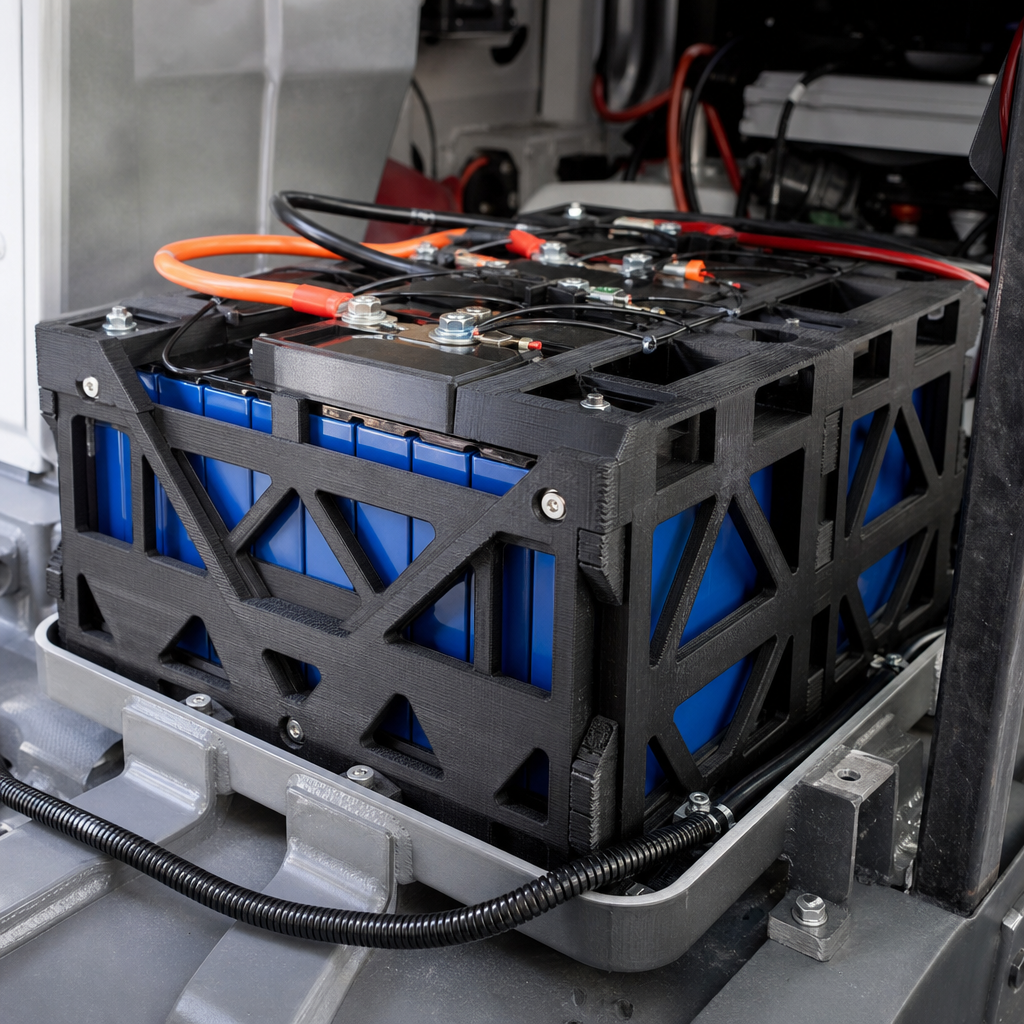
3D-printed battery cages are becoming a practical, high-value solution for builders planning 2026 lithium conversions, especially when a project demands secure mounting, precise packaging, and repeatable fabrication without the weight and tooling burden of traditional metalwork.
In this context, a battery cage is the structural enclosure or retention system that locates lithium cells or battery modules, controls movement under vibration and impact, and integrates mounting points, wire routing, cooling gaps, and service access. A lithium conversion means replacing lead-acid, nickel-metal hydride, or older pack architectures with newer lithium chemistries such as LiFePO4 or NMC. For custom builders, fabricators, and restoration shops, the cage is not a cosmetic add-on. It is part of the safety system, part of the electrical system, and often part of the vehicle’s packaging strategy.
I have worked on prototype enclosures for motorsport auxiliaries, e-bike packs, and classic vehicle conversions, and the pattern is consistent: battery failures are often blamed on chemistry when the real issue is mechanical support, heat management, or poor cable discipline. A well-designed 3D-printed battery cage does three jobs at once. It holds cells firmly, isolates them from abrasion and short circuits, and gives the builder a repeatable base for busbars, BMS leads, fusing, and service loops. That matters more in 2026 because higher energy density, tighter build spaces, and stricter expectations around crashworthiness are all pushing packaging quality upward.
This hub article covers the full fabrication technology stack around modern battery mounting: 3D printing materials and methods, carbon composite integration, wiring architecture, design rules, validation testing, and when to move from printed prototype to hybrid or fully engineered production hardware. If you are building an EV swap, upgrading a custom motorcycle, packaging an auxiliary lithium system in an overland rig, or designing modular battery trays for a small-volume product, this guide explains what works, where the limits are, and how the supporting technologies connect.
Why 3D-Printed Battery Cages Matter in 2026 Lithium Conversions
Battery packaging has changed because vehicle conversions have changed. Ten years ago many custom projects could accept oversized boxes, simple straps, and conservative current demand. In 2026, builders are packaging more power into tighter spaces while trying to preserve cabin room, cargo space, suspension travel, and weight distribution. That pushes the mount from a simple bracket into a designed assembly. 3D printing fits this shift because it allows complex geometry, cable channels, integrated spacers, captive nut pockets, and shape-specific cell retention without expensive tooling.
The strongest case for 3D-printed battery cages is not speed alone. It is geometric control. A printed cage can create exact cell spacing for cylindrical, prismatic, or pouch support structures, maintain airflow where needed, and prevent lateral migration under repeated shock loads. In custom motorcycle and powersports conversions, I have seen printed separators and end frames eliminate the fretting that often damages cell wraps in hand-built packs. In classic car conversions, printed module cradles make it possible to fit batteries below a trunk floor or within a former fuel tank envelope while preserving serviceability.
Another reason this matters is traceability. Once a cage design is modeled in CAD, the dimensions, tolerances, and mounting logic are documented. That improves repeat builds and makes later revisions safer. If you add a larger contactor, move a fuse, or switch from one BMS harness to another, the changes can be captured in the file instead of improvised on the bench. For builders serving customers, that consistency reduces warranty risk and supports cleaner documentation.
Material Selection, Print Methods, and Structural Design Rules
Material choice determines whether a printed battery cage is a useful engineering component or a fragile mockup. PLA is acceptable for concept models, fit checks, and low-temperature templates, but it should not be used for final battery retention in vehicles. Its heat resistance, creep performance, and long-term dimensional stability are not sufficient for underfloor, engine-bay-adjacent, or sun-exposed service. PETG performs better for chemical resistance and ease of printing, yet it still has limitations under sustained load and elevated temperature.
For real battery cage duty, builders should look at nylon, glass-filled nylon, carbon-fiber-reinforced nylon, polycarbonate blends, polypropylene in suitable applications, and high-performance engineering polymers where budget allows. PA12 remains a strong option in selective laser sintering because it combines toughness, decent thermal stability, and isotropic behavior compared with poorly tuned filament prints. In fused filament fabrication, PA-CF can produce rigid parts with good temperature performance, but layer adhesion, moisture control, and print orientation become critical. Resin printing can deliver excellent accuracy for fixtures and low-load inserts, yet most common resins are too brittle for primary structural retention unless a specialty tough formulation has been validated.
Design rules matter as much as material. Printed cages should avoid sharp internal corners, thin unsupported walls, and long cantilevers carrying dynamic loads. Load paths need to be direct. Fasteners should clamp through compression sleeves, metal inserts, or backed flanges rather than relying on threaded plastic alone in safety-critical locations. Ribbing should be used to increase stiffness without excess mass, and cells should be restrained with distributed contact surfaces rather than point pressure. The key principle is simple: the print should locate and insulate, while metal hardware and chassis structure should carry the most severe crash and retention loads.
| Material or Method | Best Use | Main Advantage | Main Limitation |
|---|---|---|---|
| PLA | Mockups and fitment checks | Easy, cheap, dimensionally predictable | Poor heat resistance and creep |
| PETG | Light-duty covers and guides | Good chemical resistance, easy printing | Moderate stiffness, long-term load concerns |
| PA-CF nylon | Functional cages and brackets | High stiffness, better heat performance | Needs dry filament and tuned process |
| PA12 SLS | Production-grade complex parts | Tough, consistent, good geometry freedom | Higher outsourcing cost |
| Polycarbonate blend | High-heat housings and guards | Impact and temperature performance | Warping and print difficulty |
Secure Mounting: Vibration, Crash Loads, and Service Access
A secure battery mount must survive three conditions: daily vibration, exceptional shock, and maintenance activity. Daily vibration causes loosening, abrasion, and fatigue. Exceptional shock includes pothole strikes, curb impacts, off-road events, and collision forces. Maintenance activity introduces accidental pry loads, dropped tools, and repeated fastener cycles. The cage has to manage all three without transferring damaging stress into the cells.
For cylindrical cells, that usually means using printed lattices or honeycomb carriers with controlled clearance, insulating fish paper or equivalent barriers where required, and compression schemes that support the assembly evenly. For prismatic cells, it means flatness, compression control, end-plate strength, and anti-swell spacing based on the cell manufacturer’s guidance. Builders should not assume that a tightly packed box is safer. Over-constraining cells can be as harmful as leaving them loose, because lithium formats respond differently to thermal cycling and swelling.
Mounting to the chassis should follow established motorsport and OEM logic. Use multiple fasteners, wide load-spreading washers or backing plates, and predictable attachment points tied to strong structure. If the enclosure sits under a floor, think about water spray, stone impact, and jacking loads. If it lives in a trunk or rear seat area, think about intrusion, vent routing, and isolation from cargo. Service access matters too. A cage that requires cutting zip ties and removing unrelated trim every time a fuse is inspected is not finished engineering. Good designs separate high-voltage service components from the core retention structure and provide access panels, labeling, and wire exits that do not force sharp bend radii.
How Carbon Composite Parts Support Modern Battery Packaging
Carbon fiber enters the conversation because builders increasingly need high stiffness at low mass. However, carbon should be used selectively around batteries. It excels in covers, secondary panels, nonconductive sandwich structures with proper isolation layers, and cosmetic or aerodynamic integration. It is less forgiving when directly exposed to uncontrolled electrical interfaces because carbon fiber can be electrically conductive. That means any design placing carbon near terminals, busbars, or damaged insulation must account for dielectric barriers and fault paths.
In practice, the most effective approach is hybrid construction. I have had the best results using 3D-printed cages for geometry, insulation features, and cable management, then adding carbon or fiberglass composite panels as covers, trays, or stiffness skins where weight savings justify the effort. For example, a printed PA-CF cell frame mounted into an aluminum cradle with a carbon top cover can combine repeatable fitment, low mass, and strong torsional behavior. In motorsport and performance street builds, this hybrid approach also makes it easier to replace only the damaged section after an incident.
Fiberglass often deserves equal attention. It is cheaper, easier to repair, and generally more forgiving around electrical systems. For many conversion builders, fiberglass or glass-reinforced sheet is the smarter choice for battery compartment liners and closeout panels, while carbon is reserved for visible covers or structural skins where every kilogram matters. The design goal is not to use exotic material for its own sake. It is to place each material where its specific properties solve a packaging problem.
Wiring Architecture, BMS Integration, and Thermal Management
Battery cages are only successful when they support wiring discipline. Every secure lithium conversion needs intentional routing for main positive and negative cables, contactor leads, pre-charge circuits, current shunt wiring, BMS sense leads, temperature probes, and low-voltage control harnesses. Printed cages can integrate these routes directly, keeping high-voltage conductors separated from low-voltage signal wires and reducing the chance of chafing. Features like snap-in loom channels, grommet seats, connector brackets, and strain-relief tabs are where additive manufacturing offers clear value over improvised brackets.
Thermal management must be considered from the first sketch. Lithium cells last longer and operate more consistently when temperatures remain controlled and balanced. A cage should not block natural airflow if the pack is air-cooled, and it should not trap heat around the hottest cells. If liquid cooling is used, the printed structure must preserve hose serviceability, leak detection visibility, and electrical isolation. Builders should also allow for thermal expansion and avoid routing sensitive wiring directly against warm busbars or enclosure surfaces.
Standards and known practices help here. Cable sizing should follow current demand, insulation rating, ambient temperature, and installation method. Fusing should be close to the source where appropriate. High-voltage orange cabling, touch-safe covers, insulation resistance testing, and clear service disconnect logic are not optional details. They are part of building a system that another technician can understand and service safely. The battery cage should reinforce that logic by making the safe wire path the natural wire path.
Validation, Compliance Thinking, and When Not to Print the Final Part
Testing is what separates a credible battery cage from a neat fabrication story. At minimum, a builder should conduct fit validation, torque-cycle checks, vibration exposure, heat soak evaluation, and inspection after repeated installation and removal. In a serious project, add drop or shock fixture testing for modules, environmental exposure for moisture and chemicals, and insulation checks after thermal cycling. If a part shows layer separation, insert pullout, stress whitening, or fastener ovalization, redesign it before the vehicle sees the road.
Compliance expectations vary by market and vehicle type, but the engineering mindset should always be conservative. Review guidance from cell manufacturers, connector suppliers, and recognized transportation and electrical standards. UN 38.3 applies to transport testing for lithium batteries, while broader automotive expectations draw from ISO, SAE, OEM service practices, and regional roadworthiness rules. A custom builder may not certify like a major manufacturer, but that does not justify guesswork. Document materials, print settings, torque values, inspection intervals, and electrical protection choices.
There are also cases where the final retention part should not be 3D printed. If the mount is in a primary crash load path, exposed to severe underbody strike risk, or carrying very high battery mass, a printed component is often best used as a prototype, mold pattern, or insulated substructure inside a metal enclosure. Aluminum sheet, formed steel, machined engineering plastic, or composite sandwich panels may be the better final answer. The right question is not whether 3D printing can be used. It is where it creates the most safety, speed, and precision in the overall fabrication process.
Building the Fabrication Tech Hub: Printing, Carbon, and Wiring Together
This page sits at the center of the broader fabrication technology conversation because modern custom building is no longer siloed. Battery cages connect directly to adjacent topics: printed fuse and relay mounts, connector retention blocks, ducting for cooling, carbon closeout panels, composite battery covers, busbar insulators, service panels, and full harness planning. A strong build sequence usually starts with packaging scans or careful measurements, moves into CAD, then uses low-cost prototype prints for fitment, followed by structural revisions, wiring layout, and only then the final mixed-material parts.
That workflow saves time and money because errors show up early. For example, a builder converting a classic pickup to LiFePO4 can print a trunk floor mockup and battery cage set, verify suspension compression clearance, then finalize cable exits before sending composite cover panels to production. An electric motorcycle builder can print module carriers, validate shock isolation and chain clearance, then commit to a carbon side cover once BMS and contactor placement are fixed. In both cases, 3D printing is not replacing fabrication skill. It is amplifying it by making the decision chain visible and repeatable.
3D-printed battery cages give 2026 lithium conversions a smarter foundation because they solve the real challenge of modern battery work: secure mounting that also supports insulation, wiring, cooling, serviceability, and repeatability. The best results come from using the right material, respecting print orientation and load paths, and treating the cage as one part of a complete system rather than a standalone container.
Across custom cars, motorcycles, overland rigs, and small-volume products, the winning pattern is consistent. Use additive manufacturing for precision geometry, hybridize with metal or composites where the loads demand it, keep wiring organized and protected, and validate every design with physical testing. Carbon has a role, but only when paired with proper electrical isolation. Wiring must be designed into the structure from day one. And when a printed part is not the safest final solution, use it as a prototype or insulating subassembly instead of forcing it into a job it should not do.
As the hub for fabrication tech covering 3D printing, carbon, and wiring, this guide should help you frame the next steps in your build with fewer assumptions and better decisions. Review your battery packaging now, identify where a printed cage or hybrid enclosure would improve retention and service access, and use that design process to raise the quality of the entire conversion.
Frequently Asked Questions
What is a 3D-printed battery cage, and why is it useful for 2026 lithium conversions?
A 3D-printed battery cage is a purpose-built structural enclosure or retention system designed to hold lithium cells or battery modules securely in place inside a vehicle, machine, or custom energy storage project. In a 2026 lithium conversion, its role goes far beyond simply “holding batteries.” A well-designed cage controls cell movement under vibration, hard braking, cornering, and impact, while also integrating mounting points, wire routing, compression features where required, service access, and spacing for thermal management. That combination makes it especially valuable for builders who need precise packaging in tight or irregular spaces.
The main advantage is design freedom. Traditional sheet metal and welded trays are effective, but they often require more tooling, more fabrication skill, more weight, and more iteration time. A 3D-printed battery cage can be modeled around the exact dimensions of the cells, busbars, BMS wiring, contactors, fusing, and mounting geometry of the host platform. That allows builders to create a cleaner, more repeatable installation with less wasted volume. For conversions where every millimeter matters, that precision can be a major benefit.
Another reason these cages are gaining attention for 2026 projects is repeatability. Once a design is proven, it can be reproduced consistently for multiple builds or replacement parts. That matters for shops, low-volume manufacturers, and serious DIY builders who want a documented, scalable solution instead of a one-off bracket arrangement. In short, 3D-printed battery cages are useful because they combine secure mounting, optimized packaging, lower fabrication overhead, and easier iteration into one highly practical system for modern lithium retrofit work.
Are 3D-printed battery cages strong enough to securely mount lithium batteries in real-world use?
They can be, provided they are engineered correctly. Strength does not come from the fact that a part is 3D-printed; it comes from the material selection, wall thickness, print orientation, infill strategy, reinforcement features, fastening method, and overall geometry of the cage. A battery cage intended for real-world use must be designed as a structural component, not as a cosmetic holder. That means accounting for static load, shock load, vibration, crash forces, fastener pull-through, long-term creep, and the way the battery mass behaves during acceleration and impact.
For that reason, the best 3D-printed battery cages typically use robust engineering plastics rather than hobby-grade materials chosen only for ease of printing. Builders often favor materials with good thermal stability, impact resistance, and dimensional reliability, especially if the installation will live near drivetrains, underbody areas, or enclosures that may see elevated temperatures. Design features such as ribbing, gussets, radiused corners, captive hardware, compression sleeves, and load-spreading interfaces help turn a printed part into a durable retention system rather than a weak shell.
It is also important to understand where the loads go. In many successful designs, the printed cage manages positioning, isolation, spacing, and packaging, while metal inserts, crossbars, straps, or vehicle-mounted brackets carry the highest structural loads. That hybrid approach is often the most practical and safest path. So yes, 3D-printed battery cages can absolutely be strong enough for secure lithium mounting, but only when they are treated as engineered assemblies with real load paths and validation, not as simple printed boxes.
What design features should a good 3D-printed battery cage include for safety, serviceability, and long-term reliability?
A good battery cage should first and foremost prevent unwanted battery movement. That means positive retention in every direction, not just support from underneath. A complete design should account for vertical lift, side loading, fore-aft shock, and torsional vibration. Depending on the cell format or module style, this may include cell separators, compression plates, end restraints, anti-rattle features, and dedicated hold-down structures. Secure mounting to the chassis or substructure is equally important, with fastener locations placed to distribute loads without concentrating stress in thin sections.
Beyond retention, wire management and electrical integration matter a great deal. A high-quality cage design should include protected routing paths for balance leads, sensor wires, main power cables, and BMS harnesses so that abrasion, pinch points, and accidental strain are minimized. It should also leave clear space for insulation barriers, busbar access, service disconnects, and fuse placement. Thermal considerations should not be ignored either. Depending on the chemistry and use case, the cage may need air gaps, vent paths, cooling interfaces, or controlled spacing between cells to support heat management and reduce hotspots.
Serviceability is another mark of a mature design. Builders should be able to inspect fasteners, replace individual modules where appropriate, remove covers, and access critical wiring without dismantling the entire pack structure. Captive nuts, threaded inserts, removable lids, labeled cable channels, and modular sections all improve maintenance over the life of the conversion. Long-term reliability also benefits from thoughtful details such as rounded cable exits, isolation from dissimilar metals, moisture management, drainage strategy, and allowance for material expansion and contraction. The best battery cages are not just secure on day one; they remain stable, inspectable, and dependable after years of use.
How do 3D-printed battery cages compare with traditional metal battery trays or fabricated enclosures?
Each approach has clear strengths, and the right choice depends on the project. Traditional metal trays and welded enclosures remain the benchmark for very high-load environments, large-format packs, and applications where extreme impact resistance or regulatory familiarity is a top priority. Metal can offer excellent stiffness and heat tolerance, and many builders trust it because the methods are proven. However, metal fabrication often brings penalties in weight, tooling requirements, manufacturing time, and design complexity, especially when the battery pack has to fit around unusual chassis shapes or packaging constraints.
That is where 3D-printed battery cages stand out. They allow complex geometries to be produced without molds, dies, or elaborate welding setups. Features such as cell indexing, integrated standoffs, cable channels, sensor mounts, and custom contours can be built directly into the part rather than added later through secondary fabrication. For prototyping and low-volume production, this can dramatically reduce iteration time and simplify the path from concept to installed system. It also makes it easier to maintain consistency across repeat builds.
In practice, many of the strongest solutions are hybrid systems. A project may use a 3D-printed cage for precision positioning, insulation management, and modular packaging, combined with metal reinforcement for chassis attachment and high-load retention. That balance captures the best of both worlds: the customization and repeatability of additive manufacturing, with the structural confidence of conventional hardware where it matters most. So the comparison is not always “printed versus metal.” Increasingly, it is about using each method where it delivers the most value in the overall battery mounting strategy.
What should builders keep in mind before using a 3D-printed battery cage in a lithium conversion project?
Builders should begin with the full system requirements, not just the cage shape. The battery mass, expected vibration environment, crash exposure, temperature range, charging behavior, service access, and mounting location all affect what the cage needs to do. A cage for an interior-mounted low-voltage auxiliary pack is a very different engineering problem from a high-energy traction battery mounted near the floorpan or in an exposed compartment. Clarifying the use case early helps determine whether a printed cage is suitable as the primary enclosure, a secondary retention structure, or one component in a broader assembly.
Material choice and manufacturing quality deserve close attention. Not all printed parts are equal, and a poor print can undermine an otherwise sound design. Builders should consider layer adhesion, print orientation, heat resistance, UV exposure, chemical exposure, and the possibility of creep under continuous load. They should also plan for threaded inserts, metal sleeves, or backing plates where fasteners and structural interfaces are involved. If the battery system is expected to face high loads or long-term duty cycles, prototype testing and iterative refinement are strongly recommended rather than assuming the first version is sufficient.
Finally, safety and compliance should stay at the center of the decision. Lithium conversions require careful attention to insulation, short-circuit protection, thermal behavior, containment strategy, and secure mounting under abnormal conditions. A battery cage should support those priorities, not complicate them. Builders should think in terms of the complete installation: enclosure design, electrical isolation, fusing, BMS integration, venting, service procedures, and inspection access. When approached with that level of discipline, a 3D-printed battery cage can be an excellent solution. When treated casually, it can introduce unnecessary risk. The most successful projects are the ones that combine smart packaging with sound engineering and realistic validation.