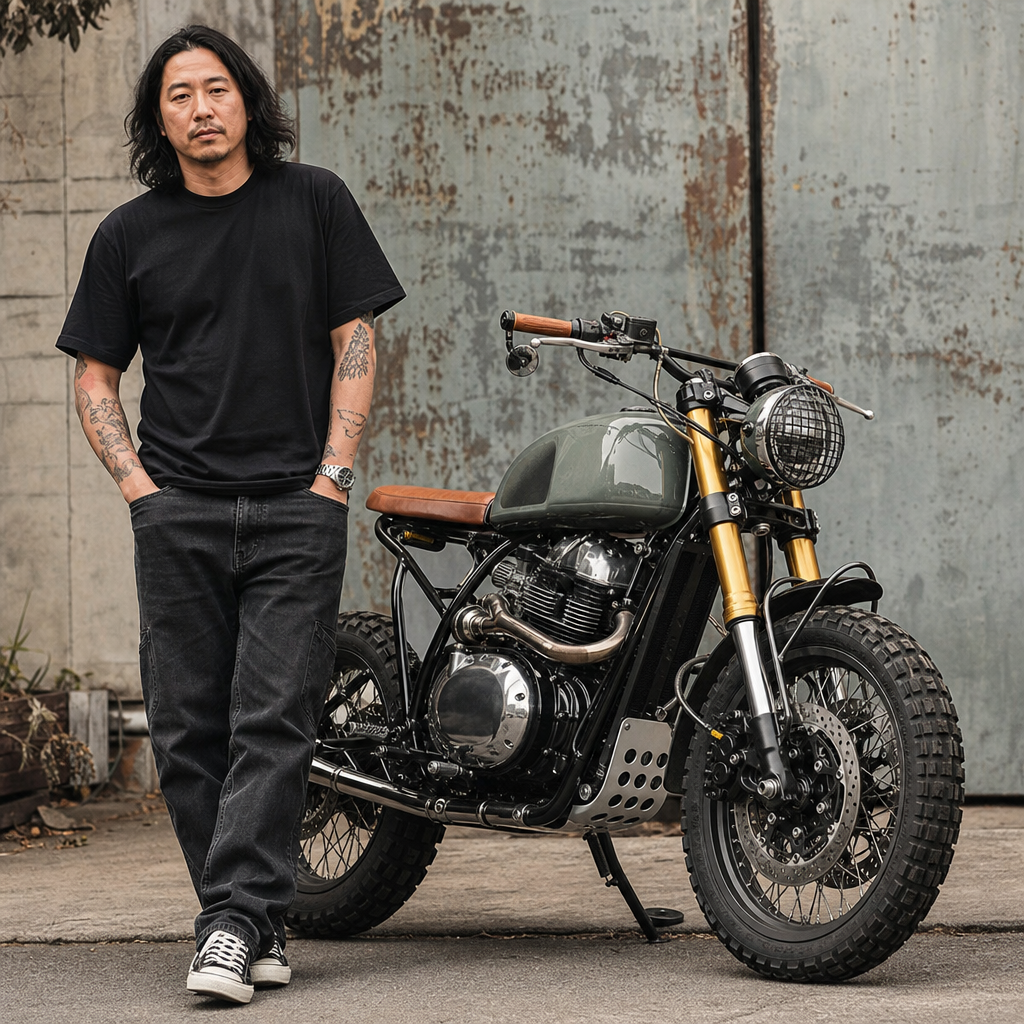
Winston Yeh’s 2026 Royal Enfield Factory Custom matters because it sits at the crossroads of motorcycle design, brand strategy, and the changing definition of custom culture. Yeh, best known as the founder of Rough Crafts in Taiwan, has spent years proving that a custom motorcycle can be radical without becoming unusable, premium without becoming precious, and modern without losing mechanical soul. When that design language is applied to a Royal Enfield factory-backed build in 2026, the result becomes more than a show bike. It becomes a reference point for how established manufacturers work with independent builders to shape taste, influence buyers, and test future product directions.
In practical terms, a factory custom is a motorcycle commissioned, supported, or officially endorsed by the manufacturer rather than built entirely outside the OEM orbit. A builder profile, especially within the new guard of fabrication, is not just a biography. It is an analysis of methods, materials, aesthetics, engineering decisions, and cultural influence. That is why this hub article focuses not only on Winston Yeh and the 2026 Royal Enfield Factory Custom, but also on the broader landscape of profiles of 2026 new guard and legendary builders. If you are mapping contemporary custom culture, this is one of the anchor stories, because it connects old-school craftsmanship with CAD-informed fitment, digital brand reach, and globally distributed inspiration.
I have followed factory custom programs and independent builder collaborations long enough to know that most successful examples solve three problems at once. They must preserve the base motorcycle’s identity, translate the builder’s visual signature clearly enough that even a casual fan recognizes it, and remain technically coherent rather than ornamental. Yeh has historically excelled at that balance. His motorcycles often feature compressed silhouettes, precise negative space, disciplined color treatment, and carefully selected performance components from recognized suppliers such as Öhlins, Brembo, BST, and Koso. Those choices are not random decoration. They create a machine that feels intentional from stance to stopping power.
For Royal Enfield, the stakes are equally clear. The brand has built modern momentum through approachable middleweight platforms, heritage-rich styling, and global accessibility. A 2026 factory custom associated with Rough Crafts signals that Royal Enfield is not content to remain a nostalgia brand. It wants relevance among younger builders, urban riders, fabrication students, and design-conscious enthusiasts who see motorcycles as cultural objects as much as transport. This article serves as the hub for that conversation, giving you the context needed to understand Yeh’s role, the machine’s importance, the technologies shaping the scene, and the related builder profiles that define this era.
Who Winston Yeh Is and Why Rough Crafts Carries Weight
Winston Yeh built Rough Crafts into one of the most recognizable names in contemporary motorcycle customization by developing a design signature that could cross brands without becoming generic. Based in Taipei, he earned international attention through custom Harleys, BMWs, and other platforms that combined low, aggressive posture with meticulous finishing and a restrained palette. Many builders can produce a dramatic motorcycle. Fewer can produce one that photographs well, rides credibly, and immediately reads as their work from twenty feet away. That consistency is why Rough Crafts holds weight within discussions of both new guard and legendary builders.
His background outside traditional motorcycle manufacturing also matters. Yeh came from design and street culture rather than from a conventional engineering department, and that perspective helped him build bikes that feel connected to sneakers, architecture, automotive restomods, and contemporary visual branding. In the social media era, that multidisciplinary fluency is not a side note; it is central to influence. A Rough Crafts build often succeeds because every detail supports a complete visual system: wheel choice, seat line, bar position, lighting integration, and surface finish all speak the same language. Manufacturers notice that kind of coherence because it converts attention into aspiration.
Within the broader profiles of 2026 new guard and legendary builders, Yeh occupies a hybrid position. He is no longer an insurgent newcomer, yet he still represents the mindset that changed custom culture over the last decade: cleaner integration, sharper brand identity, and elevated parts curation. Unlike many legacy chopper or café builders whose reputations were formed in local scenes first and media second, Yeh’s rise was inseparable from international publication, digital imagery, and cross-market recognition. That does not make his work less authentic. It means he understood early that a custom motorcycle in the modern era must perform as a rideable object and as a communicable idea.
Why a 2026 Royal Enfield Factory Custom Is Strategically Important
Royal Enfield has become one of the most interesting platforms in the global custom scene because its motorcycles are mechanically straightforward, visually legible, and price-accessible enough to invite experimentation. Models such as the Interceptor 650, Continental GT 650, Super Meteor 650, Shotgun 650, and Himalayan have all appeared in custom programs because they provide clean starting points with enough aftermarket support to make meaningful transformation practical. A 2026 factory custom by Winston Yeh therefore represents a strategic fit, not a novelty pairing.
From the manufacturer side, these projects function as live research and development in public. They test how far a platform’s design can stretch without breaking recognizability. They also reveal which details resonate with riders: revised subframes, wheel conversions, premium suspension, clip-on alternatives, integrated lighting, or sharper bodywork. I have seen factory-backed customs influence accessory catalogs, limited editions, and even stock color and trim decisions within a model cycle. What begins as a one-off often becomes a directional signal.
For Royal Enfield specifically, the partnership says the brand understands how the market has evolved. Buyers in 2026 are not sorting motorcycles only by displacement and price. They compare narrative, modifiability, finish quality, and identity. A well-executed factory custom can move all four. It reassures existing owners that their platform has depth, and it tells potential customers that the company welcomes customization rather than treating it as an afterthought. That is especially relevant in regions where Royal Enfield’s growth depends on aspirational but attainable motorcycles with strong community ecosystems.
The other strategic layer is credibility. Builder collaborations work only when the chosen name brings genuine authority. Yeh does. Rough Crafts has enough independence that its involvement feels earned, not purchased. In custom culture, that distinction matters. Enthusiasts can tell when a builder simply applies superficial styling to satisfy a marketing brief. They also recognize when the builder’s established design principles genuinely interact with the donor motorcycle. The strongest assumption about a 2026 Royal Enfield Factory Custom is that it would be expected to carry real Rough Crafts DNA in geometry, component selection, and visual discipline.
What Defines the Rough Crafts Design Language on a Royal Enfield
If you want to understand what makes a Winston Yeh build distinct, start with proportion. Rough Crafts motorcycles often look compact, planted, and forward-leaning even when the donor platform begins with relaxed geometry. Yeh achieves this through careful seat height decisions, shorter apparent rear sections, tightly controlled fender gaps, and component placement that reduces visual clutter. On a Royal Enfield, that approach would likely emphasize the engine as the visual core while tightening the silhouette around it.
Material and finish choices are equally important. Yeh has long favored satin, matte, anodized, and textured surfaces over excessive chrome or gratuitous paint complexity. Black is often present, but not as a lazy default. It is usually contrasted with machined metal, carbon fiber, bronze accents, or a sharply chosen color hit. On a Royal Enfield twin, expect any successful factory custom to use finish as a structural design tool: darkened hard parts to lower visual mass, premium fork and brake hardware to signal performance, and a tank or fairing treatment that creates one immediate focal point.
Then there is integration. The new guard separated itself from earlier custom eras by hiding wiring better, reducing exposed add-ons, and treating lighting, controls, and instruments as part of the motorcycle rather than appendages. Yeh’s best builds feel edited. Nothing appears left over from the donor unless it serves the final composition. On a 2026 Royal Enfield Factory Custom, that would likely mean revised lighting mounts, cleaner cockpit packaging, and bodywork that aligns more convincingly with the frame than many aftermarket kits do.
| Design element | Typical Rough Crafts approach | Likely effect on a Royal Enfield |
|---|---|---|
| Stance | Lower, tighter, more aggressive posture | Makes a middleweight twin look sharper and more premium |
| Surface finish | Matte, satin, anodized, selective contrast | Reduces visual noise and highlights key components |
| Component choice | Recognized premium brands with performance value | Adds credibility beyond cosmetics |
| Integration | Hidden wiring, cleaner mounts, compact lighting | Creates a factory-level appearance |
| Identity retention | Preserves core silhouette and engine presence | Keeps the bike recognizably Royal Enfield |
That final point is critical. The best factory customs do not erase the donor. They refine its strongest traits. A Royal Enfield must still look like a Royal Enfield, or the collaboration loses strategic value. Yeh’s challenge and opportunity in 2026 would be to inject Rough Crafts tension and precision while preserving the accessibility and mechanical honesty that make the brand compelling in the first place.
The 2026 Builder Landscape: New Guard Meets Legends
This hub exists because profiles of 2026 new guard and legendary builders are not interchangeable. The legendary group established visual archetypes and fabrication standards that still shape the scene: hand-formed metalwork, hardtail traditions, race-inspired specials, and the ethic of solving problems with tools rather than software alone. The new guard inherited that craft base but added digital prototyping, CNC precision, advanced composites, photorealistic rendering, and a more deliberate understanding of audience and brand storytelling. Winston Yeh is one of the clearest bridge figures between those worlds.
In practical terms, 2026 custom culture is defined by builders who can move between analog and digital fluently. A tank may still be shaped by hand, but bracket geometry is often refined in CAD first. A subframe may be TIG welded in-house, but scanner-based measurement reduces fitment errors. Paint remains artisanal, yet color planning increasingly considers lighting conditions, camera behavior, and consistent brand presentation across event floors and online publication. This combination does not cheapen craftsmanship. It raises expectations.
Other builders in this subtopic may lean harder toward race function, sculptural metal shaping, ADV conversion, electric integration, or heritage restoration, but they all operate in a field that Rough Crafts helped redefine. Today, influence belongs to workshops that create complete systems rather than isolated parts. They think about ergonomics, suspension balance, tire profile, intake and exhaust tuning, heat management, and after-sale maintainability. When a factory chooses a builder for a flagship custom, it is choosing a worldview. Yeh’s worldview is that details must support both ride quality and visual inevitability.
Fabrication Technology Behind Modern Factory Customs
The phrase fabrication tech can sound abstract, so it is worth being specific. In a modern factory custom environment, technology usually appears in five places: measurement, design, prototyping, production, and validation. Measurement includes 3D scanning and digital calipers to map stock hard points accurately. Design involves CAD platforms used to model brackets, bodywork interfaces, and revised rider triangles. Prototyping may rely on 3D-printed test pieces, foam shaping, or laser-cut templates. Production can include CNC machining, waterjet cutting, and precision TIG welding. Validation means checking suspension travel, chain line, steering lock, heat clearance, and real-world ride behavior before the bike ever reaches a show stand.
This matters for a Royal Enfield factory custom because modern audiences can tell the difference between a stylish parts swap and a resolved machine. If the seat pan collides visually with the tank line, if the rear shock angle looks improvised, or if the license plate mount appears to have been added at the last minute, the build loses authority. Yeh’s reputation suggests the opposite: a commitment to coherence. Even when his motorcycles are visually dramatic, they generally show evidence of packaging discipline and experienced decision-making.
There is also a supply-chain reality. Premium custom builds in 2026 depend on trusted vendors and repeatable manufacturing quality. Suspension from Öhlins or similar specialists, braking from Brembo, wheels from forged or carbon suppliers, electronics from Motogadget or Koso, and custom upholstery from experienced trim shops all contribute to a higher baseline. That ecosystem is part of the new guard story. Modern builders are not isolated garage romantics. They are networked specialists coordinating multiple disciplines to create a motorcycle that looks singular and works as a whole.
What Riders, Collectors, and Brands Can Learn from This Build
The main lesson from Winston Yeh’s 2026 Royal Enfield Factory Custom is that successful customization starts with clarity of intent. Every major decision should answer a specific question: Is this build trying to improve performance, sharpen identity, expand market appeal, showcase fabrication capability, or preview future accessories? The strongest projects answer more than one, but they never drift into contradiction. A motorcycle cannot convincingly signal minimalist urban aggression while carrying unresolved touring bulk or decorative race cues with no supporting engineering.
For riders, the takeaway is practical. If you admire a factory custom, study its proportions and component logic before buying parts. Often the biggest improvement comes not from spending more, but from making compatible choices: matching wheel and tire profiles to the intended stance, selecting suspension that preserves geometry, and simplifying visual clutter around the cockpit and rear end. For collectors, the lesson is that builder provenance now matters as much as rarity. A motorcycle associated with a recognized design voice and a credible manufacturer partnership carries cultural value beyond spec sheets.
For brands, the lesson is even clearer. Collaborations only work when the builder is given enough freedom to be recognizable and enough engineering support to be credible. The public can spot a superficial co-branded special immediately. By contrast, a real factory custom becomes content, research, halo product, and community catalyst all at once. That is why this article belongs at the center of a wider custom culture and builders hub. Winston Yeh represents a template for where the scene is headed: refined aesthetics, stronger technical execution, and deeper collaboration between independent creativity and manufacturer ambition.
Winston Yeh’s Royal Enfield factory custom for 2026 stands as a useful lens for reading the entire custom motorcycle landscape. It shows why builder identity now matters as much as raw fabrication skill, why manufacturers increasingly rely on independent design leaders to stretch platform perception, and why the best customs succeed through coherence rather than excess. Rough Crafts brings a distinct vocabulary of stance, finish, integration, and premium component logic. Royal Enfield brings a globally relevant platform with heritage, accessibility, and strong modification potential. Put together, they create a case study in how modern custom culture moves from fringe inspiration to mainstream influence.
As the hub for profiles of 2026 new guard and legendary builders, this page should help you evaluate every related feature with sharper eyes. Look for proportion, not just paint. Look for engineering consistency, not just branded parts. Look for whether a builder preserves the donor motorcycle’s identity while elevating it into something more focused and memorable. Those are the standards that separate enduring work from disposable spectacle. If you are exploring the future of custom culture and fabrication tech, keep this benchmark in view and continue through the connected builder profiles in this series.
Frequently Asked Questions
Why does Winston Yeh’s 2026 Royal Enfield Factory Custom matter beyond just being another custom motorcycle?
Winston Yeh’s 2026 Royal Enfield Factory Custom matters because it represents much more than a one-off styling exercise. It brings together three important forces in modern motorcycling: the credibility of an established factory brand, the influence of a globally respected custom builder, and a broader shift in what riders now expect from custom culture. Yeh has built his reputation through Rough Crafts by creating motorcycles that look unmistakably aggressive and highly curated, yet still function as real machines meant to be ridden. That philosophy is significant in a market where some customs become so extreme that they lose day-to-day usability. Applying that approach to a factory-supported Royal Enfield project suggests a serious attempt to redefine what a production-adjacent custom can be in 2026.
It also matters from a brand strategy perspective. Royal Enfield has spent years building an identity around simplicity, accessibility, and classic mechanical character. By collaborating with a designer like Yeh, the company signals that it can participate in premium design conversations without abandoning the core values that made the brand successful. In other words, this kind of factory custom has the power to attract longtime Enfield enthusiasts, design-focused riders, and younger buyers who may be less interested in nostalgia alone and more interested in authenticity, craftsmanship, and visual distinction. That makes the bike culturally relevant, not just visually interesting.
Most importantly, the project reflects a changing definition of custom culture itself. Today, customization is no longer confined to garage-built extremes or expensive collector machines. Riders increasingly want motorcycles that express individuality while still being reliable, practical, and connected to real-world ownership. Yeh’s design language fits that moment perfectly. If the 2026 Royal Enfield Factory Custom succeeds, it will stand as proof that factory-backed customs can still carry soul, edge, and design integrity rather than feeling like sanitized marketing products.
What makes Winston Yeh and Rough Crafts such a natural fit for a Royal Enfield factory custom project?
Winston Yeh is a natural fit for this kind of project because his work consistently balances visual drama with mechanical discipline. Rough Crafts motorcycles are immediately recognizable for their low, tight, performance-oriented proportions, restrained but intentional finishes, and a strong sense of cohesion from front wheel to tail section. Unlike many custom builders who chase novelty above all else, Yeh tends to focus on refinement, stance, and usability. That is especially relevant for Royal Enfield, a brand built around motorcycles that are approachable, tactile, and meant to be ridden rather than merely displayed.
There is also a philosophical connection between the two. Royal Enfield’s appeal has long come from motorcycles that feel honest. They are rarely about overwhelming horsepower or unnecessary complexity; instead, they emphasize character, simplicity, and a strong emotional connection between rider and machine. Rough Crafts approaches custom design in a similar way, even when the finished product looks radically modernized. Yeh’s best builds do not erase the motorcycle’s identity; they sharpen it. That makes him particularly well suited to reinterpret a Royal Enfield without stripping away the qualities that make it recognizable and desirable in the first place.
From a practical standpoint, Yeh’s international reputation also gives the project weight. He is not simply a local builder producing niche work for a small audience. He is one of the most influential names in contemporary motorcycle customization, with a design language that resonates globally. For Royal Enfield, that kind of collaboration helps elevate the bike beyond a regional curiosity and positions it as a serious design statement. It tells the industry that this is not just a factory trying to imitate custom culture from the outside; it is engaging with one of the figures who helped define what modern custom culture looks like.
How could the 2026 Royal Enfield Factory Custom influence Royal Enfield’s brand image and future product direction?
The 2026 Royal Enfield Factory Custom has the potential to influence Royal Enfield’s image in a meaningful way because it expands what the brand can represent without requiring it to abandon its roots. Historically, Royal Enfield has been associated with heritage-inspired motorcycles, elemental engineering, and strong value. Those qualities remain central to its appeal, but the company also operates in a market where design sophistication and lifestyle positioning matter more than ever. A factory custom shaped by Winston Yeh allows Royal Enfield to present itself as both grounded and forward-looking: a brand with tradition, but also with enough confidence to reinterpret that tradition through modern custom design.
That kind of image shift can have practical consequences. A successful project may influence future trim levels, accessory catalogs, limited editions, or even full-production models. Manufacturers often use factory customs as design laboratories, testing audience reaction to details such as bodywork proportions, wheel and tire combinations, finish treatments, seat design, lighting integration, and more aggressive stances. If riders respond positively, those cues can filter into mainstream offerings. In that sense, the bike could become less of an isolated showpiece and more of a preview of how Royal Enfield wants to evolve aesthetically in the years ahead.
It may also strengthen Royal Enfield’s position in conversations about premiumization. Premium does not always mean expensive in the luxury-brand sense; it can also mean thoughtful, intentional, and emotionally compelling. If this factory custom demonstrates that Royal Enfield can deliver higher design value while preserving the approachable spirit of the brand, it broadens the company’s reach considerably. It could appeal to urban riders, style-conscious enthusiasts, and experienced motorcyclists who want a machine with character and design credibility rather than just specifications on paper. That would make the project strategically important, not merely promotional.
Will a factory-backed custom like this still feel authentic, or does factory involvement dilute custom culture?
That is one of the most important questions surrounding any manufacturer-backed custom project, and in this case the answer depends on execution. Factory involvement can dilute custom culture if the result feels overly focus-grouped, visually generic, or constrained by branding rules that prevent the builder from leaving a genuine signature on the machine. However, a collaboration with Winston Yeh has the potential to avoid that trap precisely because his work has such a distinct point of view. If the motorcycle clearly reflects Rough Crafts’ principles in its silhouette, details, finishes, and overall attitude, then factory support does not automatically make it less authentic. In fact, it can make the result more meaningful by proving that custom ideas are influential enough to shape the broader industry.
Authenticity in modern custom culture is no longer defined only by whether a motorcycle was built in a private garage with no corporate input. It is increasingly defined by coherence, intention, and honesty. Riders can usually tell when a bike has been assembled as a superficial branding exercise, and they can also tell when a collaboration has real design depth. A truly authentic factory custom should preserve a sense of tension and personality. It should not smooth away every sharp edge in pursuit of mass approval. Yeh’s reputation suggests that he understands that balance well, which is exactly why this project has drawn interest.
There is also a broader cultural argument in favor of these collaborations. Factory-backed customs can introduce custom design language to riders who may never commission a bespoke build, giving them access to ideas that would otherwise remain confined to elite circles. That does not replace grassroots customization, but it can energize it by inspiring owners to personalize their own motorcycles. If Royal Enfield’s 2026 Factory Custom encourages more riders to think about proportion, craftsmanship, and individuality, then factory involvement has not diluted custom culture at all. It has helped extend its reach.
What should riders and enthusiasts pay attention to when evaluating the 2026 Royal Enfield Factory Custom?
Enthusiasts should look beyond paint and first impressions and focus on whether the motorcycle demonstrates true design integration. The best customs are not simply stock bikes with expensive parts attached; they feel unified, as though every line and component belongs to the same visual and functional story. On a Winston Yeh build, that usually means paying attention to stance, wheel fitment, tank-to-seat flow, handlebar position, lighting treatment, and the relationship between the bike’s mass and its negative space. If the motorcycle looks leaner, more purposeful, and more resolved than the base machine while still appearing rideable, that is a strong sign the concept has been executed at a high level.
It is equally important to examine usability. One reason Yeh’s work earns so much respect is that it tends to preserve function even when the result looks highly stylized. Riders should ask practical questions: Does the seating position still make sense for real-world riding? Is suspension travel preserved or intelligently revised rather than sacrificed for appearance? Are tires, brakes, and controls chosen for actual performance instead of purely visual effect? Can the machine still be understood as a motorcycle meant to cover miles, not just pose for photographs? Those details reveal whether the build lives up to the Rough Crafts ethos of radical but usable.
Finally, viewers should consider what the bike says about the future of Royal Enfield and custom motorcycling more broadly. Does it expand the brand’s visual vocabulary in a believable way? Does it show confidence in design, or does it play things too safe? Does it feel like a meaningful collaboration between builder and manufacturer, or like a temporary marketing gesture? The answers to those questions will determine whether the 2026 Royal Enfield Factory Custom becomes a genuinely influential machine or simply an interesting footnote. Given Winston Yeh’s track record and Royal Enfield’s current momentum,