Chris Hatton stands out in modern custom motorcycle culture because he proves that a radically clean chopper can still be deeply handmade, technically disciplined, and unmistakably personal. In a scene often split between nostalgic reproduction and digital-age excess, Hatton’s work shows a third path: traditional fabrication values expressed through precise proportions, restrained engineering, and a level of finish that rewards close inspection. For readers exploring profiles of 2026 New Guard and legendary builders, his career is an ideal hub topic because it connects shaping, frame design, metal finishing, and the broader evolution of custom culture.
When builders talk about a single-loop chopper masterpiece, they mean more than a bike with a simplified frame. A single-loop chassis uses a continuous visual line through the backbone and rear section to create exceptional flow from steering neck to axle. Done well, it looks inevitable, almost effortless. Done poorly, it exposes every mistake in stance, geometry, and fabrication. That is why Hatton matters. His motorcycles are case studies in how to remove visual noise without removing structural integrity, rideability, or character.
I have followed high-end fabrication trends long enough to know that many bikes photograph better than they function. Hatton’s machines draw respect because they survive scrutiny from multiple angles: frame construction, weld quality, body integration, control placement, and the hard-to-fake harmony between engine mass and chassis line. His work also matters historically. As the custom world moves deeper into 2026, builders are judged not only by style but by how intelligently they combine analog craft with modern expectations for safety, machining accuracy, and repeatable execution. Hatton sits at that intersection.
This article serves as a central reference point for readers researching custom culture and builders in the current era. It explains Hatton’s design language, his place among both New Guard and established legends, the fabrication methods that shape his best-known bikes, and the practical reasons his approach influences other shops. It also helps answer a key search question directly: why does Chris Hatton’s hand-shaped single-loop chopper work feel so important right now? The answer is simple. He demonstrates that the future of custom motorcycles belongs to builders who understand line, metallurgy, geometry, and restraint as one connected discipline.
Why Chris Hatton Matters in the 2026 Builder Landscape
Within the 2026 builder landscape, Hatton represents a generation that respects icons like Indian Larry, Cole Foster, Jesse Rooke, Chica, and Shinya Kimura without merely echoing them. The strongest New Guard builders study history, then solve today’s problems with sharper fabrication standards and more intentional design editing. Hatton’s significance comes from that exact balance. His bikes carry the emotional charge people want from a hand-built chopper, but they are not careless exercises in retro styling. They are highly resolved machines built around proportion, visual continuity, and fabrication confidence.
That distinction matters because modern custom audiences are more informed than ever. Enthusiasts zoom into photos, compare neck angles, inspect gusset choices, ask about trail figures, and understand the difference between filler-heavy cosmetics and true metal shaping. Hatton’s reputation holds up in that environment. His frames and bodywork communicate competence before anyone asks for a spec sheet. In practical terms, that makes him a useful benchmark within this subtopic hub. If you want to understand what separates serious custom motorcycle craftsmanship from trend cycling, his work provides a clear reference.
He also bridges multiple subcultures. Traditional chopper purists appreciate the long, uninterrupted lines and the absence of unnecessary parts. Fabrication-focused builders admire the way he resolves difficult transitions by hand. Design-oriented readers respond to the coherence of the final silhouette. That broad appeal is rare. Many shops dominate one lane and lose others. Hatton’s motorcycles move across them because the bikes are not built around gimmicks. They are built around disciplined decisions repeated consistently.
The Single-Loop Chopper Explained
A single-loop chopper uses one dominant rear frame loop to create a cleaner visual path than a conventional triangulated hardtail or heavily interrupted softail conversion. The concept sounds simple, but execution is demanding. The loop must complement the wheel diameter, tire profile, seat position, drivetrain mass, and backbone angle. If any of those elements are off, the bike looks awkward immediately. This is why the single-loop layout has become a litmus test for elite builders. It exposes proportion problems that busier motorcycles can hide.
Hatton’s mastery lies in treating the frame as the beginning of the composition, not the skeleton underneath it. He shapes the motorcycle around the line of the chassis so the tank, oil bag, seat pan, rear fender, and bars all contribute to a unified arc. That approach reflects strong coachbuilding logic. Rather than stacking interesting parts onto a bike, he creates one coherent form with components that feel mutually dependent. This is exactly what separates a memorable custom from a parts catalog special.
There is also a technical side. Single-loop builds require careful management of rigidity and rider position. Tube selection, bend radius, fishmouth precision, heat control during welding, and alignment on a frame table all matter. Experienced builders commonly use fixtures from companies such as Anvil, Arlen Ness fabrication references, or custom jigs developed in-house, but the principle is universal: beautiful line means nothing if the chassis tracks poorly. Hatton’s builds earn respect because the line serves the motorcycle rather than overriding its function.
| Builder Focus | Common Result | Hatton’s Approach |
|---|---|---|
| Style-first assembly | Strong photos, weak integration | Frame line determines the entire composition |
| Heavy cosmetic filler | Smooth look, limited authenticity | Hand-shaped metal with visible fabrication discipline |
| Extreme geometry without testing | Poor trail and compromised rideability | Balanced stance with controlled chassis behavior |
| Busy component selection | Visual clutter | Restrained parts choice that preserves the silhouette |
Hand-Shaping as a Design Philosophy, Not a Marketing Phrase
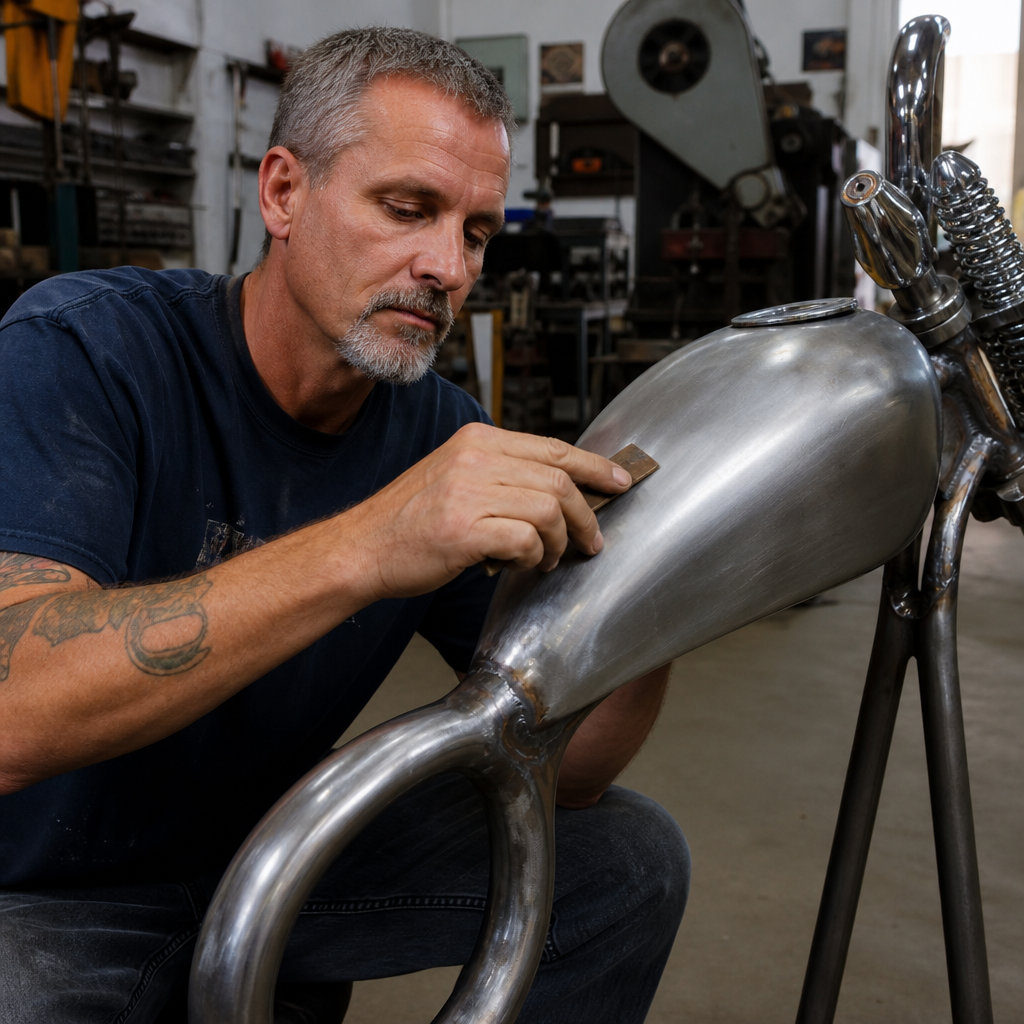
In custom motorcycles, hand-shaped is sometimes used too loosely. Real hand-shaping means the builder actively forms sheet metal and structural elements to solve fit, line, and proportion problems that off-the-shelf parts cannot solve. It involves patterns, shrinker-stretcher work, hammer-and-dolly refinement, planishing, wheeling where appropriate, and repeated trial fitting. Hatton’s reputation rests on doing that work honestly. His tanks do not merely sit on a frame; they belong to it. His fenders are not decorative afterthoughts; they reinforce the bike’s geometry and centerline story.
That honesty is what people respond to when they call one of his bikes a masterpiece. Perfection in customs is rarely sterile. It is the visible result of informed judgment. You can see where a contour was tightened for leg clearance, where a crown was adjusted to catch light correctly, where a mount was simplified so the eye stays on the larger shape. These are decisions that come from hours in the shop, not from software alone. Digital tools can support measurement and layout, but they cannot replace tactile understanding of how metal moves.
For readers studying the New Guard, this point is essential. The builders gaining long-term influence are not just branding themselves well on social platforms. They are demonstrating process literacy. They know TIG sequencing, tube coping, surface prep, post-weld cleanup, and the visual consequences of every bracket. Hatton’s body of work helps define that standard. He reminds the market that genuine fabrication skill remains the strongest differentiator in an era crowded with polished content and shallow builds.
What Makes Hatton’s Proportions So Effective
The fastest way to evaluate any custom motorcycle is to step back and read the silhouette. Before paint, plating, or engraving, the bike either flows or it does not. Hatton’s motorcycles tend to read clearly because he controls the relationships that most builders fight: wheel-to-frame spacing, backbone height, neck attitude, engine placement, and the transitions between tank, seat, and rear fender. Good proportion is not luck. It is the disciplined elimination of interruptions.
One hallmark of his style is visual compression without cramped ergonomics. The bike appears tightly resolved, but the rider triangle still makes sense. Another is mass distribution. The engine remains the emotional center of the machine, yet it does not overpower the frame. This is harder than it sounds. Many custom builds either bury the engine in too much bodywork or leave it visually detached from the chassis. Hatton balances the two by letting the frame line emphasize the motor rather than compete with it.
He also understands negative space, a concept legendary builders have long treated seriously. The empty areas between downtubes, beneath the seat, around the oil tank, and above the rear wheel are part of the design. If those spaces are unresolved, the bike feels noisy. If they are tuned correctly, the entire machine looks intentional. This is where his single-loop work becomes especially strong. The simplified architecture makes negative space obvious, and he uses that exposure to his advantage rather than hiding from it.
Fabrication Standards: Frame Geometry, Welding, and Finish
High-level custom work lives or dies by standards that many casual viewers never notice directly. Frame geometry is the first. Builders working on long-fork or stretched chopper layouts must account for rake, trail, axle height, wheelbase, and fork length as one system. A dramatic neck angle can look compelling on a lift and behave poorly on the road if trail falls outside a usable range. Skilled shops calculate this early, then verify with mock-up. Hatton’s work reflects that discipline. His bikes carry attitude without looking dynamically confused.
Welding quality is the second standard. On a minimalist build, poor penetration, inconsistent bead profile, and overheated joints have nowhere to hide. This is why serious builders obsess over fit-up, cleanliness, material compatibility, and sequence. TIG welding dominates premium custom fabrication because it offers superior control on thin-wall tubing and detailed brackets, but process alone is not enough. Joint design matters. So does post-weld inspection. A visually delicate motorcycle still needs structural confidence.
Finish quality is the third standard, and it extends beyond shiny paint. Surface preparation, metal straightness, edge refinement, hardware selection, and hidden mounting strategies all contribute to the final effect. Hatton’s best bikes feel complete because no single area receives all the attention. The frame, sheet metal, controls, and small fabricated pieces operate at the same standard. That consistency is a hallmark of authoritative custom building and one reason his motorcycles are repeatedly discussed in serious fabrication circles.
Chris Hatton Among Legendary Builders and the New Guard
Any hub covering profiles of 2026 New Guard and legendary builders should position Hatton in a continuum rather than a vacuum. Legendary builders established the emotional vocabulary of custom motorcycles: rebellion, elegance, speed, mechanical honesty, and showmanship. The New Guard has inherited those themes but faces a different environment shaped by CAD-informed consumers, global media, stricter expectations for fabrication transparency, and a marketplace that quickly exposes imitation. Hatton belongs in the conversation because he translates timeless ideas into current standards.
Compared with old-school show-bike excess, his work is more distilled. Compared with some ultra-modern customs, it remains warmer and more human. That middle ground is powerful. It allows his bikes to speak to veteran chopper fans and younger fabrication audiences at the same time. In editorial terms, this makes him an excellent hub subject for related profiles on coachbuilt frames, hand-formed tanks, modern jig practice, and the aesthetics of stripped-down customs.
Readers exploring this topic should also connect Hatton’s work to larger themes across the category: the return of craft-driven minimalism, renewed respect for structural elegance, and the rise of builders who can document process as convincingly as they present finished bikes. Those are the forces shaping 2026 custom culture, and Hatton’s single-loop chopper philosophy sits near the center of them.
Why His Influence Extends Beyond One Motorcycle
The lasting value of Hatton’s work is not tied to one famous build. His influence spreads because his methods are teachable in principle even when they are difficult in practice. Builders can learn from his commitment to line discipline, controlled geometry, honest metal shaping, and restraint in parts selection. Shops can apply those lessons to choppers, performance customs, rigid builds, and even certain restomod projects. The underlying message is universal: start with structure, resolve the silhouette, and let craftsmanship carry the design.
For enthusiasts, that influence changes how bikes are judged. Instead of asking only whether a motorcycle is radical, more people now ask whether it is coherent. Does the frame earn the tank? Does the seat transition make sense? Are the bars serving the bike’s posture or fighting it? These are healthier questions for the culture because they reward substance over spectacle. Hatton helps push that shift.
For readers using this article as a hub, the next step is straightforward. Explore related builder profiles, study frame geometry, compare hand-shaped metal techniques, and look closely at how leading customs manage negative space and component flow. Chris Hatton’s single-loop chopper masterpiece matters because it teaches a durable lesson: the most memorable motorcycles are not overloaded with ideas. They are refined until every line feels necessary. If you want to understand where custom culture is headed, start there, then keep following the builders who make simplicity look impossibly hard.
Frequently Asked Questions
What makes Chris Hatton’s single-loop chopper approach stand out in modern custom motorcycle culture?
Chris Hatton’s work stands out because it balances opposing values that many builders treat as mutually exclusive. On one side, there is the old-school chopper tradition of hand fabrication, visual minimalism, and deeply personal design. On the other, there is the modern expectation of technical precision, flawless execution, and cohesive engineering. Hatton brings those worlds together in a way that feels natural rather than forced. His single-loop chopper builds are not simply styled to look clean; they are constructed with a discipline that makes the entire motorcycle feel resolved from every angle.
What separates Hatton from builders who rely heavily on retro imitation is that he does not appear interested in copying a period-correct formula for its own sake. Instead, he uses traditional fabrication values as a foundation, then refines proportion, geometry, and finish until the bike reads as timeless rather than nostalgic. Likewise, he avoids the trap of digital-age excess, where highly machined parts and visual overstatement can overwhelm the personality of a build. The result is a third path: handmade motorcycles that feel intimate and human, yet controlled enough to reward close technical inspection.
That is especially important in a profile of a 2026 New Guard builder. Hatton represents a generation of custom motorcycle makers who understand that authenticity is no longer proven by roughness alone. In his world, evidence of the hand is still crucial, but so is restraint. Every line has to justify itself. Every welded, shaped, or finished surface has to contribute to the larger composition. That combination of craftsmanship, engineering clarity, and personal expression is what makes his single-loop chopper philosophy so compelling in today’s custom scene.
Why is the single-loop frame such an important design feature in a handcrafted chopper?
The single-loop frame matters because it is both a structural decision and a visual statement. In chopper design, the frame is not just a hidden skeleton beneath the bodywork; it is one of the primary elements that define the bike’s identity. A single-loop arrangement creates a continuous, elegant flow through the rear of the motorcycle, giving the machine a cleaner and more deliberate silhouette. When executed properly, it can make the entire bike feel lighter, longer, and more coherent, even before a viewer notices the details.
From a fabrication standpoint, the single-loop concept also raises the level of difficulty. A simple-looking frame is often harder to make than one filled with visual distractions, because any imbalance in curvature, alignment, or spacing becomes immediately visible. There is nowhere to hide poor decisions. Builders like Hatton use that challenge to their advantage. By reducing visual clutter, they force attention onto proportion, stance, and craftsmanship. The loop must relate correctly to the backbone, rear wheel, seat position, and engine mass, or the design loses its authority.
That is why a hand-shaped single-loop chopper can feel so powerful. It communicates confidence. It tells the viewer that the builder was willing to let line and structure carry the design, rather than relying on ornament. In Hatton’s case, the single-loop layout becomes a symbol of discipline: traditional enough to honor the roots of chopper building, but refined enough to feel contemporary. For enthusiasts and new readers alike, it is one of the clearest indicators that they are looking at a motorcycle built with intention, not just assembled with style cues.
How does hand-shaping influence the quality and personality of a custom motorcycle like Hatton’s?
Hand-shaping changes a motorcycle on multiple levels. At the most obvious level, it affects the physical form of components such as tanks, fenders, mounts, and frame details. Pieces that are shaped by hand tend to carry a subtle, organic harmony that is difficult to fake with off-the-shelf parts. They can be tuned to the exact dimensions and visual rhythm of the build, allowing the motorcycle to feel unified rather than pieced together. On a Chris Hatton chopper, that matters because the overall impression depends on the relationship between every major line and surface.
Just as importantly, hand-shaping introduces authorship. A custom motorcycle becomes more than a collection of premium components when the builder physically determines the form of the machine. Hammer marks may be finished out, welds may be smoothed, and surfaces may appear incredibly clean, but the human decision-making remains embedded in the work. That is the paradox that makes Hatton’s style so interesting: his bikes can look extremely precise and controlled, yet they do not feel sterile. The personality comes through in what was chosen, what was removed, and how each form was refined.
Hand-shaped fabrication also tends to improve design integrity. When a builder creates parts from scratch, there is less compromise forced by catalog dimensions or generic fitment. The seat can sit exactly where it needs to sit. The tank can support the frame’s visual arc. The rear section can complement the tire and stance instead of simply accommodating them. In a well-executed single-loop chopper, those decisions add up quickly. That is why Hatton’s craftsmanship resonates with serious enthusiasts: it is not handmade merely for romance, but because hand-making allows a deeper level of design control and personal expression.
What does “restrained engineering” mean in the context of Chris Hatton’s chopper builds?
Restrained engineering refers to technical problem-solving that serves the design without drawing unnecessary attention to itself. In custom motorcycle culture, it is easy for engineering to become either invisible in a careless way or overemphasized in a showy way. Hatton’s work suggests a more mature middle ground. The motorcycle is engineered carefully, but the engineering is integrated so cleanly that it supports the visual language rather than competing with it. Brackets, mounting strategies, clearances, routing, and structural decisions all appear considered, but they do not interrupt the flow of the machine.
This kind of restraint is much harder to achieve than it sounds. It requires the builder to think several steps ahead, because the cleanest final result often depends on early planning. If the frame geometry, drivetrain position, tank shape, seat mount, and rear fender relationship are not resolved from the beginning, later solutions tend to look compromised. Hatton’s discipline is visible in the way the bikes feel edited. Nothing appears excessive. Nothing feels accidental. Even details that many casual viewers might overlook contribute to a sense of order and mechanical honesty.
For readers exploring the 2026 New Guard of builders, this matters because it marks a shift in what counts as sophistication. Today, advanced custom work is not only about adding complexity; it is about knowing where complexity should disappear. Restrained engineering means a motorcycle can be radical in silhouette while remaining credible in construction. It means the viewer experiences elegance first, then discovers how much technical thought was required to make that elegance possible. That quality is a major reason Hatton’s choppers feel both emotionally engaging and technically convincing.
Why do Chris Hatton’s motorcycles reward close inspection rather than just making a strong first impression?
Many custom motorcycles are designed to deliver immediate impact through stance, paint, unusual parts, or aggressive visual cues. There is nothing inherently wrong with that, but a bike that only succeeds at first glance can lose power the longer you study it. Hatton’s motorcycles tend to work differently. They make a strong initial impression because the proportions are right and the silhouette is memorable, but their real depth emerges through closer viewing. The more time you spend with the build, the more you notice how carefully each line, gap, junction, and finish has been resolved.
That ability to reward inspection comes from layered craftsmanship. A clean motorcycle can sometimes seem simple, but genuine simplicity is usually the result of intense refinement. On a Hatton chopper, the frame line may echo the tank shape with subtle precision. The seat may sit in a way that completes the visual arc instead of interrupting it. The metal finishing may be so controlled that the surfaces feel calm rather than flashy. These are not loud details, but they create the sense that the builder understood the motorcycle as a complete composition rather than a set of isolated highlights.
For enthusiasts, that depth is what gives a build lasting authority. It means the bike is not dependent on trend, gimmick, or overstatement. It can be photographed beautifully, but it also holds up in person, where the quality of fabrication and design logic becomes undeniable. In the context of a feature on Chris Hatton as part of the 2026 New Guard, this is especially significant. It positions him as a builder whose work is not just visually attractive, but intellectually and technically satisfying. His motorcycles invite admiration at a distance and respect up close, which is one of the highest compliments a custom machine can earn.