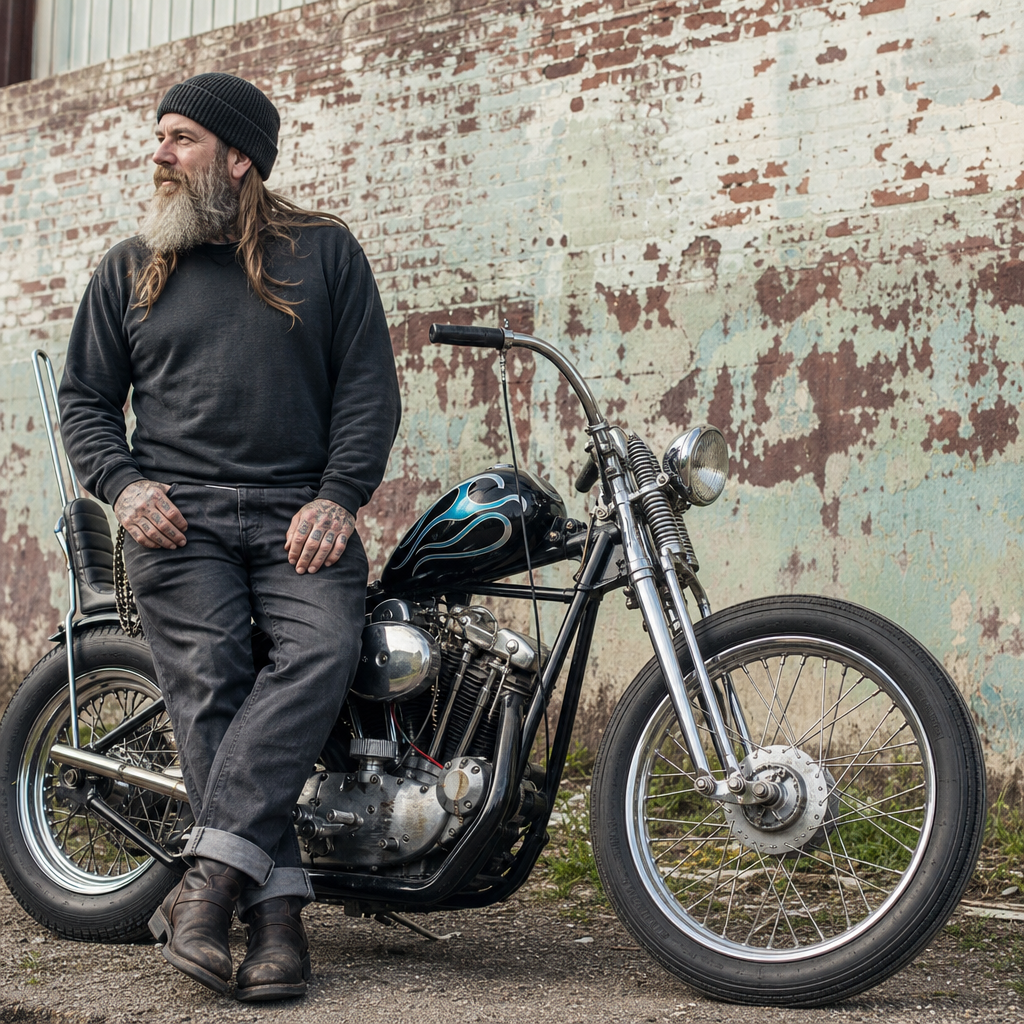
Tim Sneed stands at a rare crossroads in custom motorcycle culture: a builder grounded in Mobtown roots, shaped by traditional handwork, and recognized for a 1967 generator Shovelhead that captures why the best machines feel both historical and alive. In the context of custom culture and builders, this profile matters because it connects two threads that define the current scene in 2026: respect for legendary American chopper language and the increasingly disciplined fabrication standards associated with the new guard. When riders, historians, and first-time readers search for profiles of 2026 new guard and legendary builders, they are usually asking the same practical questions. Who actually influences the scene? What makes one builder’s work credible rather than trendy? Which motorcycles show the line between restoration, customization, and fully authored fabrication? Sneed offers useful answers because his work is not built on branding alone. It is built on proportion, mechanical correctness, and a lived relationship with Baltimore’s long, rough-edged motorcycle culture.
Mobtown, the long-standing nickname for Baltimore, is more than regional color here. It signals a working environment where industrial materials, port-city grit, and neighborhood-level resourcefulness shaped how motorcycles were built, repaired, and ridden. In shops like that, style was never separate from function. A frame decision changed handling. A tank choice altered the entire motorcycle’s line. A generator-era Shovelhead was not a costume piece; it was a machine that had to start, charge, track straight, and survive real roads. I have spent enough time around serious custom builders to know that this distinction is where reputations are made. Sneed’s 1967 generator Shovelhead matters because it sits at the hinge point between Harley-Davidson history and custom authorship. It references the final years before later design shifts changed the visual and mechanical character of Big Twin customs, and it does so without flattening the bike into nostalgia. That combination makes this article a hub for understanding both Sneed and the broader builder landscape surrounding the new guard and legendary fabrication culture.
Why Tim Sneed Matters in the 2026 Builder Conversation
Any serious hub covering profiles of 2026 new guard and legendary builders has to explain why certain names keep surfacing across garages, shows, social feeds, and long-form print features. Tim Sneed matters because his work satisfies the standards that experienced builders use when judging another builder’s motorcycle. The first is silhouette. Before anyone asks about parts lists, they look at stance, axle relationship, neck height, backbone line, wheel spacing, and visual tension between engine mass and empty space. The second is execution. That includes weld quality, tab placement, bracket logic, cable routing, and the discipline to leave parts off when they are unnecessary. The third is mechanical honesty. A chopper can be radical, conservative, period-correct, or hybrid, but it must still behave like a motorcycle. Sneed’s reputation grew because his bikes communicate all three quickly.
Within the 2026 conversation, the phrase new guard usually describes a generation of builders who absorbed digital visibility, easier access to parts, and a more informed customer base, yet still chose to learn old fabrication methods. That group often uses CAD mockups, precision machining, TIG welding, and modern metrology, but the strongest among them still understand forging a line by eye, setting trail correctly, and selecting a drivetrain that suits the intended riding style. Legendary builders, by contrast, are the people whose names carry weight because they moved the culture, not just because they sold motorcycles. Sneed is compelling as a hub subject because he helps bridge those categories. He is rooted in older custom values, but his continued relevance shows why younger builders keep studying historically coherent bikes instead of chasing novelty for its own sake.
His visibility also reflects a larger shift in custom motorcycle culture. Audiences in 2026 are more literate. They can spot catalog assembly disguised as craftsmanship. They know the difference between a stock geometry bike with decorative parts and a true custom with intentional proportions. They ask better questions about donor selection, engine cases, title issues, fabrication scope, and whether a bike’s appearance aligns with its use. A builder who remains respected under that level of scrutiny has earned it. Sneed’s body of work, and especially the generator Shovelhead associated with his name, gives readers a benchmark for evaluating other builders in this subtopic.
The Meaning of Mobtown Roots in Custom Motorcycle Culture
Mobtown roots describe more than geography. In custom motorcycle terms, they point to an ethos shaped by Baltimore’s industrial history, working-class neighborhoods, maritime economy, and hard-ridden street culture. Builders from environments like this tend to value durability, practicality, and identity built through use rather than display. That does not mean the bikes are plain. It means decoration follows structure. Paint, metal finish, wheel choice, and front-end length all mean something because they are tied to a rider, a scene, or a regional way of building. In my experience, this is why local roots still matter in a globally visible custom world. A builder with real regional grounding usually has stronger visual discipline because the work came from solving actual problems within a real community.
Baltimore has long supported overlapping motorcycle worlds: club culture, street customs, performance-minded Harley riders, independent repair shops, and builders who could move between all those circles. That mix creates a sharper standard than a trend-only environment. If a bike looks right but leaks, charges poorly, or handles badly, riders notice immediately. If a builder claims originality while recycling someone else’s formula, that also gets noticed. Mobtown credibility comes from surviving that test over time. Sneed’s name carries the atmosphere of a place where bikes were built to be seen in alleys, under sodium lights, on city pavement, and on longer runs out of town, not just under exhibition hall lighting.
That regional identity is important for this hub because many 2026 readers are trying to map builder influence. West Coast long-bike traditions, Midwest performance customs, Japanese interpretations of American choppers, and East Coast street-driven customs all have distinct visual grammar. Sneed belongs to the East Coast side of that map, where compact aggression, mechanical clarity, and urban toughness often matter more than excess. Understanding that background helps explain why the 1967 generator Shovelhead resonates. It is not only a vintage Harley custom. It is a motorcycle built in conversation with a place that rewards restraint, function, and character.
The 1967 Generator Shovelhead: Why This Bike Is a Reference Point
The 1967 generator Shovelhead is a reference point because it sits at a technically and aesthetically significant moment in Harley-Davidson Big Twin history. The Shovelhead engine debuted for the 1966 model year, replacing the Panhead while carrying forward much of the visual authority riders expected from a big-inch Harley. Early Shovelheads retained generator charging systems before the later transition to alternator-equipped arrangements. For custom builders, that generator-era configuration matters. It changes the profile of the powertrain, affects packaging, and reinforces a specific period-correct look prized by knowledgeable enthusiasts. A 1967 example therefore occupies a narrow and respected niche: early enough to preserve generator-era character, late enough to reflect the Shovelhead’s arrival as a new chapter in factory engineering and custom possibility.
What makes Sneed’s machine stand out is not simply that it uses a desirable year of engine. Plenty of builders start with good parts and produce forgettable motorcycles. The value lies in how the motorcycle resolves proportion, period signal, and usability. A successful generator Shovelhead custom needs a coherent relationship between frame stance, wheel and tire dimensions, tank shape, seat height, and front-end choice. If one element is too loud, the bike loses balance. If the builder chases period correctness so rigidly that the motorcycle becomes static, it reads like a museum exercise rather than a living custom. Sneed’s 1967 bike is widely discussed because it avoids both errors. It looks rooted in history while retaining the tension and directness that make a custom feel authored.
For readers evaluating builders, this bike also offers a practical lesson in authenticity. Early Harley customs are often imitated through bolt-on styling cues: narrow tanks, king-and-queen seats, chrome accessories, or overlong forks. But experienced eyes look deeper. They check engine year consistency, charging setup, primary arrangement, frame logic, and whether the visual line from steering head to rear axle feels intentional. Sneed’s 1967 generator Shovelhead is important precisely because it rewards that deeper reading. It gives this hub article a strong center, one bike through which broader questions about craftsmanship, historical fluency, and the builder’s voice can be answered.
How to Evaluate Legendary Builders and the New Guard
The most useful way to compare profiles of 2026 new guard and legendary builders is to evaluate them against specific criteria rather than popularity. The table below reflects the standards I use when assessing custom motorcycles and the builders behind them.
| Criterion | What to Look For | Why It Matters |
|---|---|---|
| Proportion | Balanced stance, coherent wheelbase, correct visual line from neck to axle | Good proportion makes a bike memorable before any detail is noticed |
| Fabrication Quality | Clean welds, sensible brackets, accurate alignment, thoughtful routing | Execution separates genuine craft from parts swapping |
| Mechanical Integrity | Reliable charging, oil control, proper trail, serviceable assembly choices | A custom must function on the road, not just in photographs |
| Historical Fluency | Correct use of period components and references without imitation | Builders earn trust by knowing the lineage they are working within |
| Original Voice | Recognizable style that is not derivative or trend-led | Influence comes from authorship, not from copying what already works |
Using that framework clarifies why Sneed belongs in a hub alongside both newer fabrication leaders and established names. Legendary builders generally score high on historical fluency and original voice because they helped define the visual language others later borrowed. The strongest new guard builders often excel in fabrication quality and mechanical integrity because they have access to better tools, broader technical documentation, and a more demanding audience. The best work happens when all five criteria align. That is also why some highly visible motorcycles fade quickly. They may look dramatic online, but they do not hold up when viewed through structure, serviceability, or originality.
Readers building an internal map of this subtopic should treat Sneed as a benchmark node. From his profile, it makes sense to branch toward articles on generator-era Harley customs, East Coast chopper traditions, frame geometry, surviving legendary builders, and younger fabricators translating old forms with modern precision. That hub approach mirrors how enthusiasts actually learn. They do not move in a straight line. They begin with one bike or one builder, then follow linked questions: what engine is that, why does that frame look right, who influenced this style, what changed between Panhead and Shovelhead customs, and which current builders deserve serious attention. A strong hub article answers those questions directly while pointing to the next layer of research.
What Sneed’s Work Teaches About Fabrication, Restraint, and Influence
The clearest lesson from Tim Sneed’s work is that restraint is not the opposite of creativity. In custom motorcycle fabrication, restraint is often the proof of maturity. A builder can cut, stretch, mold, polish, engrave, and chrome almost anything. The harder decision is knowing what not to alter. On a generator Shovelhead, preserving the authority of the engine while supporting it with the right chassis language is more difficult than overwhelming it with ornament. Sneed’s approach shows that a strong bike often comes from subtraction, sequencing, and line control. That means choosing a tank that does not fight the motor, setting ride height so the bike carries weight correctly, and refusing details that interrupt the silhouette.
This is also where the connection between legendary builders and the new guard becomes most useful. Young builders who want longevity should study motorcycles like Sneed’s not to reproduce them part for part, but to understand decision-making. Why does this seat height work? Why is this front-end length believable? Why do these finishes support the bike rather than distract from it? Why does the motorcycle still read clearly from fifty feet away? In my experience, builders improve fastest when they learn to answer those questions before they buy components. The fabrication technology available in 2026 is impressive, from CNC-machined one-off parts to digital frame fixtures and high-quality TIG setups. But technology only sharpens judgment; it does not replace it.
Sneed’s influence therefore extends beyond one motorcycle. He represents a method: know the lineage, respect mechanical realities, shape the bike with intention, and let the final machine carry a point of view without forcing it. That is why his Mobtown roots and his 1967 generator Shovelhead deserve a central place in any serious guide to profiles of 2026 new guard and legendary builders. If you are exploring this subtopic, use this article as your starting point, then follow the related builder profiles, technical deep dives, and history pieces that branch from it. The reward is a clearer eye, a better standard, and a deeper understanding of what makes a custom motorcycle endure.
Frequently Asked Questions
Who is Tim Sneed, and why does his background matter in custom motorcycle culture?
Tim Sneed matters because he represents a kind of builder that custom motorcycle culture continues to value more with time: someone whose work is informed by regional identity, practical hand skills, and a real understanding of older American motorcycle language rather than trend-chasing. His connection to Mobtown roots gives his profile substance. That phrase suggests more than geography; it points to a gritty, hands-on, working-class sensibility tied to local garage knowledge, fabrication discipline, and a respect for motorcycles as mechanical objects first and lifestyle symbols second. In a scene where branding can sometimes overshadow craftsmanship, builders like Sneed stand out because their credibility is visible in the machine itself.
His significance also comes from where custom culture stands in 2026. The current scene increasingly rewards motorcycles that balance authenticity with execution. Riders and enthusiasts still admire the visual vocabulary of classic American choppers and period-correct builds, but they also expect a higher standard of fit, finish, engineering, and rideability than many earlier eras required. Sneed sits right at that intersection. He appears grounded in traditional methods and historical reference points, yet the work associated with his name suggests discipline rather than nostalgia for nostalgia’s sake. That combination is important because it reflects how the best contemporary builders operate: they preserve the soul of old motorcycles while refusing to excuse bad fabrication, weak proportions, or careless assembly in the name of “old-school” style.
In other words, Tim Sneed is noteworthy not simply because he builds custom motorcycles, but because his identity as a builder helps explain why certain motorcycles still resonate. He stands for continuity between regional craft traditions and the broader American custom canon. That makes him relevant to longtime enthusiasts who recognize the references, and to newer audiences who are looking for motorcycles that feel rooted, honest, and mechanically convincing.
What makes the 1967 generator Shovelhead such an important motorcycle in Tim Sneed’s story?
The 1967 generator Shovelhead is important because it functions as both a machine and a statement. Historically, a 1967 Shovelhead sits at a fascinating point in Harley-Davidson evolution, linking older mechanical architecture and visual character to the performance and identity of a newer engine era. The generator Shovelhead, especially, carries a strong appeal for builders and enthusiasts because it preserves early details that make the bike feel especially connected to mid-century American motorcycle design. It has the weight of history, but it also offers a foundation that can be transformed into something deeply personal.
In Tim Sneed’s case, that motorcycle appears to embody why the best custom builds feel historical and alive at the same time. It is not merely a restored artifact and not merely a heavily modified platform stripped of context. Instead, its value comes from the way it channels the language of classic American choppers and hand-built customs while still feeling intentional, usable, and emotionally immediate. That balance is difficult to achieve. Many builds look period-correct but feel static, as if they belong only in photographs. Others perform well but lose the visual authority and cultural memory that give an older machine its magnetism. A strong generator Shovelhead build avoids both extremes.
This motorcycle also matters because it reinforces Sneed’s credibility as a builder who understands proportion, restraint, and historical tone. A 1967 generator Shovelhead does not need gimmicks to command attention. If it is built well, every choice becomes more visible: stance, frame attitude, metal finishing, wheel and tire relationship, exhaust routing, cockpit simplicity, and engine presentation. On a motorcycle like this, there is nowhere to hide weak decisions. That is part of why enthusiasts respond so strongly to these builds. They reveal whether a builder genuinely understands the platform. In that sense, Sneed’s 1967 generator Shovelhead is important because it serves as proof of philosophy through metal, shape, and function.
What does “Mobtown roots” add to the meaning and style of Sneed’s build philosophy?
“Mobtown roots” adds identity, realism, and texture to the way people understand Tim Sneed’s work. In custom motorcycle culture, place still matters. Builders are often shaped by local scenes, local roads, local mechanical traditions, and the expectations of the people around them. A builder tied to Mobtown evokes a harder-edged, more workmanlike perspective—one that values capability, fabrication skill, and earned style over polished performance of image. That kind of background tends to show up in the details of a build: practical choices, honest materials, cleaner structural thinking, and an overall sense that the motorcycle belongs in motion, not just under lights.
Stylistically, roots like these can create an important distinction. Some custom motorcycles are assembled around borrowed aesthetics, referencing eras or regions without really understanding them. Others feel native to their builder’s experience. When people describe Sneed as grounded in Mobtown roots, they are identifying that second category. The bike does not simply wear signs of authenticity; it appears to grow out of a lived mechanical culture. That matters because custom motorcycles have always been strongest when they communicate a specific point of view rather than a generic catalog of cool parts.
There is also a broader cultural dimension. In 2026, the custom scene is highly networked and visually saturated. Bikes are seen globally the moment they are photographed, which can flatten regional differences. Profiles like Sneed’s push back against that flattening by reminding audiences that the most compelling motorcycles often come from builders who remain anchored in real places and real methods. “Mobtown roots” therefore strengthens his reputation not as a marketing phrase, but as shorthand for a builder shaped by tradition, toughness, and a practical relationship to craft. It helps explain why the work feels grounded instead of performative.
Why do builders and enthusiasts still care so much about traditional handwork in 2026?
Traditional handwork still matters in 2026 because it remains one of the clearest signs that a motorcycle has been truly built rather than merely configured. In an era when access to parts, machining, digital design tools, and visual inspiration is greater than ever, the difference between assembling and building has become more visible, not less. Hand-formed metal, considered welding, carefully resolved brackets, cleanly integrated controls, and subtle fabrication choices all communicate intention. They show that the builder engaged directly with the problems the motorcycle presented instead of selecting a ready-made solution for every part of the process.
That is especially relevant in a profile like Tim Sneed’s. The article’s context points to a builder shaped by traditional handwork, which suggests not just skill but values: patience, accuracy, mechanical literacy, and respect for materials. Enthusiasts recognize that quality even when they cannot name every fabrication technique involved. They can see when a gas tank sits correctly, when a line flows naturally from neck to rear axle, when tabs and mounts disappear into the motorcycle instead of interrupting it, and when a machine feels coherent from every angle. Those outcomes usually come from handwork informed by experience rather than from shortcuts.
At the same time, the modern scene does not celebrate handwork simply because it is old-fashioned. It celebrates handwork because it supports higher standards. Today’s best builders are expected to honor traditional aesthetics while delivering motorcycles that are safer, cleaner, more structurally sound, and more refined than many period builds ever were. That is where the conversation gets especially interesting. Traditional methods are no longer admired only for romance; they are admired when they are paired with disciplined execution. In that sense, handwork remains central because it carries both cultural and technical authority. It connects the builder to the lineage of custom motorcycles while proving they can meet the exacting standards of the present.
How does Tim Sneed’s 1967 generator Shovelhead reflect the broader direction of custom motorcycle culture in 2026?
Tim Sneed’s 1967 generator Shovelhead reflects the broader direction of custom motorcycle culture in 2026 by showing how the scene has matured without losing its emotional core. The strongest motorcycles today tend to honor recognizable American chopper and custom traditions—long-established visual cues, iconic engine platforms, stripped-down silhouettes, hand-built details—while also meeting a much more rigorous standard of craftsmanship than many earlier generations demanded. That means builders are no longer praised simply for having the right influences. They are praised for understanding those influences deeply enough to reinterpret them with precision.
The generator Shovelhead is an ideal vehicle for that conversation. It already carries historical significance, mechanical charisma, and unmistakable visual identity. But when a builder like Sneed brings those qualities into a contemporary context, the motorcycle can do more than reference the past. It can demonstrate how heritage becomes relevant now. A successful build of this kind tells viewers that the old forms still matter, not because they are frozen in myth, but because they continue to offer a powerful framework for proportion, attitude, and mechanical expression. The bike becomes a bridge between history and present-day standards.
This is why Sneed’s profile resonates beyond one machine. It speaks to a larger movement inside custom culture: a renewed respect for foundational American motorcycle aesthetics combined with a sharper commitment to fabrication quality, functional clarity, and visual honesty. The scene in 2026 increasingly rewards builders who can make a motorcycle feel timeless without making it feel derivative. Sneed’s 1967 generator Shovelhead appears to do exactly that. It suggests that the future of custom culture