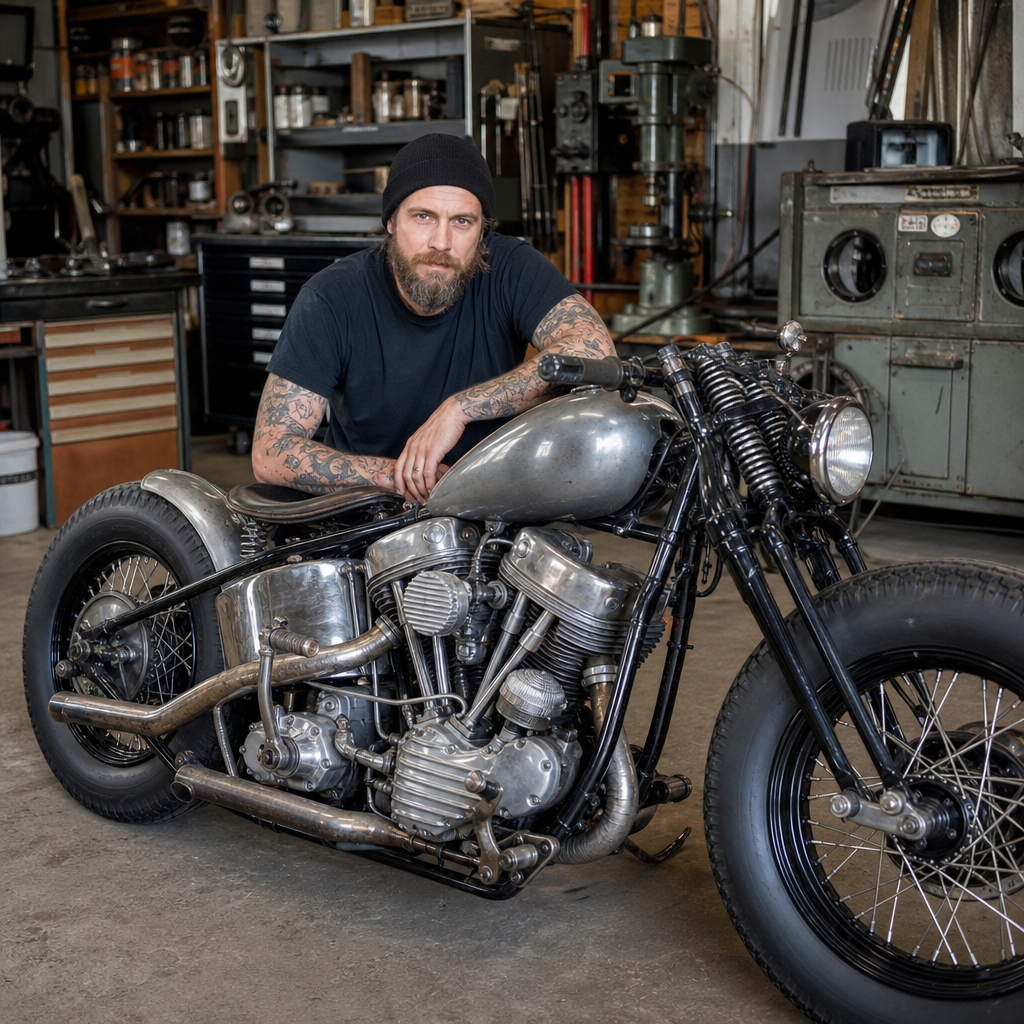
Jack Weidmayer stands out in custom motorcycle culture because he proves that vision, fabrication skill, and historical respect can turn an overlooked machine into a benchmark build. In the world of American V-twins, his transformation of a $2,000 Shovelhead into a Panhead masterpiece captures the exact tension that defines modern custom culture: preserve the soul, improve the execution, and create something that feels both timeless and unmistakably personal. For readers following profiles of 2026 New Guard and legendary builders, this story works as a hub because it connects legacy craftsmanship, contemporary fabrication methods, and the evolving standards by which builders are judged today.
A Shovelhead and a Panhead are not interchangeable labels. The names refer to distinct Harley-Davidson overhead-valve engine families, with Panheads produced from 1948 to 1965 and Shovelheads from 1966 to 1984. In custom circles, those names also signal era, styling language, and engineering assumptions. Panheads are associated with sculptural rocker covers, clean postwar lines, and a romantic image of classic choppers and bobbers. Shovelheads carry a tougher, often more utilitarian reputation, though they remain beloved for torque, sound, and rebuildability. Transforming a Shovelhead-based project into a Panhead-inspired or Panhead-centered masterpiece is not a cosmetic trick. It requires decisions about frame geometry, powertrain compatibility, sheet metal, stance, finish quality, and how far a builder should go before authenticity gives way to reinterpretation.
I have spent enough time around custom shops, swap meets, and build sheets to know that the most serious builders never start with fantasy. They start with what is on the floor, what can be saved, what must be fabricated, and what story the finished motorcycle should tell. That is why Weidmayer’s $2,000 starting point matters. Cheap donor bikes often hide expensive problems: cracked cases, poor prior welds, misaligned frames, title issues, incorrect tabs, and hacked wiring. A low buy-in creates room in the budget, but only if the builder has the skill to recognize which flaws are recoverable and which ones will consume the project. Weidmayer’s reputation rests on making those calls well.
This article serves as a central guide to why his work matters within the larger landscape of 2026 builders. It explains the technical leap from rough donor to finished showpiece, the fabrication disciplines behind that leap, and the reasons his approach resonates with both veteran enthusiasts and a younger generation of builders using CAD mockups, digital measurement, TIG welding, CNC assistance, and social-driven storytelling. More importantly, it shows how one motorcycle can illuminate the broader movement linking legendary names with the New Guard reshaping custom culture right now.
Why Jack Weidmayer matters in the 2026 builder landscape
Jack Weidmayer matters because he sits at the intersection of reverence and reinvention. Legendary builders earned status by establishing visual languages: long bikes, tight chops, molded frames, handmade tanks, narrow silhouettes, and disciplined proportions. The New Guard earns attention differently. Today’s builders are judged not only by style but by metallurgy, machine work, reliability, documentation, and the ability to explain every modification with purpose. Weidmayer’s builds hold up under both standards. They photograph well, but more importantly, they survive close inspection.
That distinction is crucial in 2026. Social platforms reward instant impact, yet informed enthusiasts still look for details such as neck rake consistency, proper chain alignment, oiling strategy, brake upgrades, and whether handmade parts appear integrated or simply decorative. Weidmayer’s best work avoids “parts-bin custom” syndrome. His motorcycles read as complete compositions, where tank stretch, seat contour, wheel size, fork length, and exhaust routing all support one another. That level of coherence is exactly why his profile belongs at the center of a hub covering both emerging and legendary builders.
He also represents a wider change in custom culture: the return of disciplined craftsmanship after years when some builds prioritized trend over function. Builders now mix old-school visual cues with better fabrication standards. A bike may look period-correct, yet run improved charging, stronger braking, cleaner harness routing, and better-machined internals. Weidmayer’s Shovelhead-to-Panhead project is a strong example of this balanced philosophy.
From $2,000 donor to serious platform: what the starting bike really represented
A $2,000 Shovelhead sounds like a bargain until you list the likely realities. At that price, a buyer is usually getting incomplete history, uncertain engine condition, tired suspension, improvised electrics, and cosmetics that hide old repairs. In many cases, the project value lies less in the assembled motorcycle than in the sum of usable components: cases, transmission, titled frame, wheels, or front end. Experienced builders evaluate these projects by triage. Which parts are structurally sound? Which can be rebuilt economically? Which must be replaced to achieve the target style and performance?
Weidmayer’s success begins with reading the donor accurately. Builders with less discipline often overspend restoring poor components just because they came with the bike. Better builders set a standard early. If the frame is questionable, they fixture it and measure it. If the motor is unknown, they inspect the bottom end, check flywheel trueness, and verify case integrity before buying polished covers or paint. If the goal is Panhead elegance, they know bulky or mismatched pieces will undermine the final effect no matter how glossy the finish becomes.
In practical terms, a low-cost Shovelhead donor offers raw opportunity: a usable backbone for a custom if the fundamentals check out. It can provide hardware, transmission compatibility, rolling stock, and a starting VIN or title path, depending on jurisdiction. Weidmayer’s accomplishment was not merely spending money wisely. It was understanding which original elements could anchor the build and which had to be rethought completely.
How a Shovelhead becomes a Panhead masterpiece
Turning a Shovelhead into a Panhead masterpiece can mean several different build paths, and that nuance matters. One path is a true Panhead engine installation using a Shovelhead-sourced chassis or donor components. Another is a Panhead-style custom built from a Shovelhead platform, where the engine family remains Shovelhead but the bike adopts the visual and proportional language most enthusiasts associate with classic Panhead-era customs. The strongest interpretation combines mechanical integrity with unmistakable period character.
Weidmayer’s approach, as understood through the admiration his build receives, reflects mastery of proportion. Panhead customs succeed when the motorcycle looks lean without appearing fragile. The tank sits correctly on the backbone. The bars, fork, and wheels establish a flowing line from steering head to rear axle. The seat does not interrupt the silhouette. Oil tank, battery solution, exhaust, and foot controls are all resolved cleanly. This sounds simple, but it is where many expensive customs fail. They have quality parts yet no visual rhythm.
Fabrication is what closes the gap. Mounts need to disappear into the design. Sheet metal should look inevitable, not attached as an afterthought. If the bike uses hand-formed fenders, narrowed tanks, or modified mounts, the weld quality and finishing process determine whether the result looks handmade in the best sense or merely unfinished. Weidmayer’s reputation suggests a builder who understands that the viewer notices transitions as much as standout parts.
| Build Area | Common Donor Problem | Weidmayer-Level Solution | Result |
|---|---|---|---|
| Frame | Poor alignment, awkward stance | Measure, fixture, correct geometry, refine tabs | Balanced silhouette and stable handling |
| Engine choice | Mismatch between style and powertrain identity | Select or present motor to support Panhead-era character | Authentic visual language |
| Sheet metal | Generic off-the-shelf look | Hand-fit tank and fender relationships | One-piece visual flow |
| Wiring and plumbing | Visible clutter and reliability issues | Hidden routing with service access maintained | Cleaner appearance and better dependability |
| Finish | Over-restored or inconsistent surfaces | Use paint, polish, and metal texture intentionally | Depth, cohesion, and period-correct attitude |
The fabrication disciplines behind the transformation
Every acclaimed custom build is really a stack of disciplined processes. In Weidmayer’s case, the Shovelhead-to-Panhead story highlights metal shaping, welding, machining judgment, mockup strategy, and parts integration. Mockup is the underrated stage. Before final paint or plating, serious builders assemble the motorcycle repeatedly to confirm alignment, tire clearance, primary spacing, chain run, exhaust path, control reach, and the relationship between seat height and tank tunnel. That stage prevents expensive cosmetic work from hiding mechanical mistakes.
TIG welding has become a baseline expectation for visible fabrication because it offers control and clean presentation, but process choice alone is not craftsmanship. Joint preparation, fixture stability, heat control, and post-weld finishing matter just as much. The same is true for machining. A spacer turned on a lathe is not impressive by itself; what matters is whether it solves a tolerance problem correctly and disappears into the assembly. Weidmayer’s caliber of build suggests that many of the best parts are the ones casual viewers never notice because they simply make the motorcycle feel resolved.
Modern fabrication technology also shapes the New Guard context of this profile hub. Today’s builders may scan dimensions digitally, design small brackets in CAD, or use CNC equipment for repeatable components, then finish the final motorcycle with traditional handwork. That blend is not a compromise. It is often the smartest path. Precision tools ensure fit; hand finishing ensures character. Builders who master both worlds are setting the tone for custom culture in 2026.
Why this build resonates with both legendary and New Guard audiences
The custom motorcycle world often talks as if old-school and new-school builders are opposed, but the best builds prove they are connected. Legendary builders established the emotional standard: a bike should stop people in their tracks. The New Guard added a technical standard: it should also be engineered cleanly enough to withstand scrutiny from experienced fabricators. Weidmayer’s project resonates because it meets both tests.
For longtime enthusiasts, the bike delivers familiar cues: stripped elegance, mechanical honesty, and the unmistakable charisma of a classic American V-twin custom shaped by human hands. For newer builders, it offers lessons in process discipline. Start with a rough platform. Establish a clear visual target. Cut only when measurements support the move. Fabricate parts that improve both form and function. Finish the bike so every element belongs. That recipe sounds obvious, yet it remains rare because it requires restraint as much as talent.
This is also why the build works as a hub topic for profiles of 2026 New Guard and legendary builders. It gives readers a framework for evaluating any builder profile that follows: What did they start with? What technical problems did they solve? What visual language are they speaking? Did they simply assemble premium parts, or did they author a coherent machine? Weidmayer’s motorcycle becomes a reference point for asking smarter questions across the entire subtopic.
What readers should look for in related builder profiles
If this page is the hub for the subtopic, the next step is knowing how to read other builder stories critically. Start with provenance and platform. A titled basket case, an original rigid frame, and a reproduction chassis all create different constraints. Then assess the builder’s choices in geometry, engine presentation, wheel-and-tire proportion, and controls. Good profiles explain why those choices were made, not just what parts were used.
Also look for evidence of process. Strong builders document mockup stages, frame correction, machining, and problem-solving around charging systems, oiling, and brake feel. They can name the standards and tools they trust, whether that is a frame jig, dial indicators for runout, pressure testing, or known component suppliers such as S&S, Morris, Linkert specialists, or reputable machine shops familiar with vintage Harley tolerances. Credibility rises when a builder acknowledges tradeoffs. A kick-only setup may look cleaner, for example, but daily usability changes. Vintage drum brakes may suit a period build, yet modern riding conditions may justify a discreet disc conversion.
Jack Weidmayer’s transformation remains compelling because it demonstrates those principles instead of merely talking about them. It shows how a low-cost Shovelhead can become the foundation for a Panhead masterpiece when guided by judgment, fabrication fluency, and respect for the lineage of custom motorcycles. If you are exploring the wider world of 2026 New Guard and legendary builders, use this build as your benchmark, then follow the connected profiles with sharper eyes and higher standards. Study the details, compare the methods, and let the best work refine your understanding of what true custom craftsmanship looks like today.
Frequently Asked Questions
Why is Jack Weidmayer’s $2,000 Shovelhead-to-Panhead build considered so important in custom motorcycle culture?
Jack Weidmayer’s build matters because it represents far more than a simple motorcycle restoration or a cosmetic custom project. It shows what happens when a builder looks past a machine’s market value and sees its design potential, mechanical character, and historical possibilities. Starting with a modestly priced Shovelhead, Weidmayer created something that resonates with enthusiasts because it reflects one of the core ideals of American V-twin culture: great motorcycles are not defined by what they cost at purchase, but by the intelligence, craftsmanship, and intent invested into them afterward.
What makes the transformation especially compelling is the balance it strikes between eras. The Shovelhead and Panhead each carry strong identities in Harley-Davidson history, and blending the spirit of one with the visual and emotional language of the other takes more than technical ability. It requires sensitivity to proportion, period cues, mechanical authenticity, and restraint. Weidmayer’s achievement is often viewed as a benchmark because the finished motorcycle does not feel forced or gimmicky. Instead, it feels cohesive, believable, and deeply rooted in the traditions that shaped custom bike culture in the first place.
For readers interested in standout builders among profiles of influential custom motorcycle figures, Weidmayer’s project stands out because it proves that reverence for the past does not have to produce static museum work. A bike can honor history while still being reinterpreted through a highly personal lens. That tension between preservation and reinvention is exactly why the build continues to attract attention.
What does it mean to turn a Shovelhead into a Panhead-inspired masterpiece?
At its core, turning a Shovelhead into a Panhead-inspired custom means reshaping the motorcycle so it captures the elegance, visual rhythm, and timeless appeal associated with classic Panhead machines, while still relying on the builder’s fabrication choices and the underlying opportunities presented by the donor bike. This is not just a matter of swapping a few visible parts. A convincing Panhead-inspired build depends on the overall silhouette, stance, tank and fender relationship, engine presentation, frame attitude, front-end choice, wheel setup, control placement, exhaust flow, and the countless small details that determine whether a bike feels authentic or merely dressed up.
The phrase “masterpiece” applies when all of those elements work together without obvious compromise. In Weidmayer’s case, the significance lies in execution. A successful build of this kind does not scream for attention with unnecessary excess. Instead, it reflects maturity in design. Every surface, bracket, line, and mechanical decision supports a larger visual story. The motorcycle should feel as though it could have existed in an earlier golden era of custom American twins, yet still reveal the builder’s own hand upon close inspection.
That is why enthusiasts respond so strongly to projects like this one. They recognize that true transformation is not about imitation alone. It is about understanding why Panheads remain iconic, then channeling those qualities through fabrication, engineering, and styling choices that produce a machine with both historical gravity and individual identity.
How did Jack Weidmayer’s fabrication skill influence the final result of the build?
Fabrication is the difference between a motorcycle that looks assembled and one that looks authored, and that distinction is central to why Weidmayer’s work earns respect. On a build like this, fabrication skill shapes everything from fit and finish to the bike’s emotional impact. Clean mounts, thoughtful metalwork, proper spacing, seamless integration of components, and carefully resolved transitions all contribute to the sense that the motorcycle belongs together as one complete object rather than a collection of parts from different eras.
Weidmayer’s reputation is tied to the idea that craftsmanship should elevate the machine without erasing its soul. That means his fabrication choices are not only technical solutions; they are aesthetic decisions. The way a tank sits over the backbone, the way a seat follows the frame, the way the exhaust complements the engine’s mass, and the way the stance settles visually from front to rear all depend on an experienced eye. Builders at this level understand that a fraction of an inch can alter the character of the entire motorcycle.
Just as important, strong fabrication preserves credibility. A Panhead-inspired custom built from a low-cost Shovelhead could easily feel contrived if the workmanship were sloppy or overdone. Instead, Weidmayer’s approach demonstrates control and intention. That is what allows the final bike to communicate historical respect while also standing as a modern benchmark in custom execution. People notice the style first, but it is fabrication discipline that makes the style believable.
Why does historical respect matter so much in a custom build like this?
Historical respect matters because motorcycles like Panheads and Shovelheads are not just mechanical platforms; they are cultural symbols with deep roots in American riding, hot-rodding, chopper evolution, and garage-built individuality. When a builder references that lineage, enthusiasts immediately look for signs that the work understands the original language of those machines. Respecting history does not mean refusing to modify anything. It means knowing what should be preserved, what can be improved, and what visual or mechanical cues give the motorcycle its lasting identity.
In Weidmayer’s case, the appeal comes from his ability to preserve the soul of the donor and the era he is invoking while refining the execution to a higher level. That is a sophisticated approach. It avoids two common mistakes: blind restoration on one side and careless reinvention on the other. A historically aware custom build acknowledges proportion, period-correct influences, traditional craftsmanship, and the emotional character of classic V-twins, even when the finished bike is undeniably personalized.
This is also why the build speaks to modern custom culture so clearly. Today’s best builders are often judged not only by how inventive they are, but by how intelligently they engage with the past. A motorcycle can feel fresh precisely because it understands tradition so well. Weidmayer’s project demonstrates that historical respect is not a limitation. It is the foundation that gives the final machine authenticity, depth, and staying power.
What can readers and aspiring builders learn from Jack Weidmayer’s Panhead-inspired transformation?
One of the biggest lessons is that vision is often more valuable than starting budget. A $2,000 donor bike would be easy for many people to dismiss as rough, compromised, or unremarkable, but Weidmayer’s project shows that a skilled builder can identify hidden opportunity where others see only limitations. That mindset is essential in custom motorcycle culture. Great builds often begin with the ability to imagine a finished machine long before anyone else can see it.
A second lesson is that detail work is what separates memorable customs from forgettable ones. Readers may be drawn to the headline transformation from Shovelhead to Panhead-inspired masterpiece, but the real takeaway is how much discipline goes into achieving that result. Proportion, finish quality, part selection, fabrication cleanliness, and respect for visual continuity all matter. A successful custom is rarely the product of one dramatic change. It is usually the accumulation of dozens of correct decisions.
Finally, aspiring builders can learn that authenticity comes from clarity of purpose. Weidmayer’s build works because it is not trying to be everything at once. It has a strong point of view. It honors classic American V-twin history, improves the machine through craftsmanship, and expresses a personal design philosophy without losing coherence. That is the deeper reason the motorcycle resonates. It reminds builders and fans alike that the best customs are not random exercises in modification; they are carefully shaped statements about taste, tradition, and mechanical artistry.