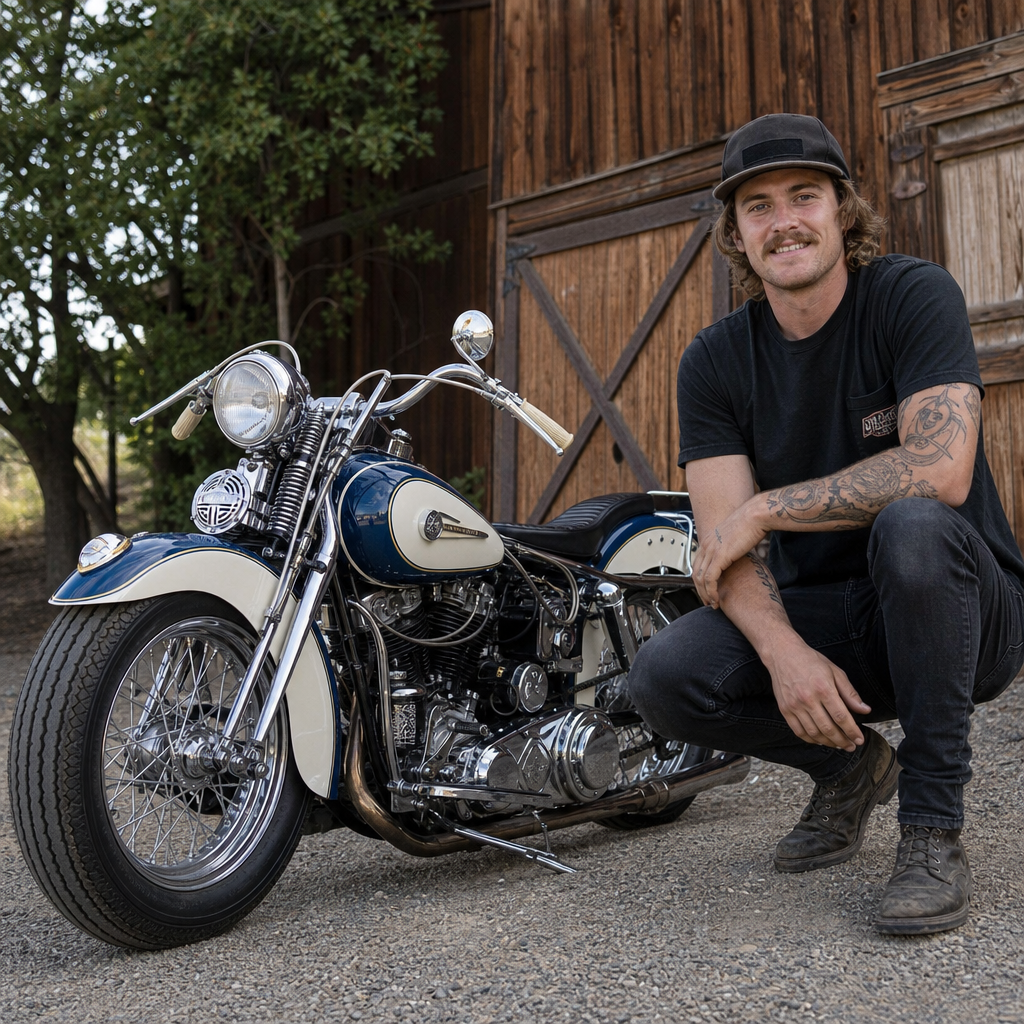
Ryder Leavitt represents a new kind of motorcycle builder: technically fluent, historically aware, and bold enough to let a first major project compete on merit against seasoned names. His 1969 Harley-Davidson FLH, selected as a finalist in 2026 builder conversations, has become a useful lens for understanding where custom culture is heading. This article examines Leavitt’s rise, the machine itself, and why this profile matters within the broader map of 2026 “New Guard” and legendary builders. In custom culture, a builder profile is more than biography. It connects design choices, fabrication methods, parts sourcing, judging criteria, and cultural influence. A finalist bike is not simply well painted or expensive; it is coherent from stance to fastener choice, and its workmanship survives close inspection. I have spent years around custom bike coverage, show floors, and fabrication shops, and the pattern is clear: the most important emerging builders are not copying the old masters, but extending them. Leavitt’s FLH sits squarely in that shift. It respects period Harley language while using modern fabrication discipline, sharper planning, and a cleaner narrative. As a hub article, this page introduces the subtopic “Profiles of 2026 New Guard and Legendary Builders” by showing how one young builder’s project can anchor discussions about heritage, innovation, judging, and influence across the custom motorcycle scene today.
Who Ryder Leavitt is and why his 1969 FLH matters
Ryder Leavitt entered public view as a first-time builder with unusual clarity of vision. That distinction matters. Many first builds are learning exercises assembled from trends, donor parts, and unfinished ideas. Leavitt’s 1969 FLH reads differently. It presents like a builder understood the assignment from day one: pick a platform with historical weight, decide what story the motorcycle should tell, and execute every modification so the result feels inevitable rather than experimental. The Harley-Davidson FLH is a loaded platform in American custom history. By 1969, the shovelhead era had begun, electric start touring models were gaining identity, and the big-frame Harley offered enough visual mass to support transformations ranging from period dresser restorations to radical show customs. Choosing a 1969 FLH signals confidence because the bike carries expectations. Purists know what should remain. Judges know what shortcuts are common. Experienced fabricators know how quickly proportion can collapse if the stance, wheel fitment, sheet metal alignment, and trim language do not agree.
Leavitt’s relevance within the 2026 “New Guard” comes from how he meets those expectations without leaning on nostalgia as camouflage. He appears to belong to a generation that studies archive photography, old show coverage, and landmark builders, yet works with newer standards for prep, tolerancing, digital planning, and finish consistency. That matters because the modern custom scene rewards originality but punishes incoherence. Builders now create in an environment where close-up images circulate instantly, fabrication details are enlarged on screens, and audiences can compare a young builder’s work directly with motorcycles from icons who shaped chopper, bagger, performance, and show-bike traditions. A finalist designation, in that context, is evidence that the bike held up under scrutiny from both old-school eyes and contemporary media exposure.
The motorcycle: reading the 1969 FLH as a complete build
The strongest custom motorcycles communicate before the engine starts. Leavitt’s 1969 FLH works because it can be read as a complete sentence. Start with proportion. A heavyweight Harley must carry visual mass through the tank, engine, primary, transmission, and fender lines without looking bloated. On a finalist-level build, that balance usually comes from careful wheel-and-tire sizing, fork attitude, ride height, and the relationship between the rear fender arc and the frame backbone. If any of those are misjudged, the motorcycle either looks cartoonish or merely restored with accessories. Leavitt’s approach, by all indications surrounding its finalist attention, avoids both traps.
Then there is surface strategy. Custom judges and informed enthusiasts rarely separate paint from metalwork because they know paint often hides weak preparation. A compelling FLH build requires straight panels, disciplined gap management, and trim choices that support the era being referenced. If a builder chooses period cues, hardware finish, seat shape, and control design all need to agree. If a builder modernizes selectively, the updates must appear intentional. That is where younger builders often gain ground. They may use CNC-assisted prototyping, laser-cut tabs, precise mock-up techniques, and better measurement workflows, but they still succeed or fail on whether those methods disappear into the final form. The viewer should feel the motorcycle, not the software.
The powertrain dimension also matters. A 1969 FLH is not a blank sculpture. It is a machine with mechanical expectations: heat management, vibration control, oiling integrity, charging reliability, and rider ergonomics all shape whether the build is credible. In my experience, one sign of serious craftsmanship is when a builder solves utility issues without announcing them. Clean cable routing, sensible service access, predictable control feel, and stable mounting decisions tell you the project was ridden, checked, revised, and understood as a motorcycle first. That is a major reason finalist bikes separate themselves from polished garage art.
How first-time builders reach finalist level in 2026
Leavitt’s story matters beyond one bike because it illustrates how a first-time builder can now enter elite conversations. The process is more rigorous than outsiders assume. Successful new builders usually begin with a strong reference set, not imitation but disciplined research. They study landmark Harley customs, period OEM literature, geometry conventions, and the work of fabricators known for repeatable quality. They also understand sequencing. Good builds are won during teardown documentation, frame assessment, parts triage, and mock-up, not at the end with paint and chrome. I have watched enough shop projects go sideways to know the pattern: enthusiasm outruns planning, outsourced work is poorly timed, budget gets burned on cosmetics, and the motorcycle loses cohesion.
What distinguishes 2026’s “New Guard” is the combination of analog skill and modern workflow. Young builders are using CAD for brackets and fitment checks, structured photo logs for assembly order, torque documentation, vendor communication spreadsheets, and high-resolution references for period correctness. They source through a mix of swap meets, specialist breakers, restoration suppliers, and boutique fabrication houses. They understand that originality today often comes from editing, not adding. On a heavy Harley especially, restraint is a high-level skill.
| Build factor | Common first-build mistake | What finalist-level builders do instead |
|---|---|---|
| Concept | Mixes several eras and styles without hierarchy | Defines one visual direction and uses every part to support it |
| Mock-up | Rushes to paint before testing stance and clearances | Completes full dry assembly, checks alignment, then finishes parts |
| Fabrication | Hides rough work under filler or coating | Produces clean welds, straight metal, and serviceable mounting points |
| Parts sourcing | Buys trendy components that fight the platform | Selects parts sized and styled for the FLH’s weight and era |
| Rideability | Treats the bike as a display object | Resolves controls, heat, charging, and maintenance access for real use |
Leavitt fits this model. His recognition suggests not luck, but method. A finalist first build usually means the builder accepted critique early, revised details repeatedly, and refused to confuse complexity with quality. That lesson is valuable for anyone following emerging builders in this sub-pillar topic.
Connecting Leavitt to legendary builders and the 2026 builder landscape
No new builder emerges in isolation. The reason this page functions as a hub is that Leavitt’s FLH can be understood only against the traditions that shaped it. Legendary builders established the grammar. Think of the discipline around silhouette, negative space, hand-formed metal, integrated controls, and finish quality that came from decades of show bikes, long bikes, Pro-Street machines, performance customs, and refined touring conversions. The best young builders do not quote those influences superficially. They understand why certain lines work, why some modifications age badly, and why durable craftsmanship always outlasts trend-driven spectacle.
In 2026, the builder landscape is unusually rich because categories are blending. A bike can carry vintage bones, modern machining, understated paint, and roadworthy engineering without losing soul. That creates space for someone like Leavitt. He is not forced to choose between “traditional” and “technical.” Instead, he can use better tools to pursue an older ideal: a motorcycle that feels personal, exacting, and complete. This is the hallmark of the “New Guard.” They are often less interested in loud self-mythology and more interested in proving competence through details. Their audience notices stem machining, bracket thickness, hidden wiring routes, seat pan fit, and the way polished and painted surfaces transition under changing light.
That same audience still reveres legendary builders because benchmark work remains benchmark work. The connection matters for editorial coverage and for readers using this article as a directory into the broader topic. When you study Leavitt alongside established names, useful questions emerge. Which old-school principles are nonnegotiable? Where do modern fabrication tools genuinely improve the result? How should judges weigh historical fidelity versus innovation? Which builders can shape trends without collapsing into sameness once social media amplifies their style? Leavitt’s FLH helps frame those questions because it sits at the intersection of respect and ambition.
What judges, media, and serious enthusiasts look for in a finalist bike
Finalist status is rarely about one dramatic feature. It comes from cumulative evidence. Judges generally begin with coherence. Does the motorcycle know what it is? From there they assess fabrication quality, paint and finish execution, mechanical credibility, proportion, originality, and restraint. Restraint is worth emphasizing. An advanced build often removes more than it adds, but every subtraction must preserve function. Media coverage adds another layer: photographability. Harsh truth from years around bike events is that some motorcycles impress in person but collapse in images because their lines are unresolved. Others are camera-friendly yet flimsy up close. A true finalist survives both tests.
Leavitt’s FLH appears to have done that. The bike evidently offers enough visual identity to stand out in a crowded field while maintaining the sort of close-detail integrity that invites repeated inspection. That is where experienced enthusiasts become the best evaluators. They notice whether drilled hardware is purposeful or decorative, whether tabs are symmetrical, whether edge finishing was rushed, whether primary and exhaust decisions create service headaches, and whether upholstery shape supports the bike’s visual centerline. Those details are not trivia. They are evidence of process.
For readers exploring the wider subject of 2026 builders, this framework is practical. It helps compare profiles across the subtopic. Whether the article is about an emerging Harley specialist, a multi-platform fabricator, or a legendary name still influencing younger shops, the same questions apply: Is the concept clear? Are the modifications structurally sound? Does the finish reveal discipline? Does the motorcycle look right from every angle? Does it ride as seriously as it photographs? By those measures, a first-time builder becoming a finalist is not a feel-good story. It is a sign of real capability.
Why this profile matters for the future of custom culture
Ryder Leavitt’s 1969 FLH matters because it shows that custom culture still rewards craftsmanship over noise. In an era shaped by rapid image sharing, algorithmic attention, and short trend cycles, a finalist build built by a newcomer proves that standards have not disappeared. They have become more visible. Every weld, bracket, line choice, and finish decision can be inspected by thousands of informed viewers. Builders who rise now do so because their work holds up across history, photography, and practical use.
That is the larger value of this hub article within “Profiles of 2026 New Guard and Legendary Builders.” Leavitt offers an entry point into the full builder conversation: heritage platforms, fabrication process, judging logic, and the ongoing exchange between established masters and emerging talent. His FLH demonstrates that first-time builder does not have to mean amateur outcome. With research, patient mock-up, disciplined sourcing, and clear visual intent, a newcomer can produce work that belongs in serious company. Follow this subtopic with that standard in mind. Study the bikes, compare the methods, and look closely at the details that make a machine feel inevitable rather than assembled. That is where the future of custom motorcycle building is being written today.
Frequently Asked Questions
Who is Ryder Leavitt, and why is he getting attention as a first-time builder?
Ryder Leavitt is attracting attention because he represents a meaningful shift in how new builders enter the custom motorcycle conversation. Rather than being framed only as a novice with potential, he is being discussed as a serious emerging figure whose work stands on its own. That distinction matters. In a field where recognition is often earned over many years, Leavitt’s rise signals that a builder with technical fluency, strong historical understanding, and a clear point of view can break through faster if the motorcycle itself justifies the attention. His 1969 Harley-Davidson FLH has helped make that case in a very public way.
What makes his story especially compelling is the combination of reverence and confidence. Leavitt is not approaching vintage Harley-Davidson material as a museum piece to be preserved without interpretation, nor is he treating it as raw stock for shock-value customization. Instead, he appears to understand the lineage of the FLH platform, the visual language surrounding classic American touring and custom builds, and the expectations that come with presenting a bike to an informed audience. For a first major project, that balance is unusually mature. It suggests a builder who has done more than simply learn fabrication or assembly; it suggests someone who has studied why certain motorcycles endure in memory and why others fade despite technical competence.
His growing visibility also fits a broader 2026 pattern often described as the rise of a “New Guard” in custom culture. These are builders who are digitally literate, historically informed, and less interested in fitting neatly into old categories. They can speak the language of craftsmanship, but they also understand presentation, narrative, community response, and the role of curation in how bikes are perceived. Leavitt’s attention, then, is not just about one motorcycle. It is about what his presence says regarding the current standards of custom building: the work still has to be real, the execution still has to be convincing, but the path to relevance is no longer limited to the traditional, slow-moving gatekeeping channels that dominated earlier eras.
What makes Ryder Leavitt’s 1969 Harley-Davidson FLH such an important bike in the 2026 builder conversation?
The importance of Leavitt’s 1969 FLH comes from how effectively it functions on multiple levels at once. On the surface, it is a period-rooted Harley-Davidson platform with natural historical weight. The 1969 FLH sits in a part of the Harley timeline that carries enormous cultural and mechanical significance, making it a strong canvas for any builder willing to engage with that legacy. But what has elevated this particular machine in 2026 builder discussions is not simply the base model. It is the sense that the motorcycle was built with intention, discipline, and enough originality to justify being considered alongside work from more established names.
As a finalist, the bike has become more than a personal project. It now serves as a reference point in larger conversations about what judges, audiences, and fellow builders value today. People are reading the bike not only for finish quality or parts selection, but for worldview. Does it honor the FLH’s silhouette? Does it modernize without flattening personality? Does it feel like a builder is speaking through the machine rather than merely demonstrating competence? Those are the kinds of questions serious custom motorcycles provoke, and Leavitt’s FLH appears to invite them in a way that has resonated widely.
There is also a symbolic element. A first major build reaching finalist status suggests that the standards of entry have changed, but not necessarily become easier. Instead, the standards may be becoming more precise. Builders are being rewarded for coherence, authenticity, and command of both tradition and execution. Leavitt’s FLH matters because it occupies that intersection. It helps show where custom culture is heading in 2026: toward motorcycles that can withstand close inspection from purists, excite newer audiences, and still feel like fully realized statements rather than algorithm-friendly impressions.
Why does a 1969 FLH make such a strong foundation for a custom build?
A 1969 Harley-Davidson FLH is a powerful foundation for a custom build because it carries both mechanical identity and immediate visual authority. The FLH platform is deeply tied to Harley-Davidson’s big-twin heritage, and by the late 1960s it already occupied a special place in American motorcycle culture. Builders and enthusiasts recognize it as substantial, expressive, and rich with possibilities. That means any custom built from a 1969 FLH starts with a platform that already speaks to history, long-distance functionality, and classic American form. The challenge is not making it interesting; the challenge is shaping it without losing the gravity that made it compelling in the first place.
From a design standpoint, the FLH gives a builder a broad but demanding canvas. Its proportions allow for elegant customization, but those same proportions can quickly expose weak decisions. A builder has to understand stance, mass, line, and visual rhythm. Changes to handlebars, sheet metal, wheel setup, suspension attitude, drivetrain presentation, trim, and finishing choices all have amplified consequences on a bike like this. When the work is successful, the result can feel inevitable, as though the motorcycle always wanted to look that way. When it is not, the bike can become confused or overworked very quickly. That is one reason a well-executed FLH custom earns so much respect: the platform rewards discernment, not just ambition.
Historically, a 1969 FLH also invites interpretation because it sits close enough to several key eras to support different philosophies. A builder can lean toward period-correct restoration values, classic custom cues, performance-minded reinterpretation, or a hybrid approach that bridges vintage soul with contemporary execution. That flexibility is part of the attraction. In Leavitt’s case, the FLH becomes especially meaningful because it lets him demonstrate historical awareness while still making a case for his own voice. For readers trying to understand why this bike matters, the answer starts with the machine itself: the 1969 FLH is not just old, desirable metal. It is one of those platforms that reveals whether a builder truly understands what he is touching.
How does Ryder Leavitt’s build reflect the direction of the 2026 “New Guard” in custom motorcycle culture?
Leavitt’s build reflects the 2026 “New Guard” because it suggests a generation of builders who do not see a contradiction between scholarship, craftsmanship, and self-definition. Earlier custom scenes often pushed builders into clearer camps: traditionalist, radical stylist, fabricator’s fabricator, performance-first operator, or heritage loyalist. The newer wave is more fluid. Builders are often technically educated, visually literate, and highly aware of the stories surrounding the machines they touch. Leavitt’s 1969 FLH seems to fit that pattern by showing respect for the historical language of the platform while also presenting a build with enough confidence to avoid becoming a nostalgic exercise.
Another defining characteristic of the “New Guard” is that credibility is increasingly built through transparency and coherence rather than mystique alone. Audiences today pay attention to process, sourcing, design logic, and whether a motorcycle feels honestly conceived. A first-time builder cannot rely only on reputation because there is no long-established reputation to hide behind. The work must communicate clearly. In that sense, Leavitt’s recognition says something important: newer builders can earn serious notice if they present a motorcycle that feels complete in its thinking, not just polished in its photography or loud in its concept.
His profile also reflects a broader change in how custom culture values dialogue between generations. The 2026 landscape is not simply about replacing legendary builders with younger names. It is about placing new builders into meaningful conversation with them. Leavitt’s FLH matters because it encourages comparison without seeming derivative. That is a difficult line to hold. If a young builder references the past too heavily, the work can feel imitative. If he ignores it, the work can feel detached from the tradition that gives custom culture depth. The “New Guard” earns legitimacy by understanding both risks. Leavitt’s emergence suggests that he understands that balance, which is exactly why his bike has become such a useful case study for where the culture is heading.
Why does Ryder Leavitt’s finalist status matter beyond just one motorcycle?
Leavitt’s finalist status matters beyond a single bike because it influences how people think about talent, access, and standards in contemporary custom building. When a first major project reaches finalist territory, it challenges old assumptions about how authority is earned. That does not diminish the value of experience; if anything, it sharpens the conversation around what experience should produce. A young builder being recognized at a high level forces observers to ask better questions. Is the work conceptually strong? Is it technically convincing? Does it carry historical intelligence? Does it contribute something to the larger culture rather than merely quote from it? Those questions elevate the conversation for everyone.
There is also a cultural significance to the timing. In 2026, the custom motorcycle world is increasingly attentive to builders who can connect eras, audiences, and expectations. A finalist like Leavitt becomes a signal that the field is still open to new voices, but only if those voices arrive with substance. That is healthy for the scene. It encourages emerging builders to aim higher than aesthetics alone and reminds established names