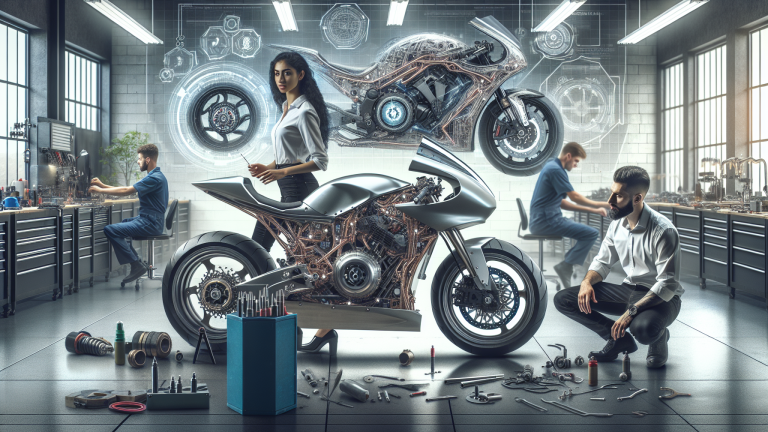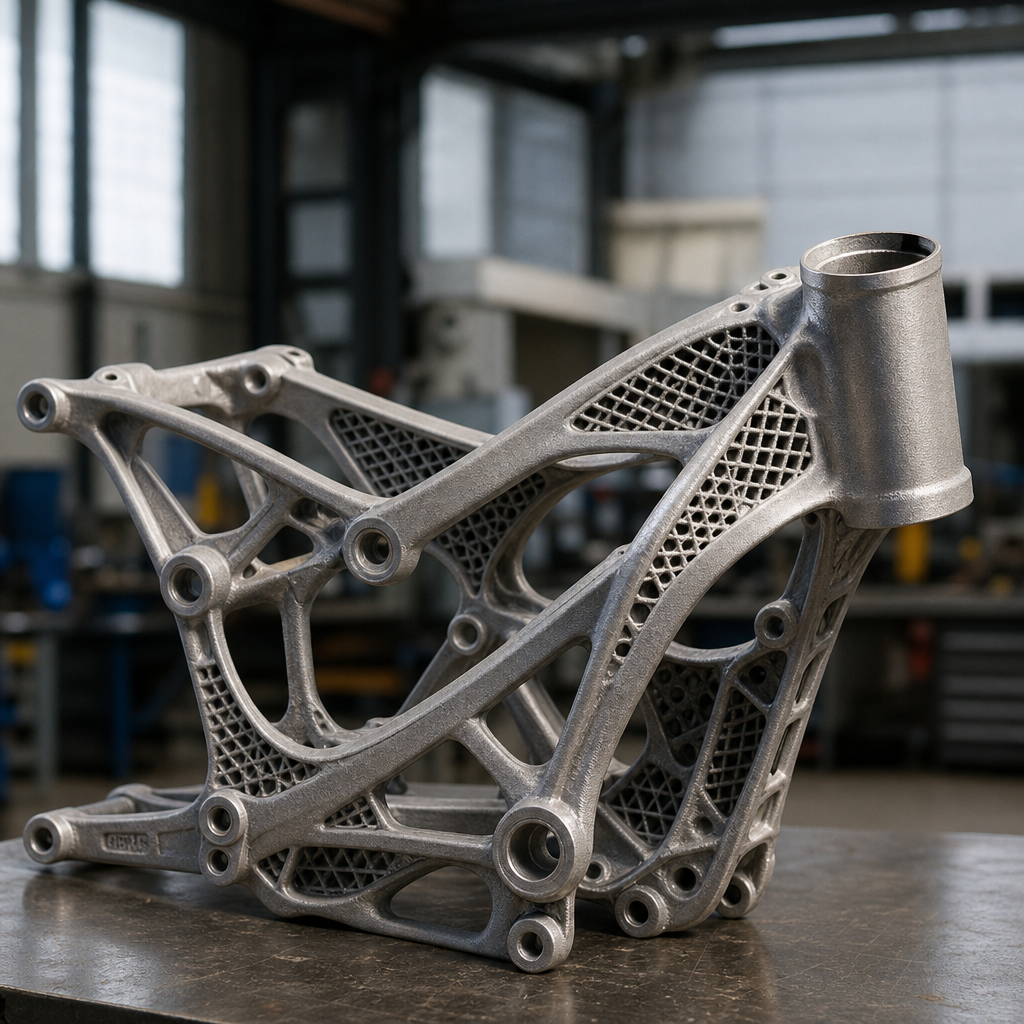
The LFC700 frame is one of the clearest demonstrations of how additive manufacturing moved from prototype theater into functional motorcycle structure, and a casting review of its mechanics reveals why builders now treat 3D printing, carbon composites, and advanced wiring as one integrated fabrication system rather than three separate technologies. In custom motorcycle work, “casting review” usually means a critical examination of how a part was conceived, modeled, formed, finished, and validated against the mechanical demands of real riding. With the 3D-printed LFC700 frame, that review starts with an unusual fact: the frame is not simply printed as a decorative shell, but developed through a workflow that uses digital design, foundry practice, metallurgical control, composite integration, and compact electrical architecture to create a rideable chassis.
That matters because modern custom culture is changing. Traditional fabrication still depends on tube bending, welding, hand-shaped panels, and the practical intuition of experienced builders. I still rely on those methods in the shop because they are fast, repairable, and proven. But the “new guard” of builders combines CAD, simulation, scanning, resin and metal printing, carbon layup, and tightly packaged wiring looms to produce shapes and packaging solutions that conventional fabrication struggles to match. The LFC700 sits at the center of that shift. It shows how a frame can be engineered as a digitally controlled mechanical system, then refined by casting and finishing methods familiar to motorsport and aerospace suppliers.
To understand the mechanics of the 3D-printed LFC700 frame, it helps to define the three technologies that surround it. First, additive manufacturing is the layer-by-layer creation of parts from a digital model, using polymers, resins, or metal feedstock. In motorcycle development, it is often used for intake parts, brackets, ducting, mold tools, patterns for casting, and increasingly for structural nodes. Second, carbon fabrication refers to the use of carbon-fiber reinforced polymers for bodywork, substructures, battery enclosures, ducts, and other components where low mass and directional stiffness are valuable. Third, wiring has become a fabrication discipline of its own because electronic control units, battery management systems, CAN communication, sensors, lighting modules, and compact switchgear all demand cleaner routing and tighter tolerance packaging than old analogue looms.
As a hub topic, this article uses the LFC700 frame as the anchor case because it highlights the practical relationship between these technologies. The frame itself is the headline, but the deeper lesson is process integration. A builder evaluating 3D printing needs to know when printing should produce a final-use component, when it should create a casting pattern, and when it should only serve as a fitment model. The same builder needs to know where carbon genuinely saves weight, where it merely adds expense, and how wiring architecture can undermine an otherwise elegant design if service loops, heat shielding, and connector access are ignored. Those are the mechanics that separate a compelling showpiece from a machine that can be maintained, ridden, and replicated.
How the LFC700 frame is made and why the casting review matters
The most important mechanical point in any review of the 3D-printed LFC700 frame is that printing does not eliminate casting discipline; it intensifies it. In practice, highly complex frame sections are developed in CAD, optimized around engine mounting, suspension loads, rider ergonomics, and packaging, then produced through additive methods that support either direct manufacture or castable geometry. For builders, the phrase “3D-printed frame” can be misleading because the final structural reality depends on material behavior, post-processing, heat treatment, machining, and inspection. Geometry freedom is only useful if the finished structure carries torsional and bending loads predictably.
That is why a casting review matters. Any structural frame section must be judged for wall thickness control, internal stress risers, junction transitions, porosity risk, and machining allowance at critical interfaces. In conventional welded frames, the obvious failure points are often weld toes, heat-affected zones, and local buckling around tabs or bends. In cast or additively assisted structures, attention shifts toward gate design, shrink behavior, trapped voids, anisotropy if a printed metal process is used, and the quality of post-cast finishing. Builders who ignore those factors tend to overestimate the strength of complex organic shapes simply because they look advanced. Good mechanics are not aesthetic; they are measurable.
I have found that the best way to assess a frame like the LFC700 is to trace the load path before looking at the styling. Start at the steering head, move through the main frame spars or shell sections, follow the engine mount interfaces, then continue to the swingarm pivot and rear support members. If each transition has smooth section changes, adequate material around bores, and sensible reinforcement where peak loads converge, the design is usually mechanically honest. If the frame relies on abrupt cosmetic hollows, thin unsupported skins, or inaccessible cavities that cannot be inspected, that is a warning sign regardless of how futuristic the rendering appears.
Structural mechanics: load paths, stiffness, weight, and failure control
The LFC700 frame concept is mechanically interesting because additive manufacturing enables shapes that can place material where stress is highest and remove it where it contributes little. This is often described as topology optimization, but in motorcycle terms it means building a frame around actual forces: steering input, braking dive, chain pull, cornering side load, and suspension reaction. A well-executed printed-and-cast frame can improve stiffness-to-weight ratio by thickening material around the headstock and pivot while thinning low-stress connecting regions. That approach mirrors race engineering, where every gram removed from a chassis must be justified against fatigue life and feel.
However, light weight alone is not the goal. A motorcycle frame must have the right stiffness in the right directions. Excessive torsional rigidity can make a bike harsh or vague at the limit, while too little lateral and longitudinal control can produce weave, wallow, or poor braking stability. The LFC700 frame review therefore should focus on tuned stiffness rather than minimum mass. Digital fabrication helps because finite element analysis can predict stress concentration and deflection before a tool is cut, but simulation is only as good as the assumptions behind it. Real validation still requires fixture testing, dimensional checks after heat cycles, and road or track feedback.
| Fabrication area | Main advantage | Primary mechanical risk | Best use on a custom build |
|---|---|---|---|
| 3D printing | Complex geometry and rapid iteration | Poor material choice or weak post-processing | Patterns, housings, brackets, structural nodes after validation |
| Casting | Strong integrated shapes with fewer welds | Porosity, shrink defects, machining drift | Frame sections, triples, covers, suspension components |
| Carbon fiber | Low mass and directional stiffness | Impact damage and galvanic interaction with metals | Bodywork, airboxes, ducts, subframes, battery trays |
| Advanced wiring | Packaging efficiency and electronic reliability | Heat, vibration, and poor serviceability | Compact looms, sensor networks, control integration |
Failure control is where advanced fabrication earns or loses credibility. Structural castings should be checked by non-destructive inspection methods such as dye penetrant, X-ray, or computed tomography when budget allows. Critical machined faces must hold alignment at the steering head and pivot centers, because a visually perfect frame with even minor dimensional error will compromise handling and bearing life. Surface finishing also matters more than many builders expect. Sharp internal corners, rough machined transitions, or aggressive blasting can shorten fatigue life by creating stress raisers. On a premium custom, those details define whether the frame is engineering or sculpture.
Where 3D printing fits in custom motorcycle fabrication
For the broader hub topic, the LFC700 frame demonstrates the most mature use of 3D printing in custom motorcycle fabrication: not as a gimmick, but as a precision manufacturing step selected for a specific reason. In most shops, polymer printing is still the daily workhorse. FDM printers produce fast fitment models, connector mounts, routing clips, and ergonomic mockups. SLA and DLP resin systems create smoother, higher-detail parts, useful for mold masters, lens prototypes, and castable patterns. SLS nylon is often the most practical end-use choice for air ducts, electronics trays, and enclosure parts because it offers good heat resistance and no support scarring.
Metal printing remains more expensive, but it is increasingly relevant for highly loaded brackets, foot control carriers, lightweight clamps, and complex internal channels. The key lesson from the LFC700 is that builders should think in workflows. A printed part may become a pattern for investment casting, a sacrificial tool for carbon layup, or a test mule that confirms clearances before CNC machining begins. That layered approach lowers risk. It also shortens the redesign cycle dramatically. Instead of reworking aluminum by hand after every packaging change, a builder can revise the CAD model, print overnight, test fit the next morning, and lock dimensions before committing to expensive material.
There are limits. Printed polymers can creep under heat, absorb moisture, and crack under vibration if the wrong process is selected. Layer orientation matters. Threaded inserts need proper design around boss thickness and pull-out strength. UV stability can be poor without coating. In practical shop use, I trust printed plastics most for non-structural or semi-structural functions unless the material data, temperature range, and mounting conditions are fully understood. That caution is not anti-technology; it is what makes the technology usable.
Carbon fabrication: where it complements a printed-and-cast frame
Carbon fiber enters the conversation because the most advanced custom builds rarely stop at the frame. Once a builder creates a compact, sculptural central structure, every surrounding component has to justify its weight and volume. Carbon is ideal for bodywork, intake covers, seat pans, front fairing supports, and battery or electronics enclosures because it can deliver high stiffness with low mass when fiber orientation matches the load. In a project like the LFC700, carbon also helps preserve the visual logic of the frame by allowing thin, clean panels that do not interrupt the architecture with bulky metal brackets.
But carbon should not be treated as universally superior. It is expensive, labor-intensive, and unforgiving of poor process control. Vacuum bagging improves fiber volume fraction, but resin selection, cure schedule, edge finishing, and insert bonding all affect final performance. Builders also need to understand galvanic corrosion when carbon contacts aluminum or steel in the presence of moisture. Isolation layers, correct fasteners, and thoughtful drainage are not optional. Impact behavior is another tradeoff. A carbon panel can remain visually intact while suffering subsurface delamination, which means inspection methods and repair decisions differ from those used on aluminum bodywork.
When used correctly, carbon complements additive fabrication beautifully. Printed molds and trim fixtures reduce setup time. Printed locating features keep inserts, mounting points, and wire channels consistent across repeat parts. This is where the subtopic becomes practical: 3D printing accelerates carbon manufacturing, and carbon reduces mass around a complex frame, improving the total package rather than just one component.
Wiring architecture: the hidden fabrication discipline
Advanced wiring is often overlooked in frame discussions, yet it is one of the decisive factors in whether a modern custom bike feels engineered. A frame like the LFC700 invites tight packaging, concealed electronics, and minimal visual clutter. That only works if the wiring architecture is planned at the same stage as the frame model. I have seen too many high-end builds where elegant metalwork is undermined by last-minute loom routing, inaccessible connectors, or overheated control modules boxed into dead-air cavities.
The best practice is to divide the system into zones: power distribution, control, sensing, charging, and lighting. Compact modules from firms such as Motogadget, Axel Joost Elektronik, or modern OE-style fuse and relay systems make this easier, especially when paired with TXL or Tefzel wire, proper crimp tooling, Raychem-style heat shrink, and sealed connectors from Deutsch or TE Connectivity. Routing should account for steering sweep, suspension travel, abrasion points, and electromagnetic noise near ignition components. Service loops need to exist, but they must be controlled, not stuffed wherever room remains.
Digital fabrication improves wiring in several ways. Printed clips, channels, and junction housings keep looms stable. Carbon enclosures can isolate sensitive electronics from splash while preserving low weight. Cast frame cavities can hide runs if drainage, grommeting, and inspection access are built in from the start. In the best examples, the electrical system becomes part of the structural packaging strategy, not an afterthought.
What builders should learn from the LFC700 frame
The broader lesson of the 3D-printed LFC700 frame is that fabrication technology works best when each method is assigned a clear job. Use 3D printing for iteration, geometric freedom, and manufacturing support. Use casting for integrated structural forms where weld count, shape complexity, and consistency matter. Use carbon where mass reduction and thin-section stiffness justify the process. Use disciplined wiring design to make the machine reliable, serviceable, and visually coherent. None of these methods replaces craftsmanship. They shift craftsmanship into digital modeling, materials knowledge, process control, and verification.
For builders exploring this space, start with one subsystem rather than attempting a full technology stack at once. Print ducting, mounts, or pattern pieces first. Develop a carbon battery box or seat unit with proper inserts. Rebuild a loom using professional wire, sealed connectors, and planned service access. Once those processes are reliable, move toward more ambitious parts, including structural castings or printed metal hardware. The LFC700 matters because it proves the direction of travel: custom motorcycles are increasingly defined by how well builders integrate fabrication technologies into one mechanically coherent whole. Study that integration, apply it carefully, and the results will be lighter, cleaner, smarter, and more durable on the road.
Frequently Asked Questions
1. What makes the 3D-printed LFC700 frame such an important example in a casting review?
The LFC700 frame matters because it shows that additive manufacturing is no longer just a way to make visual mockups or one-off concept parts. In a casting review, the frame stands out as a real structural component that had to satisfy design, load, fitment, finish, and validation requirements at the same time. That is a major shift from earlier uses of 3D printing in motorcycle development, where printed parts were often limited to patterns, molds, or styling studies rather than load-bearing architecture.
What makes the review especially revealing is the way the frame bridges multiple manufacturing logics. It begins as a digitally modeled structure optimized for geometry and packaging, but it must also behave like a serious mechanical system under acceleration, braking, cornering, torsion, vibration, and heat cycling. In other words, the casting review is not simply about whether the printed shape looks advanced. It is about whether the frame’s conception, formation, finishing, and verification support real-world motorcycle performance.
The LFC700 also demonstrates why modern builders think in terms of integrated fabrication rather than isolated materials or processes. A printed frame does not exist in a vacuum. Its geometry must work with carbon composite body elements, embedded or carefully routed wiring, engine mounting points, steering loads, and manufacturing tolerances across the whole bike. That makes the frame an ideal case study because every design decision affects several systems at once. In a proper casting review, that interconnectedness is exactly what gets examined.
2. How does additive manufacturing change the mechanical design of a motorcycle frame compared with traditional casting or fabrication?
Additive manufacturing changes frame mechanics by giving engineers much greater freedom to place material exactly where it is needed and reduce it where it is not. Traditional fabrication methods, such as welded tubes, machined sections, or cast components, tend to impose geometric limits. Those limits often force designers to compromise between manufacturability and ideal load paths. With 3D printing, especially in metal, the frame can be designed around stress flow, stiffness targets, packaging constraints, and weight distribution far more directly.
Mechanically, that means the frame can use organic transitions, variable wall thicknesses, internal reinforcement strategies, and highly localized structural tuning that would be difficult or impossible to achieve with conventional methods. Areas that experience concentrated stress, such as steering head junctions, swingarm pivot zones, or engine mounting interfaces, can be shaped to spread loads more smoothly. That reduces abrupt section changes that often create stress risers. In a casting review, this is one of the most important questions: not just how the part was made, but whether the process enabled better mechanical behavior.
Another major difference is how digital simulation becomes tightly connected to the physical part. Because the frame starts as a computational model, engineers can iteratively adjust topology, ribbing, wall sections, and connection geometry before fabrication. The result is a frame that is often more intentionally engineered than a conventional piece that evolved around process constraints. However, additive freedom also brings responsibility. The review must consider print orientation, residual stresses, post-processing, support removal, surface finish, and final tolerances, because all of those influence actual strength and fatigue life. So while additive manufacturing opens new structural possibilities, its success depends on disciplined engineering and verification.
3. Why are 3D printing, carbon composites, and advanced wiring treated as one integrated fabrication system in builds like the LFC700?
They are treated as one system because on a modern high-end motorcycle, structure, packaging, electronics, and outer surfaces are no longer independent layers added one after another. Instead, they are co-designed. The frame defines load paths and mounting architecture, the carbon components influence stiffness, enclosure, airflow, and mass distribution, and the wiring must be routed in ways that protect reliability while preserving clean packaging and serviceability. On a bike like the LFC700, these decisions overlap so much that separating them into independent manufacturing conversations no longer makes sense.
For example, a 3D-printed frame can incorporate precise channels, cavities, brackets, and mounting provisions that support composite interfaces and electrical routing from the start. That means the wiring harness is not simply tied on afterward, and the composite bodywork is not treated as decorative skin alone. Instead, the printed structure can anticipate sensor placement, cable management, battery or control module accommodation, and the attachment logic required for lightweight carbon parts. In a casting review, this integrated design thinking is a sign of maturity. It shows that the builder is reviewing the part as a node in a complete mechanical and electrical ecosystem.
This integration also improves performance and manufacturability. Better routing protects wires from vibration, abrasion, and heat. Better interfaces with composites reduce awkward brackets and excess fasteners. Better packaging can improve center of gravity, maintenance access, and visual clarity. So when experts say additive manufacturing, composites, and advanced wiring now function as one fabrication system, they mean the project has moved beyond novelty. It is using digital design and advanced materials in a coordinated way to improve the complete motorcycle.
4. What does a proper casting review examine when evaluating the mechanics of the LFC700 frame?
A proper casting review looks at the entire life cycle of the frame, not just the finished appearance. It begins with conception: what performance goals drove the design, what load cases were considered, and how the frame geometry was developed to support handling, rigidity, weight, and packaging objectives. From there, the review examines modeling choices, including how stress concentration zones were managed, how joints and interfaces were shaped, and whether the design took advantage of additive manufacturing in a mechanically meaningful way rather than using complexity for its own sake.
The next stage is formation and build execution. Here, the review considers the actual printing process, including material selection, layer strategy, support design, print orientation, thermal behavior during fabrication, and any risk of distortion or hidden defects. For a structural motorcycle frame, these are not small details. They affect microstructure, consistency, dimensional accuracy, and long-term durability. A serious review also looks at post-processing: heat treatment, machining of critical interfaces, surface finishing, joining methods if the frame is modular, and inspection procedures used to confirm the final part matches the engineering intent.
Finally, validation is central. The frame must be assessed under real mechanical expectations, including static loads, dynamic loads, fatigue cycles, vibration exposure, and alignment verification. Reviewers will also want to know how the printed frame behaves when integrated with the engine, suspension, steering assembly, bodywork, and electrical system. In that sense, “casting review” is really a comprehensive audit of whether the part was conceived intelligently, produced correctly, finished competently, and validated honestly. For the LFC700, that full-chain review is what makes its frame such a compelling benchmark.
5. What are the biggest engineering challenges and benefits of using a 3D-printed frame in a motorcycle like the LFC700?
The biggest benefits are geometric freedom, structural optimization, and system integration. A 3D-printed frame allows the designer to pursue forms that better match actual stress paths and packaging requirements, which can improve stiffness-to-weight performance and reduce unnecessary material. It also supports a high degree of customization, which is especially valuable in premium custom motorcycle work where aesthetics, brand identity, and engineering can be tightly linked. Because the frame is digitally native, it can also be adapted more quickly than traditional tooling-heavy methods would allow.
At the same time, the challenges are substantial. Structural printed metal parts demand rigorous control over material behavior, process repeatability, and finishing quality. Surface roughness, internal porosity, residual stress, dimensional variation, and anisotropic properties can all affect mechanical reliability if they are not understood and managed. A frame is a safety-critical part, so it cannot rely on design ambition alone. It must be validated for fatigue resistance, joint integrity, impact tolerance, and long-term stability under real riding conditions. That is why a thoughtful casting review spends so much time on process discipline rather than just celebrating the use of advanced technology.
There is also the challenge of translating innovation into serviceable, buildable reality. A beautiful printed frame still has to accept bearings, mounts, fasteners, wiring, coatings, and composite attachments with repeatable accuracy. It has to be inspectable and maintainable. It has to work with assembly workflows and not create unnecessary complications elsewhere on the motorcycle. When all of that is handled well, the benefit is enormous: the LFC700 becomes evidence that additive manufacturing can contribute not just visual drama, but credible mechanical performance. That is ultimately why the frame is so significant in a casting review context.