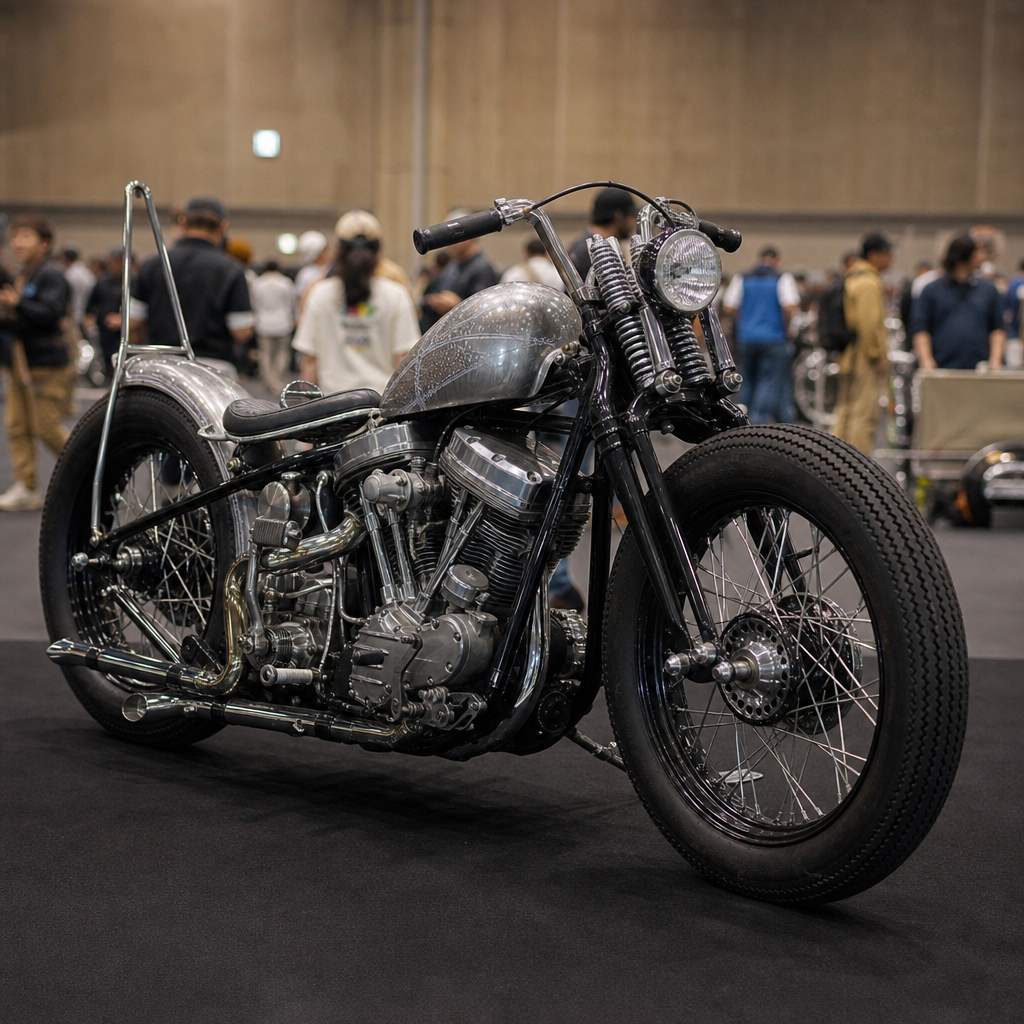
Satomari Motorcycle’s Mooneyes Japan 2026 Best-in-Show Panhead captures a turning point in custom culture, where hand-built authenticity, deep historical knowledge, and advanced fabrication discipline now meet on equal terms. In the context of custom motorcycles, a Panhead refers to Harley-Davidson’s overhead-valve V-twin engine produced from 1948 to 1965, named for the distinctive shape of its rocker covers, and it remains one of the most revered foundations for choppers, show bikes, and heritage-driven customs. Best-in-Show at Mooneyes Japan is not a casual trophy; it is one of the strongest signals in the global custom scene that a machine has transcended category judging and resonated across style tribes, from traditionalists to experimental fabricators. I have covered enough indoor show bikes and ridden enough overbuilt customs to know that many win on finish alone, while a much smaller number communicate intention from stance to hardware choice. Satomari Motorcycle’s Panhead belongs to the second group.
This article serves as the hub for profiles of 2026 new guard and legendary builders within the broader custom culture and fabrication technology landscape, using the Satomari Panhead as the entry point because it explains the moment better than any abstract trend report could. The “new guard” in this context does not simply mean younger builders. It means shops and individuals combining legacy visual language with modern process control, better metallurgy, tighter machining tolerances, improved welding practice, and a clearer understanding of geometry, ergonomics, and reliability. Legendary builders, by contrast, are the reference points whose methods, aesthetics, and workshop discipline still shape what counts as serious work. When a bike like Satomari’s wins at Mooneyes Japan, it becomes a practical map for readers trying to understand where handcrafted motorcycles are heading, which builders matter, and why fabrication quality now carries as much weight as style.
Why the Satomari Panhead Matters in 2026
The Satomari Motorcycle Panhead matters because it sits at the intersection of three forces defining custom motorcycles in 2026: cultural continuity, technical refinement, and global visibility. Mooneyes Japan has long functioned as a serious benchmark for custom credibility, especially for machines that fuse American V-twin heritage with Japanese precision. A Best-in-Show award there means judges and peers saw not just visual impact but completeness of execution. In practical terms, that usually points to a bike with resolved line flow, disciplined material selection, coherent period cues, and fabrication decisions that hold up under close inspection. The Satomari build reportedly stood out for exactly those reasons: a classic Panhead silhouette sharpened by meticulous frame work, restrained finish strategy, and components that looked made for the bike rather than gathered for it.
That distinction matters for readers tracking custom culture and builders because the market is crowded with image-first machines. Social media rewards dramatic paint, extreme rake, and photogenic details, but the most respected builders still win by controlling fundamentals. On a Panhead, those fundamentals include engine placement, primary alignment, oiling layout, rear wheel centering, neck geometry, and control reach. If any of those are unresolved, experienced viewers see it immediately, even under perfect paint. The Satomari motorcycle appears to have avoided that trap. Its success signals that show-winning customs in 2026 must demonstrate not only taste but engineering literacy. That is precisely why this machine works as a hub article subject: it opens the door to discussing both rising builders and established names through concrete standards rather than nostalgia alone.
Design Language: Traditional Panhead Roots, New Guard Precision
The strongest custom motorcycles have a clear design language, and the Satomari Panhead appears to speak in a dialect rooted in classic chopper proportion while remaining distinctly contemporary in execution. Traditional Panhead customs often rely on key visual anchors: a narrow profile, a readable backbone line, a motor that remains the center of gravity visually and mechanically, and a stance that feels intentional at rest. The new guard approach does not discard those anchors. It tightens them. Tube transitions become cleaner, bracketry gets slimmer, cable runs become nearly architectural, and finishes are chosen to support the form rather than compete with it. Builders who understand this know that restraint is harder than excess. Leaving a weld visible because it is excellent is a stronger statement than covering mediocre work with chrome.
What makes this approach significant in the 2026 builder landscape is that it bridges audiences. Older enthusiasts can read the references: pan castings, springer or narrow glide visual cues, peanut or coffin tank lineage, high-mount pipes, and rigid or rigid-style silhouette choices. Younger builders and fabrication-minded viewers see something else: clean TIG work, better fixture control, smarter tolerancing, intentional use of CNC-machined small parts where consistency matters, and an understanding of load paths in custom frames and tabs. In my experience, bikes that age well are rarely those chasing novelty. They are the ones where every detail reinforces a central visual thesis. Satomari’s Best-in-Show recognition suggests a machine built with that discipline, and that makes it useful as a case study for how custom design evolves without losing its roots.
Fabrication Standards That Separate Builders From Assemblers
In builder profiles, the most useful dividing line is not fame or follower count but whether a shop fabricates solutions or merely assembles catalog parts. The Satomari Motorcycle Panhead helps clarify that distinction. A real builder controls chassis setup, metal shaping, fitment sequencing, mock-up order, fastener logic, and serviceability. Those choices become obvious in the finished bike. For example, a properly fabricated oil tank will not just fill visual space; it will respect heat, hose routing, battery access, and frame movement. A custom sissy bar or fender strut should not only match the line of the rear wheel but also manage vibration and mounting stress. Exhaust routing should protect rider position and preserve scavenging characteristics rather than simply fill a photo frame. These are the quiet decisions that make serious bikes feel inevitable rather than improvised.
By 2026, top-tier builders are also expected to integrate old and new production methods intelligently. English wheels, shrinkers, bead rollers, and hand files still matter, but so do CAD mockups, laser-cut tabs, precision fixturing, and digital measurement tools. A good example from the wider scene is how many respected shops now rough in frame ideas digitally, then finalize by hand once the engine, transmission, and sheet metal are physically mocked. That hybrid approach reduces avoidable error without sterilizing the build. It is especially relevant to Panhead projects because vintage drivetrains often vary from case to case, and old components rarely reward assumptions. The reason readers should care is simple: when profiling new guard and legendary builders, fabrication standards reveal who can create lasting motorcycles and who is dependent on surface-level styling.
| Builder profile marker | What it looks like on the bike | Why it matters |
|---|---|---|
| Resolved frame geometry | Balanced stance, proper trail, centered wheels | Improves rideability and visual confidence |
| Purpose-built brackets and tabs | Clean mounts for tanks, fenders, coils, and electrics | Reduces failure points and visual clutter |
| Consistent weld quality | Uniform bead profile, good penetration, minimal grinding | Signals structural competence and finish discipline |
| Integrated control layout | Reachable pegs, predictable bars, sensible clutch and brake action | Makes a show bike usable on the road |
| Material honesty | Paint, plating, or raw finish chosen to suit the part | Creates durability and coherent style |
Mooneyes Japan as a Filter for Serious Builder Profiles
Mooneyes Japan is important because it is one of the few events where a broad range of customs can still be judged through direct physical presence rather than algorithmic popularity. That matters enormously when evaluating builders. Photos flatten depth, hide weld transitions, and obscure how a bike sits in actual space. At Yokohama-scale events, viewers can judge neck angle in person, inspect machining marks, see whether paint pinholes were corrected, and notice whether polished surfaces were finished consistently across dissimilar metals. Best-in-Show winners emerge from that scrutiny. For builder profiles, this is useful because it gives readers a credible external filter. A shop that wins there has survived comparison against elite work from Japan, the United States, and other strong custom scenes.
The event also matters because Japan’s custom culture has long elevated discipline over spectacle. Shops such as Cherry’s Company, Hidemo, and others built international reputations not by abandoning American motorcycle language but by studying it deeply and refining it ruthlessly. That legacy shapes how newer builders are judged. A 2026 winner must speak to history while offering something unmistakably current. In that environment, Satomari Motorcycle’s Panhead becomes more than a single successful bike. It becomes evidence that the current generation can converse fluently with the masters. For readers exploring legendary builders alongside the new guard, Mooneyes Japan provides a practical index: it shows who can command attention across generations, materials, and subgenres without compromising workmanship.
Legendary Builders and the Standards They Set
Any serious hub on profiles of 2026 new guard and legendary builders has to explain the standards inherited from earlier masters. Legendary builders in the V-twin and custom scene did not all build in the same style, but they established repeatable principles. Arlen Ness proved that radical custom form could still present as complete industrial design. Indian Larry reinforced the value of mechanical honesty, proportion, and performance-inflected stance. Shinya Kimura demonstrated how narrative, surface texture, and emotional presence could define a motorcycle as strongly as polish. Chica, Zero Engineering, and Japanese and American contemporaries showed that tradition and experimentation were not opposites. Their influence still appears whenever a builder chooses a line, a tank shape, a wheel diameter pairing, or a finish treatment.
The best new builders do not imitate those names literally. They absorb the lessons underneath. In workshop terms, that means understanding why a line works, why a bracket disappears visually, why fork length changes the emotional reading of a bike, and why negative space around the engine can be as important as any fabricated part. When I evaluate builder profiles, I look for signs that a shop has moved beyond mood boards into structural understanding. Satomari’s Panhead appears to meet that test. It suggests a builder who recognizes Panhead history without becoming trapped by replica thinking. That is exactly what readers should look for throughout this subtopic: not empty reverence, but builders who can translate foundational custom language into motorcycles that feel alive in 2026.
The New Guard: What Defines Emerging Elite Builders
The new guard is often misunderstood as a generational label, but in the custom world it is really a methodology. Emerging elite builders today are distinguished by process transparency, broader technical literacy, and a willingness to hold aesthetics and reliability to the same standard. They are as comfortable discussing offset sprockets, trail calculations, and 4130 behavior as they are talking about paint references or postwar motorcycle history. Many learned through mixed pathways: shop apprenticeships, motorsports fabrication, industrial design training, machining backgrounds, and years of restoring vintage hardware. That blend creates stronger motorcycles. A builder who has actually solved charging issues on old magneto or generator-equipped engines, corrected poor frame alignments, or rebuilt worn springers will design details differently from someone who has only styled around them.
This is why the Satomari Motorcycle story matters beyond one trophy. It exemplifies the kind of builder profile readers increasingly want: a shop that can execute heritage work at world-class visual level while proving command over modern fabrication expectations. Across the custom scene, the most promising shops document jig building, sheet metal buck making, machining operations, test fitting, and road validation, not just glamour shots. They know that credibility now comes from showing the process and standing behind the mechanical result. As this hub expands into linked profiles, that will be the central filter. The builders worth following in 2026 are the ones who can create motorcycles that survive scrutiny from judges, riders, fabricators, and historians at the same time.
How to Read a Builder Profile Like an Insider
Readers new to high-end custom culture often ask how to tell whether a featured builder is truly exceptional. Start with the motorcycle’s proportions before you focus on details. Does the bike sit with intention, or do the parts fight each other? Then look at transitions: tank to backbone, seat to rear fender, pipe sweep to ground line, bars to fork height. After that, inspect function. Are the foot controls plausible for actual use? Does the rear fender mount look capable of surviving road vibration? Are the oil lines and electrical components routed thoughtfully? These questions immediately separate professional builders from stylists. The Satomari Panhead is important because a Best-in-Show bike should answer all of them convincingly.
Next, consider context. Does the builder understand the historical platform being modified? On a Panhead, that means respecting engine character, service needs, and the visual significance of the motor itself. Finally, look for evidence of restraint. Advanced builders know when to stop. They do not add parts simply because they can machine them. That is one of the clearest signs of maturity, and it is a trait shared by many legendary builders and the best of the new guard.
Satomari Motorcycle’s Mooneyes Japan 2026 Best-in-Show Panhead is more than an award-winning custom; it is a benchmark for understanding today’s builder landscape. It shows how a motorcycle can honor Panhead tradition while embracing the exacting fabrication standards that define serious custom work in 2026. For readers exploring profiles of new guard and legendary builders, this machine provides the criteria that matter most: coherent design language, precise execution, mechanical credibility, and cultural fluency. Those are the qualities that distinguish enduring builders from temporary attention-getters.
As this sub-pillar hub grows, use the Satomari Panhead as your reference point. Compare every featured shop against the same questions: Can they fabricate, not just assemble? Do they understand history without copying it blindly? Can they build motorcycles that work on the road and withstand close inspection under show lights? If the answer is yes, they belong in the conversation. Explore the connected builder profiles, study the details, and you will quickly see where custom culture is headed next.
Frequently Asked Questions
What makes Satomari Motorcycle’s Mooneyes Japan 2026 Best-in-Show Panhead so significant?
Satomari Motorcycle’s Best-in-Show-winning Panhead matters because it represents more than a beautifully finished custom motorcycle; it signals where the highest level of custom culture is heading. Traditionally, top-tier custom bikes have often been judged through separate lenses: historical faithfulness, creative styling, fabrication difficulty, or rideable functionality. What makes this Panhead stand out is that it appears to bring all of those values together without one weakening the others. It is rooted in a revered Harley-Davidson Panhead platform, which already carries enormous historical weight, yet it does not rely on nostalgia alone. Instead, it demonstrates a deep understanding of period-correct visual language while also showcasing modern standards of engineering precision, metal shaping, proportion, and mechanical execution.
That is especially important in a show environment like Mooneyes Japan, where the field is known for its exceptionally refined builds and its global influence on hot rod, chopper, and kustom aesthetics. Winning Best in Show there means the bike spoke not just to fans of one niche, but to judges and enthusiasts who recognize excellence across craftsmanship, concept, finish quality, and cultural authenticity. In other words, this Panhead is significant because it does not simply revive history; it interprets it with authority. It captures a moment when hand-built motorcycles are expected to be emotionally resonant, technically rigorous, and culturally literate all at once.
What exactly is a Panhead, and why is it such an important foundation in custom motorcycle culture?
A Panhead is a Harley-Davidson overhead-valve V-twin engine produced from 1948 to 1965, named after the distinctive shape of its rocker covers, which resemble upside-down pans. Within motorcycle history, the Panhead occupies a special place because it sits at the intersection of mechanical evolution and custom mythology. It followed the Knucklehead and preceded the Shovelhead, giving it a central role in the development of Harley-Davidson’s big-twin identity. For many builders and enthusiasts, the Panhead represents one of the most visually iconic and emotionally charged engines ever made.
Its importance in custom culture comes from several factors. First, the engine has an unmistakable silhouette that instantly communicates heritage and mechanical character. Second, it became deeply associated with early chopper culture, postwar customization, and the broader American custom motorcycle tradition. Third, Panheads reward builders who understand both their historical context and their mechanical demands. They are not just decorative artifacts; they require knowledge, patience, and respect. As a result, a well-built Panhead custom often carries more credibility than a motorcycle assembled purely from catalog parts or modern components.
For show bikes, choppers, and heritage customs, the Panhead serves as a canvas with enormous storytelling power. Builders can lean toward period-correct restoration, radical custom interpretation, or a blend of both. When someone like Satomari Motorcycle chooses a Panhead foundation and executes it at an award-winning level, it signals participation in one of the deepest and most respected conversations in custom motorcycling.
Why would judges at Mooneyes Japan choose a Panhead-based custom as Best in Show in 2026?
A Best-in-Show decision usually reflects more than visual impact. At an event like Mooneyes Japan, judges are likely responding to the totality of the motorcycle: concept, craftsmanship, historical awareness, fabrication complexity, finish discipline, and how convincingly every component supports the bike’s identity. A Panhead-based custom can be especially compelling because the platform already carries strong emotional and historical associations, but that alone is never enough to win at the highest level. The builder must show mastery over proportion, stance, detail management, and mechanical coherence.
In the case of a winning bike like Satomari Motorcycle’s Panhead, the decision likely reflects how successfully it balances reverence and originality. Judges tend to notice when a motorcycle feels complete rather than merely expensive or overworked. That means the frame, engine presentation, sheet metal, controls, paint, plating, exhaust, wheels, and small fabricated pieces all need to speak the same design language. If the bike evokes classic custom traditions while introducing exceptional fabrication or finish quality, it becomes memorable in a way that many technically impressive but less soulful builds do not.
There is also a cultural dimension. Mooneyes Japan has long celebrated machines that feel authentic rather than trend-driven. A Panhead executed with historical intelligence and refined craftsmanship can embody that ideal perfectly. Choosing such a bike as Best in Show suggests the judges recognized not only technical excellence, but also the builder’s ability to create a motorcycle with genuine presence, lineage, and lasting significance.
How does this motorcycle reflect a broader shift in modern custom motorcycle culture?
This Panhead reflects a major shift in custom culture because it shows that today’s most respected builds are no longer judged on style alone. In earlier eras, a custom motorcycle could achieve fame through radical appearance, rare parts, or association with a scene. While those things still matter, the contemporary standard at the top level is much higher. Builders are now expected to possess historical fluency, fabrication skill, finishing discipline, and design restraint, while still producing something emotionally powerful and unmistakably personal. Satomari Motorcycle’s achievement fits that evolution precisely.
The broader shift is the merging of old-world authenticity with highly advanced craftsmanship. Enthusiasts increasingly value motorcycles that feel hand-built and deeply rooted in tradition, but they also expect extremely high standards in metalwork, alignment, machining, fitment, and overall execution. In that sense, the custom world has matured. It is no longer enough to imitate a vintage silhouette or bolt together period-inspired components. The strongest builds show evidence of research, intention, and technical problem-solving at every level.
This is why a Best-in-Show Panhead resonates beyond one event. It represents a custom scene where heritage is not treated as a costume, but as a body of knowledge. Builders who succeed in this environment are those who can honor the past while meeting modern expectations for precision and completeness. That combination gives the motorcycle weight, credibility, and relevance within today’s global custom landscape.
What should enthusiasts pay attention to when looking closely at a high-level custom Panhead like this one?
Enthusiasts should start by looking at proportion and stance, because those are usually the clearest signs of whether a custom motorcycle truly works as a complete design. On a great Panhead build, nothing feels accidental: the wheelbase, neck attitude, ride height, tank placement, seat line, handlebar position, and rear fender relationship should all create visual harmony. The best bikes often feel “right” immediately, even before you identify specific details. That overall coherence is usually the result of many small, disciplined decisions rather than one dramatic styling move.
Next, pay close attention to fabrication quality. Look at mounts, brackets, exhaust routing, oil tank integration, wiring concealment, and transitions between custom-made and original components. High-level builders do not leave awkward gaps, unresolved intersections, or parts that look visually disconnected. The metalwork should appear intentional from every angle, and the finish choices should reinforce the motorcycle’s character rather than compete for attention. On a bike of this caliber, details such as fastener selection, surface preparation, paint edges, weld finishing, and mechanical layout can reveal just as much as the larger design elements.
It is also worth studying how the builder treats the Panhead engine itself. A truly authoritative build does not use the engine merely as a centerpiece; it integrates it into the entire composition. The surrounding chassis, controls, intake, exhaust, and finishing choices should respect the engine’s historical gravity while making the whole motorcycle feel unified. Finally, consider the emotional quality of the bike. The finest customs combine technical excellence with atmosphere. They feel lived-in, believable, and culturally grounded, even when the workmanship is at a museum level. That balance is often what separates a very good custom from an unforgettable one.