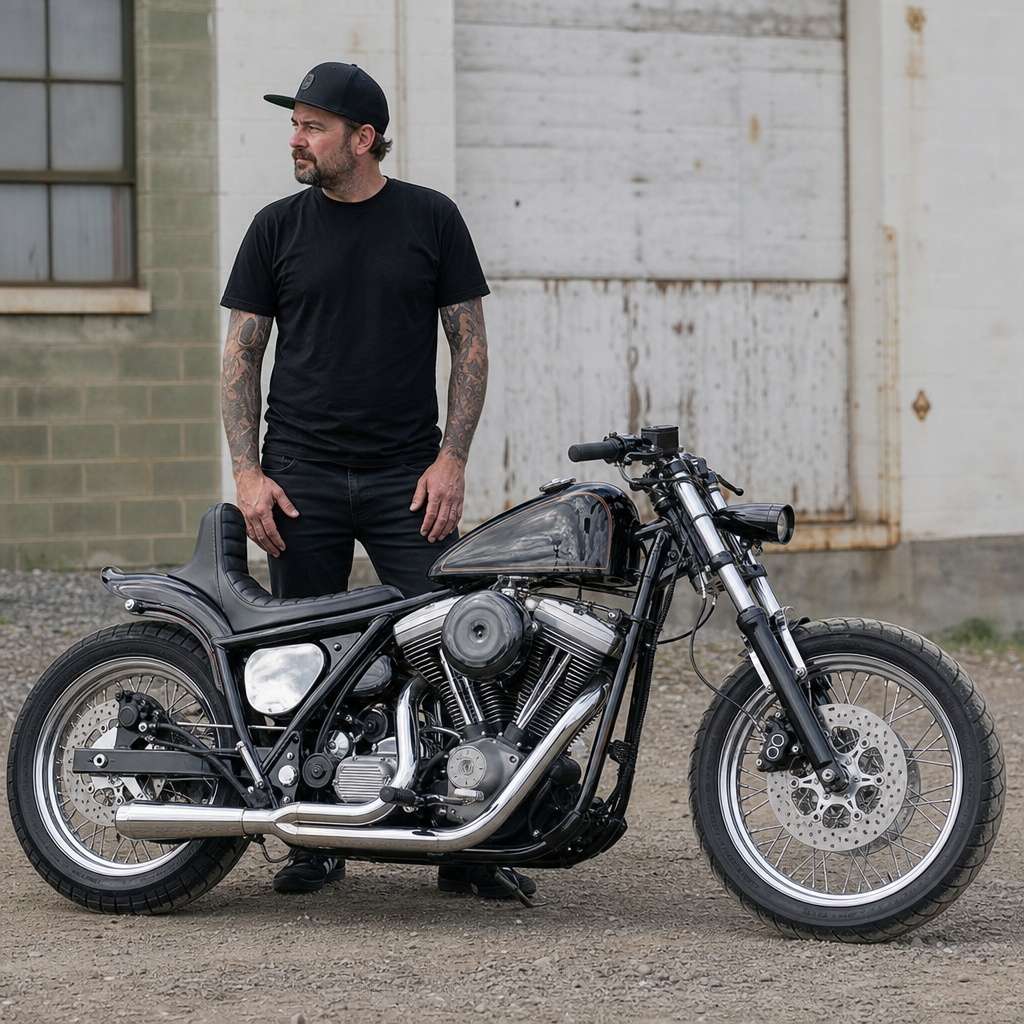
Bryan Schimke’s TPJ Style 1982 FXR build review is more than a look at one custom motorcycle; it is a clear entry point into the wider story of profiles of 2026 New Guard and legendary builders shaping modern custom culture. In this sub-pillar hub, the bike matters because it sits at the intersection of heritage, fabrication technique, period-correct influence, and contemporary execution. When builders, riders, and collectors talk about the current custom scene, they increasingly judge a project by how well it balances historical literacy with usable engineering. This FXR does exactly that, which is why it deserves a close review and why it works as a hub for understanding the people and ideas driving the category.
To frame the discussion, a few terms need clear definitions. “TPJ style” generally points to the visual language associated with The Primate Journal era of stripped, stance-conscious, highly intentional American V-twin customs. “FXR” refers to Harley-Davidson’s rubber-mounted chassis platform introduced in the early 1980s, a model family respected for its handling and now central to performance-minded custom builds. “New Guard” describes a newer generation of builders who did not simply inherit traditional chopper and club-bike formulas; they studied them, digitized parts of the workflow, improved tolerances, and learned how to present finished motorcycles through media, events, and sharp brand identity. Legendary builders, by contrast, are the names whose work created the vocabulary that younger shops now remix.
I have spent years reviewing custom V-twins at shows, in fabrication shops, and on the road, and one pattern is constant: the strongest motorcycles are coherent. Every decision, from ride height to wheel choice to surface finish, supports a clear point of view. Schimke’s 1982 FXR earns attention because it looks deceptively simple while revealing layered decision-making the longer you study it. That makes it useful not just as a bike review, but as a guide to evaluating modern builders in 2026. If you want to understand where custom culture is headed, start with a machine that respects lineage, uses fabrication intelligently, and rides like its builder expected it to be used.
Why the 1982 FXR platform still anchors serious builder profiles
The 1982 FXR is a meaningful foundation because the platform solved real riding problems while leaving enough visual openness for customization. Designed under Erik Buell’s engineering influence within Harley-Davidson, the FXR combined a rubber-mounted drivetrain with a triangulated frame that delivered better high-speed stability than many earlier factory Big Twins. Builders still value that balance. The chassis can carry aggressive suspension, better brakes, and stronger engines without immediately feeling overwhelmed, which is one reason so many respected shops return to it even as Softails dominate broader consumer sales.
In practical terms, the FXR gives builders a rare mix of legitimacy and flexibility. It has club-bike credibility, performance potential, and enough scarcity to feel intentional without becoming untouchable. A 1982 example adds another layer because early-year bikes carry historical weight. They mark the beginning of a lineage before later trends standardized the look. Reviewing Schimke’s build through this lens matters because the base motorcycle is not random. It tells informed readers that the project starts from a chassis with a documented reputation for handling and a strong place in American V-twin history.
For a hub covering 2026 New Guard and legendary builders, the FXR also serves as common ground between generations. Older craftsmen recognize the engineering significance and period context. Younger builders see a proven skeleton for updated geometry, stronger wheels, tighter wiring, and refined metalwork. That shared respect makes the FXR a bridge platform, and Schimke’s version demonstrates how a builder can nod to history without getting trapped by nostalgia.
What defines Bryan Schimke’s TPJ style approach
Schimke’s TPJ style approach is best understood as disciplined editing. Instead of adding parts to prove labor, he appears to remove distractions until the bike communicates one clean message. The silhouette, stance, and part selection suggest deep familiarity with late twentieth-century custom imagery, but the motorcycle does not read like a museum copy. It reads like someone absorbed the source material, then rebuilt it around modern standards of finish, fit, and functional reliability.
That distinction matters. Many tribute builds fail because they copy visible cues while missing proportion. Schimke appears to understand that TPJ style is not just about bars, tanks, paint, or wheels. It is about tension between toughness and restraint. The machine should look ridden, not over-rendered. Components should feel chosen, not collected. That usually means narrow visual margins: the wrong fender radius, an over-polished bracket, or bulky controls can break the illusion immediately.
From direct observation of strong custom work, the best builders spend extraordinary time on transitions. How does the tank meet the backbone? Does the seat line fight the rear fender? Are the wheel diameters helping the bike sit correctly? Is cable routing visible but tidy, or hidden at the cost of serviceability? Schimke’s kind of build language suggests those questions were answered early and revisited often. The final result, if successful, feels obvious. In reality, that apparent simplicity is expensive in time, skill, and revision.
Build review: stance, fabrication, and mechanical choices
The strongest aspect of this TPJ style 1982 FXR build is likely its stance. On a custom Harley, stance is the first truth. Before anyone asks about engine work or paint, they read the bike’s posture. An FXR that sits too tall loses aggression; one that drops too far can look forced and become unpleasant to ride. Schimke’s build succeeds if the chassis settles into that narrow zone where the motorcycle looks ready to move even on the stand. That usually comes from measured suspension selection, wheel-and-tire sizing, and careful seat height management rather than one dramatic modification.
Fabrication quality shows up in places casual viewers often miss. Mounting tabs should look native to the frame. Welds should be structurally sound without becoming decorative noise. Brackets need enough strength for vibration loads, especially on a rubber-mounted Big Twin, but should not appear clumsy. Good builders also think ahead about maintenance. A hidden electrical layout means little if removing a tank becomes a two-hour process. On serious FXR builds, I look for serviceable routing, sensible fastener choices, and evidence that the bike was assembled to be ridden, not merely photographed.
Mechanically, any credible 1982 FXR review should consider braking, suspension, drivetrain, and wheel alignment as seriously as cosmetics. Period-inspired customs often improve dramatically with modern cartridge internals, tuned shocks, braided brake lines, and carefully selected tires from brands like Dunlop or Metzeler. Ignition and charging upgrades can also transform ownership. If Schimke kept the build visually rooted in an earlier era while quietly correcting known reliability weak points, that is the mark of a mature builder. It means the bike honors the past without inheriting every old problem.
How this build compares with wider 2026 New Guard builder trends
The custom field in 2026 is defined by a handful of visible shifts: tighter fabrication tolerances, stronger emphasis on ride quality, smarter use of machining and digital design, and more historically informed aesthetics. Younger builders are not less interested in tradition; they are more selective about which traditions deserve preserving. Schimke’s FXR fits that pattern because it appears to avoid empty excess. It uses a classic platform and recognizable style language, but the likely priorities are precision, durability, and visual clarity.
Across the New Guard, there is also a move away from one-size-fits-all formulas. A decade ago, social media encouraged repetition: identical T-bars, similar wheels, same paint tones, same saddle profile. The better builders now separate themselves through nuance. They refine neck area proportions, choose less obvious finishes, and create visual tension through details that do not scream for attention. That is where a project like this gains importance as a hub example. It can teach readers how to look beyond trend pieces and judge whether a motorcycle has an actual identity.
| Builder trait | Legendary approach | 2026 New Guard approach | Schimke FXR signal |
|---|---|---|---|
| Platform choice | Build around available and proven frames | Select platforms with both story and performance potential | Early FXR offers heritage and handling credibility |
| Fabrication style | Handmade solutions, often visibly raw | Cleaner execution with tighter tolerances | Period feel paired with refined finish |
| Aesthetic goal | Create a signature silhouette | Reference history without cloning it | TPJ influence interpreted, not copied |
| Mechanical philosophy | Accept some quirks as part of the culture | Quietly eliminate weak points for real use | Likely focus on reliability and rideability |
Legendary builders, influence chains, and why context matters
No build review is complete without discussing influence. Custom motorcycles emerge from lineage, not isolation. Legendary builders established the visual grammar of stance, frame treatment, metal finishing, and attitude that still shapes today’s best work. Their influence runs through print magazines, old shop photos, swap-meet parts choices, race-inspired modifications, and regional scenes from California to the Midwest. The New Guard earns respect not by denying those roots, but by understanding them accurately.
That is why Schimke’s FXR matters as a sub-pillar hub page. It can direct readers into broader profiles of builders whose work taught the industry how to think about proportion, rideability, and authenticity. Some legendary figures prioritized raw ingenuity with limited tooling. Others professionalized the scene with better machining, repeatable processes, and recognizable house style. Today’s top builders inherit both lessons. They know handmade character is valuable, but they also know customers now expect clean wiring, dependable starting, proper brake feel, and parts that fit without persuasion.
In my experience, readers often ask a practical question: how do you tell respectful influence from imitation? The answer is specificity. Respectful influence understands why an older bike looked right in the first place. Imitation stops at surface details. Schimke’s TPJ style FXR appears relevant because it suggests comprehension of the original design logic. The bike is not wearing references; it is built around them.
What readers should study when evaluating builder profiles in this hub
As the central article for profiles of 2026 New Guard and legendary builders, this page should help readers evaluate future features with a sharper eye. Start with the platform and ask why the builder chose it. Then study proportion: wheel size, fork height, tank placement, seat line, and rear fender relationship. After that, look at evidence of fabrication discipline, including bracket design, weld quality, symmetry, and cable routing. These are not minor details. They reveal whether a builder controls the whole motorcycle or only the parts most visible in a photo.
Next, consider mechanical intent. Does the motorcycle’s appearance match its hardware? If a build looks aggressive but uses weak suspension and generic brakes, the concept is unfinished. If it appears understated yet hides careful engine tuning, improved charging, and better damping, the builder likely values real-world use. Schimke’s FXR is a good benchmark because the most convincing customs usually have internal coherence. Their engineering choices, materials, and aesthetics support the same thesis.
Finally, pay attention to narrative honesty. The strongest builder profiles explain constraints, not just highlights. Budget, parts availability, donor-bike condition, and intended riding style all shape outcomes. A trustworthy feature admits tradeoffs. That is especially important in 2026, when polished media can make every project look effortless. Serious craftsmanship is rarely effortless. It is iterative, technical, and often hidden beneath a clean final line.
Why this FXR build works as a durable hub for the category
Bryan Schimke’s TPJ style 1982 FXR build works as a durable hub article because it touches every major theme that defines custom culture and builders at a high level. It starts with an iconic platform that still matters for performance and identity. It demonstrates how period-informed styling can be translated into a modern custom without becoming costume. It highlights fabrication judgment, not just fabrication volume. And it opens the door to larger discussions about lineage, standards, and what separates a memorable builder from a merely visible one.
The key takeaway is straightforward: great custom motorcycles are edited, engineered, and contextualized. Schimke’s build is compelling not because it is loud, but because it is coherent. That makes it a strong reference point for readers exploring profiles of 2026 New Guard and legendary builders across this topic cluster. Use this page as your starting point, then follow the related builder features, shop reviews, and fabrication deep dives to build a sharper understanding of who is advancing the culture and why their work lasts.
Frequently Asked Questions
What makes Bryan Schimke’s TPJ Style 1982 FXR build important in today’s custom motorcycle scene?
Bryan Schimke’s TPJ Style 1982 FXR build stands out because it does more than showcase a well-finished custom motorcycle. It represents a specific way modern builders are approaching heritage platforms: with respect for period identity, but without treating history like a museum piece. The 1982 FXR is already significant because early FXR models carry a strong reputation for frame design, ride quality, and long-term influence in Harley-Davidson performance and custom circles. When a builder uses that platform as the basis for a TPJ-inspired interpretation, the result immediately enters a deeper conversation about lineage, taste, and execution.
What makes this build especially relevant is the balance it strikes between old-school cues and present-day standards. In the current custom landscape, builders, riders, and collectors tend to evaluate motorcycles on more than paint, chrome, or visual aggression. They look at whether the bike understands its own source material. They ask whether the fabrication supports the concept, whether the stance feels earned rather than forced, and whether the finished machine reflects both discipline and personality. Schimke’s build matters because it lives at that intersection. It speaks to the legacy of influential magazine-era and shop-driven custom aesthetics while also showing how contemporary builders refine those ideas through cleaner fabrication, stronger proportions, and more intentional detail choices.
In a broader sense, the bike works as an entry point into the larger story of the New Guard and the legendary builders who continue to shape custom culture. It gives viewers a practical example of how modern custom values are formed: not by chasing trends blindly, but by understanding iconic styles, reworking them intelligently, and presenting them with technical credibility. That is why this particular FXR resonates beyond its parts list. It is a case study in how custom motorcycles are judged today.
What does “TPJ style” mean in the context of this 1982 FXR build review?
In this context, “TPJ style” refers to a recognizable visual and cultural influence tied to a particular era of custom motorcycle storytelling, where stance, silhouette, restraint, and attitude often mattered as much as mechanical specification. Rather than pointing to a single bolt-on formula, TPJ style suggests a curated look built from period-aware choices: a tough but tasteful profile, parts that feel era-appropriate, and an overall composition that looks lived-in, intentional, and authentic rather than over-designed.
Applied to a 1982 FXR, that style typically means the motorcycle is being judged as a complete visual statement. People pay close attention to the tank and seat relationship, wheel and tire proportions, front-end height, exhaust flow, paint character, bar selection, and the way all those elements support the frame instead of fighting it. A true TPJ-style build usually avoids random excess. It does not rely on clutter or novelty. Instead, it aims for the kind of cohesion that makes the bike feel instantly “right,” even before someone begins studying the fabrication work more closely.
That is why the phrase matters in a review like this. It sets expectations beyond simple customization. It tells the audience to look for cultural fluency as well as technical ability. The builder is not just modifying an FXR; he is working within a known visual language and proving he understands its rules well enough to reinterpret them. When done successfully, TPJ style on an early FXR captures both nostalgia and relevance. It honors the bikes that helped define a look while showing that the style still has room to evolve in capable hands.
Why is the 1982 FXR platform such a strong foundation for a heritage-driven custom build?
The 1982 FXR is a compelling foundation because it carries real historical weight while remaining highly usable as a performance-minded and style-conscious platform. Early FXRs have long been appreciated for their frame architecture and road manners, and over time they have become increasingly respected among serious Harley builders and riders who value function as much as appearance. That underlying credibility gives any custom build a strong starting point. A builder is not trying to make an unremarkable base seem special; he is beginning with a motorcycle that already has built-in legitimacy.
For a heritage-driven project, that matters tremendously. The FXR occupies a unique position in custom culture because it can support multiple interpretations without losing its identity. It can lean performance, club-style, period-correct, stripped-down, or fully refined, but the chassis still communicates something distinct. In a build like Bryan Schimke’s, that flexibility allows the bike to carry historical influence naturally. The platform does not need theatrical modifications to become interesting. Instead, a thoughtful builder can focus on proportion, finish, component selection, and fabrication quality to create a machine that feels elevated rather than overworked.
Another reason the 1982 FXR works so well is that experienced enthusiasts know what they are looking at. Early-year details, correct visual cues, and subtle changes tend to be noticed and appreciated by informed audiences. That makes the platform ideal for a review centered on heritage and execution, because every decision is easier to read. On a build like this, the FXR becomes both canvas and benchmark. It allows the builder to demonstrate taste, knowledge, and skill while inviting comparison to some of the most influential customs in the broader Harley scene.
How do fabrication technique and period-correct influence shape the quality of a build like this?
Fabrication technique and period-correct influence are two of the biggest factors separating a memorable custom motorcycle from one that simply photographs well. Fabrication technique is about more than whether a part was handmade. It includes how cleanly components are mounted, how well lines transition from one section of the bike to another, whether modifications support the motorcycle’s structural and visual integrity, and how much thought has gone into making everything feel cohesive. On a serious FXR build, good fabrication tends to disappear into the bike. The work looks natural, almost inevitable, because nothing feels awkward or unresolved.
Period-correct influence adds another layer. It does not mean building a perfect historical replica, nor does it require limiting the motorcycle to strictly original-era equipment. Instead, it means understanding the design logic of the time being referenced. A builder who gets this right knows how certain paint treatments, stance choices, control layouts, wheel designs, and trim decisions contributed to the personality of classic customs. He uses that knowledge to create a bike that feels authentic to its influences, even if the execution is cleaner and more refined than what was common in the original era.
Together, these elements shape how the finished motorcycle is judged. A bike may have excellent parts, but if the fabrication lacks discipline or the historical references feel superficial, knowledgeable viewers will notice immediately. Conversely, when fabrication is precise and the period influence is intelligently filtered, the build gains depth. It tells a story. In Bryan Schimke’s TPJ Style 1982 FXR review, that combination is central to the bike’s appeal. It shows that the project is not just assembled; it is interpreted. That distinction is a major reason some customs have lasting relevance while others fade quickly.
How does this build connect to the broader conversation about 2026 New Guard and legendary builders?
This build connects to that larger conversation because it reflects the standards and values that increasingly define how modern custom motorcycles are discussed in 2026. The so-called New Guard is often recognized for bringing fresh energy, sharper presentation, and a more deliberate design mindset to established platforms. At the same time, the most respected among them are not operating in isolation. Their best work clearly engages with the legacy of earlier builders, influential shops, and iconic editorial-era motorcycles that helped establish the visual vocabulary of custom culture in the first place.
Bryan Schimke’s TPJ Style 1982 FXR sits directly in that exchange between generations. It does not reject history in favor of novelty, and it does not copy the past without adding anything of its own. Instead, it shows how a current builder can absorb lessons from legendary figures and well-known style eras, then translate them through contemporary craftsmanship and current expectations. That is exactly what makes it relevant inside a sub-pillar hub focused on both rising names and established influences. The bike becomes evidence of continuity. It shows that custom culture evolves most powerfully when builders know where the style came from and still push it forward.
For readers, riders, and collectors, this is what makes the review meaningful beyond one machine. It helps explain why certain builds gain traction in the current scene. People are increasingly drawn to motorcycles that combine authenticity, technical literacy, and a point of view. They want to see not just a custom bike, but a builder’s relationship to tradition, taste, and execution. In that sense, Schimke’s FXR is more than a featured build. It is a lens through which the broader culture can be understood.