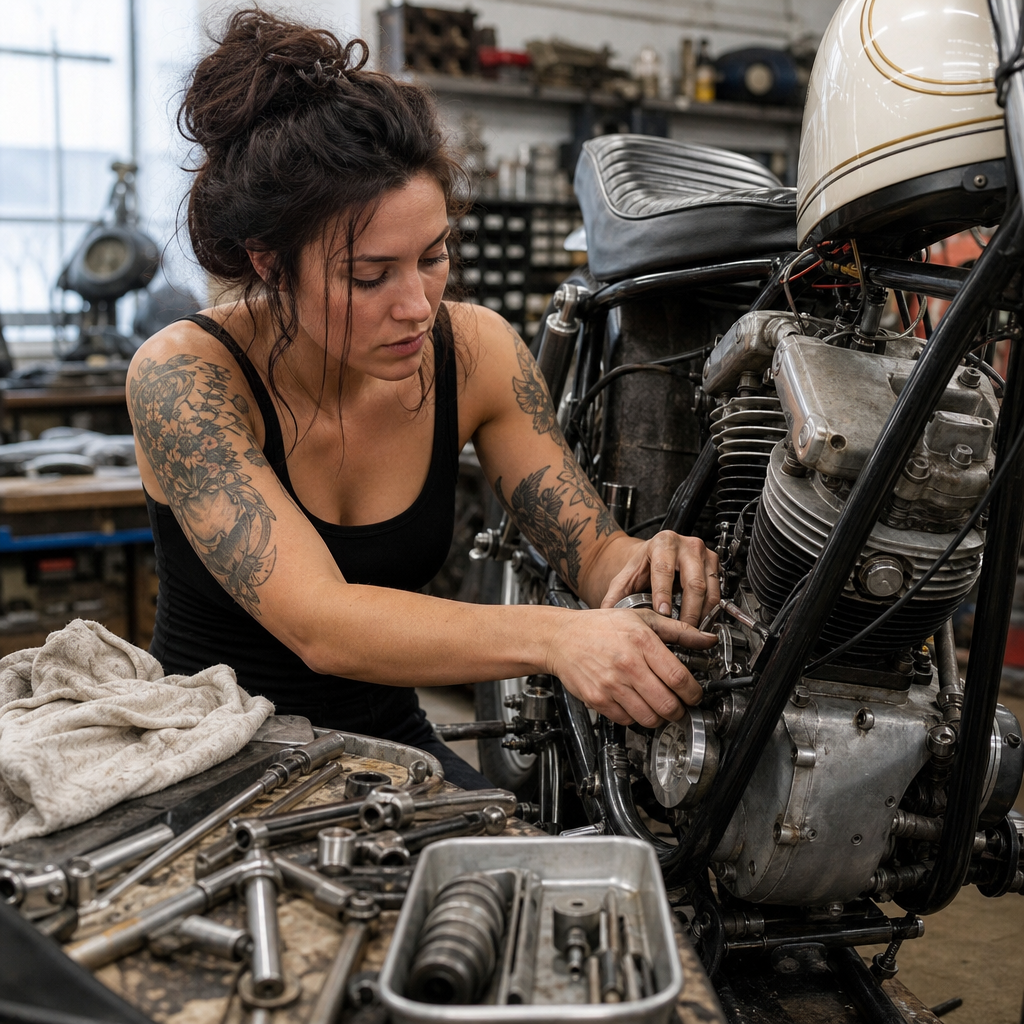
Brittany Conard represents a turning point in custom motorcycle culture because her first-time engine work on a 1974 cone shovel captures exactly what the 2026 New Guard stands for: technical courage, historical respect, and a willingness to learn in public. In builder circles, a cone shovel refers to the 1970 to 1984 Harley-Davidson Shovelhead engine with the recognizable cone-shaped cam cover on the right side. A 1974 cone shovel sits in a particularly interesting moment, carrying old-school visual identity while demanding mechanical judgment that no app, tuning wizard, or bolt-on kit can fully replace. That combination makes Conard’s story larger than one teardown. It makes it a practical lens for understanding where modern custom culture is headed.
I have spent years around home garages, swap meets, machine shops, and bike nights where people talk constantly about authenticity but often define it too narrowly. The truth is simpler. Real builder culture is not reserved for veterans with decades of TIG time or famous last names. It is built every time someone opens an unfamiliar motor, documents what they do, measures twice, asks smarter questions, and puts the machine back together with more understanding than they started with. Brittany Conard’s work matters because it shows that hands-on credibility still begins with risk, patience, and humility.
As a hub article for profiles of 2026 New Guard and legendary builders, this page uses Conard’s first-time shovel engine work as the anchor point for a broader map of the scene. The New Guard includes younger builders, cross-discipline fabricators, women entering technical spaces previously gatekept, digital-native creators who still care about metallurgy and geometry, and hybrid craftspeople who move fluently between CAD, hand shaping, wiring, machining, and storytelling. Legendary builders remain essential because they established the visual language, fabrication standards, and hard-earned methods that newer names adapt rather than erase. To understand today’s landscape, you need both groups in the same conversation.
Why does this topic matter now? Because custom culture is changing at the exact moment old machines are becoming harder to maintain, donor parts are more expensive, and online audiences reward polished content that can hide weak workmanship. A first-time engine build on a 1974 cone shovel cuts through that noise. It forces attention onto service manuals, torque values, crank end play, oiling paths, ring gaps, fastener integrity, and the judgment calls that separate a photogenic project from a reliable motorcycle. It also reveals who the next influential builders will be: not simply the loudest personalities, but the people who can bridge heritage, fabrication skill, and transparent process.
Why Brittany Conard’s 1974 cone shovel project stands out
Conard’s project stands out because first-time engine work is usually where image culture meets reality. Shovelheads are not impossible motors, but they do punish carelessness. The 1974 engine asks a builder to understand top-end condition, oil return behavior, timing chest wear, pushrod adjustment, carburetion, charging limitations, and the small but critical differences between parts that interchange loosely and parts that only seem to. Anyone can post a before-and-after photo. Pulling a cone shovel apart, inspecting it honestly, and reassembling it with a workable plan is different. That is where builder identity becomes real.
In practical terms, the project also reflects a wider 2026 pattern: builders learning through documentation instead of pretending mastery from day one. That transparency is powerful. In my experience, the best garages are not the ones with no mistakes; they are the ones where mistakes are caught early because someone measured valve guide clearance, checked rocker geometry, or asked whether that scoring on the piston skirt came from heat, lubrication failure, or debris. Conard’s appeal is that she embodies competence in progress, not perfection staged for social media.
Her bike choice matters too. A 1974 cone shovel carries cultural weight. It lives squarely in the language of long forks, narrow tanks, kick-and-electric compromises, cast-and-polished contrasts, and the rough-edged dignity that made many seventies chops memorable. Working on one now signals commitment to mechanical history. It says the builder wants to know how the machine thinks, not just how it photographs. That choice places Conard within a line of respected builders who value understanding over convenience.
The 2026 New Guard: what defines the emerging builder class
The New Guard is not a single aesthetic, age bracket, or social media niche. It is a group defined by method. These builders are more likely to combine archival research, service literature, digital measurement, and traditional fabrication. They use Fusion, SolidWorks, or simple scan-to-template workflows when needed, but they still hand-fit brackets, true wheels, rebuild forks, and read spark plugs. They are often comfortable discussing offset, trail, runout, porosity, dwell, and air-fuel ratio in the same conversation as paint line, stance, and visual tension.
Another defining trait is cross-training. Many of the strongest 2026 builder profiles started in adjacent fields: aerospace machining, industrial design, welding, automotive wiring, bicycle framebuilding, motorsports data, or fabrication for film and events. That background shows up in better fixturing, cleaner electrical systems, and more disciplined problem solving. It also broadens who gets recognized. The scene no longer belongs only to people who inherited a shop or grew up around one brand. Builders now enter from multiple technical pathways, and that diversity is improving the work.
Conard fits this shift because fearless first-time engine work is not random bravery. It is structured learning. New Guard builders tend to break intimidating jobs into systems: bottom end, top end, oiling, ignition, charging, and controls. They use factory manuals, JIMS or S&S references where relevant, machinist inspections, leak-down data, and measured tolerances. That approach is why newer builders are earning respect from established names. They are not bypassing fundamentals. They are rediscovering them.
| Builder profile type | Typical strengths | What they contribute to the hub topic |
|---|---|---|
| First-time engine rebuilder | Documentation, humility, careful learning | Shows how credibility starts and how newcomers enter the craft |
| Fabrication-first customizer | Frame mods, metal shaping, welding, stance | Explains how visual identity is engineered, not merely styled |
| Heritage specialist | Period correctness, sourcing, historical knowledge | Keeps legendary builder influences accurate and contextualized |
| Technology-bridging builder | CAD, scanning, CNC, wiring, modern materials | Demonstrates how new tools can support rather than dilute tradition |
| Legendary veteran | Proven methods, iconic design language, hard-earned judgment | Sets the benchmark that newer builders still measure against |
Legendary builders still shape every serious profile
No honest hub on builder profiles can treat the New Guard as a clean break from the past. The strongest emerging builders are in dialogue with legends whether they say so explicitly or not. You can see it in neck proportions, hardtail lines, gas tank placement, seat transitions, stainless hardware choices, and the decision to leave certain cast textures visible instead of over-finishing everything. Those instincts came from earlier generations who learned by failing on real roads, not by optimizing for comments and shares.
Names and shops associated with enduring influence matter because they established repeatable standards. Arlen Ness pushed form and finish into the mainstream of custom credibility. Indian Larry became shorthand for fearless handmade vision rooted in rideable machines. Denver’s chopper ecosystem normalized aggressive silhouettes with strong fabrication discipline. Performance-oriented Harley shops taught that power, geometry, and reliability are inseparable. Even builders with very different aesthetics inherit lessons from those traditions: know your material, know your fit-up, and never let style outrun function.
That is why Conard’s cone shovel work belongs in a broader profiles hub. It demonstrates how legendary influence actually operates in 2026. It is not cosplay. It is the transfer of method. A builder opening an old Harley engine today is participating in the same chain of knowledge that sustained independent garages for decades. The tools may be better, and access to information may be wider, but the central test remains the same: can you make the machine run right, ride right, and survive scrutiny from people who know what they are seeing?
What first-time engine work on a Shovelhead really involves
For readers asking what this kind of job actually includes, the answer is straightforward: inspection, measurement, cleaning, parts evaluation, machine work decisions, and disciplined reassembly. On a 1974 cone shovel, a builder may start by documenting compression, leak-down, oil behavior, and obvious noises. Once disassembled, the serious work begins. Cylinder walls must be checked for wear and taper. Pistons must be matched appropriately to bore condition. Ring end gaps must be measured, not guessed. Heads may need valve job attention, guide work, or spring inspection. Rocker boxes deserve close attention for wear patterns and oiling issues.
The timing side deserves equal respect. Cam bushings, pinion condition, breather timing, and ignition setup are not glamorous topics, but they decide whether the engine will be dependable. Charging systems on seventies Harleys are another common weak point. Builders who rebuild the top end while ignoring wiring integrity, grounds, and charging output often create a bike that looks sorted and behaves badly. In my own shop experience, electrical cleanup and oil leak prevention usually determine whether an old Harley becomes enjoyable or exhausting.
First-time work also means knowing when not to improvise. A trustworthy build often includes outsourcing selective machine work to specialists. Cylinder boring, valve seat cutting, flywheel truing, and crack inspection are not admissions of weakness. They are signs of judgment. Conard’s profile resonates because fearless does not mean reckless. The best new builders know the difference.
Fabrication technology and old iron: where the scene is actually going
The phrase fabrication tech can mislead people into thinking advanced tools automatically replace hand skill. In practice, the opposite is true. Better technology raises the standard for fit, repeatability, and diagnosis, but it does not eliminate the need for touch. Digital calipers, dial bore gauges, runout indicators, borescopes, laser alignment tools, and design software help builders make better decisions. They do not teach heat control in welding, thread feel during final assembly, or how to hear a valvetrain that is adjusted close but not quite right.
That is why old bikes remain such powerful proving grounds. A 1974 cone shovel does not flatter sloppy work. Modern fabrication tech can help preserve these machines responsibly. Builders now scan worn brackets before remaking them, model spacers to solve chain line problems, and use CNC where precision makes the motorcycle safer. They also use structured wiring diagrams, lithium-compatible charging checks where appropriate, and data logging on some hybrid builds. The important point is that technology is most valuable when it serves mechanical truth rather than replacing it.
Within the New Guard, this blend of analog and digital skill is becoming the norm. The builders worth watching in 2026 are not choosing between tradition and innovation. They are selecting the right process for the job. Conard’s engine work sits inside that larger pattern. It proves that learning old systems deeply is still the foundation for using new tools intelligently.
How this hub connects builder profiles across the subtopic
As the hub for profiles of 2026 New Guard and legendary builders, this page should guide readers toward several recurring questions. Who is advancing fabrication standards? Who is preserving historical accuracy without becoming static? Who is opening the culture to new participants while still respecting craft? Who can build a bike that survives a close mechanical inspection, not just a photo shoot? Brittany Conard’s cone shovel story gives clear entry points into each question because it joins courage, education, and historical machinery in one readable narrative.
Sub-articles under this hub can logically branch into women reshaping technical motorcycle culture, first-engine rebuild case studies, legendary shovel and chopper influences, modern fabrication workflows in vintage bike shops, and profile features on builders whose work bridges performance and style. Internal linking should follow those reader intents because that is how people actually research builders: they start with a personality, then move to process, then to tools, then to historical lineage.
The larger takeaway is simple. The future of custom culture will not be secured by nostalgia alone, and it will not be improved by novelty alone. It will be carried forward by builders who can explain what they did, why they did it, what standards they used, and what tradeoffs they accepted. Brittany Conard’s fearless first-time engine work on a 1974 cone shovel is valuable precisely because it is concrete. It turns abstract talk about the New Guard into a testable example of skill development, historical respect, and real mechanical accountability.
For readers following Profiles of 2026 New Guard and Legendary Builders, use this article as your starting point. Study the people who document process, not just results. Pay attention to how they inspect, measure, source, fabricate, and revise. Compare their work against the standards set by established names, then notice where they extend those standards with better tools and broader access. If you are building, rebuilding, or simply learning, let Conard’s project remind you that credibility begins when you open the motor, do the hard work carefully, and share what you learned with the next person in the garage.
Frequently Asked Questions
Why is Brittany Conard’s first-time engine work on a 1974 cone shovel getting so much attention?
Brittany Conard’s project stands out because it represents more than a simple garage milestone. Her first-time engine work on a 1974 cone shovel reflects a broader shift in custom motorcycle culture, where credibility increasingly comes from curiosity, discipline, and hands-on effort rather than gatekeeping or image alone. In that sense, her work captures what many riders and builders describe as the 2026 New Guard: people who are willing to take on intimidating mechanical challenges, respect the machines they are working on, and share the process honestly as they learn.
The motorcycle itself also matters. A 1974 cone shovel sits at a fascinating point in Harley-Davidson history. The cone shovel, referring to the 1970 to 1984 Shovelhead with its distinctive cone-shaped cam cover, blends older design character with the realities of a later-era big twin platform. That makes it approachable enough for serious enthusiasts to study and rebuild, yet complex enough to demand real care and mechanical understanding. When someone takes on engine work for the first time on a machine like this, it immediately signals commitment.
What makes Brittany’s story especially compelling is the combination of fearlessness and humility. She is not interesting because she knows everything already. She is interesting because she is willing to enter a traditionally intimidating space, do the work, ask questions, and improve in public. That transparency resonates with modern builders who value process over posturing. It shows that preserving motorcycle history does not require perfection on day one; it requires respect, patience, and the courage to begin.
What exactly is a 1974 cone shovel, and why is it important in Harley-Davidson history?
A 1974 cone shovel is a Harley-Davidson Shovelhead engine from the era when the motor used the recognizable cone-shaped cam cover on the right side. In builder shorthand, “cone shovel” generally refers to Shovelhead engines produced from 1970 through 1984 that feature this design. The 1974 model year is especially interesting because it exists in a transition period where old-school Harley identity, mechanical simplicity, and evolving factory engineering all meet in one package.
That matters historically because these bikes occupy a middle ground between earlier, more purely vintage Harleys and later big twins that came with different engineering priorities. A 1974 cone shovel still carries unmistakable traditional character: big visual presence, strong mechanical personality, and a riding feel that is deeply analog. At the same time, it belongs to an era many builders love because parts knowledge is widespread, the platform is deeply documented, and the engines reward careful tuning and mechanical involvement.
For custom culture, the cone shovel is important because it has long been a favorite platform for chops, period-correct customs, and performance-minded street bikes. It is historically rich without being untouchable. Builders can preserve it faithfully, reinterpret it creatively, or simply keep it running as a living machine rather than a static object. That combination of heritage and usability is a big reason a first-time engine project on a 1974 cone shovel gets noticed. It is not just an engine; it is a piece of American motorcycle history that still invites direct engagement.
What does Brittany Conard’s engine project say about the “New Guard” in custom motorcycle culture?
Brittany Conard’s engine work says that the New Guard is defined less by exclusivity and more by active participation. In earlier eras, custom motorcycle culture could sometimes feel heavily policed by hierarchy, with technical knowledge treated like something to be guarded. The New Guard tends to reject that mindset. Instead, it values people who step forward, do serious work, learn from experienced builders, document mistakes, and contribute to the culture through openness and effort. Brittany’s project fits that model perfectly.
Her approach highlights three values that increasingly define this newer wave. The first is technical courage. Taking apart and working on a vintage Harley engine for the first time is not a cosmetic exercise; it requires willingness to face uncertainty, follow procedures, measure carefully, and accept responsibility for the outcome. The second is historical respect. Working on a 1974 cone shovel means engaging with a machine that has specific design logic, quirks, and historical importance. The third is public learning. Instead of pretending mastery, the New Guard often earns trust by showing the real process, including what is difficult.
This shift matters because it broadens who gets to belong in the culture. It creates room for new builders, younger riders, women in technical spaces, and people coming in through storytelling, fabrication, tuning, or restoration rather than inherited access alone. Brittany’s work is meaningful not because it breaks with tradition, but because it extends tradition in a healthier way. She is proving that respect for the past and a modern, transparent learning ethos can exist together in the same garage.
What are the biggest challenges of doing first-time engine work on a Shovelhead?
First-time engine work on a Shovelhead can be challenging because these engines demand both mechanical precision and historical awareness. A Shovelhead is not impossible to understand, but it will quickly expose rushed work, poor organization, or overconfidence. One of the biggest challenges is simply knowing what you are looking at. Vintage Harley engines often come with decades of prior repairs, aftermarket parts, mixed fasteners, undocumented modifications, and wear patterns that do not always match the manual perfectly. A first-time builder has to learn not just the original system, but also the bike’s unique history.
Measurement and inspection are another major hurdle. Engine work is not just about disassembly and reassembly. It involves checking tolerances, examining sealing surfaces, identifying wear in valvetrain components, evaluating oiling concerns, and understanding when a part can be reused versus when it needs replacement or machine work. On a Shovelhead, details matter. Pushrod setup, top-end sealing, cam chest condition, ignition compatibility, and oil management all influence whether the engine will run cleanly and reliably.
There is also a mental challenge that should not be overlooked: intimidation. For many first-time builders, the biggest barrier is not the tool set but the fear of making an expensive mistake. That is why disciplined process is so important. Taking photos, labeling parts, using the service manual, asking experienced people for input, and moving slowly are not signs of weakness. They are signs of competence. A careful beginner can often outperform a careless veteran. That is part of what makes Brittany Conard’s story resonate. She demonstrates that first-time engine work on a Shovelhead is difficult, but completely achievable with patience, respect, and a willingness to learn.
Why does learning engine work in public matter for vintage Harley and custom bike communities?
Learning engine work in public matters because it helps preserve knowledge, lower unnecessary barriers, and keep vintage motorcycle culture alive in a practical way. Machines like a 1974 cone shovel survive because people are willing to understand them, maintain them, and pass along what they learn. When builders share that process openly, they create a record that benefits everyone coming after them. That transparency can turn individual experience into community knowledge, especially for younger enthusiasts or first-time owners trying to understand older Harley-Davidson platforms.
It also changes the tone of the culture for the better. Public learning pushes back against the idea that mechanical skill has to look effortless to be respected. In reality, every skilled engine builder started as a beginner. Showing the research, the uncertainty, the troubleshooting, and the corrections makes the craft more accessible without making it less serious. It tells people that competence is built, not inherited. For a scene that depends on new participation, that message is essential.
In Brittany Conard’s case, learning in public gives her project significance beyond the bike itself. She is not only working on a vintage engine; she is modeling a way of engaging with motorcycle culture that is honest, rigorous, and inviting. That matters for the future of custom bikes, restorations, and hands-on mechanical literacy. A culture survives when people are inspired not just to admire old machines, but to understand them deeply enough to keep them running. Public learning helps make that possible.