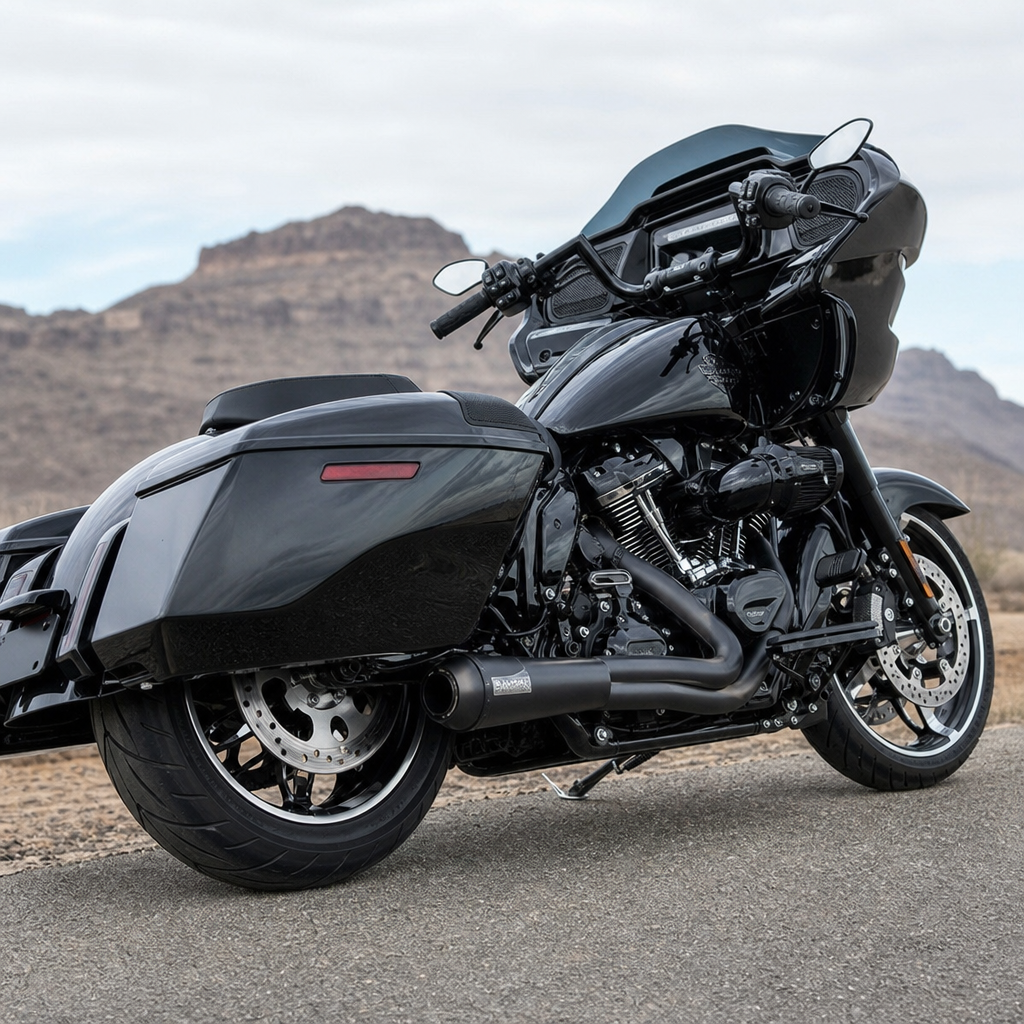
Performance bagger exhaust design has become one of the clearest signals of where custom touring motorcycles are headed, and in 2026 the 2-into-1 shorty sits at the center of that shift. In practical terms, a performance bagger exhaust is an aftermarket system built to improve scavenging, torque delivery, rider clearance, and weight while still fitting the visual language of a large American V-twin with hard bags and long-mile comfort. A 2-into-1 shorty combines both cylinders into a single collector and exits through a compact muffler, usually higher and shorter than traditional dual systems. That formula matters because modern bagger culture no longer separates style from function. Riders want a motorcycle that can carve a mountain road, survive city traffic, sound authoritative, and still look intentional when parked at a show.
I have watched that transition happen in real garages, tuning bays, and fabrication shops. Ten years ago, many touring builds still prioritized stretched saddlebags, massive front wheels, and visual symmetry over measurable performance. Today, serious builders talk about collector angle, anti-reversion, lean-angle clearance, heat management, and dyno repeatability with the same intensity they once reserved for paint and engraving. The result is a broader design conversation that connects performance bagger thinking with older custom traditions such as Chicano style and Frisco influence. Understanding why the 2-into-1 shorty dominates in 2026 requires understanding those design theories, how they differ, and where they overlap.
Design theory in motorcycle building means the set of visual, mechanical, and cultural rules that guide decisions. Chicano style often emphasizes elegant long lines, deep paint, chrome accents, spoke wheels, and a low, deliberate silhouette rooted in cruising culture and identity. Performance bagger design focuses on speed, control, braking, suspension geometry, and rider input while still respecting the scale and presence of a touring chassis. Frisco style typically traces to stripped, elevated, urban customs with narrow tanks, tall bars, and a raw, elemental stance. “Beyond” includes club style, race-influenced touring, digital fabrication-led customs, and crossover builds that borrow from all three. Exhaust choice is where these schools become visible, because pipe routing affects power, sound, posture, and the bike’s entire side profile.
For builders, brands, and riders researching custom culture and builders, this hub matters because exhaust is not an isolated bolt-on. It intersects with floorboard position, rear shock length, bag cutouts, tune strategy, emissions constraints, and even the story a bike tells. The shorty 2-into-1 has become the 2026 choice not because trends are random, but because this layout solves more problems at once than competing formats. It improves cornering clearance, centralizes mass, simplifies tuning, and visually supports the harder, more athletic look defining the new guard of fabrication. To see why, it helps to map the design language first and then connect that language to the engineering under the bike.
How Chicano, Performance Bagger, and Frisco Design Theory Shape Exhaust Choices
Every custom style carries assumptions about what a motorcycle should feel like before the engine even starts. In Chicano design, the motorcycle is often composed around flow. Long fishtails, upswept duals, or extended visual lines reinforce grace, presence, and low-slung motion. A Road King or Softail built in that tradition may use exhaust as jewelry as much as hardware. The pipes are part of the silhouette, often mirroring the frame and saddlebag line. That does not mean Chicano builders ignore performance; many do careful engine work. But the visual contract is clear: elegance first, aggression second.
Performance bagger design reverses that hierarchy. Here the exhaust is expected to earn its space. On a tuned Milwaukee-Eight or Twin Cam bagger, the system must support a broad torque curve, allow higher lean angles, keep the right side tighter to the chassis, and avoid dragging during hard transitions. That is why companies such as Bassani, HPI, S&S, D&D, SP Concepts, Two Brothers Racing, and Trask have all pushed 2-into-1 development. A properly engineered merge collector improves exhaust pulse timing and scavenging. In plain terms, one cylinder helps pull spent gases from the other, which increases cylinder fill on the next cycle. That usually means stronger midrange, cleaner throttle response, and easier tuning compared with many true dual layouts.
Frisco style points in another direction but still influences the current moment. Traditional Frisco builds are lean, direct, and less decorated. They celebrate mechanical honesty, with tall bars, compact bodywork, and a stance that feels ready rather than polished. That mindset has carried into modern fabrication, especially among younger builders using TIG welding, CNC brackets, modular subframes, and mixed-finish surfaces. The shorty 2-into-1 fits that ethic because it looks purposeful. It exposes more wheel, reduces visual bulk, and suggests the bike was built to be ridden hard. Even on a full-dress touring platform, that compact exhaust gives the machine a stripped, more athletic center of gravity visually and physically.
What happens in 2026 is convergence. Builders increasingly blend Chicano finish quality, performance bagger chassis engineering, and Frisco restraint into one package. A bagger can wear candy paint, custom stitching, and machined details while still running a high-clearance exhaust, tall shocks, radial brakes, and performance cams. The 2-into-1 shorty works as the bridge because it does not lock the build into one old category. It can look refined, race-bred, or industrial depending on tip design, heat shield treatment, coating, and mounting height.
Why the 2-into-1 Shorty Wins in 2026
The strongest reason the 2-into-1 shorty leads the market is that it aligns with how modern baggers are actually used. Riders are taking 800-pound touring bikes to track days, canyon runs, stunt lots, and cross-state trips in the same season. A long dual setup can sound good and preserve classic symmetry, but it often gives up cornering clearance, adds weight, and creates more tuning compromise. A shorty 2-into-1 pulls the muffler closer to the bike, shortens overhang, and leaves more room around the rear axle and bag line. That matters when suspension travel increases and lean angle becomes a real performance metric, not a marketing phrase.
On the dyno, many well-designed 2-into-1 systems consistently outperform comparable duals in usable torque. Exact gains depend on displacement, cam timing, intake flow, and tune, but the pattern is repeatable. On a Stage 2 Milwaukee-Eight 117, it is common to see stronger midrange and smoother power carry from 2,500 to 5,000 rpm with a merge-collector 2-into-1 than with decorative slip-ons. For street riders, that is the range they feel when rolling on out of a corner or passing in top gear. The short muffler section does not automatically reduce performance; what matters most is collector design, stepped header dimensions, and internal core engineering.
There is also a packaging advantage. Modern baggers use longer shocks from brands such as Öhlins, Legend Suspensions, Fox, and Bitubo to raise rear ride height and improve damping. As ride height increases, the exhaust has to coexist with more swingarm movement and more aggressive lean. A shorty system is easier to route without compromising the suspension arc. It also makes service simpler around the rear wheel and axle. In fabrication terms, it gives the builder cleaner negative space, which is one reason these systems photograph so well and dominate current custom media.
| Exhaust style | Main strength | Main tradeoff | Best fit |
|---|---|---|---|
| 2-into-1 shorty | Midrange torque, clearance, compact packaging | Less traditional symmetry, more visible heat concentration | Performance baggers, mixed-use touring builds |
| 2-into-1 full length | Strong performance with slightly more volume control | More visual bulk and longer rear overhang | Touring riders wanting power with conventional proportions |
| True duals | Classic look, balanced appearance, familiar sound | Usually weaker scavenging and lower clearance | Traditional touring and style-led customs |
| Upswept dual custom pipes | Strong visual identity, style-specific fit | Tuning complexity, passenger and bag limitations | Chicano, show, and highly personalized builds |
Another reason the shorty wins is sound quality. Riders want a sharper, more defined exhaust note than the broad rumble of many dual systems. The better shorty designs produce a crisp, hard-edged tone under load without becoming unmanageably loud at cruise. That distinction matters because sustained touring still matters. The best systems are not simply short; they are acoustically managed through perforated cores, packing density, and outlet sizing. In shops, I have seen cheap short pipes disappoint because they chase volume instead of wave control. The 2026 leaders win because they sound intentional, not just aggressive.
Fabrication Tech and the New Guard of Builders
The rise of the 2-into-1 shorty also reflects a change in how customs are designed and built. Younger fabrication shops increasingly prototype parts in CAD, scan mounting points, cut brackets on CNC plasma or laser systems, and verify fit with digital jigs before final welding. That process reduces the old compromise between one-off style and repeatable mechanical quality. A collector can be modeled for flow path consistency. A muffler hanger can be engineered to control vibration instead of merely filling space. Heat shields can be shaped to preserve boot clearance and still expose enough metal to look custom.
Materials and finishing methods have improved as well. Builders now choose between 304 stainless, 321 stainless for higher heat tolerance in premium applications, mild steel for specific visual treatments, and titanium in niche race-driven builds. Ceramic coatings from companies like Cerakote and Jet-Hot help lower radiant heat and protect finish quality. Mandrel bending, pie-cut sections, purge-backed TIG welds, and merge collectors built with smoother internal transitions all matter more than cosmetic branding. These details affect flow, durability, and discoloration control over time.
This is where the subtopic of custom culture and builders becomes broader than one part category. The new guard tends to reject the old split between “show bike” and “rider.” They want a bagger that can post a credible dyno sheet, survive real mileage, and still display advanced craftsmanship. Exhaust is a proving ground because bad fabrication reveals itself quickly through cracked mounts, blueing, vibration, rider heat complaints, or dyno inconsistencies. Good fabrication disappears into the ownership experience. The pipe starts cleanly, clears the bags, stays off the floorboard in a hard right turn, and supports a tune the engine actually likes.
How This Hub Connects the Design Theory Conversation
As a hub for design theory across Chicano, performance bagger, Frisco, and adjacent styles, this page establishes the core idea that exhaust choice is never only technical and never only aesthetic. It is a declaration of allegiance, but modern custom culture allows multiple allegiances at once. A Chicano-influenced Road Glide can run a shorty 2-into-1 if the builder prioritizes rideability and tucks the system cleanly under the bags. A performance bagger can borrow Chicano paint discipline and chrome detail without losing function. A Frisco-inspired touring build can use compact exhaust routing to make a huge chassis feel more elemental and urban.
That blended approach explains why the 2-into-1 shorty is not a fad. It serves the realities of current engines, chassis upgrades, and rider expectations while leaving enough design flexibility for different subcultures to make it their own. If you are planning a build under this broader topic, start by asking what the motorcycle must do, what visual line matters most, and where compromise is acceptable. Then choose the exhaust accordingly. In 2026, the answer is often the same: a well-built 2-into-1 shorty gives the best balance of power, clearance, packaging, and modern custom identity. Use that standard as the baseline for your next build, then refine the details to match your style and the roads you actually ride.
Frequently Asked Questions
Why is the 2-into-1 shorty considered the top performance bagger exhaust choice for 2026?
The 2-into-1 shorty has become the standout choice for 2026 because it solves several performance and packaging priorities at the same time. On a modern performance bagger, riders want stronger low- and mid-range torque, cleaner exhaust scavenging, reduced weight, better cornering clearance, and a design that still looks intentional on a full-size American touring motorcycle. A properly engineered 2-into-1 shorty delivers on all of those points better than many longer dual systems or traditional true dual setups. By merging both cylinders into a single collector, the system can improve exhaust pulse timing and help the engine evacuate spent gases more efficiently, which often translates into sharper throttle response and a more usable powerband where big V-twins spend most of their time on the street.
The “shorty” aspect matters just as much as the 2-into-1 layout. A shorter muffler and tighter routing typically keep the system tucked in closer to the bike, which improves rider clearance and reduces the chance of dragging hard parts during aggressive cornering. That has become especially important as performance baggers continue borrowing ideas from club-style builds, track-influenced setups, and high-output touring customs. In 2026, riders are no longer choosing exhausts only for sound or chrome; they are choosing systems that support suspension upgrades, tuned engines, and more athletic riding. The 2-into-1 shorty fits that direction perfectly because it offers a strong balance of performance gains, compact dimensions, and a modern aggressive look that complements the evolving performance bagger aesthetic.
How does a 2-into-1 shorty exhaust improve performance on a bagger compared with other exhaust styles?
A 2-into-1 shorty improves performance primarily through exhaust scavenging and overall efficiency. In a V-twin engine, exhaust design has a major effect on how quickly spent gases leave the cylinders and how effectively the next intake charge can fill the combustion chamber. When both header pipes feed into a well-designed collector, pressure waves can be used more effectively to help pull exhaust out of the engine. That usually results in stronger torque delivery across the rpm range, especially in the low and middle sections where heavy touring motorcycles need it most. For a bagger carrying rider weight, luggage, audio equipment, and often touring accessories, usable torque matters more than a peak dyno number alone.
Compared with many dual exhaust systems, a 2-into-1 also tends to simplify flow and reduce excess weight. A lighter system can improve the bike’s overall feel, especially during transitions and low-speed maneuvering. The shorty muffler design can further reduce bulk and move mass into a more centralized position, which supports the more responsive handling riders want from performance baggers. Another important factor is tuning consistency. Many builders and tuners prefer a quality 2-into-1 because it often gives them a more predictable foundation for air-fuel calibration and engine modifications such as cams, intake upgrades, and cylinder head work. While every combination is different, the general advantage of the 2-into-1 shorty is that it is engineered for real-world riding performance, not just visual symmetry or traditional styling.
Does a 2-into-1 shorty exhaust affect rider comfort, ground clearance, and long-distance usability?
Yes, and this is one of the biggest reasons the design is so relevant for modern baggers. A performance bagger still has to function as a touring motorcycle, which means the exhaust cannot improve power at the expense of comfort or practicality. A well-designed 2-into-1 shorty generally helps rider comfort by improving leg and foot clearance around the rear brake area and floorboard or peg zone. Because the system is often routed more tightly and finishes with a compact muffler, riders may find there is less interference with aggressive body positioning and less concern about contacting the exhaust during spirited riding.
Ground clearance is another major advantage. Longer, lower-hanging exhausts can limit lean angle and become one of the first parts to scrape in turns. A shorty system is typically tucked higher and closer to the chassis, which better matches upgraded suspension and the more assertive lean angles common in performance-oriented touring builds. Long-distance usability also remains strong when the system is properly engineered. Good heat management, smart placement relative to saddlebags, and durable construction materials all matter. The best 2026 systems are designed with real touring use in mind, so they aim to preserve bag functionality, maintain passenger and rider space, and deliver performance without making the bike less enjoyable on all-day rides. In other words, the best 2-into-1 shorty setups support both canyon carving and highway miles, which is exactly what performance bagger riders want.
Will installing a 2-into-1 shorty exhaust require tuning or other supporting upgrades?
In most cases, yes. Anytime you significantly change exhaust flow on a fuel-injected V-twin, tuning should be treated as part of the upgrade rather than an optional extra. A freer-flowing 2-into-1 shorty can change backpressure characteristics, airflow behavior, and the engine’s overall operating needs. Without proper calibration, the motorcycle may not deliver the full performance benefits of the new system and could experience drivability issues such as deceleration popping, inconsistent throttle response, elevated heat, or air-fuel ratios that are less than ideal. A correct tune helps align ignition timing, fueling, and throttle behavior with the new exhaust so the engine performs cleanly and reliably.
Supporting upgrades depend on the rider’s goals. For someone looking for a balanced street setup, a quality intake and a proper tune may be enough to make the most of the exhaust. For riders building a more serious 2026-style performance bagger, the 2-into-1 shorty often becomes part of a larger system that includes a high-flow air cleaner, torque-focused camshaft, upgraded clutch components, suspension work, and brake improvements. That is because the exhaust is rarely a standalone styling change anymore; it is often one piece of a performance package. The good news is that a strong 2-into-1 shorty usually works very well as a foundation for future upgrades. It supports both mild and aggressive engine combinations, making it a smart long-term investment for riders who want room to grow their build over time.
What should riders look for when choosing the best 2-into-1 shorty exhaust for a performance bagger?
Riders should look beyond appearance and focus on engineering, fitment, and how the exhaust matches the bike’s intended use. Collector design is one of the most important details because it directly affects scavenging and torque characteristics. Header diameter, stepped pipe construction, merge quality, and muffler core design all influence how the engine will respond. Material quality also matters. Stainless steel is often favored for durability, corrosion resistance, and performance use, while high-quality finishes can improve longevity and maintain a premium look. Mounting hardware, weld quality, and bagger-specific routing should all be evaluated closely, especially on bikes that will see heavy mileage or aggressive riding.
It is also important to consider compatibility with saddlebags, floorboards or rearsets, passenger accommodations, and any existing suspension upgrades. The best system on paper is not the best system if it creates clearance issues or undermines the bike’s touring function. Sound should be part of the decision as well, but not the only one. A deep, authoritative tone is appealing, yet the real value of a 2026-ready 2-into-1 shorty is how well it integrates performance, packaging, and durability. Riders should also consider whether the manufacturer has a strong reputation for dyno development, platform-specific testing, and tuning support. In the current performance bagger market, the best exhausts are not generic accessories; they are purpose-built components designed to improve the entire riding experience, from city acceleration to mountain-road lean angles to long-distance touring confidence.