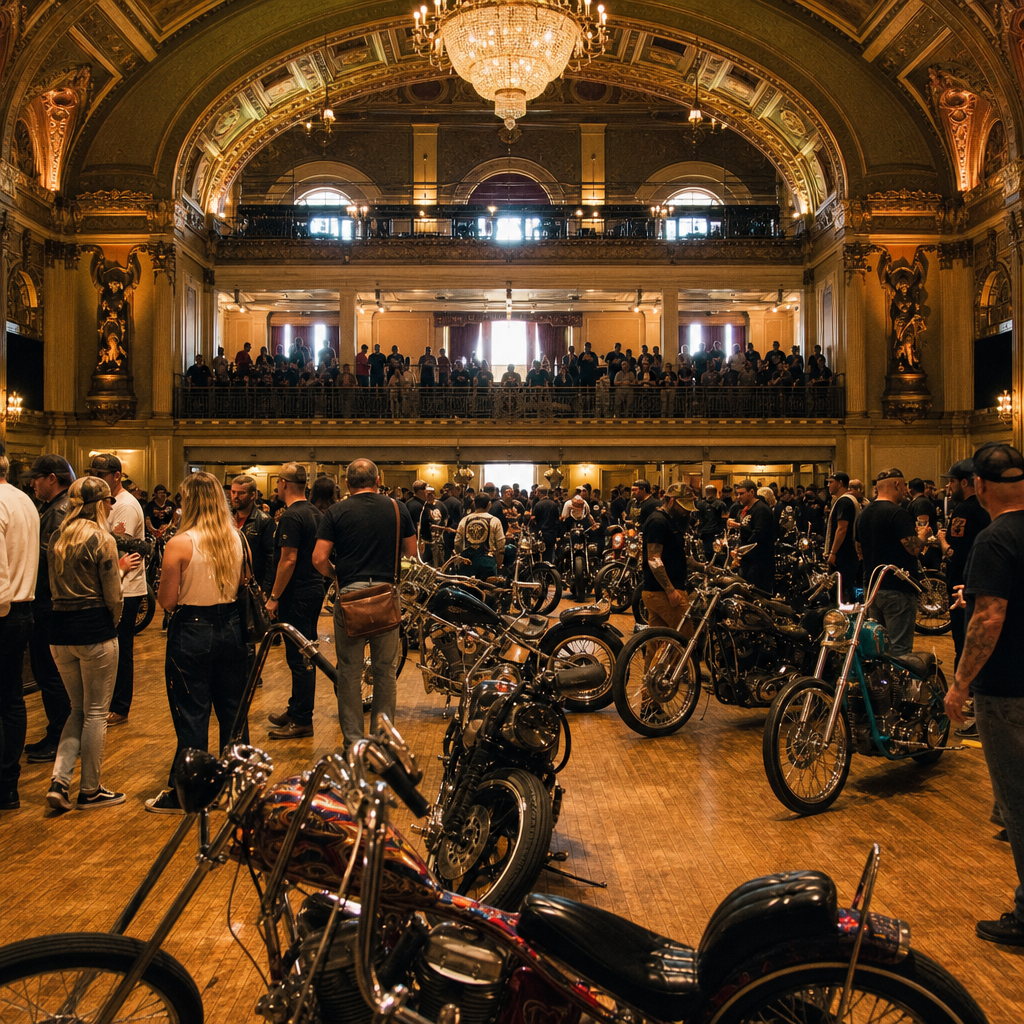
Mama Tried 2026 arrives with unusual weight because the Invitational at the Eagles Ballroom has become more than a motorcycle show: it is a barometer for where custom culture is heading next. In this room, legacy builders share floor space with a rising class of fabricators who blend hand skills, digital design, motorsport engineering, and a sharper editorial eye than the scene once demanded. For anyone tracking profiles of 2026 New Guard and legendary builders, the Eagles Ballroom is the hub where reputations are tested in public, where craftsmanship is compared side by side, and where trends stop being predictions and become finished machines.
The term New Guard describes builders, workshops, and individual fabricators redefining customs without rejecting history. They may use CNC-machined components, CAD mockups, 3D-printed patterns, data-driven suspension tuning, and advanced coatings, yet their credibility still rests on proportion, packaging, and ride quality. Legendary builders, by contrast, are the names that established visual grammar and fabrication standards over decades: masters of stance, frame modification, sheetmetal shaping, paint, race influence, and storytelling through mechanical detail. Mama Tried matters because it places these groups in the same cultural frame. Visitors can study a hand-formed gas tank inspired by postwar board-track racers, then turn and find a turbocharged street tracker assembled with aerospace-grade tolerances and modern electronics.
I have walked enough invitational floors to know that venue changes the way work is perceived. The Eagles Ballroom amplifies significance. Its scale, age, and stage-like presentation force every machine to communicate instantly. Weak concepts disappear in the atmosphere; coherent builds gain authority. That makes this event especially useful as a hub topic. If you want to understand who is shaping custom motorcycle culture in 2026, which workshops deserve closer study, and how fabrication technology is influencing aesthetics, the Invitational offers a concentrated, high-signal sample. It shows what builders value when they know knowledgeable peers, media, collectors, and riders will all inspect the same welds, castings, fasteners, finishes, and geometry.
This article maps the key profiles and themes that define Mama Tried 2026 at the Eagles Ballroom. It explains what distinguishes New Guard builders from established legends, how judging and attention typically coalesce around specific qualities, where fabrication technology is changing the game, and why this invitational remains essential even in an era of nonstop social media exposure. As the central overview within Custom Culture and Builders, it is designed to guide readers toward deeper builder-specific coverage while giving a complete understanding of the field in one place.
Why the Eagles Ballroom remains the ideal stage for builder profiles
The Eagles Ballroom is not a neutral container. It is part of the message. Custom motorcycles are objects of engineering, but they are also objects of theater, and this venue emphasizes both. The ballroom’s historic architecture frames motorcycles as cultural artifacts rather than disposable products. That matters for builder profiling because context influences evaluation. In a convention hall, attention often drifts to spectacle alone. At Mama Tried, the environment encourages slower looking: rake and trail decisions, tank-to-seat transition, exhaust routing, hidden wiring, oil line management, rearset placement, and wheel choice all become easier to read when a bike is staged with breathing room and intentional lighting.
For legendary builders, this setting reinforces continuity. Their work often rewards close inspection because the highest-level traditional fabrication hides labor. A perfectly sectioned tank or subtly altered neck angle can be more impressive than an obvious billet-heavy build, but only if the audience has the chance to notice. For New Guard builders, the venue creates a productive pressure test. Digital tools can accelerate prototyping, but they cannot disguise poor proportions or unresolved concepts once the bike stands among elite company. The Ballroom exposes empty novelty and rewards synthesis.
That is why profiles from this show tend to age well. They are not based solely on launch-day hype or algorithmic visibility. They arise from direct comparison in a room full of informed observers. Builders who stand out here usually do so because they have solved the hard problems: preserving serviceability while cleaning a chassis, integrating electronics without clutter, using modern suspension without breaking period language, or introducing new materials without making the bike feel sterile.
Who defines the 2026 New Guard
The 2026 New Guard is not one style. It is a shared approach to problem solving. These builders respect lineage but refuse costume. They know a Knucklehead, Shovelhead, unit Triumph, Yamaha XS650, Honda CB, Harley Sportster, or modern performance twin carries visual rules, yet they treat those rules as a starting point. The strongest younger builders are multidisciplinary. Many cut and fixture frames, machine one-off controls, scan or model components before committing to metal, and tune bikes to be ridden hard rather than merely photographed. Their shops may be small, but their process is rigorous.
A typical standout profile in 2026 includes several traits. First, concept discipline: every decision supports a coherent identity, whether the bike reads as endurance racer, desert sled, hillclimber, high-performance chopper, or compact city custom. Second, manufacturing fluency: the builder understands when hand forming is superior to machining and when precision fabrication improves durability or repeatability. Third, finish restraint: polished alloy, Cerakote, nickel, chrome, paint, powder, and raw steel are balanced rather than piled on. Fourth, mechanical honesty: cooling, fueling, ergonomics, and maintenance access are not sacrificed for a clean photo.
In practical terms, that means the New Guard often produces bikes that start reliably, steer predictably, and survive road miles. A modern custom tracker may hide an ECU neatly under a bespoke seat pan, use a data-logged quickshifter, and still preserve the sparse visual language of a seventies racebike. A chopper builder may retain hardtail drama but choose better fork internals, stronger braking, and cleaner charging-system integration. This generation understands that credibility now comes from both visual originality and engineering competence.
How legendary builders still shape the floor
Legendary builders at Mama Tried 2026 do not appear as nostalgia acts. They function as benchmarks. Their influence can be seen in the way younger shops handle line, restraint, and narrative. Long before current fabrication software and compact electronics made integration easier, established masters were already solving packaging problems with saws, torches, English wheels, lathes, and relentless iteration. Their bikes continue to command attention because they reflect mature judgment. Nothing is unresolved, and nothing is accidental.
When viewers compare a legendary builder’s machine with a newer entrant, the difference is often not boldness but editing. Experienced builders know exactly what to remove. They understand how much neck stretch a frame can tolerate before the bike loses visual tension, how a fender radius affects wheel presence, why a seat profile can make a motorcycle look fast while stationary, and when a paint idea should stay in the sketchbook. These are not abstract talents. They are the result of decades spent building, racing, repairing, and living with motorcycles.
The most important point for this hub is that legendary and New Guard profiles should be read together, not separately. The best younger builders are rarely disconnected from history. They have studied the work of earlier figures in choppers, race customs, hot rods, and coachbuilt specials. Likewise, strong veteran builders are rarely frozen in time. Many have adopted TIG welding over older methods for specific tasks, improved CAD-assisted fixturing, or embraced better metallurgy, braking, and tire technology. Mama Tried makes that continuity visible.
The fabrication technologies changing custom culture
Fabrication technology is now central to builder identity, but the Invitational repeatedly proves that tools matter only when they serve design and rideability. In the strongest 2026 profiles, technology appears as leverage, not decoration. Builders use CAD to verify clearances before cutting expensive material. They rely on CNC machining for repeatable rearsets, triples, hub adapters, caliper brackets, and intake components where precision directly affects function. They use 3D printing to test shapes, create sand-casting patterns, or prototype electrical mounts hidden from view. Laser cutting and waterjetting speed bracket production, but finishing and fit still determine whether a part looks bespoke or industrial.
Suspension and electronics are the biggest quiet shifts. A decade ago, many customs tolerated compromised geometry and weak damping because aesthetics ruled. The current top tier increasingly treats suspension setup as foundational. Builders select fork cartridge kits, tune spring rates, refine shock length, and calculate trail because they expect the bike to perform. On the electrical side, compact control modules from brands such as Motogadget, combined with high-quality connectors, lithium battery packaging strategies, and disciplined loom planning, allow clean builds without the reliability penalties older customs often accepted.
Materials have evolved too. Stainless exhaust systems are now frequently back-purged and finished to a standard once limited to race shops. Aluminum oil tanks and bodywork are TIG-welded with tighter distortion control. Modern adhesives, sealants, and coatings extend durability in ways the audience may never see. Yet the Invitational tends to reward restraint. If a builder uses titanium fasteners, billet covers, or carbon elements, those choices must solve a real problem or sharpen the concept. Otherwise they read as expense, not excellence.
| Area | Traditional approach | 2026 leading practice | Why it matters at Mama Tried |
|---|---|---|---|
| Frame setup | Cut and mock by eye | Fixture-based alignment with digital verification | Improves stance without sacrificing tracking |
| Parts fabrication | Handmade one-offs only | Hybrid hand shaping plus CNC for precision components | Combines character with repeatable tolerances |
| Electrics | Basic hidden wiring, limited diagnostics | Compact controllers, labeled looms, high-grade connectors | Cleaner presentation and better reliability |
| Prototype process | Cardboard and repeated metal revisions | CAD modeling and 3D-printed test pieces | Reduces waste and speeds fitment decisions |
| Ride quality | Looks prioritized over function | Geometry, damping, and braking tuned deliberately | Separates serious builders from stylists |
What separates an invitational-level motorcycle from an online hit
Social platforms reward novelty, color, and instant readability. The Mama Tried Invitational rewards completeness. That distinction is critical when profiling builders. A motorcycle that performs well online may rely on one dramatic gesture: an extreme fork, loud paint, an improbable engine swap, or a provocative silhouette. On the floor, however, audiences can assess whether the pegs are usable, whether the chain line makes sense, whether the rear brake is engineered safely, whether the oil system is logical, and whether the bike’s visual center of gravity feels intentional.
Invitational-level motorcycles usually excel in transitions. The tank flows into the seat; the seat acknowledges the rear fender; the exhaust echoes frame movement; the bars fit the fork length and rider triangle; finishes shift in a controlled rhythm. This coherence is harder to achieve than a dramatic single feature. It is also why certain builders become reference points. They understand the motorcycle as a whole system rather than a collection of highlights.
Another difference is durability of influence. Online trends burn quickly. A strong Mama Tried build can shape the scene for years because other builders recognize that the work solves real design problems. A bracket may inspire copies not because it looks exotic but because it packages a master cylinder elegantly. A subframe treatment may spread because it cleans the rear of the bike without hurting serviceability. That is how the Invitational functions as a true cultural filter.
How to read builder profiles from this hub
As the hub for profiles of 2026 New Guard and legendary builders, this page should help readers evaluate each feature article with sharper criteria. Start with lineage. What machine, racing discipline, regional style, or historical period is the builder drawing from? Then assess intervention. Did the builder merely restyle a donor bike, or were geometry, controls, intake, exhaust, chassis, and bodywork rethought from first principles? Next, examine execution. Are welds appropriate to the material and location? Is fastener choice consistent? Are brake lines and cables routed with both cleanliness and service access in mind?
After that, consider innovation carefully. Not every new idea is useful. Effective innovation removes compromise. It makes a motorcycle lighter, stiffer where needed, easier to maintain, safer, or more expressive without adding clutter. Finally, ask whether the bike would still matter in unpainted metal with the lights off and the crowd gone. If the answer is yes, the builder probably belongs in this conversation.
This framework also clarifies why the Eagles Ballroom remains essential to the broader Custom Culture and Builders topic. It gathers enough variety to show the full spectrum: heritage choppers, race-influenced twins, rare restorations with custom logic, radical reinterpretations of Japanese platforms, and performance-first American V-twins. As deeper pages branch from this hub, readers can trace shared themes across very different machines and see how the New Guard is being shaped, challenged, and refined by legends still working at a high level.
Why Mama Tried 2026 matters beyond one weekend
Mama Tried 2026 matters because it captures custom culture at a point where access to tools has widened, but true excellence remains difficult. More people can design parts, order machined components, and broadcast a finished build than ever before. That democratization is healthy, yet it also increases noise. The Invitational at the Eagles Ballroom helps separate capability from trend-chasing. It shows which builders can unite concept, fabrication, engineering, and emotion in a motorcycle that holds up under scrutiny.
For readers following the New Guard and legendary builders, the main takeaway is simple. The future of custom motorcycles will not be decided by technology alone or tradition alone. It will be shaped by builders who can use modern methods without losing mechanical soul, and by veterans whose standards continue to define what finished really means. Mama Tried is where that exchange becomes visible. Use this hub as your starting point, then move into the individual builder profiles, compare their methods, and study the details that make their work endure.
Frequently Asked Questions
Why is the Mama Tried 2026 Invitational at the Eagles Ballroom considered such an important part of the custom motorcycle calendar?
The Mama Tried 2026 Invitational at the Eagles Ballroom matters because it has evolved into far more than a well-curated indoor motorcycle show. It is now widely viewed as a live snapshot of where custom culture is moving next. The Invitational brings together legendary builders whose reputations were earned through decades of fabrication, racing influence, design innovation, and scene leadership, while also giving serious floor space to a newer generation of makers who approach motorcycle building with a different set of tools and references. That combination makes the room unusually revealing. You are not just seeing polished finished bikes; you are seeing competing philosophies of design, engineering, aesthetics, and identity presented side by side.
What sets the Eagles Ballroom apart is the concentration of influence. Builders, photographers, brand founders, racers, media, and dedicated enthusiasts all move through the same space, reading the same cues and reacting to the same work. The result is that the Invitational functions like a barometer. It tells attendees which visual themes are gaining traction, which technical approaches are being refined, and which builders are setting the tone for the next phase of the scene. For many people following motorcycle culture closely, the question is not simply who showed up, but what the collective standard of taste, execution, and originality looked like in that room in 2026.
What makes the Eagles Ballroom the right setting for the Mama Tried Invitational?
The Eagles Ballroom gives the Invitational a specific kind of gravity that a generic convention hall could never replicate. The venue has history, scale, atmosphere, and architectural character, and all of that changes the way the motorcycles are experienced. Custom bikes are not just technical objects; they are visual statements, cultural artifacts, and in many cases deeply personal interpretations of speed, craft, and style. A room with texture and legacy supports that reading. The Ballroom helps the show feel less like a retail display and more like a gathering with real continuity, where past and future are visibly sharing the same floor.
That setting also amplifies the editorial quality of the Invitational. Builders know the room rewards machines with presence, proportion, and detail that can hold attention beyond first impact. In other words, the Eagles Ballroom encourages substance. A bike has to stand up under close viewing, photography, conversation, and comparison. That is one reason the Invitational has become so respected among people who care about both craftsmanship and curation. The venue frames the work in a way that makes every design decision more legible, from stance and frame geometry to finish choices and restraint in presentation. For attendees, that means the experience is immersive and memorable rather than simply crowded and transactional.
How does Mama Tried 2026 reflect the rise of the New Guard in custom motorcycle building?
Mama Tried 2026 reflects the rise of the New Guard by showing how younger and emerging builders are redefining what a top-tier custom motorcycle can be without rejecting the scene’s fundamentals. The new wave is still rooted in fabrication, mechanical literacy, and respect for the machine, but its members often bring broader influences and more interdisciplinary methods into the build process. Many are combining traditional hand skills with digital design tools, CAD planning, CNC-assisted prototyping, data from motorsport engineering, advanced materials knowledge, and a highly developed sense of visual storytelling. That means the end result can feel sharper, more resolved, and more intentional across every element of the build.
Just as importantly, the New Guard tends to understand presentation at a very high level. They are building motorcycles that work in person, in print, and across digital media, and that awareness affects everything from silhouette to surface finish to how individual components relate visually. At the Eagles Ballroom, that approach becomes impossible to ignore because these builders are not placed in isolation. Their work is viewed directly alongside that of established names. If the newer builders hold their own or even push the conversation forward, it signals a real transition in the culture. That is why the Invitational is so closely watched in 2026: it reveals not just who is talented, but who is defining the next standard.
What should attendees pay attention to when walking the Invitational floor at Mama Tried 2026?
Attendees should look beyond paint, polish, and immediate visual drama and pay attention to the deeper decisions that separate a compelling custom from a merely attractive one. Start with proportion and stance. Does the motorcycle feel resolved from every angle? Do the wheel sizes, tank shape, seat line, bar choice, and ride height work as one coherent idea, or does the bike depend on one or two flashy details to create impact? The best builds at the Eagles Ballroom usually reveal themselves gradually. The first impression matters, but the strongest motorcycles continue to reward closer inspection with thoughtful engineering, disciplined editing, and consistency of intent.
It is also worth studying fabrication quality and systems integration. Look at bracketry, routing, transitions, welds, controls, and how the builder solved packaging challenges. Notice whether performance-minded choices feel authentic or cosmetic. In 2026, one of the defining traits of influential builders is their ability to merge style with function rather than treating them as opposing goals. Finally, pay attention to what themes recur across the room. Are more builders borrowing from racing? Are there signs of increased digital precision without losing hand-built character? Are younger builders using restraint rather than excess? Those patterns are often the most valuable thing to observe, because they hint at where custom motorcycle culture is heading after the show ends.
Why do profiles of legendary builders and 2026 New Guard fabricators matter so much at this year’s Mama Tried Invitational?
These profiles matter because they help explain the broader significance of the Invitational beyond the motorcycles themselves. Legendary builders represent continuity, hard-earned authority, and the accumulated design language of the custom world. Their presence establishes a benchmark. When they bring work to the Eagles Ballroom, they are not just showing a machine; they are reaffirming standards of craftsmanship, identity, and relevance that have shaped the culture for years. Understanding who these builders are and what they have contributed gives visitors a clearer way to read the room and appreciate how today’s trends connect to deeper traditions.
The 2026 New Guard profiles are equally important because they identify the builders most likely to influence what comes next. These are the fabricators whose work often synthesizes analog craft and modern process in a way that feels current rather than forced. They may be drawing from racing, industrial design, fashion, photography, engineering, and digital workflows while still producing motorcycles with soul and physical presence. Tracking their backgrounds, methods, and design philosophies adds context to the bikes on display and helps explain why certain machines feel especially fresh or consequential. At Mama Tried 2026, the intersection of legendary names and rising talent is the story. The Eagles Ballroom is the hub where that handoff, conversation, and creative tension become visible in real time.