Glory Daze 2026 captures a turning point in custom motorcycle culture: hand-built choppers remain the emotional center of the scene, yet a younger class of fabricators now shapes the conversation with digital design, disciplined metalwork, and a sharper sense of event storytelling. In this hub article, “new guard” refers to builders who earned attention through recent bikes, collaborative fabrication, or social-first launches rather than decades of magazine dominance, while “legendary builders” means the names whose influence still defines proportion, stance, paint, and mechanical honesty across the custom world. The Trippy Ten Helmet Show adds another layer by turning a practical safety object into a curated design statement, linking apparel, illustration, airbrush, and collector culture. This matters because custom culture in 2026 is not split between old and new; it is a live exchange between history and experimentation. I have covered builder showcases where TIG-welded hardtails sat beside long-fork survivors from earlier eras, and the strongest events always rewarded both craft lineage and fresh interpretation. Glory Daze works as a hub because it connects profiles of major builders, fabrication methods, event aesthetics, and the broader market forces shaping what gets built, photographed, sold, and remembered.
At its core, Glory Daze 2026 is about authorship. A hand-built chopper is not merely a modified motorcycle; it is a machine whose geometry, mounting decisions, wiring routes, surface finish, and visual theme reflect deliberate personal choices. The best examples show restraint as much as flair. A clean backbone modification, a well-resolved seat pan, or a narrow rear fender with correct tire clearance says more about a builder’s command than an overload of bolt-on parts. The helmet show follows the same logic. Ten helmets, each treated as a complete visual object, reveal how custom culture now values cohesive worldbuilding around a bike rather than the bike alone. For readers exploring profiles of 2026 new guard and legendary builders, this page provides the framework: who matters, what standards distinguish serious work, how fabrication technology changes execution, and why certain builders become reference points for the next generation.
The Builders Defining the 2026 Conversation
The most important shift in 2026 is that recognition comes from demonstrated process, not just polished reveal photos. Builders gaining traction now tend to show fixture setup, frame prep, mock-up stages, and problem solving in public. That transparency has raised standards because viewers can tell the difference between a complete hand-built chopper and a lightly customized donor with expensive finishing. Among the new guard, the strongest profiles combine three traits: reliable fabrication fundamentals, a point of view that is visible from twenty feet away, and the ability to explain choices in plain language. Their bikes often feature compact packaging, thoughtful cable management, modern machining where it helps, and old-school silhouettes that never feel like replicas.
Legendary builders still anchor the field because they solved the key visual questions long ago. They established what a stretched front end should feel like in motion, how tank shape affects the entire centerline of a build, and why stance can make an average parts list look exceptional. Their continued relevance in 2026 is not nostalgia. It is proof that fundamentals outlast trend cycles. Younger builders study those machines the way architects study landmark houses: not to copy every detail, but to understand proportion, balance, and editing. At Glory Daze, that exchange is visible in every parking row and curated display. A veteran’s rigid-frame build might sit near a younger fabricator’s bike with CNC-cut tabs and 3D-printed mock-up pieces, yet both communicate the same values when the work is right.
What should readers look for in builder profiles? Start with fabrication scope. Did the builder alter the frame, create mounts, shape sheet metal, wire the bike, and sort the drivetrain package, or did outside vendors handle major phases? Then examine design consistency. Do the bars, wheels, controls, seat, paint, and exhaust all belong to the same idea? Finally, consider rideability. The strongest builders in 2026 no longer treat function and beauty as opposing forces. They know correct trail, ergonomic reach, brake setup, and serviceability matter because bikes that cannot be ridden or maintained eventually lose relevance. That balance separates headline builders from social media flashes.
Hand-Built Choppers in 2026: What “Hand-Built” Actually Means
In custom culture, “hand-built choppers” is often used loosely, but at a serious event it has a specific meaning. It does not require every raw material to begin as flat stock, nor does it ban purchased components. It means the builder materially shaped the motorcycle’s structure, fit, finish, and final mechanical character through skilled labor. On a real hand-built chopper, you can identify the builder’s decisions in the neck position, axle plates, oil tank placement, bar geometry, exhaust path, and hidden details such as gusset treatment or seat hinge alignment. Those are not cosmetic add-ons; they are the architecture of the machine.
In my experience at fabrication shops and bike events, the telltale signs are consistency and problem resolution. A hand-built motorcycle usually has fewer visual compromises because the builder had the ability to move or remake a part rather than work around a mismatch. If the primary line clashes with the frame, the part gets rethought. If the rear fender arc is wrong, it gets recut and re-rolled. If a battery box complicates wiring access, the mount is redesigned. That iterative approach is why hand-built bikes hold attention longer. They read as intentional, even when the look is wild.
Fabrication technology has changed the workflow without replacing craftsmanship. CAD modeling helps builders pre-visualize bracket placement and maintain symmetry. CNC machining improves repeatability for controls, trees, and decorative hardware. TIG welding remains the benchmark for precision on thin-wall tubing and visible seams, while traditional MIG still appears where appropriate. English wheels, planishing hammers, bead rollers, and Pullmax-style tooling continue to matter because complex metal shaping still depends on judgment, not software alone. The new guard uses these tools pragmatically. They do not present technology as a substitute for skill; they use it to protect time for the hard parts that only experience can solve.
The Trippy Ten Helmet Show as a Design Barometer
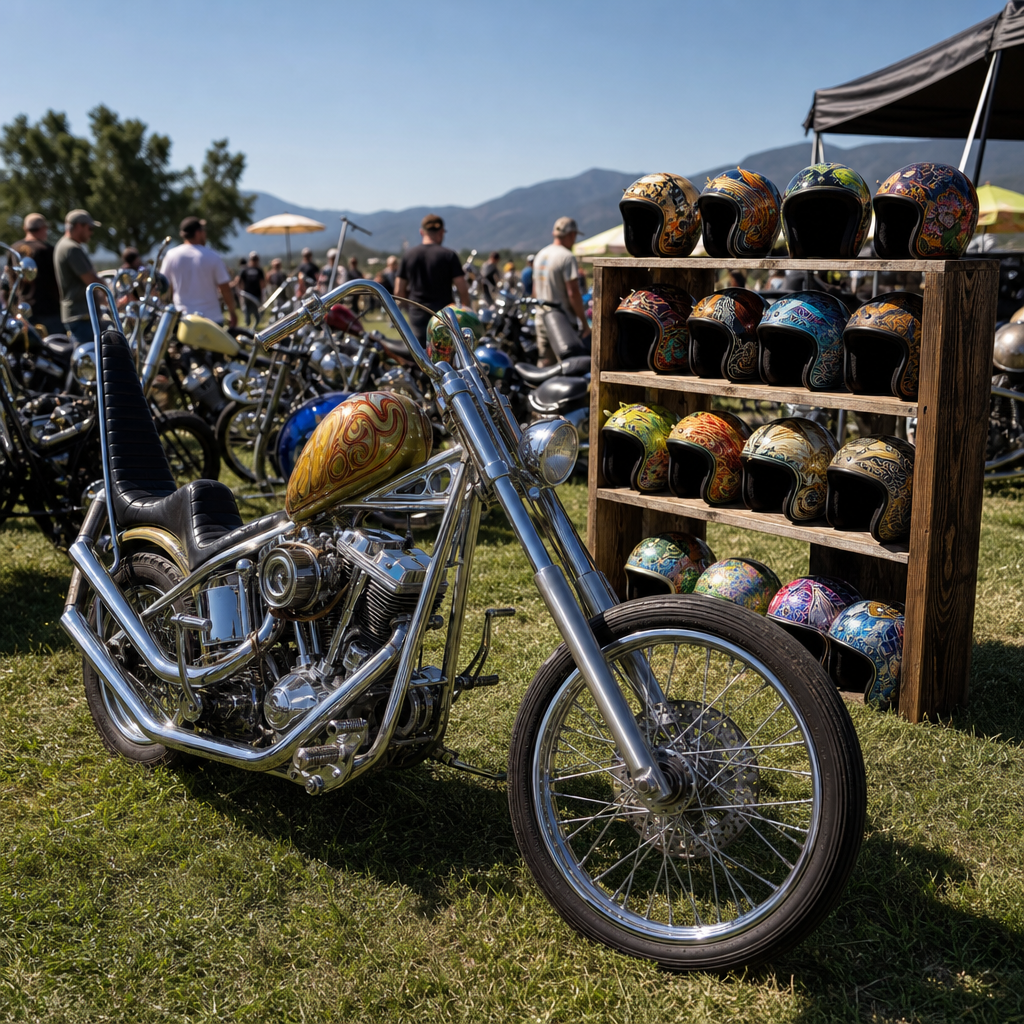
The Trippy Ten Helmet Show may sound like a side attraction, but it functions as a sharp indicator of where custom aesthetics are heading. Helmets condense the entire language of a builder or artist into a small surface area, forcing decisions about color hierarchy, line weight, iconography, typography, and finish. In 2026, helmet displays are no longer afterthought merch tables. They are tightly edited installations that connect painters, pinstripers, illustrators, composite specialists, and brand collaborators. Because a helmet is more accessible than a full motorcycle, the category also reveals which visual ideas are spreading fastest through the culture.
From an event strategy standpoint, the helmet show broadens the audience without diluting the bike focus. A visitor who may not understand frame geometry can still recognize disciplined masking, complex flake layering, lace panels, hand lettering, or a matte-versus-gloss contrast executed cleanly. For builders, that matters. The same eye that notices a balanced helmet layout can learn to appreciate a well-proportioned tank graphic or a polished but not overworked aluminum oil bag. At Glory Daze 2026, the Trippy Ten concept works because it treats helmets as collectible design objects while reinforcing the broader values of craftsmanship, narrative, and risk-taking.
It also creates a useful profile lens for this hub. Many of the most compelling builders are now multidisciplinary or deeply collaborative. One may be known for frame work but rely on a painter with signature candy techniques. Another may machine precision controls yet partner with an illustrator for period-correct psychedelic graphics. Following those collaborations gives readers a better map of the scene than focusing on bikes alone. The helmet show makes those networks visible.
How New Guard Builders Differ From Established Legends
The divide between new guard and legendary builders is less about age than about formation. Many established legends came up through regional scenes, print features, swap meets, and in-person reputation. Their authority was built slowly, often through miles ridden and the survival of bikes that still look right decades later. New guard builders often emerge through serialized online documentation, short-run part drops, and collaborations that reach an international audience immediately. Both pathways can produce excellent work, but they reward different skills beyond fabrication itself.
Here is a practical comparison of how these groups often operate in 2026.
| Dimension | New Guard Builders | Legendary Builders |
|---|---|---|
| Visibility | Digital-first launches, shop videos, rapid audience feedback | Long-term reputation, magazine history, influential past builds |
| Fabrication Workflow | Hybrid analog and digital tools, frequent prototyping | Deep manual process knowledge, proven shop methods |
| Design Language | Mixes classic stance with contemporary finishing and branding | Establishes foundational silhouettes and enduring proportions |
| Business Model | Limited parts, media collaborations, direct-to-audience sales | Commissions, legacy parts demand, event-driven influence |
| Main Strength | Adaptability and process transparency | Authority born from precedent and refinement |
Neither side automatically builds better motorcycles. The best new guard shops learn editing and patience from the legends. The best veterans stay open to improved tooling, better materials, and clearer communication with customers and followers. For readers using this as a hub, that is the key idea: meaningful builder profiles do not just rank personalities. They explain how each builder solves the recurring challenges of custom culture, from sourcing and geometry to finish quality and identity.
Fabrication Tech, Materials, and Standards That Matter
Because this sub-pillar sits under custom culture and fabrication tech, builder profiles need technical context. In 2026, the most credible shops speak fluently about materials and process control. They know when to use DOM tubing instead of cheaper alternatives, when a fixture must be built before a frame change, and why heat management during welding affects alignment. They also understand standards beyond style. Brake line routing, fastener quality, torque discipline, electrical protection, and chain or belt alignment are not glamorous topics, yet they determine whether a build is trustworthy.
Modern tools have improved quality ceilings. Digital angle finders make rake and neck measurements easier to verify during mock-up. Laser-cut templates reduce setup error. Compact 3D scanners help with repeat part fitment, especially in small-batch manufacturing. Powder coating remains common, but many top-tier builders still prefer paint over critical welded surfaces because it keeps inspection and future repair simpler. For sheet metal, 3003 aluminum remains popular for tanks and oil bags due to formability, while steel still wins where impact resistance or a traditional finish process is preferred. Good profiles should note these choices because materials tell you as much about a builder’s judgment as the final silhouette does.
Readers should also watch for how builders discuss limits. A serious fabricator does not claim every innovation is universally better. Extremely thin hidden wiring can complicate roadside repairs. Aggressive packaging can create heat issues. Radical geometry may photograph well and ride poorly. The most respected names in 2026 acknowledge those tradeoffs clearly. That honesty builds confidence and keeps the culture grounded in machines, not just images.
Why This Hub Matters for Following the Scene
As a hub for profiles of 2026 new guard and legendary builders, this page helps readers navigate a fast-moving scene without losing the thread of what actually matters. Trends will come and go: certain paint palettes will saturate the feed, particular wheel sizes will cycle in and out, and event branding will continue to become more sophisticated. What lasts is craft, coherence, and influence. The builders worth following are the ones whose motorcycles hold up under close inspection, whose methods can be explained, and whose ideas change how others build.
Glory Daze 2026 offers a clear lens because it gathers all of those elements in one place: hand-built choppers that show genuine authorship, legendary figures whose standards still guide the field, and the Trippy Ten Helmet Show, which reveals the visual language surrounding the bikes. Use this hub as your starting point for deeper builder profiles, fabrication breakdowns, paint and helmet features, and event coverage across the wider custom culture landscape. If you want to understand where the new guard is taking choppers without losing sight of the legends who built the foundation, follow the connected articles from this page and study the details that serious builders never leave to chance.
Frequently Asked Questions
What makes Glory Daze 2026 such an important moment for hand-built choppers?
Glory Daze 2026 feels important because it shows that hand-built choppers are not fading into nostalgia—they are evolving without losing their soul. The event centers the bikes themselves: narrow lines, custom frames, one-off tanks, detailed fabrication, and all the visual drama that made choppers culturally powerful in the first place. At the same time, it highlights a newer generation of builders who approach the craft with a different toolkit. Many of these fabricators combine traditional hands-on methods with CAD planning, precision machining, cleaner production workflows, and more intentional presentation. That blend matters because it proves craftsmanship can stay emotional and raw while also becoming more exacting and more visible to broader audiences.
What really makes this year feel like a turning point is the way the scene is being narrated. For years, custom motorcycle culture was often defined by a relatively small group of legendary builders whose names carried weight through magazines, events, and long-standing reputations. Glory Daze 2026 still respects those figures, but the conversation is no longer controlled exclusively by legacy status. Builders who gained traction through recent projects, collaborations, short-run parts work, or social-first releases are now shaping what people talk about, photograph, and remember. In other words, the event is not just preserving chopper culture—it is documenting a shift in who gets to lead it.
Who are the “new guard” builders in the context of Glory Daze 2026?
In this article’s context, the “new guard” does not simply mean younger builders by age. It refers more specifically to fabricators and custom motorcycle creators who built their reputations through recent bikes, collaborative shop work, digital visibility, and contemporary forms of audience engagement rather than through decades of magazine-era dominance. These are the people whose names started circulating because a single striking bike hit hard online, because they contributed standout fabrication to multiple projects, or because they understand how to launch a build with strong visuals, process storytelling, and community interaction.
That distinction is important because it describes a real cultural shift. The new guard often treats the motorcycle as both an object and a narrative. Their builds still depend on real skill—frame work, sheet metal shaping, machining, finish choices, geometry, stance, and rideability—but they also think carefully about how a bike is introduced to the world. They are often more fluent in documenting process, showing fabrication stages, collaborating across shops, and building momentum before a project ever reaches an event floor. At Glory Daze 2026, that means the energy around certain builders comes not only from the final machine, but from the story, the build philosophy, and the way the work connects with a wider audience in real time.
How do legendary builders still fit into the story at Glory Daze 2026?
Legendary builders remain essential because they provide the foundation that makes an event like Glory Daze meaningful in the first place. Their influence is visible in the silhouettes, mechanical choices, fabrication standards, and rebellious spirit that still define custom chopper culture. Even when newer builders seem to dominate the conversation, much of what they are doing is in dialogue with earlier generations—whether they are honoring old-school proportions, reworking classic paint language, or updating techniques first made famous by established names in the scene. The legendary figures are not just historical references; they are active benchmarks for taste, originality, and execution.
At Glory Daze 2026, their role is especially important because the event is less about replacement and more about transition. The strongest stories come from the tension and overlap between eras. Legendary builders bring credibility, lineage, and the kind of hard-earned authority that only comes from long-term influence. The new guard brings urgency, experimentation, and new methods of presentation. When both are present, the audience gets a fuller picture of where chopper culture has been and where it is headed. That balance gives the event depth: it honors builders who shaped the visual language of the custom scene while also making room for those who are currently redefining how that language gets spoken.
What is the Trippy Ten Helmet Show, and why does it matter within the event?
The Trippy Ten Helmet Show matters because it expands the conversation beyond motorcycles alone and into the broader visual culture surrounding custom riding. Helmets are functional safety equipment, but in scenes like Glory Daze they also act as personal artifacts—rolling declarations of taste, identity, humor, and artistic allegiance. A focused helmet show spotlights the crossover between motorcycle fabrication, paint culture, graphic design, lowbrow art, psychedelia, and custom craftsmanship. That makes it more than a side attraction. It becomes a compact, highly visible expression of the same creativity driving the bikes themselves.
Within the larger event, the Trippy Ten format also works because it is curated and memorable. Rather than overwhelming attendees with endless entries, it creates a tighter showcase where concept, finish, and execution can stand out. For visitors, that means the helmet display becomes an easy point of entry into the event’s artistic identity. For builders, painters, and brands, it is a chance to show how visual storytelling travels across different objects in the culture—not just frames and engines, but wearable pieces too. In SEO and editorial terms, the helmet show matters because it gives Glory Daze 2026 another distinct angle: not only hand-built choppers, but also the art ecosystem that surrounds them.
What themes should readers expect from an article about Glory Daze 2026?
Readers should expect an article that goes beyond event recap language and instead treats Glory Daze 2026 as a snapshot of a changing custom motorcycle scene. One major theme is continuity: hand-built choppers still sit at the emotional center of the culture, and the values of individuality, fabrication skill, and mechanical expression remain intact. Another major theme is transition: a newer generation of builders is gaining influence not by imitating the past, but by translating its energy through cleaner craftsmanship, modern tools, collaborations, and sharper visual storytelling. That combination gives the article a strong narrative arc, because it is not simply asking which bikes looked best—it is asking who now defines relevance in the scene.
Readers should also expect attention to aesthetics, community, and authorship. The best coverage of Glory Daze 2026 will likely explore how bikes are built, how they are presented, and how audiences respond to them both in person and online. It will probably examine the relationship between legendary builders and emerging names, the role of curated experiences like the Trippy Ten Helmet Show, and the increasing importance of storytelling as part of a build’s impact. In practical terms, that means the article should appeal to longtime chopper fans, casual event followers, and newer readers trying to understand why this gathering feels bigger than a single weekend show. It represents a broader cultural handoff—and that is what makes it worth reading closely.