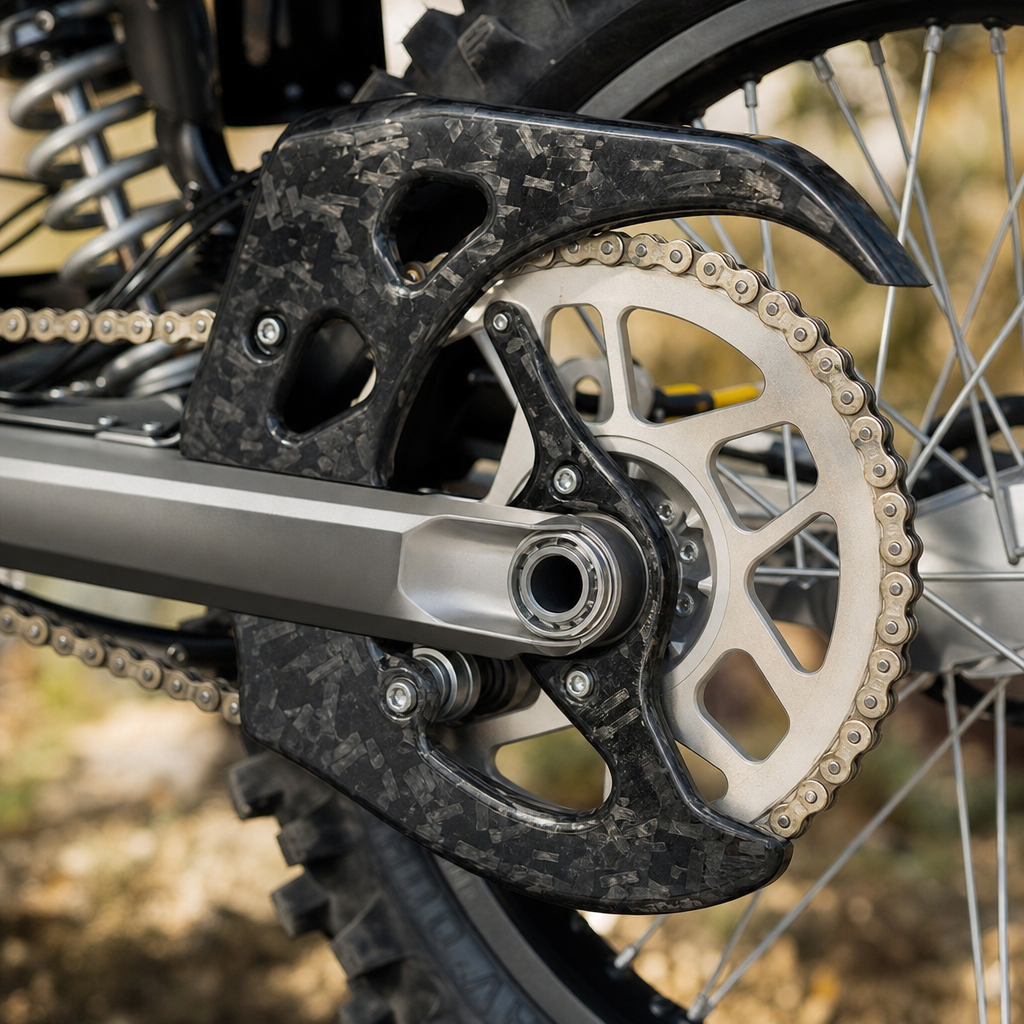
Forged carbon sprocket guards are moving from niche custom builds into serious 2026 drivetrain conversations because they solve a practical problem: protecting expensive final-drive components without adding the bulk, corrosion risk, or visual heaviness of traditional metal guards. In workshop terms, a sprocket guard shields the front or rear sprocket area from debris strikes, chain whip, rider contact, and accidental impact during service or low-speed drops. “Forged carbon” refers to compression-molded chopped carbon fiber in a resin matrix, a process that creates the marbled appearance builders now recognize from high-end motorcycle parts, automotive trim, and aerospace-adjacent components. Unlike woven carbon sheet, forged carbon can fill complex shapes more easily, which matters when a guard must clear chain lines, mounting bosses, case contours, and swingarm movement while still looking intentional on a custom machine.
This matters because 2026 drivetrains are getting tighter, more powerful, and more customized. Builders are packaging wider rear rubber, quickshifters, revised rearsets, chain conversions, and sensor-rich electronics into less space. At the same time, expectations around finish quality have risen. A part can no longer be merely light; it must fit cleanly, survive heat cycles, resist road grime, and integrate with the visual language of the entire bike. I have seen thin aluminum guards vibrate loose, mild-steel guards rust around hardware, and poorly laid carbon crack at mounting points after only a season. A well-made forged carbon sprocket guard addresses those failure modes through better stiffness-to-weight, thoughtful laminate design, and precise fabrication. It also sits at the center of a broader fabrication shift, where 3D printing, composite work, and modern wiring practice now shape how custom motorcycles are designed, prototyped, and finished.
As a hub for fabrication tech, this guide explains how forged carbon sprocket guards fit into the wider custom builder toolkit. It covers what they are, why they work, how they compare with aluminum and plastic, how 3D printing speeds development, why wiring decisions affect drivetrain-area parts, and what standards separate a showpiece from a durable road component. If you are deciding whether forged carbon belongs on your next build, the short answer is yes when the design is engineered around real loads, proper clearances, heat exposure, and service access.
Why Forged Carbon Works on Sprocket Guards
A sprocket guard lives in a punishing environment. It sees chain lube, grit, cleaning chemicals, vibration, thermal cycling from nearby engines or exhaust routing, and occasional impact from thrown debris. In that setting, forged carbon offers three core advantages. First, it delivers high stiffness at low mass. Second, it enables complex geometry without the tooling compromises of hand-shaped metal. Third, it offers a premium finish that aligns with modern custom culture, where visible technical materials matter almost as much as mechanical function.
The performance case is straightforward. Carbon fiber composites typically provide excellent specific stiffness, meaning they resist bending for their weight better than common metals used in guards. In practical terms, that can reduce flutter and resonance in thin sections. Forged carbon also allows local reinforcement around bolt holes, stand-offs, and edges, which is where guards usually fail. Instead of simply cutting a flat plate and drilling it, a builder can shape ribs, pockets, and thicker hard-point zones into the mold. That design freedom is especially useful on bikes with irregular case covers, offset sprockets, or aftermarket slave-cylinder brackets.
There are limits, and good builders acknowledge them. Forged carbon is not automatically stronger than aluminum in every impact direction. Resin choice, fiber length, compaction, and hardware design all matter. Poorly engineered forged carbon can delaminate, crack around inserts, or wear quickly if chain contact occurs. For that reason, the best applications use forged carbon as a structural shell with controlled clearances, chamfered edges, and metal inserts or bonded bushings where clamp load is high. The goal is not to pretend composite solves everything; the goal is to use it where its properties deliver a better part.
Design Rules for 2026 Drivetrain Packaging
Modern drivetrain packaging leaves little room for guesswork. On current customs and performance street builds, the sprocket area often shares space with ABS routing, quickshifter wiring, speed sensor leads, case savers, chain guards, rearset plates, and aftermarket engine covers. Before making any guard, I start by mapping the chain path through full suspension travel and checking the widest likely chain excursion during deceleration and misalignment. A guard that looks clean on a stand can become a chain catcher under compression if clearances were taken at only one ride height.
For 2026 builds, design should account for larger 520 and 525 chain conversions, revised anti-squat geometry, and the tendency of custom swingarm setups to alter chain growth. Minimum static clearance is not enough. Builders need dynamic clearance, service clearance, and contamination clearance. Dynamic clearance covers movement under load. Service clearance ensures a mechanic can remove the countershaft cover, clean accumulated grease, and inspect wear without dismantling half the bike. Contamination clearance prevents mud and debris from packing into dead pockets that trap moisture or rub the chain side plates.
Mounting strategy matters just as much as material choice. Whenever possible, mount the guard to existing bosses designed for accessory load rather than unsupported case edges. Spread load with proper washers or integrated metal sleeves. Avoid unsupported tabs that cantilever the part into vibration. If the guard spans between dissimilar structures, such as an engine case and a rearset bracket, account for differential movement and thermal expansion. Many cracked custom parts fail because designers assumed the bike was a rigid object. It is not. Engines vibrate, cases heat up, and brackets flex.
How 3D Printing Improves Composite Development
3D printing has changed fabrication economics more than any single tool I have added to the workshop in the last decade. For sprocket guards, additive manufacturing shortens the path from idea to test-fit part. Instead of committing to aluminum cutting or expensive mold work immediately, builders can scan the mounting area, model the guard in CAD, print prototypes, and validate clearances on the bike. That process catches interference with chain links, fasteners, shift linkage, and wiring before carbon is ever laid up or molded.
FDM printing with nylon, carbon-filled nylon, or even PLA for simple form checks is usually enough for early iterations. SLA can help with small detailed brackets, but for large fitment bucks, tougher thermoplastics are more forgiving in the shop. In one recent build sequence, we printed three front sprocket guard versions in a single weekend, changing only rib placement and fastener access. The third version reduced tool obstruction during chain adjustment and increased mud shedding simply by opening a lower relief channel that was not obvious on screen. That is the kind of refinement 3D printing makes routine.
Printed parts also support composite tooling. A printed plug can be sealed, surfaced, and used to create a mold for forged carbon compression work. Builders producing low-volume runs often print the master, correct it by hand, then machine only the final production tool if demand justifies it. This is why 3D printing belongs in any conversation about forged carbon: it de-risks shape development, lowers iteration cost, and lets custom shops offer near-OEM fit on uncommon donor platforms.
| Fabrication method | Best use on sprocket guards | Main advantage | Main limitation |
|---|---|---|---|
| FDM 3D printing | Prototype fitment bucks and airflow or clearance studies | Fast, inexpensive iteration | Surface finish and heat resistance vary by material |
| Forged carbon molding | Final lightweight production parts with complex geometry | High stiffness-to-weight and premium finish | Tooling and process control are critical |
| CNC aluminum | Hard-point inserts, spacers, and hybrid guard structures | Precise mounting interfaces | Higher weight than composite shells |
Material Comparison: Forged Carbon, Aluminum, and Polymer Guards
Builders usually compare forged carbon with three alternatives: sheet aluminum, machined billet aluminum, and injection-molded or thermoformed polymers. Sheet aluminum remains popular because it is easy to cut, bend, and powder coat. It is the right choice for budget race bikes and simple workshop fabrication. Billet aluminum offers excellent precision and premium appearance, but weight can climb quickly unless pockets are machined aggressively. Polymer guards are common on OEM bikes because they are cheap, resilient, and quiet when struck by debris, though they often lack the visual impact custom clients want.
Forged carbon sits between those worlds. It is lighter than billet, often stiffer than thin sheet, and visually more distinctive than black polymer. It also damps vibration differently than metal, which can reduce buzz in lightly supported sections. However, it demands more engineering discipline than a bent aluminum plate. Fiber orientation in forged carbon is less predictable than in woven laminate, so the part’s geometry and local thickness have to do more of the work. Resin selection is also crucial. Epoxy systems generally outperform polyester for structural motorcycle components, and high-temperature formulations are preferable near engine cases.
When should you not choose forged carbon? If the guard is expected to take repeated direct chain strikes, a sacrificial polymer insert or aluminum wear strip may be smarter. If the bike is a mud-heavy off-road machine where abrasion dominates, replaceable thermoplastic can outperform a cosmetic composite finish. If production volume is large, injection-molded engineering polymer may deliver better consistency and lower cost. The right answer depends on use case, not trend pressure.
Wiring Integration Around the Sprocket Zone
Wiring is often treated as a separate discipline from bodywork and drivetrain protection, but on modern customs they overlap constantly. The sprocket area frequently houses speed sensor cabling, quickshifter leads, stator wiring exits, and sometimes relocated regulator or data-logging harness runs. A beautifully made forged carbon guard can become a liability if it traps heat around wiring, creates a chafe point, or blocks inspection of a harness rubbing against the case.
The best practice is to design the guard and the wiring path together. Use abrasion-resistant sleeving such as PET braid, braided Nomex where heat is significant, or DR-25 heat-shrink tubing in higher-end motorsport-style harnesses. Secure harnesses with proper stand-offs and P-clamps rather than zip ties pulled around sharp edges. If a cable must pass near the guard, specify edge radii and install grommeted pass-throughs or bonded isolators. I have repaired more than one intermittent quickshifter fault that was ultimately caused by a cosmetic bracket wearing through insulation near the front sprocket cover.
Serviceability matters here as well. A guard should not force complete harness disassembly for routine chain cleaning. Builders who plan wiring early can route connectors to accessible zones, protect them from fling-off contamination, and preserve room for diagnostics. That is the broader lesson of fabrication tech in 2026: carbon, printing, and wiring are not separate upgrades. They are interdependent systems that need one design language.
Manufacturing Quality, Standards, and Real-World Buying Criteria
Not every forged carbon part on the market deserves to be installed on a running motorcycle. Buyers should evaluate manufacturing quality with the same seriousness they apply to brakes or suspension hardware. Look for clear documentation on resin system, curing method, hardware inserts, and temperature capability. Ask whether the part was tested on the exact bike model or only “inspired by” it. Confirm fastener torque recommendations and whether metal sleeves are included to prevent clamp crushing. If a seller cannot answer basic fitment and material questions, that is a warning sign.
Standards from the wider composites and wiring world offer useful guidance even when no motorcycle-specific certification exists for an aftermarket guard. Shops borrowing motorsport harness methods, IPC workmanship discipline, and aerospace-style traceability usually produce better results because their process is controlled. On the digital side, CAD validation, scan-to-part workflows, and repeatable jigs separate serious manufacturers from hobby sellers. Named tools such as Fusion, SolidWorks, Rhino, Markforged printers, Bambu Lab systems, and Hexagon or Creaform scanning solutions now appear in many credible custom fabrication pipelines for good reason: they improve repeatability.
For buyers, the checklist is simple. Verify clearance. Inspect edge finishing. Check insert quality. Look for UV-stable clear coat if the weave or marbling will remain visible. Confirm that no sharp internal feature can contact the chain under deflection. Make sure replacement hardware is standard and available. The best forged carbon sprocket guards do not just look advanced on social media; they survive weather, maintenance, and miles.
Forged carbon sprocket guards represent more than a styling trend. They show how custom fabrication has matured, combining digital design, additive prototyping, composites knowledge, and disciplined wiring practice into parts that are lighter, cleaner, and better integrated than older one-material solutions. For 2026 drivetrains, that matters because the space around the sprocket is crowded, expensive, and mechanically unforgiving. A guard that protects without adding excess weight, blocks debris without trapping contamination, and mounts securely without stressing the case is a meaningful upgrade, not decoration.
The key takeaway is that forged carbon works best when treated as one part of a complete fabrication system. Start with accurate measurement and dynamic clearance checks. Use 3D printing to test shape, service access, and chain behavior before investing in tooling. Build in proper hard points, thermal margin, and abrasion management. Route wiring with the same care you give the composite surface. Choose vendors who can explain their process and back fitment with evidence. Those steps are what separate a durable custom component from an expensive experiment.
If you are building the next generation of custom motorcycles, use this page as your starting hub for fabrication tech across carbon, 3D printing, and wiring. Apply the same standards to every bracket, cover, and harness near the drivetrain, and your bike will not only look current for 2026, it will perform like a machine engineered on purpose. Review your current sprocket area, identify the weak points, and plan the upgrade with materials and methods that earn their place.
Frequently Asked Questions
What is a forged carbon sprocket guard, and how is it different from a traditional metal guard?
A forged carbon sprocket guard is a protective drivetrain component made from compressed, randomly oriented chopped carbon fiber embedded in resin, then molded under heat and pressure into a dense, rigid part. Unlike a woven carbon part, which uses visible fabric layers, forged carbon has a marbled, technical appearance and can be shaped more freely around tight clearances near the front or rear sprocket. In practical terms, that gives manufacturers and custom builders a way to create a lightweight guard that still feels substantial enough for real-world use.
Compared with traditional aluminum or steel guards, the biggest differences are weight, corrosion behavior, and visual presence. Metal guards are proven and durable, but they can add noticeable mass, especially on builds where every gram matters. They can also corrode, chip, or develop a worn appearance over time depending on finish quality and riding conditions. Forged carbon avoids rust entirely and typically delivers a cleaner, more premium look without the bulk many riders associate with heavier protective hardware.
Functionally, both types are intended to shield the sprocket area from debris strikes, chain lash, boot contact, accidental knocks during maintenance, and low-speed impact events. The reason forged carbon is gaining attention for 2026 drivetrains is that it addresses those needs while fitting the broader trend toward lighter, better-finished, more component-specific protection. It is not just a cosmetic upgrade when designed correctly; it is a practical material choice for riders who want drivetrain protection without the visual or physical heaviness of metal.
Do forged carbon sprocket guards actually provide enough protection for real riding and workshop use?
Yes, when they are properly designed, mounted, and manufactured, forged carbon sprocket guards can provide meaningful protection in the scenarios they are most commonly expected to handle. That includes shielding the sprocket zone from gravel and road debris, reducing the chance of direct contact from boots or tools, helping contain incidental chain whip, and taking the edge off minor impacts during servicing, transport, or low-speed drops. For the vast majority of street, sport, and performance-oriented applications, that is exactly the kind of protection riders need.
It is important, though, to define what “enough protection” means. A sprocket guard is not a structural crash bar, nor is it meant to survive every severe impact without damage. The job of the part is to create a protective barrier around a vulnerable and expensive area of the final drive. In that role, forged carbon can perform very well because it combines low weight with high stiffness and a shapeable manufacturing process that allows close-fitting designs around the sprocket and chain path.
Quality matters more here than marketing. A well-made forged carbon guard should have proper resin content, controlled fiber compression, clean mounting interfaces, and enough thickness in impact-prone areas. Poorly made parts may look impressive but crack prematurely, delaminate around fasteners, or fail to provide adequate coverage. Riders considering one for 2026 drivetrain upgrades should look for precise fitment, reinforced mounting zones, and evidence that the part was designed as protection first, not just styling. When those boxes are checked, forged carbon is absolutely a credible protective material for real use.
Why are forged carbon sprocket guards becoming more relevant for 2026 drivetrain setups?
They are becoming more relevant because modern drivetrain discussions are increasingly focused on efficiency, weight management, component longevity, and premium materials that serve an actual purpose. As motorcycles and performance machines continue to evolve, owners are spending more on high-end chains, sprockets, covers, swingarm finishes, and drivetrain tuning. That makes the area around the final drive more valuable to protect. A forged carbon sprocket guard answers that need by offering lightweight coverage that feels modern and intentional rather than like an afterthought.
Another reason is fit and packaging. Newer drivetrain layouts, aftermarket rearsets, swingarm designs, and bodywork combinations often leave less room for generic guards. Forged carbon manufacturing allows more sculpted shapes and cleaner integration than many stamped or bent-metal parts. That means a guard can be built to closely follow the sprocket area, protect vulnerable zones, and still preserve access for cleaning, adjustment, and inspection. For 2026-focused builds, where riders expect both performance and finish quality, that balance matters.
There is also a broader shift in rider expectations. People no longer want protective parts that look purely industrial unless the bike is built around that aesthetic. They want protection that complements premium drivetrains visually while still delivering workshop credibility. Forged carbon fits that niche extremely well. It communicates motorsport influence, reduces unnecessary mass, resists corrosion, and helps maintain a cleaner appearance around one of the dirtiest zones on the bike. That combination is why it is moving from niche custom use into mainstream drivetrain conversations.
Are there any downsides to forged carbon sprocket guards compared with aluminum or steel?
Yes, and a balanced answer is important. While forged carbon offers excellent benefits, it is not automatically better in every category. One of the main downsides is cost. A well-made forged carbon guard usually costs more than a basic aluminum or stamped steel alternative because the material, tooling, finishing, and quality control requirements are higher. If a rider simply needs inexpensive functional coverage, metal may still be the more economical choice.
Impact behavior is another consideration. Metal tends to bend or dent in a way that is often visible and predictable, while carbon-based parts may chip, crack, or fracture depending on the force and point of contact. That does not make forged carbon weak, but it does mean damage assessment can be different. After a hard strike, a forged carbon guard should be inspected carefully around edges, mounting holes, and corners to confirm it has not developed structural damage that is not immediately obvious at a glance.
Heat exposure, chain clearance, and installation precision also matter. A poorly designed carbon guard mounted too close to moving drivetrain parts can create rubbing issues, and overtightening hardware can stress the material around the fasteners. In contrast, some metal guards are more forgiving of rough installation practices. The takeaway is straightforward: forged carbon is an excellent material for this application when the part is engineered properly and fitted correctly, but buyers should treat it as a premium technical component, not just a decorative panel.
What should riders look for when choosing and maintaining a forged carbon sprocket guard?
Start with fitment and functional coverage. A good forged carbon sprocket guard should be designed specifically for the bike or drivetrain platform, with enough clearance for the chain, sprocket, and surrounding hardware through the full range of normal use. It should protect the critical strike zones without interfering with maintenance tasks such as chain cleaning, sprocket inspection, axle adjustment, or cover removal. If the part looks great but leaves obvious exposure where debris or contact is most likely, it is prioritizing style over real protection.
Next, inspect the construction details. Look for clean molding, consistent surface finish, reinforced mounting points, quality hardware provisions, and edges that are properly finished rather than sharp or resin-heavy. Reputable manufacturers will usually provide clear installation guidance and may note torque recommendations, washer usage, or spacing requirements. Those details matter because carbon parts perform best when clamped correctly and supported evenly. A guard that bolts on securely without twisting or preload is far more likely to last.
For maintenance, treat the part like a premium drivetrain-adjacent component. Clean it regularly to prevent buildup of chain lube, grit, and road contamination, especially around mounting areas and tight corners. During routine service, check for cracks, chips, abrasion marks, or loosened hardware. If the bike experiences a drop or a drivetrain issue such as chain slap or derailment, inspect the guard before riding again. Done right, maintenance is simple: keep it clean, make sure it stays properly mounted, and verify that no damage has developed from impact or vibration. That basic care will help a forged carbon sprocket guard continue doing what it is meant to do—protect expensive 2026 drivetrain components without adding unnecessary weight or visual clutter.