The survival of a 1990s classic in 2027 increasingly depends on fabrication technology, and 3D printing spare parts has moved from a niche workshop trick to a practical maintenance strategy for owners who refuse to park rare, aging cars. In this context, a “1990s classic” means vehicles from roughly 1990 to 1999 that now sit in the difficult middle ground: old enough for trim, brackets, ducts, clips, switchgear, and interior pieces to be discontinued, yet modern enough that owners still expect reliability, clean fitment, and road-trip usability. “Fabrication tech” covers three linked disciplines that I use regularly in restoration planning: additive manufacturing for parts reproduction, composite repair or replacement using carbon-based materials, and wiring renewal through modern harness methods, connectors, and diagnostics. Together, these tools solve the exact problems that strand 1990s cars: unavailable plastics, brittle interior components, cracked underhood ducts, and electrical failures caused by aging insulation, corroded terminals, and previous-owner modifications.
This matters because traditional parts sourcing is no longer enough. Dealer inventory for many Japanese, European, and domestic 1990s platforms has collapsed, used parts are often as fragile as the originals, and overseas new-old-stock prices can exceed the value of the part’s function. I have seen owners spend weeks chasing a simple ABS relay cover, HVAC flap gear, or battery hold-down, only to discover that the “last good used one” breaks during installation. Additive manufacturing changes that equation by letting a shop scan, model, test, revise, and reproduce low-volume components on demand. Composite fabrication extends the same logic to lightweight ducts, shrouds, aero pieces, and structural cosmetic panels, while modern wiring practice keeps these cars dependable enough to justify the rest of the effort. For anyone building, preserving, or daily driving a 1990s classic in 2027, understanding how these technologies fit together is no longer optional; it is the difference between a car that sits waiting for obsolete parts and one that stays on the road.
Why 3D printing spare parts works for 1990s classics
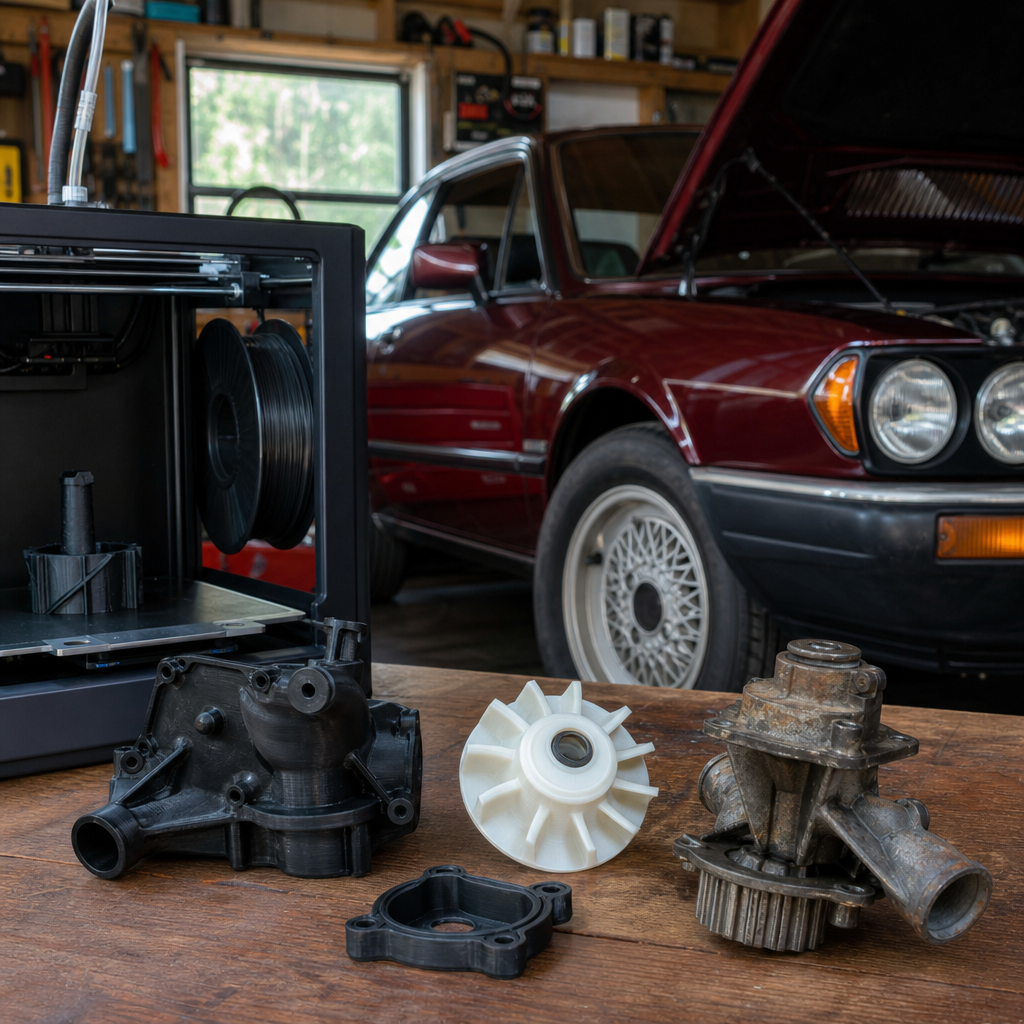
3D printing works especially well on 1990s cars because many of the failing components were originally injection-molded plastics with modest loads, complex shapes, and low replacement demand. Think center-console mounting tabs, headlight adjuster gears, cowl clips, window switch bezels, washer bottle brackets, fuse box covers, intake snorkels, and heater control linkages. These are exactly the parts that become unobtainable first and are often too specialized for mass remanufacturing. In the workshop, the process usually starts with reverse engineering: measuring a surviving part, scanning it with structured light or photogrammetry, rebuilding the geometry in CAD, then selecting a print method that matches heat, chemical, and vibration exposure. FDM printing with nylon, PETG, ASA, or polycarbonate blends handles many brackets and interior items. SLS nylon is better for stronger, more dimensionally stable pieces with complex geometry. Resin printing can reproduce intricate small parts, but it is rarely my first choice underhood because heat and long-term UV resistance vary widely.
The key advantage is speed of iteration. If an OEM clip snaps during test fit, I can thicken a wall, add a fillet at the stress riser, change infill strategy, or reorient the print, then produce a revised part the same day. That is impossible when waiting on salvage-yard inventory or hoping a discontinued part appears in another market. Good candidates for printed spare parts include non-safety-critical plastics, trim supports, guides, housings, and fixtures. Poor candidates include brake components, suspension arms, seatbelt hardware, and any part where a material failure could cause injury. The strongest results come when a printed part improves on the original design. A common example is replacing a brittle HVAC blend-door coupler with a glass-filled nylon version that includes more radius at the base and slightly tighter tolerances. On many 1990s cars, the original part failed because the material aged, not because the design goal was wrong. Additive manufacturing lets you correct both issues at once.
Choosing the right printing process and material
Material selection determines whether a printed spare part becomes a durable fix or a short-lived experiment. For interior parts exposed to light and moderate heat, ASA is often preferable to standard PLA because it resists UV better and tolerates hotter cabin temperatures. PETG is easy to print and works for enclosures, covers, and brackets, but it can creep under load. Nylon, especially PA12 in SLS or well-dried FDM nylon, is a better match for clips, ducting, hinge-like pieces, and underhood items that need toughness rather than cosmetic perfection. Polycarbonate blends add heat resistance but require careful print settings. TPU is useful for grommets, bushings, and flexible isolators, though hardness selection matters. Carbon-filled filaments can improve stiffness and surface finish, but they are not automatically stronger in every direction; anisotropy still matters, and brittle behavior can increase if the design is wrong.
When owners ask what process to use, the practical answer is to match the technology to the environment. A dashboard vent thumbwheel can be resin printed for crisp detail. A radiator support clip should usually be nylon. An intake airbox latch near heat soak should be tested in a material with known thermal performance, not printed in the easiest filament on the shelf. Reputable material datasheets matter. So do post-processing steps such as annealing, vapor smoothing where appropriate, threaded inserts, or sealing porous prints that will see moisture. In my own projects, the most successful parts come from treating the print as a manufactured component, not a gadget. That means orienting load paths intelligently, designing for the printer’s strengths, and validating dimensions after cooling, because a half-millimeter deviation can turn a perfect CAD file into a rattling, misaligned part in the car.
From scan to roadworthy part: the workflow that saves time
A reliable workflow keeps additive manufacturing from becoming expensive trial and error. The first step is diagnosis: confirm the failed part is actually the root cause and document every interface before removal. Next comes geometry capture, using calipers, radius gauges, thread checks, and, when available, 3D scanning. CAD reconstruction should include tolerance strategy, fastener interfaces, wall thickness targets, and stress-relief features such as ribs or fillets. Before printing the final version, I often print a low-cost draft to confirm fit, clip engagement, and assembly sequence. Only then do I run the final material. After test installation, the part should be checked for heat exposure, vibration, and neighboring components that may abrade it. This workflow sounds methodical because it needs to be. Most bad printed parts fail not because printing is flawed, but because the operator skipped validation.
| Part type | Best common process | Recommended material | Main risk to manage |
|---|---|---|---|
| Interior clips and trim mounts | FDM or SLS | ASA or nylon | Snap fatigue and cabin heat |
| HVAC gears and ducts | SLS or tuned FDM | PA12 nylon | Wear, tolerance drift, heat |
| Underhood brackets and covers | SLS or polycarbonate-capable FDM | Nylon or PC blend | Heat soak and chemical exposure |
| Flexible seals and grommets | FDM | TPU | Compression set and fit |
| Cosmetic detail parts | Resin | Engineering resin | UV stability and brittleness |
Real-world examples prove the value of this approach. On 1990s Japanese coupes, pop-up headlight mechanisms often use small plastic bushings or gear isolators that degrade and create grinding or uneven operation. Printed replacements in the correct elastomer or nylon blend can restore function faster than hunting donor assemblies. European cars from the same era commonly suffer cracked heater flap pivots and sunroof guide pieces; rebuilding those parts from CAD saves entire subassemblies. Domestic F-body and Fox-platform owners use printed switch bezels, HVAC control backings, and speaker grilles to rescue interiors that salvage yards have already picked clean. In each case, the successful shops document versions, material choices, and fitment notes so future owners are not starting from zero. That library effect is one of the biggest hidden benefits of fabrication tech: every solved problem becomes repeatable.
Where carbon composites fit into 1990s restoration and modification
Carbon has a place in this subtopic, but it should be used with discipline. For 1990s classics, carbon-based fabrication is most valuable for lightweight ducts, intake boxes, splash panels, seat backs, instrument pods, aero pieces, and replacement skins where the original part is damaged, heavy, or impossible to source. It is less convincing when used only for visual drama. A proper carbon repair or reproduction starts with understanding whether the original component was structural, semi-structural, or cosmetic. Vacuum bagging, wet layup, prepreg, and infused laminates each have different cost, finish, and strength profiles. In practical street builds, many shops combine 3D printing and composites by printing a mold, plug, or core, then laying composite over it. That hybrid method is extremely effective for NACA ducts, air guides, battery trays, and custom intake plumbing where a one-off shape needs strength without tooling costs.
There are tradeoffs. Carbon fiber is stiff, but stiffness is not the same as impact toughness, and galvanic corrosion can occur when carbon contacts certain metals without proper isolation. Heat management also matters; resin systems have glass-transition temperatures, and underhood use requires the right matrix, shielding, and realistic expectations. For many parts, glass fiber or carbon-reinforced nylon is more sensible than full carbon laminate. I advise owners to choose composites where they solve a real problem: reducing mass high in the car, recreating a discontinued duct with better airflow, or making a durable panel that will not absorb moisture like old fiberboard. When used this way, carbon belongs in the same conversation as 3D printing because both are low-volume manufacturing tools for keeping niche cars functional.
Modern wiring methods are as important as printed parts
No 1990s classic stays dependable on printed hardware alone if the wiring is deteriorating. By 2027, most original harnesses are dealing with decades of heat cycles, brittle loom, oxidized grounds, and amateur alarm or stereo installs. The best fabrication shops treat wiring as the third pillar of preservation. That means using proper open-barrel crimps, adhesive-lined heat shrink where appropriate, DR-25 or braided sleeve for protection, and connectors sourced from recognized manufacturers such as TE Connectivity, Yazaki, Delphi-Packard, Deutsch, or Sumitomo. It also means understanding circuit loading before adding electric fans, fuel pumps, EFI conversions, wideband sensors, or LED lighting. I have corrected many repeat failures that were blamed on “old cars being unreliable” when the real issue was voltage drop through a corroded splice or an undersized feed wire added years earlier.
Printed parts and wiring often intersect directly. A replacement relay box cover may need a new cable pass-through. A custom ECU mount may require strain relief and service loops. A restored center console may need printed switch carriers to hold modern USB charging, gauge controllers, or CAN-based accessories without cutting original trim. The smartest builds document wire color, gauge, connector family, fuse rating, and ground location so future troubleshooting remains straightforward. For engine swaps and standalone management, modular harness design is especially valuable: printable brackets and pass-throughs can make the installation neat, but proper shielding, grounding strategy, and fuse distribution are what keep the car starting every morning. Reliability is fabrication too.
Limits, legality, and how to build a parts strategy for 2027
The biggest mistake is assuming every obsolete part should be printed. Safety-critical components, emissions-regulated equipment, and heavily heat-cycled structural items demand caution, testing, or OEM-grade alternatives whenever possible. Insurance, inspection standards, and local roadworthiness laws may affect what modifications are acceptable. Shops should disclose materials and intended use clearly, especially when selling reproduction parts. Quality control also matters more than social-media hype suggests. A part that looks excellent in photos can fail early from poor layer bonding, moisture-contaminated nylon, incorrect infill, or sloppy dimensional control. For hub-level planning, owners should separate needs into categories: must-have reliability parts, cosmetic restorations, performance upgrades, and future-proof inventory. Then build a digital archive with part numbers, scans, CAD files, print settings, wiring diagrams, and supplier notes. That archive becomes the backbone for every related project in fabrication tech, whether the next article focuses on printable clips, carbon ducting, or harness refurbishment.
The core lesson is simple: 3D printing spare parts keeps your 1990s classic on the road in 2027 because it replaces scarcity with capability. When combined with disciplined material selection, selective carbon composite work, and modern wiring practice, it gives owners a realistic path to preserve cars that the traditional parts market no longer supports. The benefit is not only lower downtime; it is control. You can reproduce what broke, improve what was weak, and document the solution so the fix becomes repeatable instead of luck-based. Start by identifying one fragile, non-safety-critical part on your car, capture its dimensions, verify the load and heat it sees, and build from there. The owners who create these systems now will be the ones still driving their 1990s classics years from today.
Frequently Asked Questions
What kinds of 1990s classic car parts are realistic to 3D print in 2027?
In 2027, 3D printing is a very realistic solution for a wide range of non-structural parts on 1990s classics. The best candidates are components that were originally molded plastic, rubber-like trim, or light-duty interior hardware. That includes dashboard clips, HVAC vents and duct connectors, switch surrounds, radio brackets, speaker grilles, glovebox hinges, seat trim covers, cable guides, fuse box covers, under-bonnet shrouds, washer bottle brackets, relay holders, interior bezels, badge backings, and various mounting tabs that tend to become brittle with age. These are exactly the pieces that manufacturers often stop supplying first, yet they are also the parts that can make a car feel incomplete, loose, or difficult to maintain.
Owners should be more cautious with parts that face heat, vibration, fluids, or significant load. Some of those can still be printed successfully, but material choice and design quality become critical. For example, an engine bay clip near a hot radiator, a headlamp mounting tab, or an intake duct bracket may be printable in high-performance nylon, carbon-fiber-reinforced polymer, or another engineering-grade filament or powder, but not in a basic hobby plastic. On the other hand, safety-critical components such as suspension arms, brake parts, steering components, seat belt anchors, airbag system pieces, and structural crash elements should not be treated as casual printing projects. Those demand proven engineering, testing, and often certified manufacturing methods beyond what most owners should rely on.
A good rule is simple: if the original part mainly positions, supports, covers, channels, or clips something in place, it may be a strong candidate for 3D printing. If it must carry major loads, manage extreme temperatures, contain pressure, or protect occupants in a collision, it usually belongs in the category of original equipment, specialist remanufacture, or professionally engineered production rather than homebrew replacement. Used intelligently, 3D printing does not replace every spare part source, but it absolutely fills the growing gap that keeps many 1990s cars sidelined over surprisingly small missing pieces.
Are 3D-printed spare parts durable enough for everyday use on a 1990s car?
They can be, but durability depends far more on the process and material than on the fact that the part was 3D printed. A poorly designed part made from low-grade material may fail quickly, while a properly modeled component printed in the right engineering polymer can last for years in real service. By 2027, the biggest shift is that owners and specialist shops have a much better understanding of matching the manufacturing method to the job. FDM printing with common consumer materials may still be fine for interior clips or cosmetic trim, but parts exposed to sun, heat, oil mist, vibration, or repeated removal need more careful choices such as nylon, ASA, polycarbonate blends, TPU, or industrial SLS and MJF production.
Environmental exposure matters enormously on a 1990s classic because these cars often live in conditions their original plastics were never expected to survive for three decades. UV radiation, cabin heat, cold-weather brittleness, and under-bonnet temperature cycling can destroy cheap printed parts surprisingly fast. That is why reputable suppliers now test replacement pieces for creep, impact resistance, dimensional stability, and heat tolerance rather than just checking whether the part fits once. In many cases, a printed spare can outperform the original if the old part design is kept but the material is upgraded to something more stable than the 1990s injection-molded plastic that became brittle over time.
The real answer is that “durable enough” should be judged by application. A printed window switch retainer or boot trim fastener may be perfectly suitable for daily use with little concern. A radiator fan shroud mount, sunroof guide, or engine bay clip may also be reliable if produced by a specialist using the correct material and print orientation. But durability is not automatic. Smart owners ask how the part was printed, what material was used, whether it has been road-tested, and whether the design has been revised to strengthen known weak points. If those questions are answered well, 3D-printed spares can be a dependable part of keeping a 1990s classic on the road rather than just a temporary stopgap.
How do owners get an accurate 3D model when the original spare part is broken, warped, or completely missing?
This is one of the biggest practical questions, and fortunately there are now several workable routes. The easiest is to scan or measure an intact original part. A surviving component from the same car, the opposite-side mirror-image piece, or a borrowed part from another owner can be digitized using 3D scanning, photogrammetry, or precise manual measurement with calipers and contour tools. Once that data is captured, CAD software is used to rebuild the geometry into a clean, printable model. In most cases, the digital reconstruction is not just a copy. It is an opportunity to correct known weak points, reinforce thin tabs, improve clearances, or account for material behavior so the replacement fits better than a simple clone.
When the original is damaged, specialists often reverse-engineer it from fragments, mounting points, and the surrounding geometry in the car. For example, if a heater duct connector has cracked apart, the dashboard opening, mating duct, fastener spacing, and surviving fragments may be enough to recreate it accurately. This is where experience matters: a skilled modeler can infer wall thickness, clip flexibility, and tolerances from the design language common to 1990s OEM parts. Communities dedicated to specific models also play a growing role by sharing scans, CAD files, fitment notes, and version updates, which can dramatically reduce the cost and trial-and-error for rare vehicles.
If the part is completely missing, owners still have options. Factory workshop diagrams, parts catalogs, period photos, and measurements from the car itself can help rebuild simple brackets, trims, and housings. In some cases, a digital file may already exist in an enthusiast archive or through a specialist supplier focused on that brand or platform. The key is to avoid assuming that a file found online is automatically accurate. The best practice is to test fit a prototype, verify hole spacing and clearances, and revise before committing to final production. In other words, successful 3D printing for classic car spares is not just about the printer. It is about reverse engineering, validation, and a willingness to treat each part as a small restoration project in its own right.
Is it cheaper to 3D print discontinued parts than to hunt for original old stock or used replacements?
Often yes, but not always, and the economics depend on rarity, complexity, and how many times the part will be needed. For low-volume, discontinued pieces, 3D printing is frequently the most sensible option because it eliminates the need for expensive tooling and allows one-off or short-run production. If a 1990s interior clip, trim bracket, or vent housing is impossible to source new and used examples are brittle, damaged, or overpriced, printing a replacement can be dramatically cheaper and faster than waiting months for a salvage-yard part of uncertain quality. That is especially true for items with low raw material cost but high scarcity value in the traditional parts market.
The cost equation changes when reverse engineering is required. A part that needs scanning, CAD modeling, prototype iterations, and material testing may have a high upfront development cost. However, once the file exists, the price per part usually falls sharply. This is why owner clubs, restorers, and specialist workshops increasingly pool resources. One person funds the modeling, a small batch is printed, and suddenly a part that was effectively unobtainable becomes affordable for an entire community. For popular 1990s performance cars and luxury models, this shared digital inventory is becoming one of the most important ways to control long-term ownership costs.
Original old stock still has advantages when it exists at a fair price, especially for parts where exact factory appearance, markings, or material behavior matter. But many owners in 2027 have learned that “NOS” does not always mean “better.” Old plastic can age on the shelf, seals can harden, and rare parts can command irrational prices simply because they are labeled genuine. A quality printed replacement may offer better usability, especially if it solves an original design weakness. The smartest approach is not ideological. It is practical. Use genuine parts where they are available and sensible, use remanufactured or used parts where appropriate, and turn to 3D printing where it clearly offers a better path to keeping the car complete, functional, and roadworthy.
What should owners look for before trusting a supplier or workshop to print parts for a 1990s classic?
First, look for evidence that the supplier understands cars, not just printers. A competent workshop should ask where the part lives on the vehicle, what loads it sees, what temperatures it experiences, whether it contacts fluids, and whether appearance matters as much as strength. If a supplier jumps straight to “we can print that” without discussing use case, tolerances, and material selection, that is a warning sign. Good providers will explain why they are choosing a specific process such as FDM, SLS, SLA, or MJF, and