Chicano seat design in 2026 sits at the intersection of tradition, ergonomics, and fabrication technology, and the most debated choice remains diamond stitching versus classic button-tuck. In custom motorcycle culture, a seat is not trim; it is a visual anchor that sets the bike’s attitude, rider position, and historical references in a single glance. I have worked around builders, upholsterers, and riders who judge a bike’s intent by the seat before they look at the frame, bars, or paint, because the seat reveals whether the build leans boulevard cruiser, performance bagger, Frisco minimalist, or a hybrid style. Chicano seat design usually emphasizes elegant lines, layered symbolism, and lowrider-informed detailing, while performance bagger design prioritizes support under acceleration and hard cornering, and Frisco style strips everything to a lean, direct silhouette. Classic button-tuck uses pulled points to create deep, padded channels with a formal, almost furniture-like texture. Diamond stitching creates geometric quilting with continuous seam lines, a more modern surface, and greater freedom to tune foam density without hard tuft points. The choice matters because aesthetics affect value, comfort affects mileage, and construction affects longevity, serviceability, and weather resistance. For builders planning a coherent design theory across Chicano, performance bagger, Frisco, and adjacent customs, understanding how these seat types behave is essential.
What defines Chicano seat design in 2026
Chicano seat design draws from lowrider aesthetics, West Coast boulevard riding, and a preference for elegance over aggression, even when the motorcycle itself is highly modified. The hallmark is a deliberate profile: a long visual line from tank to rear fender, often helped by a tall sissy bar, slim side panels, lace paint, engraved metal, spoke wheels, and a seat that looks tailored rather than mass-produced. In practical terms, that means upholstery choices are doing more than adding comfort. They regulate visual rhythm. A seat with tight pleats, deep buttons, or diamond panels can either reinforce the flow of a stretched tank and rear fender or interrupt it if the scale is wrong.
In the shops I trust, the first question is never “Which stitch pattern looks coolest?” It is “What is this bike trying to be?” A Chicano Road Glide with 21-inch front wheel, fishtails, and mural paint asks for different upholstery than a performance bagger with Ohlins suspension, dual discs, and a saddle built around rider lock-in. Likewise, a Frisco chop with narrow backbone, mid controls, and minimalist rear section usually rejects bulk and ornate tufting because the seat must disappear into the bike’s line. This is why design theory matters. The seat is a style translator between rider ergonomics and cultural language.
Diamond stitching: structure, image, and modern utility
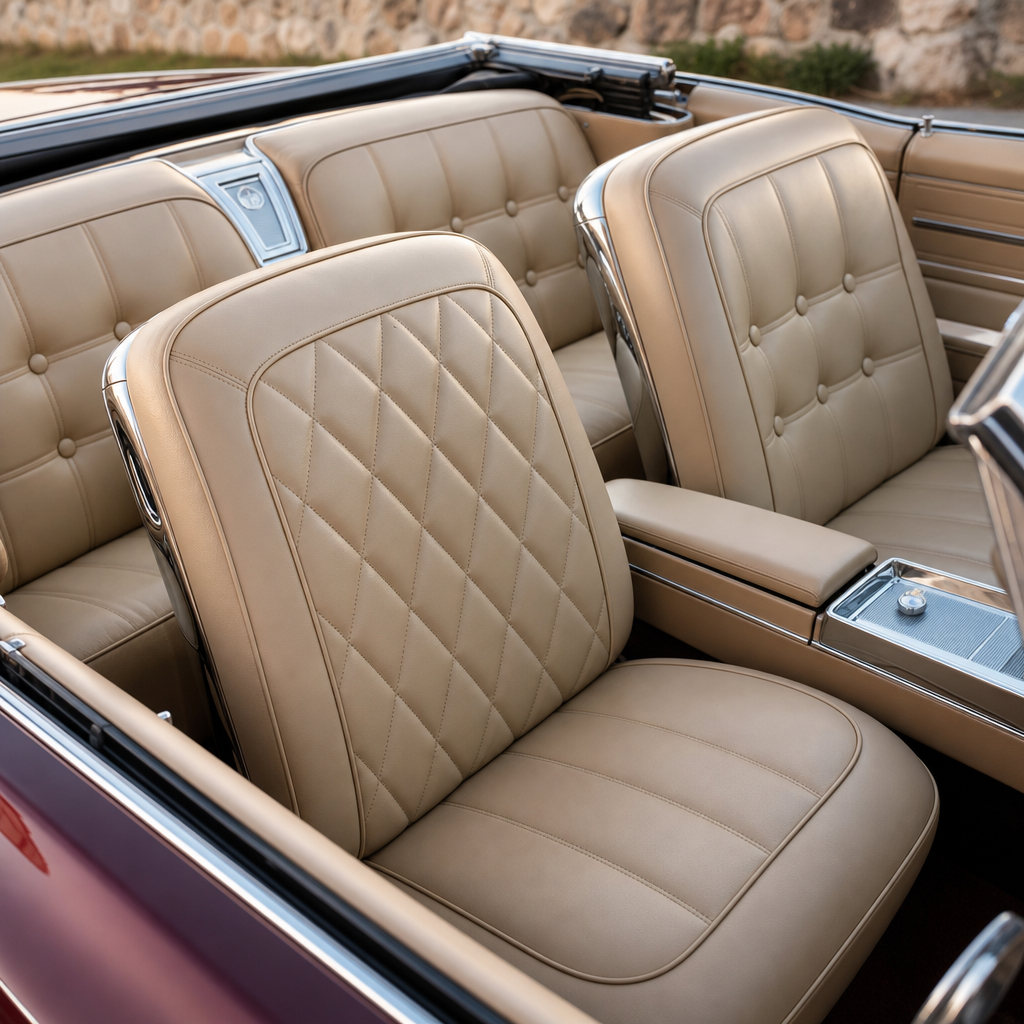
Diamond stitching has become the default premium look across many custom segments because it photographs well, scales cleanly, and adapts to modern foam and cover materials. Structurally, diamond stitching is a quilted pattern built from intersecting seam lines over foam scrim or layered backing. Unlike true tufting, it does not rely on buttons pulling material down into the cushion. That gives the upholsterer better control over top-surface tension, seam spacing, and water management. On a motorcycle that sees regular riding, especially a bagger parked outdoors or washed frequently, fewer penetrations and more consistent top tension can mean better durability.
Visually, diamond stitching reads cleaner and more contemporary than button-tuck. On a Chicano build, that can be an advantage if the owner wants traditional paint and chrome paired with a slightly updated interior language. On a performance bagger, diamond stitching often fits naturally because the pattern suggests speed and technical precision. I have seen builders use narrower diamonds on compact saddle sections to keep the surface refined, then widen the pattern toward the pillion to visually lengthen the rear of the bike. That kind of scale adjustment is difficult to achieve convincingly with button-tuck.
Material choice changes the effect. Marine-grade vinyl from brands such as Spradling or Endurasoft can hold sharp diamonds with less maintenance than leather, while top-grain leather develops richer character but requires conditioning and more careful storage. Thread matters too. UV-resistant bonded polyester generally outlasts nylon outdoors, and seam placement should avoid concentrated wear at the rider’s sit bones. In 2026, CNC-cut foam, digital patterning, and heated embossing allow diamond seats to look precise at production speed, which is one reason more boutique builders are offering them as repeatable packages rather than one-off experiments.
Classic button-tuck: heritage, depth, and limitations
Classic button-tuck remains the emotional benchmark for many Chicano and lowrider-inspired motorcycles because nothing else creates the same depth, shadow, and handcrafted presence. Proper button-tuck uses buttons or pulled anchors that draw the cover into the cushion, forming raised pads between deep channels. On a long solo seat or king-and-queen profile, those deep pockets create a luxurious, almost throne-like appearance that aligns perfectly with ornate paint, chrome accents, and tall backrests. When done by a skilled upholsterer, button spacing can make a seat feel custom in the old-school sense: measured, deliberate, and unmistakably personal.
Its visual strength is also its technical compromise. Every tuft point is a potential wear location and, if poorly sealed, a path for moisture. Over time, repeated loading can fatigue the cover around the buttons, especially on bikes that spend time in direct sun or wet climates. Comfort is nuanced too. Some riders love the plush feel and nostalgic look, but deeper tufting can create pressure variability on longer rides, and the seat surface may not permit easy body movement when the bike is ridden aggressively. That is acceptable on a boulevard-focused Chicano cruiser. It is less ideal on a performance-oriented platform where the rider shifts weight actively in corners.
Still, dismissing button-tuck as outdated misses the point. It survives because it communicates heritage instantly. On a bike with molded fender, candy paint, twisted spokes, and period-correct stance, diamond stitching can sometimes look too clean, too contemporary, or too neutral. Button-tuck, by contrast, tells the viewer the builder understands where the style came from. In that sense, it is not merely upholstery; it is a cultural citation rendered in foam, vinyl, and chrome-backed detail.
How seat choice changes the design language across Chicano, performance bagger, and Frisco builds
Seat pattern is one of the fastest ways to move a motorcycle from one design language to another without changing the frame or paint. That makes it central to this sub-pillar topic, because builders in the new fabrication era are blending categories more often than purists admit. A bagger can carry Chicano cues. A Dyna-inspired performance build can borrow lowrider upholstery. A Frisco chop can use luxury detailing if the rest of the bike stays disciplined. The seat determines whether those combinations feel intentional or confused.
| Build style | Best seat tendency | Why it works | Main caution |
|---|---|---|---|
| Chicano cruiser | Button-tuck or soft diamond | Supports elegant, lowrider-informed visual depth | Overly aggressive quilting can break the classic line |
| Performance bagger | Tight diamond stitching | Improves modern look and allows firmer, controlled foam shaping | Too-flat upholstery can feel sterile on a highly painted bike |
| Frisco | Minimal tuck or plain cover | Protects the stripped, narrow silhouette | Heavy tufting adds visual bulk and clashes with restraint |
| Hybrid custom | Scaled diamond with selective tuck cues | Balances tradition and contemporary fabrication | Mixed patterns can look indecisive without a clear theme |
For Chicano builds, either pattern can work, but proportion is everything. A long, flowing bike with murals and a 16-inch ape setup usually benefits from the softer luxury of button-tuck or larger diamonds with relaxed crown. A performance bagger with risers, radial brakes, and saddlebag cutouts usually wants tighter diamonds, firmer foam, and a defined lumbar pocket. Frisco bikes are different. Their strength lies in line economy: peanut tank, narrow front end, modest pad, and visual lightness. In that context, classic button-tuck often feels too ornate, while deep diamond quilting can look imported from another genre. A simple pleat or even smooth leather often wins.
Comfort, rider control, and fabrication technology in 2026
The biggest shift in 2026 is that seat decisions are increasingly driven by rider data and fabrication capability, not just style references. More custom shops now scan pans, digitize templates, and cut foam on CNC routers or waterjets for repeatable contours. That matters because the old tradeoff between a beautiful seat and a functional one is less absolute than it used to be. With multilayer foam construction, a builder can place high-density support foam under the ischial area, medium-transition foam along the thigh path, and softer topper foam under the cover. Gel inserts are less fashionable than they were a decade ago because they can trap heat, while pressure-mapped foams and 3D spacer meshes have proven more consistent.
For rider control, diamond stitching usually wins on technical grounds. Because the cover is not deeply punctuated, the saddle can maintain a flatter, more predictable interface with subtle dishing and lumbar rise. That supports the rider during throttle application without locking them into a single posture. Builders focused on performance baggers often pair this with gripper side panels and smoother center sections, a strategy borrowed from motorsport seating. Button-tuck can still be comfortable, but it requires more careful foam planning so the tuft pattern does not become the seat’s dominant tactile feature.
Pan construction also matters. Fiberglass remains common for custom one-offs because it is shape-friendly, while ABS and thermoformed polymer are popular in repeat production. Steel pans offer strength but add weight and can transmit vibration if not isolated correctly. I have found that a well-built seat starts with pan fitment and mounting stability; no stitch pattern can rescue a pan that flexes, rubs paint, or sits crooked between the tank and rear fender. Advanced fabrication has raised expectations. Customers now notice symmetry, seam straightness, and edge finishing immediately, and they should.
Choosing the right seat for your build and the road ahead
If the goal is an authentic Chicano silhouette with strong lowrider influence, classic button-tuck remains the clearest statement, especially on boulevard bikes where visual depth matters as much as all-day mobility. If the goal is a modern custom that references tradition while staying practical in weather and frequent use, diamond stitching is usually the better choice. For performance baggers, diamond stitching aligns with the functional brief almost every time because it supports controlled foam architecture, easier body movement, and a cleaner technical look. For Frisco builds, restraint should guide the decision, and simpler upholstery often protects the bike’s intent better than either heavily worked pattern.
The broader lesson across Chicano, performance bagger, Frisco, and beyond is that seat design is not decoration added at the end of a build. It is a design theory decision tied to frame line, riding style, material durability, and cultural reference. In 2026, better tools have made both diamond stitching and classic button-tuck more refined, but the best builders still start with the same fundamentals: define the bike’s identity, match the seat to actual riding use, and scale the pattern to the motorcycle rather than to a trend. Do that well and the seat will unify the entire machine. As you plan your next custom, compare your bike’s stance, use case, and visual influences first, then choose the seat pattern that tells the truth about the build.
Frequently Asked Questions
What is the main difference between diamond stitching and classic button-tuck in Chicano seat design?
The main difference is both visual and structural. Diamond stitching creates a repeating geometric pattern by sewing channels into the seat cover, producing a tailored, highly controlled look that reads clean, intentional, and performance-aware even when it is styled for a traditional Chicano build. Classic button-tuck, by contrast, uses pulled-in attachment points to create a tufted surface with more depth, shadow, and old-school richness. It has a softer, more upholstered appearance that instantly references lowrider interiors, vintage customs, and older hand-built motorcycle aesthetics.
In 2026, that distinction matters because builders are no longer choosing only on appearance. They are also thinking about how each method affects comfort, durability, weather behavior, and long-term maintenance. Diamond stitching often delivers a flatter and more consistent seating surface, especially when paired with modern foams and reinforced substrates. Button-tuck can feel more plush and visually dramatic, but it depends heavily on material quality, foam density, and the skill of the upholsterer to avoid premature sagging or distortion.
For Chicano bikes specifically, the choice signals intent. Diamond stitching tends to say the bike is rooted in tradition but updated with sharper fabrication standards and contemporary finish quality. Classic button-tuck says the build is leaning harder into heritage, romance, and period-correct custom language. Neither is automatically better. The right one depends on whether the seat is meant to sharpen the bike’s silhouette or deepen its nostalgic, handcrafted character.
Which seat style is more comfortable for real-world riding in 2026?
Comfort depends less on the pattern alone and more on how the seat is engineered underneath, but in practical terms, diamond stitching often has the edge for riders who spend more time in the saddle. Because the surface is usually more evenly tensioned, it can distribute weight more consistently across the rider’s seating area. On long rides, that matters. A flatter, better-supported top can reduce pressure points, minimize shifting, and work more predictably with modern ergonomic shaping.
Classic button-tuck can still be very comfortable, especially when built by an experienced upholsterer who understands contour, rider posture, and foam layering. The issue is that button-tuck introduces more variables. The tufting points create highs and lows across the surface, and if the seat is not built carefully, those visual details can become functional pressure zones over time. On a show bike or a cruiser used for shorter rides, that may not be a major drawback. On a bike ridden regularly, comfort becomes more sensitive to execution.
What changed in 2026 is the widespread use of improved seat pans, CNC-cut foam profiles, moisture-resistant barrier layers, and better marine-grade coverings. Those technologies help both styles perform better than older versions did. Still, if a rider’s priority is all-day stability, repeatable support, and a more ergonomic interaction with the bike, diamond stitching generally aligns better with modern comfort expectations. If the priority is visual warmth, heritage feel, and a deep custom look that still rides well when properly built, button-tuck remains a strong option.
Is diamond stitching more durable than classic button-tuck?
In most cases, yes, diamond stitching is considered more durable over the long term, especially on motorcycles that are actually ridden and exposed to weather, vibration, and repeated loading. The reason is mechanical. Stitching spreads tension across seams and panels, while button-tuck concentrates stress at specific pull points. On a motorcycle seat, where the material constantly flexes with rider movement and road vibration, concentrated stress areas can wear faster if the seat is not built with premium materials and precise reinforcement.
That does not mean classic button-tuck is fragile by definition. A properly constructed button-tuck seat with reinforced backing, high-quality vinyl or leather, sealed button points, and stable foam can hold up very well. But it is less forgiving of shortcuts. Inferior foam can collapse around the tufts, cheaper coverings can stretch and wrinkle, and poor moisture control can accelerate degradation around attachment points. Diamond stitching usually tolerates daily use a little better because its wear pattern tends to be more gradual and more evenly distributed.
In 2026, fabrication standards have improved enough that both designs can be made highly durable, but diamond stitching still tends to win for riders who want lower maintenance and longer visual consistency. Button-tuck remains attractive for builds where style authenticity is the top priority and the owner is willing to care for the seat accordingly. The best durability outcome in either case comes from the hidden details: sealed seams, UV-stable materials, proper drainage planning, dense but compliant foam, and a seat pan that does not flex excessively under load.
How do builders choose between these two styles when shaping a Chicano motorcycle’s overall look?
Experienced builders choose the seat by reading the entire motorcycle as a visual sentence. The seat has to agree with the tank, rear fender line, sissy bar, bars, paint treatment, chrome balance, and the rider’s intended posture. On a Chicano build, that decision is especially important because the seat acts as a visual anchor. It is one of the first elements people notice, and it tells them whether the bike is leaning more toward boulevard elegance, vintage lowrider influence, or a cleaner modern reinterpretation of classic style.
Diamond stitching is usually selected when the bike has crisp linework, refined paint, strong symmetry, and a slightly more updated custom attitude. It works well on builds where the goal is to preserve the Chicano spirit while tightening the presentation. The stitched pattern adds detail without making the seat visually heavy, so it complements bikes with long silhouettes and carefully managed proportions. It can make the whole motorcycle feel deliberate and contemporary without looking disconnected from tradition.
Classic button-tuck is chosen when the builder wants more romance, more texture, and more overt historical reference. It pairs naturally with deeply nostalgic Chicano customs, especially those drawing inspiration from lowrider upholstery language and older custom motorcycle craftsmanship. The tufting creates visual depth and softness, which can make the bike feel richer and more ceremonial. Builders often choose it when they want the seat to command attention as an object in its own right, not just support the rest of the design. The best builders are not asking which style is universally superior. They are asking which one tells the truth about the bike.
What should riders ask an upholsterer before committing to diamond stitching or classic button-tuck in 2026?
Riders should ask about construction, not just cosmetics. First, ask how the seat pan is built and whether it is matched to your riding position, frame geometry, and weight distribution. Then ask what foam densities and layering methods will be used, because comfort and longevity come from the structure under the cover. If you are comparing diamond stitching and button-tuck, ask how each design will affect the seat’s surface feel, water management, maintenance needs, and long-term shape retention.
You should also ask what materials are being used for the top cover, backing, thread, and reinforcement. In 2026, there is no reason to settle for vague answers. A good upholsterer should be able to explain whether the vinyl or leather is UV-stable, whether the seams are protected against moisture intrusion, and how the design is reinforced so it does not distort with use. For button-tuck specifically, ask how the tufting points are secured and protected. For diamond stitching, ask whether the pattern is purely decorative or part of a structured panel system that supports durability.
Finally, ask to see previous work that has aged in real use, not just fresh shop photos. A beautiful new seat tells you very little compared to one that has spent a year or two on the road. Ask how the seat will look after miles, sunlight, vibration, and cleaning. Ask whether the builder recommends one style over the other for your type of riding. The right upholsterer will not sell you a pattern in isolation; they will evaluate your bike, your posture, your aesthetic goals, and your actual use. That is how you end up with a Chicano seat that looks right on day one and still feels right long after the first show, first cruise, and first long ride.