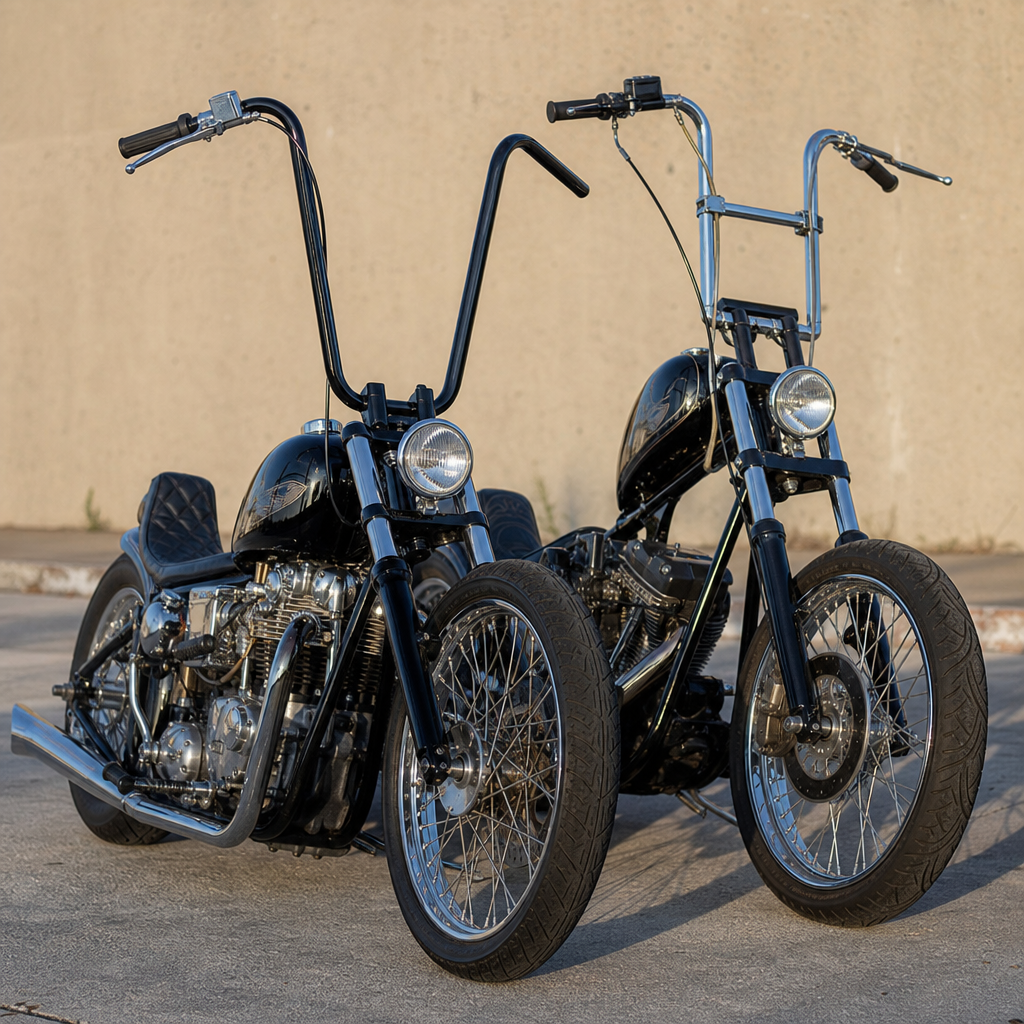
Chicano bars sit at the intersection of style, ergonomics, fabrication, and identity, and few comparisons reveal that better than 16-inch ape hangers versus the new generation of high-riser T-bars. In custom motorcycle language, “bars” means the complete handlebar setup that shapes rider posture, front-end leverage, cable routing, visual line, and often the entire personality of a build. In the Chicano scene, bars are never a minor bolt-on. They are a statement tied to long-fork boulevard tradition, Road King and Softail silhouettes, chrome-heavy finishes, spoke wheels, stretched bags, molded bodywork, and a rider’s preference for slow-roll presence over stripped-down aggression. Yet the current custom landscape is broader than one style lane. Performance baggers have pushed rigid-mount risers, moto bends, and aggressive steering control into mainstream touring builds. Frisco-inspired bikes still favor narrow, purposeful front ends and direct rider input. New fabrication tools, from 3D mockup scans to CNC-machined riser clamps and cleaner internal wiring methods, have blurred old boundaries. That is why comparing 16-inch apes to high-riser T-bars matters now. Riders are no longer choosing only between “traditional” and “modern.” They are balancing visual heritage, comfort, highway behavior, slow-speed steering, fairing compatibility, cable management, and the way a bike should feel at full lock in a parking lot or at 80 miles per hour on an interstate.
I have mocked up both setups on touring Harleys, softail-based customs, and long-fork boulevard builds, and the first lesson is always the same: bar choice changes more than your hand position. A 16-inch ape typically refers to a tall one-piece handlebar with significant rise, rearward pullback, and a broad, curved silhouette. A high-riser T-bar setup uses separate risers and a one-piece T-bar or moto-style bar/riser assembly, usually with straighter wrist angles, less sweep, and a more vertical load path into the top clamp. Chicano style generally favors taller apes because they preserve the classic visual arc that works with a sissy bar, fishtails, whitewalls, and a low, level stance. High-riser T-bars lean toward a more technical, performance-led look, but newer versions are being adapted into Chicano-influenced bikes by builders who want tighter steering input without abandoning long-and-low design cues. For this sub-pillar hub, the real goal is to define the design theory behind these choices across Chicano, performance bagger, Frisco, and adjacent customs, so riders can decide which bar architecture matches their build philosophy instead of following trends blindly.
Design theory: how bars define Chicano, performance bagger, Frisco, and hybrid customs
The fastest way to understand bar choice is to understand the design language behind each motorcycle subculture. Chicano design is rooted in lowrider aesthetics translated to motorcycles: long visual lines, rich paint, chrome or polished finishes, coordinated accessories, and a rolling profile meant to look complete from curbside distance. The handlebar in that framework must contribute elegance. Tall apes create an elevated hand line that visually stretches the bike upward while the tank, seat, bags, and rear fender carry the eye rearward. The result is a graceful S-curve from front wheel to grip tip. That is why 16-inch apes became such a staple on Road Kings, Heritage Softails, and heavily dressed FL builds in Southern California and beyond.
Performance bagger design starts from a different premise. The motorcycle must corner harder, brake later, and transmit more front-end information to the rider. Builders use taller risers with flatter bars because they place the hands in a stronger, more neutral position for countersteering and body movement. On a fixed-fairing bagger with upgraded suspension from Öhlins, Legend, or Fox, a high-riser T-bar setup complements the rest of the package. The visual message is mechanical intent. Frisco style strips things even further. Historically associated with narrow tanks, tall narrow bars, and a pared-back stance, Frisco builds prioritize directness and urban edge. They often tolerate less comfort because the aesthetic values simplicity and attitude over long-haul ergonomics. Hybrid customs now borrow from all three worlds. A bike may keep Chicano paint and wheel choice, adopt performance suspension, and run a moderate T-bar hidden under a classic nacelle or mini fairing.
That blending matters because riders often think bars are isolated parts. They are not. Bar geometry must fit fork length, seat pocket depth, tank height, neck angle, wheel diameter, and intended speed range. A 16-inch ape that looks perfect on a slammed Road King with a deep seat can feel awkward on a tall-performance bagger seat that raises the rider several inches. A 10- to 14-inch high-riser T-bar that transforms a Street Glide can look visually top-heavy on a full Chicano bike with long fishtails and a rearward-weighted composition. Good builders start with the bike’s story, then choose the bar system that reinforces it.
16-inch ape hangers: why they remain the Chicano reference point
The 16-inch ape remains the benchmark because it solves style and comfort simultaneously for many riders. On a traditional Harley touring chassis or a Softail Deluxe-style platform, 16 inches usually puts the grips near or slightly above shoulder height for average riders once seat height is factored in. That can produce a relaxed elbow bend, open chest posture, and broad cruising leverage at low and moderate speeds. More important in the Chicano context, the bar’s curve softens the front profile. With the right pullback and width, the rider appears integrated into the machine rather than perched over it. That visual integration is one reason classic boulevard customs photograph so well.
There are practical reasons too. Ape hangers allow generous clearance for tanks, nacelles, and fairings when they are selected correctly. They also leave room for decorative controls, braided lines, chrome switch housings, and detailed wiring exits that suit show-quality finishes. Builders like Paul Yaffe popularized refined bar shapes and internal wiring solutions that made tall bars cleaner and more durable than many old-school setups. On Chicano touring bikes, I often find that a well-made 16-inch ape with the proper center width and pullback reduces wrist strain compared with fashionable but overly flat bars. The rider’s hands rest naturally, and the bar sweep supports relaxed cruising during long city loops and weekend highway miles.
Still, 16-inch apes are not automatically ideal. Excessive sweep can place the wrists in ulnar deviation, which causes numbness over time. Too much width slows steering transitions. Too much rise without enough rearward relationship to the seat can overextend the shoulders. Cable and brake line length must be correct, and on modern Harley models with ABS, throttle-by-wire, and integrated switch wiring, that means careful planning. Cheap bars with poor weld consistency or thin wall tubing create flex and fitment headaches. Quality matters, especially on heavier bikes with larger front wheels and extended forks.
High-riser T-bars: the new option changing custom bar conversations
High-riser T-bars earned popularity because they improve steering precision and rider control in ways even non-aggressive riders notice immediately. Instead of a wide, highly swept one-piece curve, a T-bar system uses a stronger central structure and straighter grip section. That geometry keeps the hands more in line with the fork axis and reduces the mushy sensation that some riders feel with wide, heavily pulled-back bars. On road tests and customer builds, the difference appears first during quick lane changes, hard braking, and technical low-speed turns. The front wheel feels easier to place.
Another reason the new high-riser T-bar has crossed into style-driven customs is packaging. Builders can tune rise and bar bend separately, choosing riser heights from around 8 to 14 inches or more, then matching a bend that suits shoulder width and tank clearance. Companies such as Kraus, LA Choppers, Thrashin Supply, ODI, and Lucky Daves have influenced this ecosystem, along with Harley-Davidson’s own performance touring movement. Strong billet riser clamps, one-piece top caps, and upgraded bushings create a more solid cockpit. Riders who install a T-bar setup often say the motorcycle feels “connected” in a way they did not expect from a simple handlebar change.
The tradeoff is visual. A tall T-bar can clash with traditional Chicano themes if the rest of the motorcycle remains rooted in soft curves and chrome symmetry. The upright mechanical look may overpower a sculpted tank and flowing rear fender line. That is why successful hybrid builds usually moderate the rise, choose finishes carefully, and avoid motocross cues that break the bike’s visual narrative. Black anodized risers, for example, can look out of place on a heavily chromed boulevard build unless other dark hardware ties the scheme together. T-bars reward purposeful design; they expose weak composition faster than apes do.
Direct comparison: fit, feel, fabrication, and visual impact
For most riders, the decision becomes clearer when the comparison is broken into actual use categories rather than internet opinions. The table below summarizes the patterns I see most often on Harley-based customs.
| Factor | 16-inch Apes | High-Riser T-Bars |
|---|---|---|
| Visual style | Classic Chicano, boulevard, lowrider-inspired, elegant arc | Modern, technical, performance-led, industrial silhouette |
| Rider posture | Relaxed shoulders if pullback is correct; open chest | More neutral wrists; stronger attack position; more torso engagement |
| Low-speed steering | Good leverage, but can feel slower if very wide | Quicker, more direct input, easier precise placement |
| High-speed stability feel | Calm for cruising; less communicative under hard inputs | More front-end feedback during braking and fast transitions |
| Fairing compatibility | Works well with nacelles and some windshields; needs planning | Excellent with performance fairings; can crowd classic setups |
| Cable and wiring demands | Longer internal runs; careful line sizing required | Complex but modular; riser and bar choices affect routing |
| Best match | Traditional Chicano and boulevard customs | Performance baggers, Frisco hybrids, modernized Chicano builds |
Fabrication quality often decides whether either setup succeeds. Internal wiring on apes must be deburred and protected so harness insulation does not chafe. T-bars place more emphasis on riser alignment, clamp torque, and bushing condition. If the upper tree flexes or the riser bushings are soft, the benefits of a rigid-feeling T-bar diminish. Likewise, if ape hangers are poorly centered or asymmetrical, the whole front end looks wrong from ten feet away. Experienced builders use mockup bars, string lines, digital angle finders, and rider fit measurements before ordering finished parts. That process saves money and prevents the common mistake of choosing bars by catalog photo alone.
Choosing the right bars for your build philosophy
If your motorcycle is fundamentally a Chicano build, start by protecting the design language that defines it. Ask whether the bike’s purpose is boulevard cruising, show presentation, community rides, and all-day comfort at moderate pace. If yes, 16-inch apes are still the safest and often best answer. They align with the style’s history, support chrome-forward detailing, and preserve the signature long-line silhouette. If your project leans toward a performance bagger with upgraded suspension, dual-disc braking, taller rear ride height, and aggressive cornering goals, high-riser T-bars make more sense. They complement the bike’s mission mechanically and visually.
For hybrid customs, fit should decide the final call. Measure seated reach, elbow angle, shoulder elevation, and full-lock clearance. Consider your fork length, seat choice, and whether you run a windshield, fairing, or tall tank console. Think about where and how you ride. City parade pace, freeway commuting, and canyon runs reward different hand positions. Also think about the message the bike sends when parked. In custom culture, performance and appearance are not opposites; the best builds make both tell the same story. If you are planning a new project, mock up both styles before paint and wiring, then build the rest of the motorcycle around the cockpit that feels right.
The strongest custom motorcycles are coherent. Chicano bars are not just bars, and neither are the new high-riser T-bars. They are design decisions that shape comfort, steering, fabrication complexity, and the cultural identity of the machine. Sixteen-inch apes remain the reference point for traditional Chicano builds because they deliver the graceful profile, relaxed posture, and visual harmony that the style demands. High-riser T-bars bring sharper control, modular fit, and a more connected front-end feel, making them ideal for performance baggers, Frisco-influenced customs, and carefully executed hybrids. The right choice depends on your bike’s stance, your body dimensions, your parts package, and the story you want the motorcycle to tell. Choose the setup that supports the whole build, not just the current trend. Then test fit it, wire it correctly, and ride it long enough to know whether the bars truly belong on your machine.
Frequently Asked Questions
What is the main difference between 16-inch ape hangers and modern high-riser T-bars on a Chicano build?
The biggest difference is how each setup changes both the silhouette of the motorcycle and the rider’s relationship to the front end. Traditional 16-inch ape hangers create the unmistakable tall, sweeping line that many riders associate with classic Chicano boulevard styling. They put the hands high and wide, emphasize chrome, length, and flow, and visually complement long forks, slim tanks, full fenders, spoke wheels, and other period-inspired details. They are a major part of that elegant, laid-back profile that makes a Chicano bike look like it is gliding even when parked.
High-riser T-bars, by comparison, bring a more compact, performance-oriented attitude to the same conversation. Even when they are tall, they usually look tighter, more deliberate, and more structural because the riser and bar relationship forms a stronger vertical-and-horizontal framework. That changes the bike’s visual language immediately. Instead of emphasizing sweep and softness, high-riser T-bars tend to highlight control, precision, and a more aggressive front-end stance. On a Chicano-influenced build, that can create a newer hybrid look that blends heritage styling with modern road-focused ergonomics.
Functionally, ape hangers often encourage a more open-chested, elbows-out cruising posture, while T-bars generally place the hands in a more centralized position that many riders describe as direct and connected. Steering feel, leverage at low speed, body position over distance, and even how the bike reacts in traffic can all feel different. In short, 16-inch apes lean harder into classic tradition and visual identity, while modern high-riser T-bars often appeal to riders who want Chicano style with a stronger emphasis on front-end feedback and everyday control.
Which bar setup is more comfortable for long rides: 16-inch apes or high-riser T-bars?
Comfort depends less on trend and more on fit. A well-sized 16-inch ape hanger can be very comfortable for long boulevard rides if the grip height places the rider’s hands near or slightly below shoulder level, the pullback matches torso length, and the wrist angle stays neutral. When that geometry is right, ape hangers can reduce the feeling of being folded forward and can create a relaxed, upright cruising posture that suits long, smooth rides. That is one reason they have remained so important in Chicano custom culture: they are not just visually iconic, they can genuinely work well when chosen intelligently.
The problem starts when riders choose bars for appearance only. If 16-inch apes are too tall for the rider’s torso, shoulder mobility, or seat position, they can force the hands too high and create numbness, shoulder fatigue, upper-back tension, and reduced leverage at lower speeds. The same is true for T-bars. A high-riser T-bar setup can feel excellent on longer rides if the rise, width, and pullback place the elbows in a natural bend and keep pressure off the wrists. Many riders appreciate the more centered hand position and the sense of stability they get from T-bars, especially on mixed city-and-highway use.
For pure, relaxed cruising, properly fitted apes often still have the edge in the traditional Chicano environment. For riders who spend more time maneuvering, dealing with traffic, or wanting a firmer and more connected feel through the front end, high-riser T-bars can feel less fatiguing over a full day. The real answer is that comfort comes from rider anatomy, seat height, tank shape, riser configuration, bar angle, and control placement working together. No handlebar is automatically comfortable simply because it is popular in a given style category.
How do 16-inch ape hangers and high-riser T-bars affect handling and control?
Handlebars are one of the most important contact points on a motorcycle, so changing from apes to T-bars can significantly alter steering input, confidence, and low-speed behavior. With 16-inch ape hangers, riders often get broad leverage from the bar width and elevated hand position, which can feel smooth and natural in long, sweeping turns and easy cruising environments. On a classic Chicano build designed for style, parade-speed riding, and boulevard presence, that kind of steering feel fits the personality of the bike. The bike communicates in a slower, more graceful way, and that can be exactly the point.
High-riser T-bars usually tighten that experience. Because the setup often positions the hands in a more compact and structurally rigid arrangement, many riders feel more immediate front-end input. This can increase confidence during lane changes, tighter city maneuvers, quicker corrections, and more assertive riding. T-bars often appeal to riders who want their custom bike to retain strong visual identity without giving up too much responsiveness. Depending on width and rise, they can make the motorcycle feel more planted and more precise, particularly on heavier touring-based platforms.
That said, handling is not determined by bars alone. Fork length, neck rake, trail, wheel size, tire profile, suspension setup, seat position, and even grip choice all influence control. In the Chicano world, where long forks and stretched visual lines are common, bar choice becomes part of a larger geometry story. Ape hangers often support the traditional glide-and-cruise feel. High-riser T-bars often modernize that feel and shift the bike toward a more deliberate control style. Neither is inherently better; they simply prioritize different kinds of rider input and different interpretations of what a Chicano build should be.
Are high-riser T-bars replacing ape hangers in Chicano motorcycle culture?
No, not in the sense of making ape hangers obsolete. Ape hangers remain one of the strongest visual signatures in Chicano motorcycle tradition because they connect directly to the culture’s long-standing design values: elegance, presence, craftsmanship, and a distinct boulevard identity. On many builds, especially those rooted in classic lowrider-inspired proportions and older-school custom language, 16-inch apes still look more authentic to the era and spirit being referenced. They are not just handlebars; they are part of the cultural vocabulary of the motorcycle.
What is happening instead is an expansion of that vocabulary. High-riser T-bars are gaining acceptance because a newer generation of builders and riders wants to combine Chicano influence with modern practicality, cleaner control packaging, and a more performance-aware riding posture. That does not necessarily reject tradition. In many cases, it reflects the way custom scenes naturally evolve. Riders borrow from different eras, riding habits, fabrication methods, and regional preferences to create something personal. A bike can still carry Chicano cues through paint, stance, sheet metal, wheel choice, lighting, engraving, and detailing even if the bars move away from a fully traditional ape-hanger setup.
So the better way to frame it is not replacement, but reinterpretation. Ape hangers continue to define the classic expression of the style, while high-riser T-bars represent a newer branch that keeps the conversation alive. Both can belong in the Chicano world if the build is coherent, intentional, and respectful of the visual and cultural language it draws from.
What should riders consider before choosing between 16-inch apes and high-riser T-bars?
Start with fit, not fashion. Riders should consider arm length, torso height, shoulder mobility, seat position, and the actual frame and front-end geometry of the motorcycle before choosing either setup. A bar that looks perfect in a photo can feel wrong within minutes if the rise, width, or pullback do not match the rider. Test sitting similar bikes helps, but measurements matter more. Grip height relative to the shoulders, elbow bend, wrist angle, and how easily the rider can countersteer at low speed are all critical factors.
Next, consider the purpose of the bike. If the build is centered around traditional Chicano aesthetics, long-fork boulevard cruising, and a timeless profile, 16-inch ape hangers may align more naturally with that vision. If the rider wants a motorcycle that still references Chicano style but is used more aggressively in modern traffic, on longer mixed rides, or with a stronger emphasis on front-end confidence, high-riser T-bars may be the smarter choice. The decision should support how the bike will actually be ridden, not just how it will be photographed.
Fabrication and installation details also matter. Either setup may require longer cables, brake lines, and wiring extensions, and each can affect cable routing, riser selection, fairing compatibility, tank clearance, and mirror placement. Legal height limits vary by location as well, so riders should confirm local regulations before committing to tall bars. Finally, think about the bike as a complete composition. In the Chicano scene, bars influence the visual line of the whole machine. The right choice is the one that balances ergonomics, handling, fabrication quality, and cultural intention into one unified build rather than treating handlebars as an isolated bolt-on part.