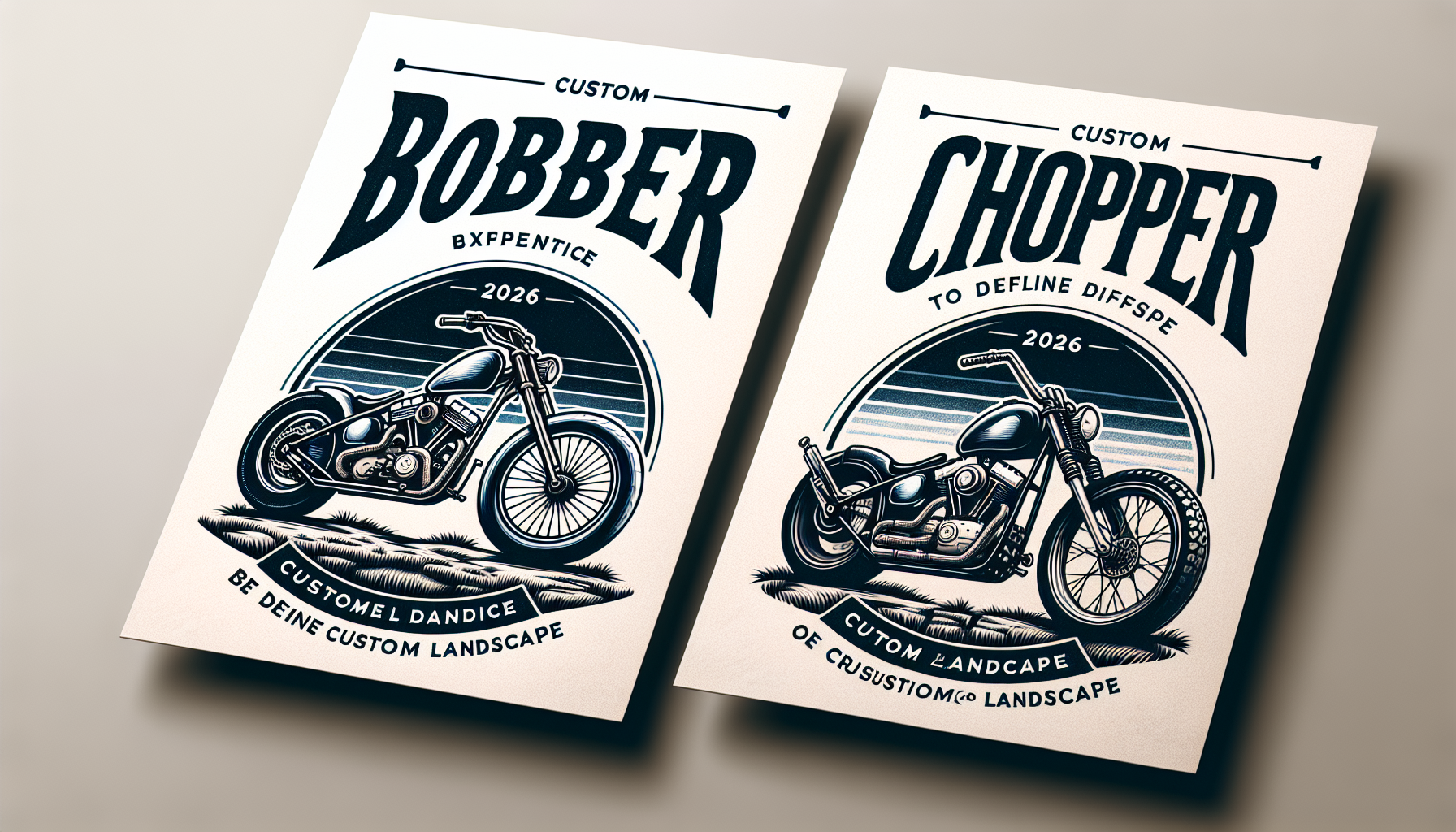
Bobber vs. chopper is no longer a simple garage debate; in 2026, it defines two distinct directions in the custom motorcycle landscape, each shaped by history, fabrication methods, rider priorities, and the way modern builders blend style with usable performance. A bobber traditionally strips a motorcycle down to essentials, often with shortened fenders, a solo seat, reduced weight, and a compact stance. A chopper, by contrast, alters the motorcycle’s frame geometry and silhouette more dramatically, typically with extended forks, increased rake, stretched proportions, and highly individualized fabrication. Those basic definitions still matter, but the modern custom scene has complicated both categories in useful ways.
As someone who has spent years around custom builds, swap meets, fabrication shops, and show fields, I have watched riders use these labels loosely until they stop being helpful. In practice, the difference comes down to intention as much as appearance. A bobber usually refines and subtracts. A chopper reimagines and transforms. That distinction matters for buyers choosing a first custom, builders planning a project budget, and enthusiasts trying to understand where trends are moving. It also matters because the 2026 market is no longer driven only by nostalgia. Builders now work within emissions constraints, registration rules, digital retail, and social media visibility, all while customers expect reliability, parts support, and a bike that photographs well without becoming miserable to ride.
Custom Culture has become broader than classic American V-twins. Builders are applying bobber and chopper language to Harley-Davidson Softails, Indian Scouts, Triumph Bonnevilles, Yamaha XS models, Honda Shadows, BMW airheads, and even electric concepts. Yet the roots remain important. Bobbers grew from riders removing unnecessary parts to make bikes lighter and cleaner. Choppers grew from more radical postwar customization, where cutting and changing frames became the point. Knowing that lineage helps explain current trends in stance, wheel choice, paint, handlebars, and fabrication priorities. This hub article maps the major trends and styles shaping the category in 2026 so readers can evaluate builds clearly, spot crossover trends, and decide which direction best fits their taste, budget, and riding goals.
What separates a bobber from a chopper in 2026
The clearest answer is that a bobber starts with an existing motorcycle architecture and pares it back, while a chopper changes the motorcycle’s visual and structural identity more aggressively. On a true bobber, you will often see stock or near-stock frame geometry, low-profile fenders, mid-height bars, blacked-out or brushed finishes, a solo saddle, and practical tire sizes. On a true chopper, you are more likely to see molded hardtails or aggressive rake changes, narrow front ends, taller bars, longer fork tubes, custom tanks, sissy bars, and hand-built details intended to elongate the bike’s line from neck to axle.
In 2026, however, there is a large middle ground. “Factory bobbers” from Triumph and Indian have made the word bobber mainstream, but many of these bikes are better described as bobber-inspired cruisers because they retain passenger capability, modern electronics, and production ergonomics. At the same time, many contemporary choppers are cleaner, shorter, and more rideable than the wild long-fork machines people picture from older magazines and films. The result is a custom landscape where labels still guide expectations, but details decide the category. Frame geometry, fabrication depth, and rider position tell the truth faster than marketing language.
Another difference is build philosophy. Bobber builders often focus on restraint: remove clutter, tidy wiring, lower visual mass, and emphasize mechanical honesty. Chopper builders typically treat the bike as a canvas for proportion, attitude, and handwork. That can include frame mods, one-off oil tanks, engraved controls, custom paint, and unusual metal shaping. Neither approach is inherently better. One prioritizes disciplined simplification; the other prioritizes artistic reinterpretation. For riders and builders in 2026, understanding that difference prevents expensive mistakes, especially when buying a project bike that may have been labeled incorrectly in an online listing.
How history still shapes current trends and styles
Bobbers and choppers share American custom roots, but they emerged from different impulses. The early bobber ethos came from riders trimming excess weight and visual bulk from standard motorcycles, especially in the pre- and postwar eras. Fenders were cut short, chrome was reduced, and parts considered unnecessary were removed. The machine became leaner and more direct. Choppers evolved later as builders pushed farther from stock. Instead of just removing parts, they cut frames, changed neck angles, stretched front ends, and turned motorcycles into unmistakably personal statements.
That history matters because many 2026 trends are really modern restatements of older values. The current rise of raw metal finishes, compact tanks, spring seats, and narrow bars in bobber builds reflects the long-standing appeal of mechanical simplicity. Likewise, the return of hand-painted tanks, molded seams, narrow 21-inch front wheels, and tall sissy bars in chopper builds reflects the enduring desire for individuality. Builders who understand period-correct influences usually produce more coherent bikes. A Panhead-inspired chopper with modern braking can feel authentic. A bobber with contemporary LED lighting and hidden electronics can stay practical without losing character.
Social platforms have also changed how history is interpreted. Instead of copying one regional style, builders now draw from California long-bike traditions, East Coast club influence, Japanese precision customs, Scandinavian minimalism, and British parallel-twin bobber styling all at once. That blending produces standout motorcycles, but it also creates confusion. The best 2026 builds tend to respect the original vocabulary of each style before mixing them. When a builder understands why a peanut tank, hardtail triangle, or bobbed rear fender became iconic, the finished bike looks intentional rather than algorithmically assembled.
The 2026 design cues defining the custom landscape
Several visual cues are dominating the current scene. For bobbers, the strongest trend is compact aggression: fat but not oversized rear tires, reduced front fenders or none at all, low solo seats, short rear loops, and finishes that favor satin black, brushed aluminum, burnt bronze, and distressed leather. Builders are hiding battery boxes and electronics more effectively than they did even five years ago, creating a cleaner side profile. Fork gaiters, mini speedometers, integrated taillights, and internally routed bars are common because they preserve the stripped-down look while keeping the bike usable.
Chopper trends in 2026 are more varied but equally identifiable. The biggest shift I have seen is toward rideable custom geometry. Extreme rake still appears at shows, yet many sought-after builds now keep trail numbers within reason so the bike can handle city streets and secondary highways. Mid-length forks, narrow glide front ends, ribbed fenders, prism tanks, hand-painted graphics, and slim king-and-queen seats are back. Builders are also mixing polished metal with imperfect finishes, giving bikes a lived-in look that photographs honestly instead of feeling over-restored.
Color is another divider. Bobbers lean toward monochrome palettes, military tones, oxide reds, and industrial neutrals. Choppers more often embrace candy paint, metalflake, scallops, pinstriping, and contrasting frame colors. Wheel choices reinforce the distinction. Bobbers usually wear practical combinations such as 16-inch rear and 19-inch front setups, often with chunkier rubber. Choppers frequently use a narrow 21-inch front paired with a wider but still proportionate rear. These choices affect not just appearance but steering feel, tire availability, and overall stance, which is why they should be treated as functional decisions rather than purely cosmetic ones.
Platform choice, fabrication depth, and real-world ownership
Choosing the right base motorcycle determines whether a build remains manageable. In my experience, bobbers usually start more successfully from complete, running donor bikes because the conversion depends on cleanup, proportion, and selective replacement rather than radical structural work. Popular foundations in 2026 include the Harley-Davidson Softail and Sportster family, Indian Scout, Triumph Bonneville and Bobber platform, Yamaha Bolt, Honda Rebel 1100, and older metric cruisers. These bikes offer enough aftermarket support to change bars, seats, lighting, exhaust, suspension stance, and fender treatment without requiring full custom fabrication from day one.
Choppers demand a different planning mindset. A convincing chopper often requires frame work, front-end calculation, welding skill, and a stronger understanding of registration and inspection rules. Builders commonly start with older Harley big twins, Sportster engines, shovelhead projects, aftermarket rigid frames from companies like Paughco, or vintage Japanese twins and fours adapted into custom hardtail builds. The romance is real, but so are the tradeoffs. Once geometry changes enter the picture, small mistakes become expensive and sometimes unsafe. Neck rake, trail, axle height, and wheelbase are not styling notes; they are engineering variables that determine whether the bike tracks predictably.
| Factor | Bobber | Chopper |
|---|---|---|
| Base platform | Usually complete stock motorcycle | Often project bike or custom frame |
| Geometry changes | Minimal | Common and often central |
| Fabrication needs | Moderate | High |
| Ride comfort | Generally better | Varies widely |
| Registration complexity | Lower | Potentially higher |
| Build budget risk | More predictable | Easier to exceed estimates |
Ownership realities matter more in 2026 because riders expect custom bikes to function outside the show circuit. Fuel injection, CAN bus electronics, ABS integration, and emissions equipment can complicate customization on newer bikes, but they also improve everyday usability. For many riders, a bobber provides the better balance of style and reliability. A chopper offers more visual payoff and creative freedom, but it asks more from the owner in setup, maintenance, and tolerance for compromise. The right choice depends on whether the motorcycle is meant to be a weekend sculpture, a daily rider, or a long-term evolving project.
Style trends by rider type, use case, and budget
One reason bobber vs. chopper remains such a strong comparison is that each style attracts different rider priorities. Newer riders and urban commuters usually lean toward bobbers because they are easier to mount, easier to insure, and less intimidating in traffic. A well-built bobber based on a modern cruiser or standard can offer decent suspension travel, manageable steering, and enough aftermarket support to personalize the bike gradually. That matters when budget is limited. Many riders in 2026 want visible personality without committing to a full teardown in the first year of ownership.
Experienced builders and riders often gravitate toward choppers because the style rewards deep involvement. You are not just buying accessories; you are making decisions about frame lines, tube diameter, tank tunnel width, oil bag placement, and front-end proportions. That process is slower and more expensive, but it creates a motorcycle with genuine singularity. In an era when many factory bikes are technically excellent yet visually similar, that singularity carries real appeal. Shows such as Born-Free and hand-built regional events continue to validate highly personal construction, especially when the bike combines old-school aesthetics with dependable execution.
Budget shapes the outcome more than most people expect. A modest bobber build can be satisfying if the owner spends money in the right places: tires, brakes, control ergonomics, suspension setup, and clean electrical work. Cheap decorative parts rarely improve a bike. Choppers are even less forgiving. Saving money on welding, frame alignment, or front-end components is false economy. The best custom motorcycles I have seen, regardless of style, dedicate the budget first to safety-critical systems and proportion-setting components. Paint and accessories come later. That sequence is what separates a cohesive build from a social media prop.
Where the custom scene is heading next
The 2026 custom landscape favors motorcycles that merge visual clarity with functional credibility. That does not mean every bike must be practical in a commuter sense. It means the strongest builds now look intentional from every angle and have mechanical choices that support the style rather than contradict it. Bobbers are moving toward cleaner packaging, smarter integration of modern electronics, and higher-quality finishes that age well. Choppers are moving toward more refined geometry, better metallurgy, and a renewed respect for craftsmanship over extremity. In both camps, discerning riders can spot when a bike was built with understanding instead of trend-chasing.
Another clear direction is the rise of hybrid customs. Some builders are creating “performance bobbers” with upgraded suspension, dual-disc front brakes, and tuned engines while keeping stripped-down styling. Others are building “daily choppers” with thoughtful trail numbers, electric start, reliable charging systems, and seating that works for more than twenty miles. These hybrids do not erase the classic definitions; they prove the categories are still alive enough to evolve. The healthiest custom scenes always allow reinterpretation, provided the builder respects the fundamentals that make each style legible.
For readers using this Custom Culture hub to explore Trends and Styles, the key takeaway is simple: choose the custom language that matches how you want a motorcycle to feel, not just how you want it to look in photos. A bobber delivers disciplined minimalism, easier ownership, and broad platform choice. A chopper delivers deeper transformation, stronger individuality, and a higher demand for planning and skill. Study geometry, fabrication quality, and component logic before you fall for paint or stance. Then use that clarity to explore related guides, compare builds, and define your own place in the 2026 custom landscape.
Frequently Asked Questions
What is the main difference between a bobber and a chopper in 2026?
The clearest difference is still the philosophy behind the build. A bobber focuses on reduction. It takes an existing motorcycle platform and pares it back to the essentials, usually with shortened or trimmed fenders, a solo seat, simplified bodywork, fewer accessories, and a tighter, lighter visual profile. The goal is to emphasize function, clean lines, and an uncluttered stance without necessarily changing the motorcycle’s fundamental structure. In 2026, that approach often includes subtle modern upgrades such as improved suspension components, better tires, cleaner wiring, and refined finishing, but the identity remains rooted in minimalism and rideability.
A chopper, on the other hand, is defined by transformation. Rather than simply removing parts, a chopper typically changes the motorcycle’s geometry, silhouette, and visual drama. That can include extended forks, altered rake and trail, stretched frames, hardtail conversions, custom tanks, elevated bars, and highly individualized fabrication work. In the 2026 custom landscape, choppers are less about one rigid formula and more about deliberate reshaping. Some are long and radical in the classic sense, while others are more modern interpretations with improved engineering and better real-world manners. So while both styles are custom, a bobber usually refines what is already there, and a chopper reimagines the machine more fundamentally.
Why has the bobber vs. chopper debate become more important in the 2026 custom motorcycle scene?
Because in 2026, the distinction says more than just what a bike looks like. It reflects how riders and builders think about purpose, craftsmanship, cost, usability, and identity. The old debate often centered on style alone, but today the choice between a bobber and a chopper signals a broader direction in custom culture. A bobber tends to appeal to riders who want a stripped, classic machine that still works well in everyday conditions. It aligns with a practical custom mindset: lighter visual mass, easier maintenance, cleaner packaging, and a design that feels intentional without becoming difficult to live with.
A chopper speaks to a different priority set. It emphasizes artistic expression, hand-built personality, and a willingness to reshape the motorcycle into something more sculptural and individual. In a 2026 environment where factory motorcycles are increasingly capable, refined, and technology-heavy, the chopper stands out as a rejection of uniformity. It turns fabrication into authorship. That matters in today’s market because enthusiasts are no longer choosing only between brands or engine types; they are choosing between two custom philosophies. One path favors disciplined simplification, while the other favors bold reinterpretation. That is why the debate has become more meaningful: it now defines the custom landscape as much as it describes two bike styles.
Which style is generally better for real-world riding: a bobber or a chopper?
For most riders, a bobber is usually the more practical real-world motorcycle. Its compact stance, relatively unchanged geometry, and lighter, simpler construction often make it easier to ride in traffic, more predictable at normal road speeds, and less demanding in tight urban settings or on imperfect pavement. Because many bobbers retain much of the donor bike’s engineering foundation, they can deliver a better balance between custom style and everyday usability. In 2026, that balance has become even more attractive, especially as builders integrate quality brakes, modern rubber, tuned suspension, and reliable electrical systems into traditionally styled machines.
That does not mean a chopper cannot be rideable. Many modern choppers are built with far more attention to geometry, alignment, and safety than the rougher stereotype suggests. A well-executed chopper can be stable, enjoyable, and surprisingly competent within the use case it was designed for. However, the further a builder pushes the frame, front-end length, seating position, and weight distribution, the more specialized the riding experience becomes. Longer wheelbases can affect low-speed maneuverability, aggressive rake changes can alter steering feel, and highly stylized ergonomics may limit comfort on longer trips or in stop-and-go conditions. So the better choice depends on the rider’s priorities, but if the question is everyday practicality, the bobber usually has the advantage, while the chopper rewards those who value statement-making design and a more distinctive riding character.
How do fabrication methods differ between bobber and chopper builds?
Bobber builds generally begin with subtraction and refinement. The fabricator often works by removing excess visual weight and simplifying the motorcycle without heavily rewriting its architecture. Common steps include trimming fenders, changing the seat setup, relocating components for a cleaner line, simplifying lighting and controls, swapping handlebars, reducing bulk around the rear section, and cleaning up the wiring. In a higher-end 2026 build, that minimalism is often much more sophisticated than it first appears. Builders hide electrical components more effectively, use carefully chosen metal finishing, improve fit and proportion, and select parts that preserve the stripped-down look while improving reliability and rider feel.
Chopper fabrication is typically more invasive and geometry-driven. It may involve cutting and modifying the frame, stretching tubes, changing neck angles, hardtailing the rear, adjusting the backbone, extending the front end, or fabricating one-off mounts and structures to achieve a specific profile. Tank placement, oil bag design, exhaust routing, seat position, and wheel-to-frame relationships all become part of the visual architecture. In 2026, the best chopper builders combine traditional hand-built methods with more precise engineering discipline. That means stronger attention to weld quality, alignment, trail calculations, brake performance, and the interaction between form and function. In short, bobber fabrication tends to simplify and sharpen an existing motorcycle, while chopper fabrication often reconstructs the machine into a new statement.
What should a rider consider before choosing a bobber or a chopper project in 2026?
The first consideration is intended use. If the motorcycle will see frequent road time, commuting, weekend rides, or mixed conditions, a bobber may offer the cleaner path because it usually preserves more comfort, balance, and serviceability. If the goal is to create a deeply personal custom centerpiece with stronger visual impact and a more handcrafted identity, a chopper may be the better fit. Riders should also think honestly about ergonomics, maintenance tolerance, and how much compromise they are willing to accept in exchange for style. A bike that looks perfect on a screen or show floor may feel very different after a long ride or repeated low-speed maneuvering.
Budget and build complexity are equally important. Bobber projects can range from simple cosmetic transformations to highly detailed customs, but they are often more manageable because the base platform remains closer to stock. Chopper projects tend to demand more fabrication time, more specialized knowledge, and more careful planning around frame integrity, steering geometry, registration rules, and component compatibility. In 2026, riders should also evaluate parts support, tire availability, brake and suspension performance, and the quality of the builder’s engineering process, not just the visual style. Ultimately, the right choice comes down to whether the rider wants disciplined minimalism or full-scale reinterpretation. A bobber tends to express clarity and restraint. A chopper tends to express individuality and boldness. Both are valid, but they ask different things from the owner.