3D printing has moved from novelty to strategic tool in custom bike building, and few examples show that shift more clearly than Revel Bikes’ titanium experiments. In this context, a concept incubator is not a marketing phrase; it is a practical workflow where an idea can be modeled, tested, revised, and either advanced to production or killed quickly before expensive tooling, molds, or frame batches are committed. For builders working inside the broader world of fabrication tech, that matters because 3D printing now intersects directly with carbon layup strategy, titanium joining, small-batch prototyping, and the increasingly important problem of clean internal wiring. I have seen shops waste months machining one-off fixtures or waiting on overseas sample runs when a printed prototype could have answered the core geometry or packaging question in days. This article explains how 3D printing functions as a concept incubator, what Revel’s titanium lessons reveal about design and manufacturing tradeoffs, and how this technology connects to the wider custom culture around carbon structures and routing systems. As a hub for fabrication tech, it also establishes the key questions readers usually have: what 3D printing is best at, where it fails, how it changes frame development, and why builders using carbon and modern cable integration should care.
At the simplest level, 3D printing is additive manufacturing: parts are built layer by layer from a digital model rather than cut away from billet or formed in a mold. In bike fabrication, that can mean polymer prototypes made with FDM or SLA printers, or end-use metal parts made through laser powder bed fusion in titanium or aluminum. Carbon fabrication sits beside that process rather than competing with it. Carbon relies on fibers, resin systems, compaction, and precise laminate schedules to deliver stiffness and strength in specific directions. Wiring, meanwhile, sounds minor until a frame is on the bench; integrated brake hoses, shift housing, and electronic leads can determine headset dimensions, serviceability, noise, and even suspension packaging. When these three topics are considered together, the real issue is not technology for its own sake. The issue is iteration speed with control. Builders who can prototype a cable guide overnight, verify a titanium lug’s clearances before printing in metal, or use a printed mandrel to support a carbon layup are better positioned to create reliable custom products. Revel’s work is useful because it highlights both the promise and the discipline required.
Why 3D Printing Became a Serious Tool in Bike Fabrication
For years, many frame builders treated 3D printing as a presentation aid: useful for mockups, not for meaningful engineering. That view is outdated. Today, additive manufacturing is valuable because it compresses the cycle between CAD and physical validation. A builder can print a suspension yoke to check shock clearance, a dropout to verify axle interface dimensions, or an internal routing port to test whether a hose will pass without kinking. Those are not cosmetic exercises. They reduce uncertainty before titanium tubes are cut, carbon molds are modified, or expensive machining programs are finalized.
The bike industry’s strongest use case is complexity without tooling. Traditional manufacturing excels when geometry is stable and volume is high. Additive methods excel when geometry is changing, features are integrated, and quantities are low to moderate. A custom builder developing a new head tube cable guide or a titanium junction with organic ribbing would struggle to justify conventional tooling costs. With additive manufacturing, that same part can be evaluated quickly, often in several versions, and the design can evolve based on direct fit, load path review, and assembly feedback.
This is especially important in the “new guard” of builders, where custom geometry, mixed materials, and visible engineering detail are part of the product’s appeal. Customers want bikes that reflect a maker’s point of view, but they still expect quiet routing, durable interfaces, and modern standards compatibility. 3D printing supports that expectation by making bespoke components economically realistic. It also improves communication. Printed prototypes let a builder show a rider exactly how a stem spacer will route brake hoses, how a battery mount sits inside a downtube, or how a titanium cluster transitions into shaped tubing.
Revel Bikes’ Titanium Lessons: What the Example Actually Teaches
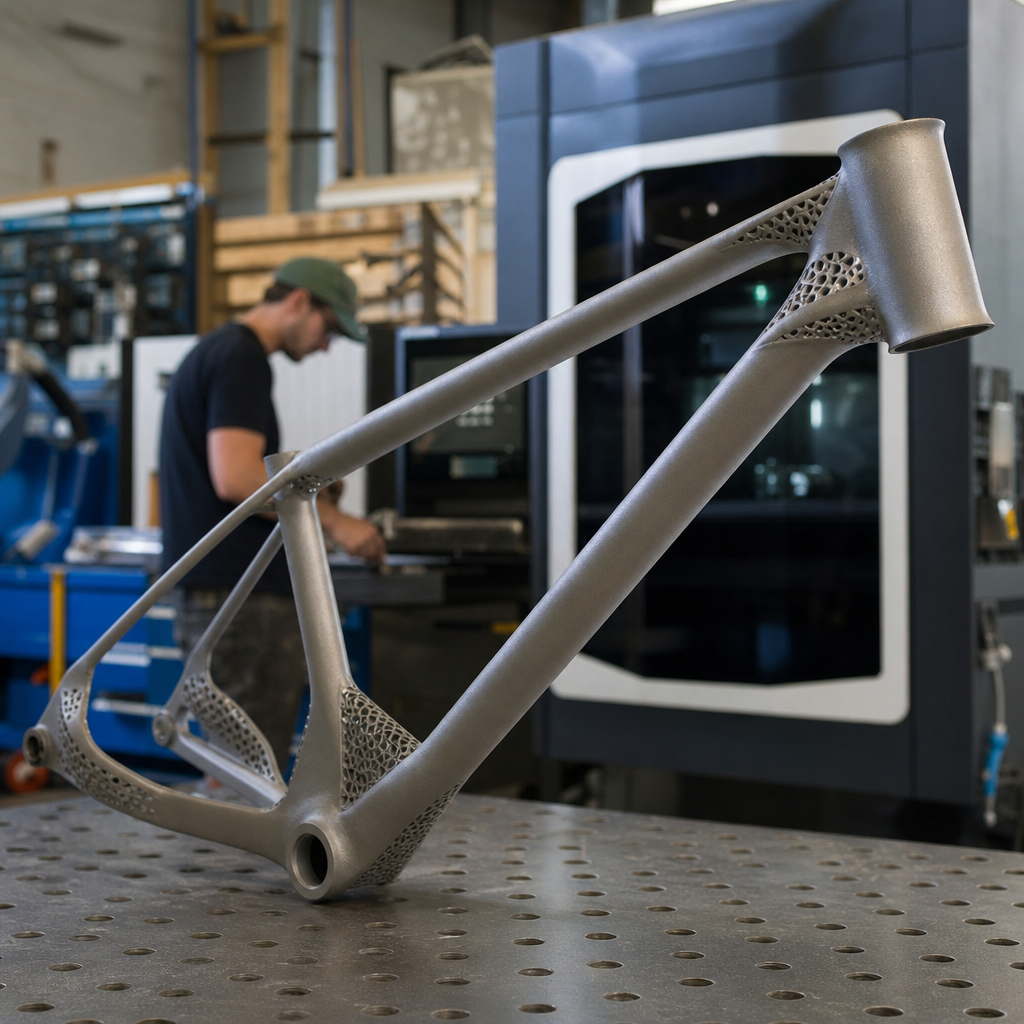
Revel Bikes drew attention when it explored titanium fabrication in ways that reflected additive-era thinking rather than old-school round-tube nostalgia. The important lesson is not simply that titanium is premium or that printed parts look futuristic. The lesson is that titanium development benefits from using 3D printing as an intermediate step between concept and production reality. In practice, that means using printed mockups, printed fixtures, and in some cases printed metal nodes to understand alignment, stress concentration, assembly sequence, and tolerance stack before committing to a final build strategy.
Titanium is attractive because it resists corrosion, offers strong fatigue performance when designed well, and carries a high-end custom identity. It is also demanding. Heat input during welding matters, contamination control matters, and localized stiffness changes matter. If a builder is experimenting with unusual shapes, internal routing paths, or integrated mounts, the design freedom can quickly create manufacturing headaches. Revel’s titanium work underscored a basic truth I have seen repeatedly: a beautiful CAD file does not guarantee a buildable frame. Parts need wrench access. Weld zones need room. Hose paths need to be serviceable. Bearings need proper support. Additive prototyping exposes these realities early.
Another key lesson is restraint. Additive manufacturing invites over-design because it can generate forms that look efficient and organic. But bicycle frames live in a dirty, impact-prone, maintenance-heavy environment. The best titanium concepts use printing to solve genuine problems such as interface integration, local reinforcement, or packaging, not to add decorative complexity. Revel’s example points builders toward that discipline. Use printed iterations to identify where custom geometry or integrated features improve performance or user experience, then simplify wherever possible for durability and manufacturability.
How 3D Printing Supports Carbon Development and Hybrid Builds
Carbon is often discussed as if it belongs to factories only, yet many custom and small-batch builders use additive tools throughout carbon development. One of the most practical applications is printed tooling. Shops produce drape guides, trim templates, bladder supports, core forms, and sacrificial molds to validate a layup plan before committing to hard tooling. This is valuable because carbon performance depends on fiber orientation, ply transitions, compaction pressure, and resin control, not just shape. A printed prototype can confirm that a junction is layup-friendly and that fibers will actually follow the intended load paths.
Hybrid thinking is where this gets interesting. A builder may use titanium or alloy inserts at wear points, carbon for major structural members, and printed prototypes to refine the interfaces between them. Bottom bracket shells, rocker links, cable stops, and battery or tool mounts can all benefit from additive testing before they are machined or molded. In some advanced workflows, printed nylon parts are even used directly for non-structural guides or housings, provided heat and impact loads are understood.
Real-world gains come from reducing avoidable mistakes. If a carbon downtube mold is altered for internal storage or electronic routing, a printed insert can confirm volume, entry angle, and assembly order before expensive mold revisions are made. If a custom seat mast topper is being integrated with a carbon frame, a printed surrogate can verify clamp access and saddle offset range. The point is not that every final part should be printed. The point is that additive methods de-risk carbon development by making hidden problems visible earlier, when changes are cheap and fast.
Internal Wiring and Cable Integration: Where Prototyping Pays Off Fastest
Modern bike design has made wiring and hose routing a core engineering problem. Fully integrated cockpits, electronic drivetrains, dropper posts, and hidden brake hoses improve appearance and aerodynamics, but they complicate service and create noise, friction, and fit challenges. I have found that internal routing is often the first place where additive prototyping delivers obvious value to both builder and rider. A simple printed guide can answer whether a brake hose rubs on a steerer, whether a battery lead crosses a pivot path, or whether a frame opening is large enough for assembly but small enough to preserve structure and sealing.
The best routing systems balance four factors: low friction, low noise, easy service, and minimal structural compromise. Printed prototypes help achieve that balance because they allow direct testing of bend radius, entry shape, grommet retention, and mechanic access. They also reveal hidden conflicts with headset bearings, compression rings, shock reservoirs, or bottle bosses. Many integration failures happen not because the concept is impossible, but because one small access point or angle was never validated physically.
| Fabrication area | What 3D printing solves | Typical example | Main limitation |
|---|---|---|---|
| Titanium development | Checks fit, weld access, and junction geometry before metal production | Prototype lug for head tube and top tube transition | Printed sample may not reflect final heat effects |
| Carbon fabrication | Creates low-cost tooling aids and verifies layup-friendly shapes | Printed bladder support or trim template | Surface finish and temperature resistance vary by material |
| Internal wiring | Tests hose paths, port sizing, and service access quickly | Headset cable guide or downtube entry grommet | Prototype friction can differ from final production polymer |
| Custom accessories | Makes short-run mounts and guides economical | Computer mount, chain guide, tool carrier | Long-term UV and impact durability must be validated |
For builders, the commercial payoff is significant. Customers notice clean integration immediately, but they remember bad service experiences even more strongly. A routing system that requires full front-end disassembly for a simple hose swap can damage a brand’s reputation. Additive prototyping helps teams avoid that trap by putting serviceability into the design review, not treating it as an afterthought.
Choosing the Right Process, Material, and Validation Method
Not all 3D printing is equal, and custom builders need to match the process to the decision they are trying to make. FDM is inexpensive and fast for packaging studies, draft fixtures, and rough ergonomics. SLA and similar resin processes capture detail well, making them useful for grommets, surface-sensitive interfaces, and aesthetic review, though some resins are brittle or unstable under heat and UV. SLS and MJF nylon parts are stronger and better for functional prototypes, cable guides, and short-run accessories. Metal additive processes, especially titanium laser powder bed fusion, are appropriate only when the business case and engineering case are both clear.
Validation matters as much as printing. A prototype that looks right can still fail if tolerances, fatigue loads, or thermal exposure were not considered. Good shops use calipers, surface comparisons, fixture checks, and destructive testing where appropriate. For structural parts, finite element analysis can help identify risk areas, but it should be paired with real-world load cases and skepticism. Layer orientation, support removal, residual stress, and post-processing can all affect outcomes. Standards from ASTM and ISO provide useful language and process discipline, even when a small builder is not formally certifying every component.
The practical rule is simple: prototype what is uncertain, then test what matters most. If the question is packaging, use the fastest affordable print. If the question is wear, fatigue, or rider safety, move beyond visual confirmation and build a validation plan. Revel’s titanium lessons fit neatly here. The value was not in printing for its own sake. The value was in using additive methods to learn faster where design freedom helps and where conventional fabrication constraints still govern the final answer.
What This Means for Custom Culture and the Next Generation of Builders
3D printing has changed custom culture because it lowers the barrier between imagination and credible execution. Ten years ago, many ambitious concepts stalled at the stage where custom tooling, machining time, or offshore sample costs became prohibitive. Now a small builder can move from sketch to rideable validation with far less waste. That does not remove the need for craftsmanship; it raises the standard. Customers can now expect refined integration, cleaner ergonomics, and more thoughtful details even from very small brands.
The most successful builders use fabrication tech to express a clear philosophy. Some prioritize repairability and use printed parts only for removable guides and mockups. Others pursue radical integration and use additive methods to create proprietary cockpit, storage, or suspension interfaces. Both approaches can work if the engineering discipline is sound. What fails is technology without purpose. Printed complexity that adds no service, fit, or performance benefit usually becomes future frustration.
As this hub for fabrication tech expands into deeper articles on metal additive manufacturing, carbon workflows, and wiring strategy, the central idea should remain clear. 3D printing is best understood as an incubator for concepts that need to become physical quickly enough to be judged honestly. Revel Bikes’ titanium lessons matter because they show how modern builders can experiment boldly while still respecting manufacturing reality. If you are designing a custom bike, reviewing a boutique brand, or planning your own fabrication workflow, start by asking where uncertainty is highest. That is where additive tools earn their keep. Explore the connected articles in this subtopic, compare methods against your use case, and use prototyping to make better bikes before you make expensive mistakes.
Frequently Asked Questions
What does it mean to use 3D printing as a “concept incubator” in bike development?
Using 3D printing as a concept incubator means treating additive manufacturing as an early-stage decision tool rather than just a way to make final parts. In the context of custom bike development, it allows engineers and builders to move from an idea to a physical object quickly, evaluate whether that idea solves a real problem, and decide whether it deserves more investment. Instead of committing immediately to expensive titanium production, machining programs, molds, or batch fabrication, a team can model a component, print it, inspect the geometry, check fit and clearances, and revise it in short cycles. That process turns product development into a more disciplined workflow.
For a brand like Revel Bikes, this matters because titanium experiments involve real cost, real fabrication complexity, and very little room for careless iteration. A printed prototype can reveal whether a dropout shape interferes with hardware access, whether a yoke design creates clearance problems, or whether a cable-routing concept is elegant in CAD but awkward in the real world. The value is not simply speed for its own sake. The value is that 3D printing helps a team learn sooner, fail earlier, and avoid scaling weak ideas into costly production mistakes. In that sense, “concept incubator” is a practical engineering method: generate options, test assumptions, kill what does not work, and only advance what proves itself.
Why are Revel Bikes’ titanium experiments such a strong example of this approach?
Revel Bikes’ titanium work stands out because titanium frame development sits at the intersection of premium materials, precise fabrication, and high expectations from riders. That makes it an ideal case study for how 3D printing can support smarter product development. When a company experiments with titanium, it is not just exploring aesthetics or marketing storylines. It is evaluating ride feel, tube shaping, junction design, manufacturing repeatability, strength considerations, and assembly practicality. Each one of those variables can create downstream cost if the concept is pushed too far before it is validated.
By using 3D printing upstream, a builder can test how frame interfaces, small structural ideas, and accessory integrations behave before cutting metal or committing to expensive production setups. That is especially important in titanium, where the margin for waste is far less forgiving than in low-cost conceptual mockups. Printed parts can help reveal ergonomic issues, compatibility problems, or packaging conflicts while the project is still flexible. They also make communication easier across design, engineering, and fabrication teams because everyone can react to a real object rather than just a drawing on a screen.
What makes the lesson from Revel especially useful to the broader fabrication world is that the principle scales beyond titanium bikes. Whether the project is a frame detail, a fixture, a custom interface, or a niche component, the same logic applies: use additive tools to compress uncertainty before entering expensive manufacturing stages. That is why these experiments are more than a curiosity. They show how 3D printing can become part of a mature product development strategy.
How does 3D printing reduce risk and cost before a titanium bike concept reaches production?
3D printing reduces risk by moving failure into a cheaper, faster stage of development. In traditional fabrication workflows, some problems are only discovered after tooling is made, parts are machined, or frame batches are underway. At that point, every design flaw becomes expensive. Additive manufacturing changes that equation by letting teams test form, fit, interface geometry, and assembly logic before those large commitments are made. If a concept proves awkward or ineffective, it can be revised digitally and reprinted without scrapping high-value material or resetting a major production process.
Cost reduction comes from several directions. First, there is less wasted labor spent producing parts that should never have advanced beyond concept. Second, there is less wasted material, which matters greatly when working around titanium-related fabrication decisions. Third, there is less risk of tying up internal resources on a design path that ultimately does not perform well. A quick printed prototype can expose hidden issues like poor tool access, inadequate tire or drivetrain clearance, impractical fastener placement, or geometric complexity that sounds innovative but creates manufacturing headaches.
There is also a strategic cost benefit. Better early validation means better confidence when it is finally time to invest in production. Teams can distinguish between ideas that merely look exciting and ideas that are durable, buildable, and rider-relevant. In competitive bike manufacturing, that kind of filtering is valuable. It keeps development focused on concepts with real potential and prevents premium projects from being derailed by avoidable mistakes discovered too late.
What kinds of bike components or design ideas benefit most from this rapid prototyping workflow?
The biggest gains typically appear in parts and features where geometry, integration, and assembly all matter at once. In bike development, that includes dropouts, frame junction concepts, cable-routing guides, protective covers, chainstay and yoke clearances, hardware interfaces, and cockpit or accessory mounts. These are the types of details that often look straightforward in CAD but become more complicated when tested against real-world frame packaging, rider use, and serviceability. A printed prototype makes those issues visible early.
Complex interfaces benefit especially well. If a part must align with bearings, bolts, brake hardware, drivetrain components, or suspension elements, a physical print can quickly reveal whether tolerances and access points make sense. Even if the print is not structurally equivalent to the final titanium part, it can still validate the underlying design logic. That makes it useful for checking spacing, body shape, placement, and maintenance considerations before engineering time is spent refining a final production version.
This workflow is also well suited to experimental or low-volume ideas that would be hard to justify with traditional tooling from day one. Builders can evaluate niche concepts, rider-specific customizations, and unconventional frame details without overcommitting. Some ideas will graduate into production; others will be abandoned after one or two printed iterations. That is exactly the point. A concept incubator is valuable because it gives teams a disciplined way to explore more ideas while spending less on the wrong ones.
Does 3D printing replace traditional fabrication in titanium bike building, or does it mainly support it?
In most serious bike development workflows, 3D printing mainly supports traditional fabrication rather than replacing it outright. Titanium bike building still depends on proven manufacturing methods, skilled welding or joining processes, careful material handling, quality control, and design choices that account for long-term durability and ride performance. Additive manufacturing does not eliminate those realities. What it does is make the path toward them more intelligent. It helps teams arrive at better final decisions before committing to expensive fabrication steps.
That distinction is important. There is a tendency to frame 3D printing as a disruptive substitute for everything that came before it, but the more useful perspective is that it is an enabling layer inside a broader development system. It strengthens ideation, accelerates validation, improves internal communication, and reduces uncertainty. Once a concept has survived that process, traditional fabrication can take over with greater confidence and fewer surprises.
For builders, engineers, and fabrication-focused brands, the lesson is clear: 3D printing is most powerful when it is used where it delivers the most leverage. That usually means early testing, fast iteration, and practical decision-making. In Revel Bikes’ titanium experiments, the technology’s role is not just to make interesting objects. Its real value is to improve the quality of choices made before premium manufacturing resources are placed on the line.