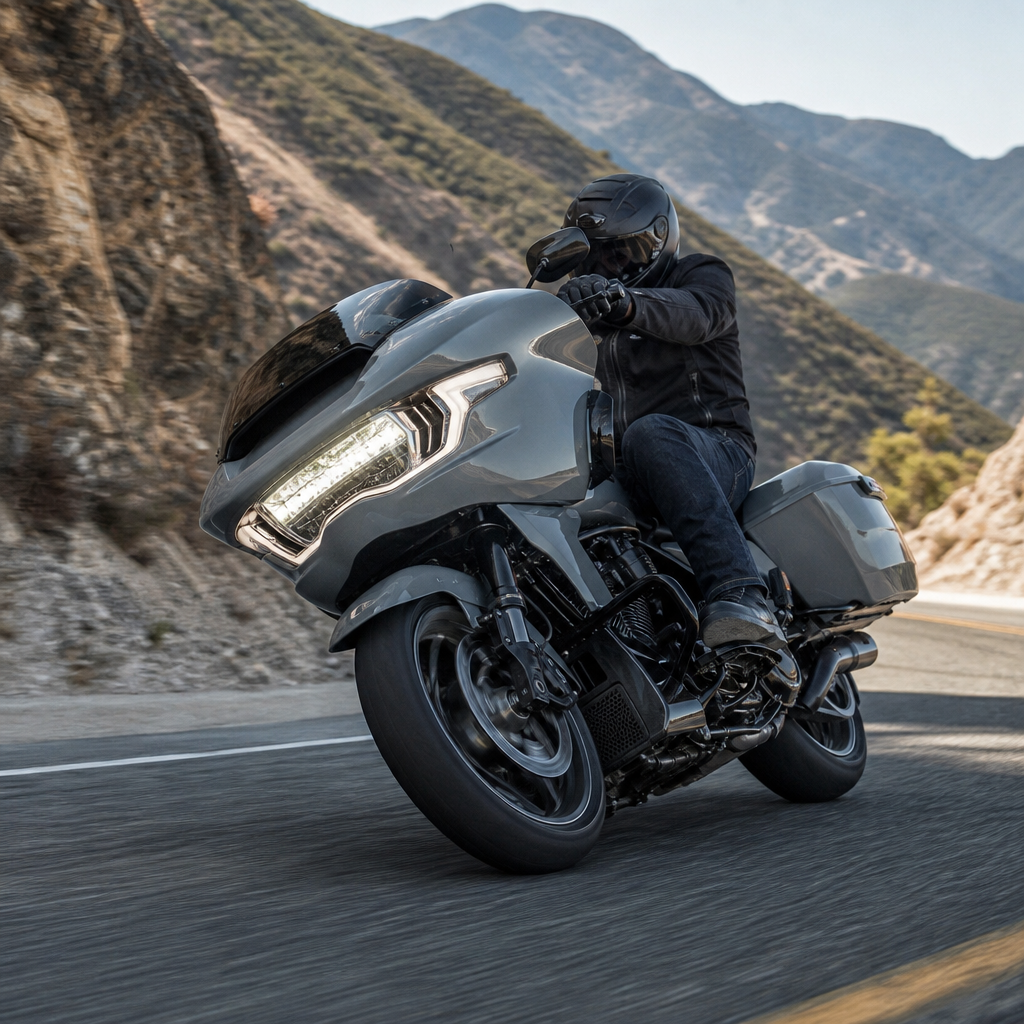
Performance bagger theory explains why a motorcycle built from traditionally heavy touring architecture can be tuned, lightened, and reimagined to corner, brake, and accelerate with surprising speed while still carrying the visual authority of long-distance American iron. In 2026, riders are racing heavy iron because design language has changed, chassis technology has caught up, and custom culture now values function and identity in equal measure.
As a builder and writer who has spent time around dyno rooms, race paddocks, and fabrication shops, I have watched the shift happen in real terms. A bagger used to mean a comfort-first machine with hard luggage, a big fairing, floorboards, and geometry intended for highway stability. Today, a performance bagger is a different proposition: upgraded suspension, stronger brakes, lighter wheels, tuned engines, revised ergonomics, and bodywork choices that preserve touring DNA while making the motorcycle capable in aggressive street riding or organized racing.
This hub page covers the broader design theory behind that shift, including Chicano style, performance bagger thinking, Frisco influence, and the hybrid customs now emerging from the New Guard of builders using CAD, CNC machining, 3D scanning, TIG fabrication, and data-driven setup work. The reason this matters is simple. These styles are no longer isolated aesthetics. They shape how motorcycles are built, how parts are engineered, what riders expect from handling, and how custom culture defines authenticity in 2026.
Design theory in this context means the relationship between stance, proportion, intended use, regional identity, and mechanical choices. A Chicano build uses elegance, rake, paint depth, chrome, and lowrider visual cues to communicate motion and lineage. A performance bagger uses the silhouette of touring machinery but prioritizes lean angle, chassis control, and rider confidence at speed. A Frisco-inspired motorcycle strips and elevates key forms to emphasize simplicity, narrowness, and raw mechanical presence. Beyond those categories, current custom builders increasingly blend them, producing bikes that cannot be understood by style labels alone.
Why heavy touring motorcycles became performance platforms
The rise of racing heavy iron starts with the base machine. Modern touring motorcycles from Harley-Davidson and Indian arrive with large-displacement V-twins, robust frames, generous aftermarket support, and rider ergonomics suited to long hours in the saddle. Those are useful foundations, not obstacles. Once suspension travel is improved, unsprung weight is reduced, and braking heat management is addressed, the same motorcycle that feels planted on an interstate can become unexpectedly competent on technical roads and closed courses.
King of the Baggers accelerated this transformation by turning a fringe idea into a visible proving ground. When race teams campaigned Road Glides, Street Glides, and Indian Challengers with serious engine work, Öhlins or Fox suspension, Brembo braking packages, and race-developed chassis setup, the public could see that “bagger” no longer meant slow by definition. Racing validated the theory. It also improved the supply chain. Parts once considered exotic became catalog items, from radial brake conversions and forged wheels to billet triple trees, adjustable rear ride-height links, and high-flow intake systems designed around real dyno testing.
There is also a cultural reason. Riders want motorcycles with presence. A superbike is fast, but it does not deliver the same visual mass, road authority, or customization canvas as a full-dress V-twin. Performance baggers satisfy both sides of the modern rider mindset: emotional attachment to American touring form and rational demand for better handling. In other words, riders are not choosing heavy iron despite its size. They are choosing it because the size, once engineered correctly, becomes part of the appeal.
The design theory behind a performance bagger
A true performance bagger is not just a touring bike with loud paint and expensive parts. The theory starts with balance. Every modification must support speed, stability, and rider input. That means wheel and tire selection affects steering effort, brake rotor size must match caliper capacity and master-cylinder ratio, rear suspension length changes swingarm angle and cornering clearance, and handlebar position influences how effectively the rider can load the front contact patch.
In practical shop work, the biggest gains usually come from suspension and wheels before engine output. I have ridden heavy touring bikes that gained more real-world pace from quality cartridges, properly sprung shocks, and forged aluminum wheels than they did from a big-bore kit alone. Less gyroscopic resistance helps turn-in. Better damping keeps the chassis settled on corner exit. More ride height can transform lean angle. A stable, predictable motorcycle lets a rider use the available power. That is the principle at the core of performance bagger theory.
The visual language follows the mechanical logic. Tall shocks, tighter body gaps, performance seats, tucked exhaust routing, and restrained graphics often signal intent. Some builds keep full bags and a fairing because the silhouette matters; others trim visual bulk while retaining enough storage and wind protection to remain recognizably baggers. The best examples look cohesive because the design is driven by function first, then finished with discipline rather than ornament for its own sake.
How Chicano style fits into modern design theory
Chicano motorcycle design is often misunderstood by outsiders as decorative only. That reading misses the historical depth. The style draws from lowrider culture, West Coast cruising, community identity, and a sophisticated sense of proportion. Key features can include stretched tanks, long fenders, narrow whitewalls or tall-spoke wheels, engraved metal, deep candy paint, murals, chrome, fishtails, and a low, elegant stance. The goal is not lap time. It is visual rhythm, craftsmanship, and cultural storytelling.
Yet Chicano influence matters in this hub because it established one of the clearest examples of motorcycles as rolling cultural statements. Builders learned to think deliberately about line, silhouette, and emotional response. That discipline carries into current performance work. Even on aggressively tuned baggers, you can see Chicano lessons in paint separation, fender-to-wheel relationship, tank profile, and the understanding that a motorcycle should communicate something before it even starts.
There are tradeoffs. Very low ride heights and extreme wheel choices can compromise handling, braking feel, and suspension travel. Skilled builders acknowledge this instead of pretending every aesthetic choice is performance neutral. In 2026, many shops now build respectful crossovers: Chicano-inspired paint and finish over a chassis with modern suspension geometry and stronger brakes. That blend works when the builder understands which historical elements are essential and which can be adapted without losing the soul of the style.
Frisco style and the return of stripped purpose
Frisco style comes from a different logic. Traditionally associated with narrow tanks, high-mounted fuel placement, tall bars, slimmed-down silhouettes, minimal bodywork, and a direct, urban toughness, Frisco builds emphasize mechanical honesty. They feel compact and intentional. Where Chicano design often stretches and smooths, Frisco tends to reduce and expose. The result is a motorcycle that looks alert, lean, and unapologetically handmade.
That matters because the New Guard of builders increasingly borrows Frisco principles when modern customs risk becoming overproduced. A stripped center section, clean wiring, visible weld quality, and a purposeful stance remind viewers that fabrication still matters in an era of bolt-on abundance. Frisco influence also shows up in ergonomics. Riders who prefer command and visibility often choose bar and seat placements that keep the body more active and connected to the front end, even on larger-displacement customs.
Frisco is not the opposite of performance bagger theory, but it is a useful counterweight. It asks whether every part earns its place, whether the silhouette is honest, and whether the machine feels alive beneath the rider. Some of the strongest 2026 builds mix bagger chassis competence with Frisco restraint, producing motorcycles that are technologically advanced without looking sterile.
Where the styles meet in 2026 fabrication
Today’s custom scene is defined less by purity and more by intelligent synthesis. Builders scan stock components, model brackets in CAD, cut prototypes on CNC equipment, print test pieces, and then TIG-weld final structures with far tighter tolerances than many custom shops accepted a decade ago. This does not erase tradition. It allows builders to preserve style while solving fitment, strength, and serviceability problems that used to be treated as unavoidable.
On a modern sub-pillar like this one, the key idea is that design categories now function as starting points. A builder may take the emotional elegance of Chicano style, the stripped intent of Frisco, and the hard-use chassis logic of a performance bagger, then combine them into a motorcycle built around a specific rider. That rider might want long-haul comfort, canyon competence, show-level finish, and reliable maintenance intervals. In 2026, those requests are no longer contradictory.
| Style | Core Visual Cues | Primary Goal | Typical Tradeoff |
|---|---|---|---|
| Chicano | Low stance, chrome, murals, stretched lines | Cultural expression and elegance | Reduced cornering clearance |
| Performance Bagger | Touring silhouette, tall shocks, brake upgrades, aggressive fit | High-speed stability and handling | Higher cost and setup complexity |
| Frisco | Narrow profile, minimal bodywork, visible mechanics | Raw presence and direct rider connection | Less comfort and storage |
| Hybrid New Guard | Blended cues supported by digital fabrication | Personalized function with coherent style | Requires disciplined design decisions |
The table shows why this design theory matters. Each style solves a different problem. Builders who understand that can make better choices, and riders can commission motorcycles that match real use instead of chasing trend-driven parts lists.
The engineering realities behind racing heavy iron
Heavy motorcycles race well only when fundamentals are addressed. Weight distribution, trail, swingarm behavior, tire carcass selection, brake cooling, and rider movement matter more than social media claims about horsepower. A bagger carrying over 700 pounds wet cannot be treated like a middleweight sportbike. It needs support under acceleration, controlled pitch under braking, and enough cornering clearance to use modern tire grip without hard parts levering the chassis off line.
That is why serious builds lean on established component makers and measured testing. Öhlins, Penske, Fox, Brembo, Lyndall, S&S, and Dynojet appear repeatedly for a reason: they produce repeatable results when installed and tuned correctly. Data logging, dyno runs, sag measurement, and controlled geometry changes beat guesswork. Even basic choices, such as switching from cast to forged wheels, can improve acceleration, braking response, and steering precision because rotational mass affects the entire dynamic system.
Engine work still matters, especially in 2026 where Milwaukee-Eight and PowerPlus platforms respond well to cam packages, head work, intake tuning, and calibrated fuel mapping. But reliable speed comes from a package, not a headline number. The fastest heavy iron I have seen was never just the loudest bike in the lot. It was the one with a predictable chassis, consistent brake feel, and a rider position that encouraged confidence over a full session.
How to read this hub and explore the subtopic
This article is the hub for design theory across Chicano, performance bagger, Frisco, and emerging hybrid customs, so the best way to use it is as a map. If your interest is cultural lineage, start with Chicano design and study paint, stance, wheel choice, and the relationship to lowrider tradition. If your focus is riding dynamics, move into performance bagger chassis theory, suspension setup, brake package design, and race influence. If you care about fabrication character, explore Frisco-derived minimalism, hand-built details, and the aesthetics of mechanical honesty.
The unifying takeaway is straightforward. Great custom motorcycles are not random collections of expensive parts. They are coherent systems shaped by intent. In 2026, riders are racing heavy iron because builders proved that big touring platforms can be engineered for serious pace without abandoning the presence, culture, and long-distance usability that made them desirable in the first place. Whether you prefer candy paint, exposed welds, or race-bred suspension, the same rule applies: define the purpose, protect the proportions, and let every modification support the story the bike is meant to tell.
If you are building, buying, or researching within custom culture and builders, use this hub as your foundation, then go deeper into each branch of the topic. Study the origins, compare the engineering choices, and be honest about tradeoffs. That approach produces better motorcycles and better decisions. Start with your intended ride experience, then choose the design language that makes that experience visible.
Frequently Asked Questions
What is performance bagger theory, and why does it matter in 2026?
Performance bagger theory is the idea that a motorcycle rooted in heavyweight touring DNA does not have to be slow, vague, or limited to highway miles. Instead, it can be engineered to handle, brake, and drive out of corners with real urgency while still preserving the long, low silhouette and visual presence that define American baggers. The theory matters in 2026 because the old assumption that “heavy equals lazy” no longer holds up. Modern chassis geometry, stronger and lighter wheels, better tire compounds, high-quality suspension, radial braking systems, and more refined engine tuning have changed what these bikes are capable of. Builders are no longer just decorating a platform; they are correcting weaknesses, improving weight control, and unlocking performance that was always possible but rarely prioritized.
What makes this shift especially important is that riders now expect dual-purpose identity from their bikes. They want something that looks substantial and unmistakably custom, but also feels sharp and confidence-inspiring when the road gets technical. In 2026, baggers are being raced because the category has matured beyond style alone. Riders have seen enough track-focused builds, King of the Baggers influence, and real-world custom development to understand that touring-based machines can be transformed into serious performers. Performance bagger theory gives language to that evolution: not abandoning heavy iron, but rethinking it through suspension science, geometry, weight management, braking capability, and rider intent.
Why are 2026 riders suddenly racing heavy iron instead of choosing lighter sport-oriented motorcycles?
The short answer is that “suddenly” is not really sudden. This has been building for years, and by 2026 the cultural and technical pieces have aligned. Riders are racing heavy iron because modern baggers now deliver something sportbikes and naked bikes often cannot: a blend of physical presence, emotional identity, V-twin character, long-wheelbase stability, and surprising speed. A performance bagger feels dramatic in a way that a purpose-built sport machine may not. It asks more of the rider, but it also rewards skill, setup knowledge, and confidence in a very visible way. There is a certain satisfaction in making a large motorcycle move with precision, and that challenge has become part of the appeal.
There is also a strong custom-culture reason behind the trend. In earlier eras, custom often leaned heavily toward appearance. In 2026, function carries equal status. Riders want a bike that says something about their taste, but they also want it to perform in a measurable way. Racing heavy iron proves the platform is more than a styling exercise. The rise of racing series, high-profile builders, and aftermarket support has validated the category, giving riders access to tested suspension packages, engine upgrades, brake conversions, chassis reinforcements, and wheel-and-tire combinations that actually work together. Add in the influence of social media, event culture, and track-day crossover, and the result is a generation of riders who see a big American V-twin not as an outdated touring rig, but as a platform for speed, identity, and craftsmanship.
How can a traditionally heavy touring motorcycle be made to corner, brake, and accelerate so well?
It starts with understanding that raw weight is only one part of the equation. Where the weight sits, how the chassis responds to load transfer, and how well the suspension keeps the tires planted matter just as much. A well-built performance bagger improves cornering by addressing ride height, lean-angle limitations, spring rates, damping control, wheel and tire selection, and overall geometry. Raising the bike strategically can improve cornering clearance and sharpen turn-in. Quality suspension components reduce wallow, improve mid-corner support, and help the motorcycle stay composed under hard braking and acceleration. Lightweight wheels can dramatically reduce rotating mass, making the bike feel more responsive in direction changes while also improving suspension performance.
Braking improves through better calipers, larger or more efficient rotors, stronger master cylinders, stainless lines, and proper pad compounds. On a heavy platform, good brakes are not just about stopping distance; they are about repeatability and confidence. When riders trust the front end under hard deceleration, they carry speed more effectively and ride the bike with less hesitation. Acceleration comes from a mix of torque-rich engine tuning, efficient intake and exhaust flow, improved fueling, better clutch performance, and drivetrain refinement. But the biggest gains often come from putting power to the ground cleanly. A bagger that is stable on corner exit, properly suspended, and geared intelligently will feel faster than one that simply makes a bigger dyno number. That is the heart of performance bagger theory: real performance comes from the system working together, not from one flashy modification.
Does racing a bagger defeat the purpose of a touring motorcycle, or is that the point?
It does not defeat the purpose at all; it expands it. The original touring motorcycle was designed to cover ground, remain stable, carry gear, and offer a strong road presence. Those are not weaknesses. In fact, they provide a useful foundation for high-speed confidence, especially when modern technology is applied correctly. A long, substantial motorcycle can feel incredibly planted. A large-displacement V-twin can deliver broad, usable torque. Hard bags and fairings contribute to a specific visual identity that many riders do not want to give up just because they also enjoy aggressive riding. Racing a bagger is not about pretending it is something else. It is about discovering how much performance can be extracted from the platform without erasing what made it appealing in the first place.
For many riders, that is precisely the point. The attraction is not to build a lighter sportbike substitute. It is to keep the authority, ergonomics, silhouette, and cultural weight of heavy American iron while proving it can do more than expected. There is also a philosophical layer here. Baggers represent history, tradition, and long-distance ethos. Racing them introduces experimentation, competition, and technical ambition. In 2026, riders are drawn to that blend because it feels authentic to the current custom scene: respectful of heritage, but not trapped by it. The best performance baggers are not stripped of personality in the pursuit of lap times. They are motorcycles that still look like they belong in front of a roadside diner or on a cross-country run, yet can attack a canyon road or a race circuit with genuine competence.
What separates a real performance bagger build from a bike that only looks fast?
A real performance bagger build is defined by integration, not cosmetics. It is easy to bolt on race-inspired parts or choose aggressive styling cues, but if the motorcycle has not been developed as a complete package, the result is mostly visual theater. A true performance build begins with a clear goal: canyon carving, street performance, track use, or a balanced mix of all three. From there, the builder works through the fundamentals in a logical order. Suspension is usually first, because it determines how the motorcycle behaves everywhere. Then come brakes, wheels and tires, ride-height strategy, chassis alignment, ergonomics, and only after that does it make sense to chase engine output in a serious way. The best builds are predictable, comfortable enough to ride hard for extended periods, and honest in the way they deliver speed.
You can usually spot the difference in how the bike is described and how it is used. A serious performance bagger owner talks about setup, not just parts. They know what spring rates are on the bike, how much travel they have, what tires they run, how the bike reacts mid-corner, where it drags, and what changed after each modification. The machine will often show thoughtful choices rather than random expense: quality suspension over purely decorative accessories, brake upgrades matched to rider demands, functional bodywork choices, and an engine tune that supports the rest of the package. In 2026, that distinction matters more than ever because the market is full of high-dollar components. A real performance bagger is not one with the longest parts list. It is the one that feels coherent from the saddle and proves, mile after mile or lap after lap, that heavy iron can be fast for reasons deeper than appearance.