Chicano style has always been about motion, stance, and identity, but in 2026 the most interesting shift is happening underneath the sheet metal: the classic vicla is moving toward performance suspension. A vicla, in the modern custom scene, is a lowrider-influenced V-twin cruiser or touring motorcycle built around elegant paint, deep chrome, fishtail pipes, spoke wheels, engraved details, and a long, low silhouette. Performance suspension, by contrast, refers to upgraded forks, shocks, cartridges, springs, geometry tuning, and braking support that improve control, cornering clearance, stability, and rider confidence without necessarily abandoning style. That intersection matters because builders and riders no longer accept the old tradeoff that a bike must either look right or ride right. Across Chicano builds, performance baggers, and Frisco-inspired customs, the new standard is intentional design: every visual choice must coexist with usable handling.
I have watched this change happen in shops, at shows, and on long freeway rides where beautiful bikes got unsettled by pavement joints, wallowed through sweepers, or dragged hard parts long before the rider reached the engine’s limits. Riders started asking better questions. Can a slammed touring bike still hold a line through a canyon road? Can a 21-inch front wheel work with proper trail and damping? Can air ride remain part of the look while the bike keeps enough travel to function? Those questions now define the leading edge of custom culture. This hub article maps that design theory in practical terms, connecting Chicano style, performance bagger engineering, Frisco posture, and adjacent trends so readers can understand why suspension has become the key technology shaping the next generation of viclas.
The core logic of Chicano motorcycle design
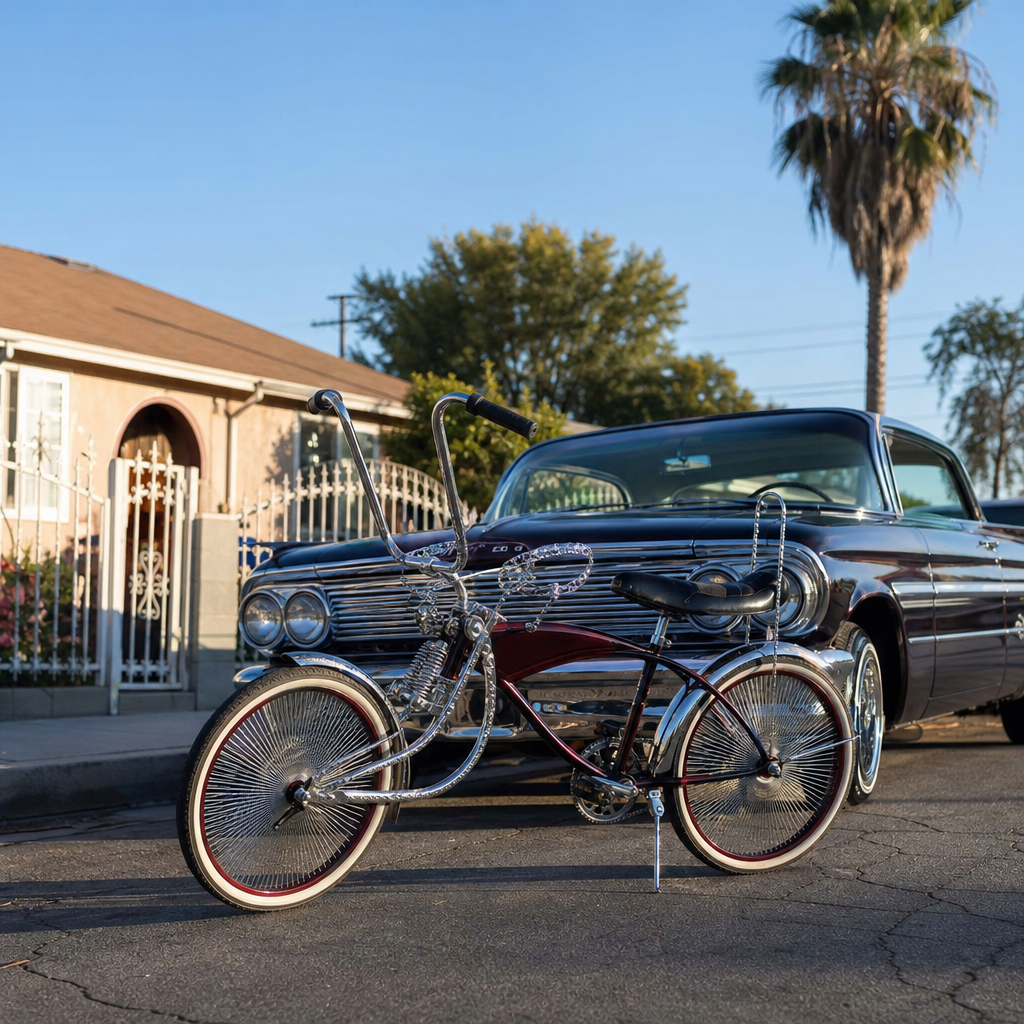
To understand why the vicla is changing, start with what Chicano motorcycle design actually values. The style is not random decoration. It is a coherent visual language rooted in lowrider culture, boulevard presence, craftsmanship, and community recognition. Signature elements include stretched saddlebags, long front fenders, tall or sculpted bars, candy and pearl paint, murals, pinstriping, chrome controls, engraved covers, and wheels that emphasize elegance over aggression. The bike should look composed from every angle, especially in profile. The line from front fender to tank to seat to bags should read as one continuous gesture.
That visual discipline explains why suspension matters so much. A Chicano build depends on stance. Too much rear ride height and the bike loses the laid-out look. Too little travel and it becomes a static sculpture that beats up the rider and handles poorly. In older builds, especially when cheap lowering kits were common, owners often sacrificed shock stroke, fork balance, and cornering clearance simply to get the silhouette lower. The result could be dramatic at a show and disappointing on the road. Modern builders have learned that true stance is not just about low height. It is about controlled proportion under load, consistent geometry, and how the bike settles when ridden.
The strongest 2026 builds preserve the emotional cues of classic vicla culture while applying better engineering. That means spring rates matched to rider weight, cartridge kits that control brake dive, longer and better damped rear shocks hidden within a low visual line, and bagger-specific setups from companies such as Öhlins, Fox, Legend Suspensions, Progressive Suspension, and Kraus-tested front-end systems. Good builders now discuss sag, damping curves, and chassis attitude in the same conversation as paint depth and fender radius. That is not a rejection of Chicano style. It is a refinement of it.
Why performance suspension is becoming essential on the modern vicla
The simple answer is that motorcycles have become faster, heavier, and more capable, while roads and rider expectations have not become more forgiving. A Milwaukee-Eight touring platform makes strong torque with little effort. Performance brake kits from Brembo and Arlen Ness-inspired bagger suppliers are common. Tire compounds have improved. Riders travel farther, carry passengers, and move between city cruising, freeway miles, and mountain roads in a single day. Once the engine, brakes, and tire grip improve, weak suspension becomes the limiting factor.
Suspension upgrades solve several real problems. First, they increase control over wheel movement. Better damping keeps the tire in contact with the road instead of skipping over bumps. Second, they improve comfort by absorbing impacts in a controlled way rather than through harsh bottoming. Third, they support geometry. When a bike dives too much under braking or squats excessively on acceleration, steering becomes vague and the chassis feels lazy. Fourth, they create usable cornering clearance by preventing the bike from collapsing into the stroke. On heavy customs, that last point is crucial. Hard parts touching down early do not just slow the bike; they can upset it.
In practical terms, I have seen riders switch from bargain lowering shocks to premium monotube or piggyback units and immediately gain confidence. They stop weaving through fast sweepers. Their passenger stops complaining. Their floorboards last longer because the bike no longer blows through its travel. The visual stance can remain low, but the machine becomes composed. This is why the vicla is moving toward performance suspension: not because the scene is chasing trends, but because enough riders have experienced the difference firsthand.
How Chicano style intersects with the performance bagger movement
The performance bagger scene contributed the technical vocabulary that many vicla builders now use. Performance baggers emphasized inverted forks, dual-disc braking, radial calipers, tall rear shocks, aggressive tires, upgraded neck bearings, motor mounts, and reinforced swingarm logic. Their look often centered on speed: short fenders, compact bags, high lean angles, and a muscular stance. Chicano bikes traditionally emphasized visual flow, ornament, and lowrider influence. For years, these looked like opposing philosophies. In reality, they are increasingly sharing hardware and design lessons.
The overlap starts with chassis fundamentals. Both styles depend on a large V-twin platform that carries significant weight and responds dramatically to better suspension. Both care about line and proportion, even if one expresses that through low elegance and the other through athletic intent. Builders now borrow selectively. A Chicano touring bike may keep stretched bags, a 21-inch front wheel, engraved accessories, and a mural tank while using performance fork cartridges, properly valved rear shocks, stronger brakes, and a steering stabilizer. A performance bagger may adopt richer paint, more chrome detail, or a front-end profile influenced by vicla culture. The border is porous.
The key design theory is this: style and function are not opposites when the chassis is planned from the beginning. If the bike will run a large front wheel, the builder must account for trail, fender spacing, tire profile, and fork springing. If the rear must sit visually low, hidden travel and damping quality become more important. If long bags are used, exhaust routing and lean angle need consideration early. The best New Guard fabricators understand this integration, which is why their bikes look finished instead of compromised.
Frisco style and the wider custom spectrum
Frisco style sits on another branch of the design tree, but it helps explain the broader shift. In motorcycle terms, Frisco usually means a stripped, urban custom language associated with narrow tanks, mid controls, taller ride height than a traditional slammed cruiser, tighter proportions, and a practical, ride-ready attitude shaped by city streets and older chopper utility. It values simplicity and directness. Where a vicla stretches the visual line, a Frisco-inspired bike often compresses it. Where a Chicano build celebrates ornament, a Frisco build often lets mechanical honesty lead.
What unites them in 2026 is respect for ride quality and chassis behavior. Frisco-oriented builders have long accepted that a motorcycle should absorb bad pavement and respond predictably. As custom scenes cross-pollinate through social media, shows, and shop collaborations, that expectation transfers into baggers and viclas. Riders who own multiple bikes notice the difference quickly. A rigid-looking aesthetic may be fine, but a machine that actually turns, stops, and tracks cleanly earns deeper loyalty. That is why “and beyond” matters in this hub. The conversation is no longer confined to one style tribe. Club-style dynas, FXRs, performance cruisers, and modern touring builds all push the culture toward functionally credible customization.
That wider spectrum also changes taste. Younger builders are comfortable mixing references that earlier generations kept separate. A bike can carry Chicano paint theory, performance bagger suspension strategy, and Frisco-influenced cockpit restraint without feeling confused, provided the overall design brief is clear. The brief matters more than purity tests. In professional fabrication, that is a healthy development.
The suspension choices shaping 2026 builds
Not every upgrade works for every motorcycle, and this is where serious builders separate themselves from parts swappers. Fork cartridges improve damping precision and are often the best first upgrade for late-model touring bikes. Rear shocks determine ride height, compliance, and stability under load; spring rate must match actual rider-plus-gear weight, not marketing claims. Air systems still appeal because they allow parking-lot drop and adjustable stance, but they need to be judged honestly: some are excellent for style-forward use, while others trade away too much dynamic control compared with premium coil-over systems.
Geometry is the hidden issue many owners miss. Changing wheel diameter, triple-tree offset, fork length, or rear shock eye-to-eye length changes rake, trail, and weight transfer behavior. A beautiful bike with poor trail numbers can feel heavy at low speed or nervous on grooved pavement. On baggers, even saddlebag extension length affects practical cornering if the suspension is too soft or too short. The best shops measure rather than guess.
| Component | Style Benefit | Performance Benefit | Main Tradeoff |
|---|---|---|---|
| Fork cartridge kit | Keeps front end composed without changing visual identity | Better damping, less dive, more steering precision | Higher cost than basic springs |
| Premium rear shocks | Low stance can be preserved with better control | Improved comfort, grip, and cornering clearance | Requires correct spring selection |
| Air ride rear system | Maximum parked-low appearance | Adjustable height for varying loads | Often less consistent in hard riding than top coil-overs |
| Large front wheel with tuned geometry | Classic vicla visual drama | Stable steering when trail is corrected | Poor setup can slow steering and reduce compliance |
| Raised ride height performance setup | Aggressive modern stance | More lean angle and bump absorption | Can conflict with traditional laid-out silhouette |
In the field, the smartest compromise I see is a bike that sits low visually but not destructively. It uses quality damping, realistic travel, matched fork and shock balance, and a brake package capable of exploiting the added control. That formula wins on real roads.
Design theory for builders: balancing silhouette, use, and mechanical truth
Every successful custom starts with a hierarchy of priorities. Is the bike primarily a showpiece, a city cruiser, a highway tourer, or a canyon-capable bagger that still carries Chicano cues? Once that is defined, the design can become honest. Problems arise when a builder promises all extremes at once: fully slammed stance, giant wheel, ultra-long bags, plush two-up comfort, and sportbike-like cornering. Physics will negotiate whether the owner does or not.
Good design theory treats the motorcycle as one system. Visual mass must be distributed so the bike does not appear nose-heavy or tail-heavy. Hardware choice must align with intended use. If the owner wants long-distance riding, heat management, seat support, wind protection, and suspension travel deserve equal attention with paint and plating. If parade speed and event presence matter most, an air system may make sense, but it should still be installed with safe routing, reliable fittings, and realistic expectations. If the bike will be pushed hard, the builder should prioritize damping, brake feel, wheel quality, and tire clearance before decorative extras.
I always come back to mechanical truth. A style survives when it adapts to reality without losing identity. Chicano design is strong enough to do that. The next era of the vicla will be defined by bikes that preserve cultural visual language while riding with the confidence modern owners expect. Builders who document measurements, explain tradeoffs, and tune rather than merely assemble will lead this subtopic across every branch of custom culture.
The reason the vicla is moving toward performance suspension is ultimately simple: riders want beauty they can trust at speed, in traffic, and on imperfect roads. Chicano style remains one of the richest visual languages in motorcycling, but its future belongs to builds that pair elegance with chassis competence. Performance bagger influence supplied useful engineering lessons. Frisco and adjacent customs reinforced the value of practical ride behavior. The New Guard of builders is now combining those threads into motorcycles that look culturally rooted and mechanically current.
For owners, the takeaway is clear. Start with your intended use, then choose suspension, wheel size, and stance as a connected package. Ask builders for actual measurements, spring-rate reasoning, and geometry plans. For shops and fabricators, this hub points to the broader conversation ahead: front-end setup, rear travel strategy, air versus coil-over systems, bag length and lean angle, braking integration, and how design language changes across Chicano, performance bagger, and Frisco platforms. Use this page as the starting point for that deeper exploration, and evaluate every custom choice by one standard: does it strengthen both the line of the bike and the way it rides?
Frequently Asked Questions
What does it mean that the vicla is moving toward performance suspension in 2026?
In 2026, the biggest change in Chicano-style motorcycle building is not just visual, it is mechanical. The vicla has traditionally been defined by low stance, stretched lines, rich paint, chrome, fishtails, engraved trim, and unmistakable cultural identity. That long, elegant silhouette still matters, but more builders and riders are now paying serious attention to what happens underneath the bodywork. When people say the vicla is moving toward performance suspension, they mean these motorcycles are increasingly being built with upgraded forks, cartridge internals, adjustable rear shocks, improved damping, better spring rates, and more carefully tuned geometry instead of relying only on appearance-driven lowering setups.
This shift reflects how the modern custom scene has matured. Riders still want a bike that looks refined when parked and unforgettable when rolling through a boulevard, but they also want something more controlled in corners, more composed over rough pavement, more stable at highway speed, and less punishing on long rides. Performance suspension gives them that. It allows a vicla to keep much of its traditional visual drama while becoming a better motorcycle in real-world use.
Just as important, this is not a rejection of Chicano style. It is an evolution of it. Chicano style has always involved motion, posture, presence, and personal expression. A bike that glides more smoothly, tracks more confidently, and responds more precisely is still honoring that tradition. In many ways, it deepens it. The 2026 vicla is increasingly becoming a machine that carries the same cultural language on the surface while gaining modern ride quality beneath it.
Why are vicla builders and riders embracing performance suspension now instead of sticking with traditional lowered setups?
There are several reasons this change is accelerating now. First, riders have become more educated about how suspension affects everything from comfort to tire wear to braking stability. A lot of people who once accepted harsh rides, limited lean angle, and vague front-end feel as part of the custom experience are realizing they do not have to choose between style and function. Suspension technology has become more accessible, more tunable, and better understood across the V-twin scene, so it is easier than ever to build a bike that looks right and rides right.
Second, the roads have not gotten smoother, and many custom motorcycles are actually being ridden farther than before. Whether it is a city cruise, a weekend run, or a multi-state event bike, a modern vicla often has to deal with expansion joints, potholes, uneven pavement, and long hours in the saddle. Traditional slammed setups can look incredible, but they often reduce travel and compromise control. Performance suspension helps preserve the low, deliberate visual language of the vicla while improving how the chassis behaves when the pavement stops being perfect.
Third, the broader custom culture has changed. Riders now want their builds to be complete, not one-dimensional. Paint and chrome still matter, but so do engineering, setup, and ride feel. In that sense, performance suspension has become part of the build conversation in the same way that wheel choice, pipe style, or engraving once did. Builders are treating suspension as a premium component of the motorcycle’s identity rather than an invisible afterthought.
Finally, modern suspension parts offer a better path than simply dropping the bike as low as possible. With the right combination of fork cartridges, spring rates, rear shocks, and tuning, a builder can retain the visual attitude that defines a vicla while restoring control, compliance, and confidence. That makes the motorcycle more enjoyable to ride and often safer as well. For many owners, that trade is no longer controversial. It is simply smart custom building.
Does adding performance suspension change the classic Chicano vicla look and feel?
Not necessarily, and that is one of the most important reasons the trend is gaining respect. A well-executed performance suspension upgrade does not automatically turn a vicla into a performance bagger or erase its lowrider-influenced character. The best builders understand that Chicano style depends on proportion, silhouette, detailing, and presence. They approach suspension upgrades in a way that protects those visual priorities instead of fighting them.
In practice, that means the motorcycle can still wear deep candy paint, murals, chrome fork tins, fishtail pipes, spoke wheels, whitewalls, engraved accessories, and a stretched, graceful profile. The difference is that the fork internals may now be more sophisticated, the rear shocks may offer better damping and travel, and the chassis may sit with more intention rather than simply being forced down for appearance alone. Some bikes are set up to maintain a low look at rest while improving ride behavior in motion. Others are built with a slightly more functional stance that only the experienced eye will notice. Either way, the core visual language can remain unmistakably vicla.
As for feel, the bike often becomes more authentic to the idea of a rolling custom rather than a static showpiece. Chicano style has never been only about standing still. It has always had a relationship to cruising, flow, procession, and elegance in motion. A suspension system that reduces wallow, absorbs road imperfections, and gives the rider a more controlled connection to the chassis does not dilute that feeling. It often enhances it. The bike still carries swagger, but it does so with more grace and less compromise.
What suspension upgrades are most common on a performance-oriented vicla build?
The most common upgrades start at the front end. Many builders replace basic fork internals with cartridge kits or improved damping components that deliver better control over compression and rebound. This helps the front wheel stay planted, reduces excessive dive under braking, and gives the rider more confidence when the road surface becomes uneven. Depending on the platform, upgraded springs matched to rider weight are also a major improvement, because spring rate is one of the foundations of proper suspension behavior.
At the rear, higher-quality shocks are usually the biggest difference-maker. Modern performance shocks can offer better damping, more precise spring choices, preload adjustability, and in some cases rebound or compression adjustment. That matters on a vicla because rear suspension has to balance appearance, rider comfort, passenger weight, luggage load, and the need to preserve as much usable travel as possible. A good shock allows the bike to stay composed without feeling harsh or unstable.
Builders also pay attention to overall ride height and geometry. Instead of simply lowering the rear and sliding the forks for appearance, they look at how the bike steers, how much lean angle remains, and how front-to-rear balance affects the chassis. In some cases, upgraded triple-tree setups, fork lengths, or rear shock lengths are selected to preserve the desired silhouette while avoiding the lazy steering or bottoming issues that badly planned custom setups can create.
Other supporting upgrades may include better tires, stiffer swingarm or chassis components, improved brakes, and careful tuning after installation. Suspension does not work in isolation. A bike with premium shocks but poor tire choice or weak braking will still feel incomplete. The strongest performance-oriented vicla builds treat the chassis as a system. That is why the best examples feel smooth, planted, and intentional rather than merely expensive.
Is performance suspension just a trend, or is it becoming the future of vicla culture?
It looks much more like a lasting evolution than a short-lived trend. The reason is simple: it solves real problems without forcing riders to abandon the aesthetic and cultural values that make a vicla special. Trends tend to flare up around appearance alone. This movement is different because it improves the actual ownership and riding experience. Once a rider spends time on a well-built vicla with properly tuned suspension, it becomes difficult to go back to a setup that looks right but rides poorly.
That said, the future of vicla culture will probably not be one-size-fits-all. There will always be room for traditional builds that prioritize stance and visual purity above everything else, especially in show settings or among riders committed to period-correct custom language. But the center of the culture is broadening. More builders now see no contradiction between preserving Chicano style and applying better engineering underneath it. In fact, many view that combination as the most sophisticated expression of the form.
What makes this especially significant in 2026 is that identity, craftsmanship, and function are no longer being treated as separate categories. They are being blended. The vicla of the future is likely to remain long, low, gleaming, and deeply personal, but it will also be more refined, more capable, and more comfortable to live with. That does not make it less authentic. It makes it more complete. For many in the scene, performance suspension is not replacing tradition. It is helping tradition keep moving forward.